
This guide in 30 seconds.
- A customer data platform unifies your scattered first-party data (storefront, email, ads, support) into one profile per customer, so you can segment and activate it.
- Most Shopify brands under about $20M with one channel and Klaviyo don't need a standalone CDP yet. The question gets real at $10M-$100M with multiple channels and a data team.
- Real 2026 pricing, the packaged-vs-composable split, and the one customer surface a CDP almost never reaches. Built for founders, COOs, and Heads of CX at $10M-$100M Shopify brands.
If you run a Shopify brand doing real volume, your customer data is probably living in five places at once. Shopify has the orders. Klaviyo has the email behavior. Your ad accounts have the click data. Google Analytics has the sessions. And your support tool has the tickets nobody else can see. A customer data platform is the tool that's supposed to pull all of that into one place so you can actually use it.
The thing is, half the brands asking about CDPs don't need one yet, and the other half are about to overpay for one. This guide covers what a CDP actually does, whether you're at the stage where it earns its cost, the real options with 2026 pricing the comparison posts keep hiding, and one gap in the whole conversation that nobody talks about.
If you're a founder, COO, or Head of CX at a $10M-$100M Shopify brand and your customer data is scattered across tools that don't talk to each other, the back half of this guide is the part you want. We've launched AI phone support for Shopify brands, so the "data that never reaches the phone line" problem is one we look at every day. Book a 30-min call if you want to talk through where your customer data goes blind.
What a customer data platform actually does
A CDP is software that collects your first-party data from every channel and stitches it into one persistent profile per customer. Site visits, email opens, purchases, support tickets, ad clicks, all of it lands in the same record. Then you can segment that record and push the segments out to wherever you market.
Strip away the marketing language and a CDP does five jobs:
- Data collection. It captures first-party data every time a customer touches your brand, from a product-page view to a purchase to a reply on an SMS.
- Unification. It pulls those events out of the silos (Shopify here, Klaviyo there, ads somewhere else) into one centralized store.
- Identity resolution. It connects activity across devices and sessions, including anonymous behavior before someone logs in, so one human isn't five different records.
- Segmentation. It groups customers by behavior, so "bought twice in 90 days but hasn't opened the last 4 emails" becomes a real audience.
- Activation. It sends those audiences to your email, SMS, and ad tools so the data actually does something.
That last job is the one that matters. A CDP that unifies your data but can't activate it is just an expensive database. The whole point is turning a clean profile into a campaign, a personalized offer, or a suppression list before you waste ad spend on someone who already bought.
First-party data is the reason this got urgent. As third-party cookies and ad-platform signal keep degrading, the data you own (what people actually do on your store) is the only durable asset you have. Shopify's own guide to choosing a CDP frames the whole category around that shift. A CDP is, at heart, the place you keep the data you own.
CDP vs CRM vs Shopify's native data
This is the question that trips up most buyers, so let's settle it. A CRM and a CDP both store customer data, but they're built for different jobs.
| CRM | CDP | Shopify native | |
|---|---|---|---|
| Built for | Sales and support teams | Marketing and growth teams | Running the store |
| Data | Known contacts, conversations, tickets | All behavior, anonymous and known | Orders, basic customer fields |
| How it's filled | Mostly manual entry | Automatic, every touchpoint | Automatic, Shopify events only |
| Main use | Manage one relationship at a time | Activate audiences at scale | Segment and email within Shopify |
A CRM creates a record once someone identifies themselves, usually after a purchase or a ticket, and it's filled by hand during interactions. A CDP captures behavior automatically across every touchpoint, including the anonymous browsing that happens before anyone logs in. Per Shopify's own CDP vs CRM breakdown, the two are complementary, not interchangeable. A CDP can pull in your CRM data, but it can't replace the dedicated tool your support team uses to handle one customer at a time.
Here's the part that saves a lot of brands money: Shopify already does basic segmentation natively, and it auto-updates as customer data changes. For a single-channel store, Shopify plus your email tool covers more than people assume. Shopify's native segmentation isn't a CDP, but it's enough for a lot of brands that think they need one. The gap shows up when you have multiple channels, anonymous traffic worth stitching, and attribution questions Shopify can't answer.
Do you actually need a CDP yet?
The roundup posts won't tell you this because they're trying to sell you something, but a lot of mid-market Shopify brands do not need a standalone CDP yet. I'd rather you spend the money on something that moves revenue this quarter.
There's a real thread on r/analytics where someone lays it out: their data is scattered across Shopify, Mailchimp, GA, and a support tool, they figure they need a CDP, and then "the pricing is insane and the setup is brutal." The most-upvoted replies aren't "buy a packaged CDP." They're some version of "keep your data warehouse as the source of truth and don't let one vendor own your data model." That skepticism is healthy.
You probably don't need a standalone CDP yet if:
- You're under roughly $20M and single-channel. Shopify segmentation plus Klaviyo covers most of what you'd use a CDP for.
- Klaviyo is already your hub. If email and SMS are your main activation channels, Klaviyo's built-in data layer does a lot of the job already.
- You don't have a data person. A CDP without someone to model the data and own the segments tends to become shelfware.
You probably do need one if:
- You're $10M-$100M with multiple channels. Email, SMS, paid, retention, a subscription program, maybe retail. The data sprawls and the silos start costing you.
- You have attribution pain. You can't tell which channel actually drove a repeat purchase, and the answer is split across four tools.
- You have anonymous traffic worth resolving. High-intent browsers who don't convert on the first visit, where stitching the journey matters.
The honest test is simple. If you can name the specific decision a CDP would let you make that you can't make today, you're ready. If the answer is "everyone says we should have one," you're not. One first-person note from launching support for Shopify brands: the brands that got real value from a CDP all had a clear activation use case before they bought. The ones that regretted it bought the category, not the outcome.
Packaged vs composable CDPs
Once you've decided you need one, the first real fork is packaged versus composable. This is the 2026 version of the conversation, and the generic guides under-cover it.
A packaged CDP does everything in one tool. It collects, stores, models, and activates your data inside its own system, which means it keeps a separate copy of your customer data. Klaviyo, Segment, and Bloomreach are packaged. You buy the whole stack from one vendor and you're running fast in days or weeks.
A composable CDP is unbundled. It sits on top of your existing data warehouse (Snowflake, BigQuery, Databricks, Redshift) and treats that warehouse as the single source of truth. Tools like Hightouch and Census popularized this "warehouse-native" model around 2020, per the CDP Institute. There's no second copy of your data drifting out of sync, and you're not locked into one vendor's data model.
The choice comes down to your team, not the tools:
- Choose packaged if you're marketing-led with limited engineering. You want activation this month, not a warehouse project.
- Choose composable if you already have a clean warehouse and a data team. You want control, no duplication, and no vendor owning your customer model.
The warehouse-native shift is the real story of the last few years, and it's why "do I buy a CDP" is increasingly "do I activate the warehouse I already have." If your data already lives in Snowflake and someone on your team knows their way around it, a composable setup can deliver the CDP outcome without the packaged-CDP price tag.
The real Shopify CDP options, with 2026 pricing
Here's the part every comparison post skips: actual prices. Most CDP vendors hide behind "contact sales," so this is where a roundup earns its keep. These are the tools a Shopify brand actually evaluates, with real 2026 pricing where it's public.
| Tool | Type | 2026 pricing | Best for |
|---|---|---|---|
| Klaviyo Data Platform | Packaged | From $500/mo (100k profiles) | Email/SMS-led DTC brands |
| Segment (Twilio) | Packaged | From ~$120/mo, scales by volume | Engineering-heavy, many destinations |
| Bloomreach | Packaged | Quote-only, low-five-figures+/yr | Larger brands wanting CDP + personalization |
| Tealium | Packaged | Quote-only, enterprise | Strict governance and compliance |
| Hightouch | Composable | Free tier, paid scales by syncs | Teams with a warehouse and data staff |
| Shopify native | Baseline | Free with your plan | Single-channel brands not ready for a CDP |
Klaviyo Data Platform
Klaviyo has the deepest native Shopify integration of any tool here, and its CDP (the Advanced Klaviyo Data Platform) is built so you can connect your store and activate unified data the same day. Pricing starts at a $500/mo minimum for 100,000 profiles, jumps to $1,250/mo at 250,000 profiles, and scales to nearly $48,000/mo at 15 million profiles, according to 2026 Klaviyo pricing breakdowns. That's on top of your base Klaviyo email/SMS plan. If email and SMS are your activation channels, this is the fastest path to value, and it's where most Shopify brands start. If you're weighing it against other tools, our Klaviyo alternatives breakdown goes deeper.
Segment (Twilio Segment)
Segment is the developer's choice. It collects data once and routes it to hundreds of destinations, which makes it the standard for brands with complex, multi-platform stacks. Mid-market plans start around $120/mo and scale with your tracked-user volume. The catch is that Segment is plumbing, not activation. It moves data beautifully but you still need the downstream tools (and usually an engineer) to do anything with it.
Bloomreach
Bloomreach bundles a CDP with 13+ native channels (email, SMS, WhatsApp, RCS, web personalization, push, ad audiences) plus AI search and merchandising, with native connectors to Snowflake, Databricks, and Shopify. Pricing is quote-only with no public number, typically low-to-mid five figures a year for smaller mid-market brands and climbing from there. Worth knowing: implementation runs six weeks to three months, so this is a commitment, not a weekend install.
Tealium
Tealium is the enterprise-grade, compliance-first option with real-time data streaming and heavy governance controls. Pricing is quote-only and lands in enterprise territory. If you're at the scale where legal cares about every data flow, Tealium is built for you. If you're not, it's overkill.
Hightouch (composable)
Hightouch is the warehouse-native activation layer. It runs on top of Snowflake, BigQuery, or Databricks and pushes audiences out without keeping a second copy of your data. There's a free tier, and paid plans scale by syncs and destinations, plus whatever your warehouse costs. This is the move if you already have the warehouse and the data team. No vendor owns your customer model, and you avoid the packaged-CDP markup.
Shopify native
Don't skip the obvious one. Shopify's built-in customer segmentation auto-updates and, paired with Klaviyo, handles more than people expect. For a single-channel brand under $20M, this is often the honest answer. It's free with your plan, and it buys you time before you take on a CDP project you're not ready to staff. If you do most of your retention work in email, our Yotpo alternatives and ecommerce personalization guides cover what you can do before a CDP.
The one place a CDP almost never reaches: the phone
Here's the gap nobody in the CDP conversation talks about. A CDP unifies your customer data so marketing can activate it. Email knows who you are. Ads know who you are. Your site personalization knows who you are. And then the customer picks up the phone to call you, and the whole thing goes dark.
The brand that knows a caller's lifetime value, their last three orders, and their open subscription suddenly starts the call with "can I get your order number?" All that unified data, and the live phone line is the one surface it never reaches. For a $10M-$100M brand, the phone is where your highest-intent, highest-frustration customers go, and it's the channel running on the least context.
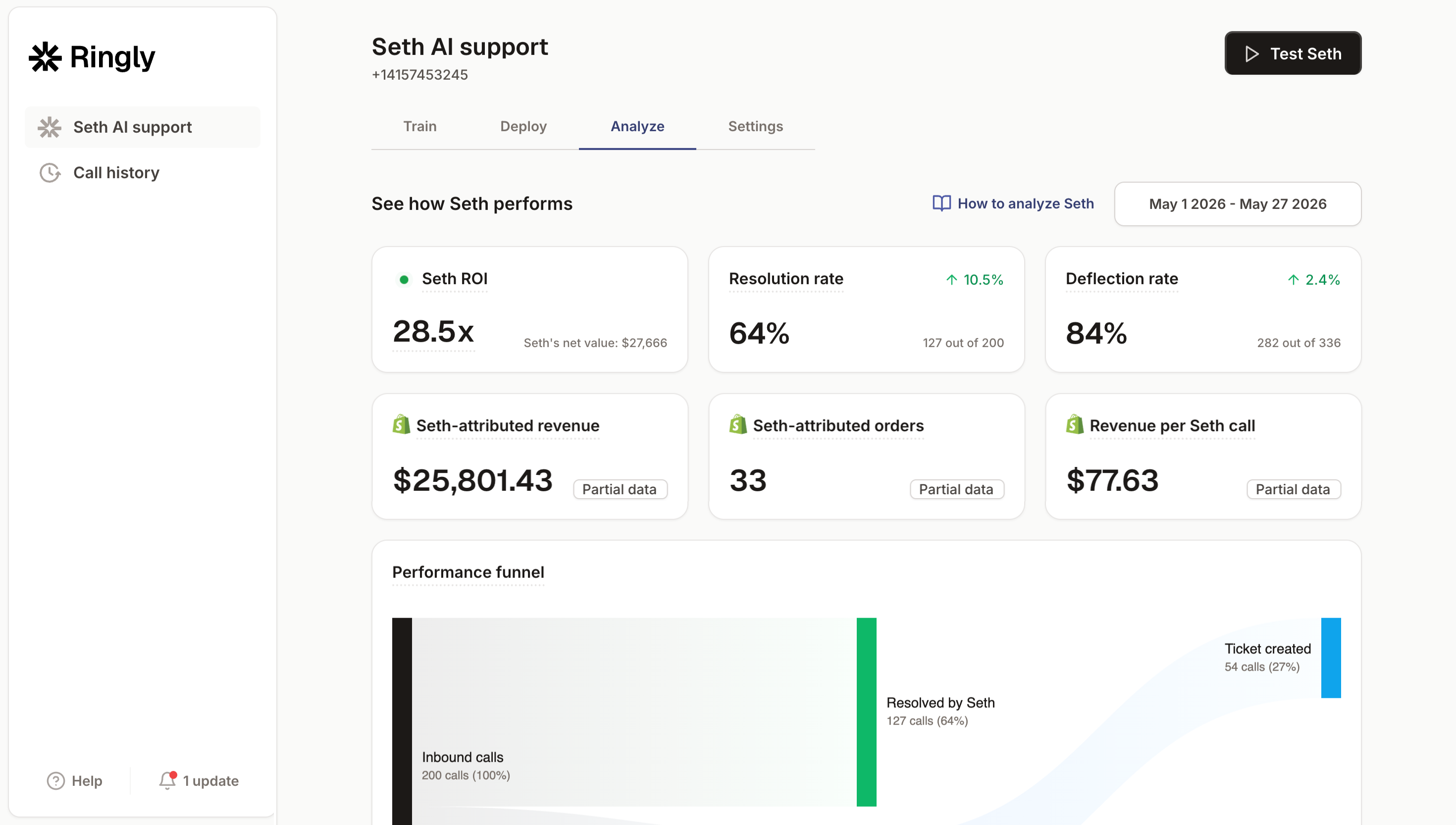
This is the part of customer data we work on. Ringly.io is AI phone support for Shopify brands. It's not a CDP. It's the AI phone agent that takes your inbound calls and uses your real Shopify order and customer context live on the call, so the caller doesn't have to recite an order number that's already on the screen. The AI finds the order, answers product and WISMO questions from your knowledge base, handles returns, and escalates the genuinely hard calls to your team. It resolves up to 90% of calls autonomously.
The AI works alongside whatever helpdesk you already run, the same way voice agents for Shopify plug into your existing stack. It's the same job a CDP does for marketing (turn fragmented data into one usable view) applied to the channel a CDP forgets. WashCo, a Shopify brand we launched, recovered $22,664 in its first 7 days on the phone by answering the calls that used to roll to voicemail. The data was always there. It just wasn't reaching the call.
If your customer data is unified everywhere except the one place customers actually call, book a 30-min call and we'll show you what your phone line is missing.
How to choose the right CDP for your store
If you've worked through the "do I need one" question and the answer is yes, the selection part is straightforward. Don't start from the tool. Start from your stack and your team.
- Audit what you already have. Map where your customer data lives today (Shopify, your email tool, ads, support) and what's actually disconnected. Sometimes the fix is two integrations, not a new platform.
- Name the decision. Write down the one activation you can't do today. Suppress recent buyers from prospecting? Trigger a win-back when LTV crosses a threshold? If you can't name it, you're not ready.
- Match your data maturity. Clean warehouse plus a data team points to composable (Hightouch, Census). Marketing-led with no engineering points to packaged (Klaviyo, Segment).
- Be honest about pricing. A $500/mo Klaviyo CDP floor or a five-figure Bloomreach contract has to pay for itself in activated revenue, not in tidiness. If you can't model the payback, wait.
- Check the implementation cost. Bloomreach runs six weeks to three months. Klaviyo can activate same-day. That timeline difference is real budget and real opportunity cost.
Here's the simplest version: choose Klaviyo if email and SMS are your engine and you want speed; choose Segment if you have engineers and many destinations; choose Bloomreach if you want CDP plus on-site personalization in one; choose Hightouch if you already have a warehouse; and choose Shopify native if you're honestly not at CDP stage yet. For more on getting your store's analytics and order data working together, those guides go deeper.
Frequently asked questions
Is Klaviyo a CDP? Klaviyo has a CDP (the Klaviyo Data Platform) layered on top of its email and SMS tools. For most Shopify brands it's the easiest entry point because the Shopify integration is native and you can activate data the same day. The standalone CDP starts at $500/mo for 100,000 profiles.
What's the difference between a CDP and a CRM? A CRM manages known contacts and conversations for sales and support, mostly filled by hand. A CDP automatically captures all customer behavior, including anonymous activity, and is built to activate audiences for marketing. They're complementary, not interchangeable.
Do I need a CDP for my Shopify store? Probably not if you're under about $20M, single-channel, and already running Klaviyo. Shopify's native segmentation plus your email tool covers a lot. The CDP question gets real at $10M-$100M with multiple channels, attribution pain, and a data person to own it.
What's the difference between packaged and composable CDPs? A packaged CDP (Klaviyo, Segment, Bloomreach) does everything in one tool and keeps its own copy of your data. A composable CDP (Hightouch, Census) sits on your existing data warehouse as the single source of truth. Packaged is faster for marketing-led teams; composable gives more control to teams with a warehouse.
What's the cheapest CDP for Shopify? Shopify's native segmentation is free with your plan and covers single-channel brands. Among real CDPs, Segment starts around $120/mo and Hightouch has a free tier. Klaviyo's full CDP starts at $500/mo. Most enterprise tools (Bloomreach, Tealium) are quote-only and start in the five figures a year.
How long does a CDP take to set up? It depends on the tool. Klaviyo can activate same-day because the Shopify integration is native. Bloomreach implementation runs six weeks to three months. Composable setups depend on how clean your warehouse already is.
Can a CDP help my customer support team? A CDP unifies data for marketing activation, but it usually doesn't reach the live support surfaces, especially the phone. To put unified order and customer context on inbound calls, you need a tool built for the phone line itself, like Ringly's AI phone support, which reads your Shopify data live on the call.
Talk to us

A CDP gets your customer data into one place for marketing. If you run a $10M-$100M Shopify brand, the next gap is usually the phone line, where all that data goes dark the moment a customer calls. A 30-min call is the fastest way to see what your inbound calls are missing and what it's costing you.
Our 3 promises.
- Live in under 1 hour. Setup and test calls are free.
- 30-day money back on the $99 plan fee.
- 65% resolution guarantee: if Seth resolves under 65% of your support calls in a month, that month comes back as credit (after 90 days on Pay per call).
Ruben (Ringly co-founder) takes these calls personally.