
This post in 30 seconds.
- Shopify has no button labeled "abandoned cart report." The data is split across three places, and once you know which is which, you can read it in five minutes.
- The count isn't the useful number. The drop between funnel stages is, because it tells you the fixable reason carts die.
- Built for founders, COOs, and Heads of CX at $10M-$100M Shopify brands who keep a visible phone line and want the lost-sales data to actually mean something.
You go looking for the Shopify abandoned cart report and find out it doesn't exist. Not under that name. There's an abandoned checkouts list, a couple of behavior reports, and a recovery email report, and they all live in different corners of the admin. So most operators end up staring at a list of dead carts with no idea what the data is telling them.
The list is the easy part. Reading it well, finding the one fixable reason carts are dying, is where the money is. We run AI phone support for Shopify brands, and one thing we see constantly: a slice of what looks like an "abandoned checkout" is actually a customer who got stuck on the site and called instead. That call never shows up in the report.
If you run a $10M-$100M Shopify brand with a real phone line and a few thousand abandoned checkouts a quarter, the report is a map of where you're dropping revenue. This is how to read it, where it lies to you, and what to do with the part it can't see. If you want, book a 30-min call and we'll pull your last week of missed calls and abandoned-cart patterns live, no homework on your end.
Where the abandoned cart data actually lives in Shopify
First, the distinction that trips everyone up. A "cart" and a "checkout" are not the same object in Shopify, and the report only tracks one of them.
A checkout counts as abandoned when it stays incomplete for more than ten minutes after the customer has entered their email (per the Shopify Help Center). No email entered means it never becomes an "abandoned checkout" at all. That's important, and we'll come back to it.
There are three native places the data shows up. Each answers a different question.
- Orders > Abandoned checkouts (the list). This is the raw record. For each entry you see the customer, their email if they gave one, the cart contents, the cart total, location, the time they left, marketing consent, the email status, and the recovery status. It answers "who left and what was in their cart."
- Analytics > Reports (the funnel). Open "Online store conversion over time" or the conversion rate breakdown. This shows the path: Sessions, then Product views, then Add to cart, then Reach checkout, then Purchase. It answers "at which step are people falling off."
- Marketing > Abandoned checkout emails report (recovery). This tracks how your recovery emails perform: sessions generated, completed orders, conversion rate, total sales, average order value, average products per order. It answers "are we actually winning any of these back."
One more, if you're on a Shopify plan tier above Basic: the website cart analysis report shows which products customers add together, even when they don't buy. Useful for bundling, less so for diagnosing abandonment.
The list tells you who, the funnel tells you where, and the emails report tells you whether you're recovering anything. Most people only ever open the list, which is the least diagnostic of the three.
Two limits to keep in mind. Shopify auto-deletes abandoned checkouts after three months, so if you want a trend line longer than a quarter, you have to export and store it yourself. And the native reporting has no built-in metric for the average value of an abandoned cart, which is why a lot of brands end up bolting on a reporting app to get it. For more on the broader picture, our ecommerce analytics guide covers what to track beyond carts.
What each metric in the report actually means
The report throws a few columns and numbers at you. Here's what each one is really telling you.
- Cart total. The revenue at stake on that single checkout. Sort the list by this and your highest-value abandons jump to the top, which is where a human follow-up earns its keep.
- Email status. Whether a recovery email got sent. If it says nothing went out, check why: Shopify won't send a recovery email when the customer already completed a purchase, when there was a payment error, when you don't ship to their address, when nothing is in stock, or when every item is free with no shipping.
- Recovery status. Whether that checkout was eventually completed. A checkout flips to recovered when the customer finishes the order, either by clicking your recovery link or just coming back on their own.
- Last step reached. This one is gold for diagnosis. Each checkout shows the furthest step the customer got to: contact info, shipping, payment, or review. The step where they quit is a direct clue to the reason.
Then there's the headline number everyone wants: your cart abandonment rate. The simple version is carts created minus completed purchases, divided by carts created. A thousand carts and three hundred orders is a 70% abandonment rate.
For context, the average across ecommerce sits around 70.19% as of 2026, per the Baymard Institute. So 70% isn't a crisis, it's Tuesday. The number to watch is the trend and the outliers. Once your rate climbs past roughly 75%, you're usually looking at a fixable problem in the checkout, not normal browsing behavior. US and EU stores lose an estimated $260 billion a year in recoverable sales to abandonment, so even a couple of points back is real money.
How to diagnose why carts abandon (read the drop, not just the count)
Here's where most guides stop and where the actual work starts. The count of abandoned carts tells you almost nothing. The shape of the drop tells you everything.
Open the funnel report and look at where people fall off:
- Big drop from Add to cart to Reach checkout. People are adding things and never starting checkout. Usually a cart-page problem: surprise shipping shown too late, no express checkout, a clunky cart UX, or slow load times.
- Big drop from Reach checkout to Purchase. People start checkout and bail mid-way. That's a checkout-flow problem: forced account creation, payment friction, or a long form.
Now cross-reference with the "last step reached" field on the abandoned checkouts list. If most of your abandons quit at the shipping step, that's a shipping-cost or delivery-speed signal. If they quit at payment, you've got a trust or payment-method gap. If they quit at contact info, your checkout is asking for too much too soon.
The reasons people actually give line up with this. Baymard's 2026 data on why shoppers abandon:
| Reason for abandoning | Share of abandoners | What it shows up as |
|---|---|---|
| Extra costs too high (shipping, tax, fees) | 48% | Drop at shipping step |
| Site wanted account creation | 26% | Drop at contact info |
| Didn't trust the site with card info | 25% | Drop at payment |
| Delivery was too slow | 23% | Drop at shipping step |
| Checkout too long or complicated | 22% | Drop across multiple steps |
Costs are the big one, and they're the most fixable. When shipping, tax, or fees only appear at checkout, nearly half of shoppers walk. Stores that surface shipping cost on the product page or in the cart instead of at checkout see roughly 17% lower abandonment (DontPayFull). That's not a recovery tactic, that's a prevention one, and the report is what points you at it.
Read the drop, match it to the step, fix the step. That loop is the entire point of the report, and it's the part the count alone never gives you. If checkout conversion is your bottleneck, our Shopify conversion rate optimization guide and the broader ecommerce CRO breakdown go deeper on the checkout fixes themselves.
What your abandoned cart report doesn't show you
The report has two blind spots, and they're both expensive.
The first is the no-email cart. Remember, a checkout only becomes an "abandoned checkout" once the customer enters an email. Plenty of people add to cart, get spooked by something, and leave before ever typing an email. Those carts don't enter the abandoned-checkout object, so they're invisible to your recovery emails and largely invisible to the list. The funnel report still counts them as a drop, which is one more reason to read the funnel and not just the list.
The second blind spot is the one we see every day. Some of your highest-intent shoppers don't email. They call. They got stuck on a shipping question or a sizing question or a "does this ship to Canada" question, and instead of abandoning quietly they picked up the phone. If nobody answers, that's an abandoned cart your report will never log, because it lives in your phone system, not your checkout.
That revenue came from calls. The customers behind it would have been invisible to a standard abandoned cart report, because the moment they got the answer they needed, they finished checkout. The report would have just shown a completed order with no story behind it.
If your phone goes to voicemail after 6 p.m., you're abandoning carts you can't even see. The cost of that is the cost of the rep who isn't there. Here's the math we run with most brands:
| Line item | Today | With Ringly |
|---|---|---|
| 6 reps x $4K loaded per rep | $24,000/mo | — |
| Ringly (~$5K/mo) | — | $5,000/mo |
| Net monthly spend | $24,000/mo | $5,000/mo |
| Monthly savings | — | $19,000/mo |
| Annual savings | — | $228,000/yr |
That's roughly 70% of the repeatable calls (order status, shipping questions, the same five things over and over) handled without a human, while the genuinely complex calls still route to your team. Exact pricing is set on a call. These are the savings shapes we see across 200,000+ calls.
If that's you, book a 30-min call and we'll run the missed-call math on your store. For the phone side specifically, our WISMO calls breakdown and the 24/7 phone support guide cover what after-hours coverage actually recovers.
Turn the report into a recovery loop
A report you read once a quarter is a museum piece. The brands that recover real money treat it as a weekly loop: read the drop, fix one thing, measure the change.
Here's the cadence that works:
- Weekly, read the funnel. Where's the biggest stage drop this week versus last? That's your one thing to fix.
- Sort the list by cart total. Your top 20 highest-value abandons each week deserve a personal touch, not just an automated email.
- Check the emails report. Is your recovery flow actually converting? Most brands recover only 3% to 5% of abandoned carts by email, while the leaders hit 10% to 14% (Mailmend). If you're under 5%, your flow is the problem, not your traffic.
- Add the channel the report misses. Answer the inbound calls and follow up on high-value carts by phone, not just email.
On the email side, the single biggest lever is sequence length. A three-email recovery sequence drives roughly 6.5x the revenue of a single email, per Klaviyo. If you're sending one email, that's your fastest win. Our guide to recovering abandoned carts and the cart abandonment statistics roundup have the rest of the benchmarks.
Ringly.io: AI phone support for Shopify brands
Ringly.io is AI phone support for Shopify brands. The phone is where your highest-intent abandons hide, and most brands either send them to voicemail or hire a team to catch them. Instead of growing your support headcount every time call volume goes up, the AI takes the routine inbound calls so your team can focus on the work that moves revenue.
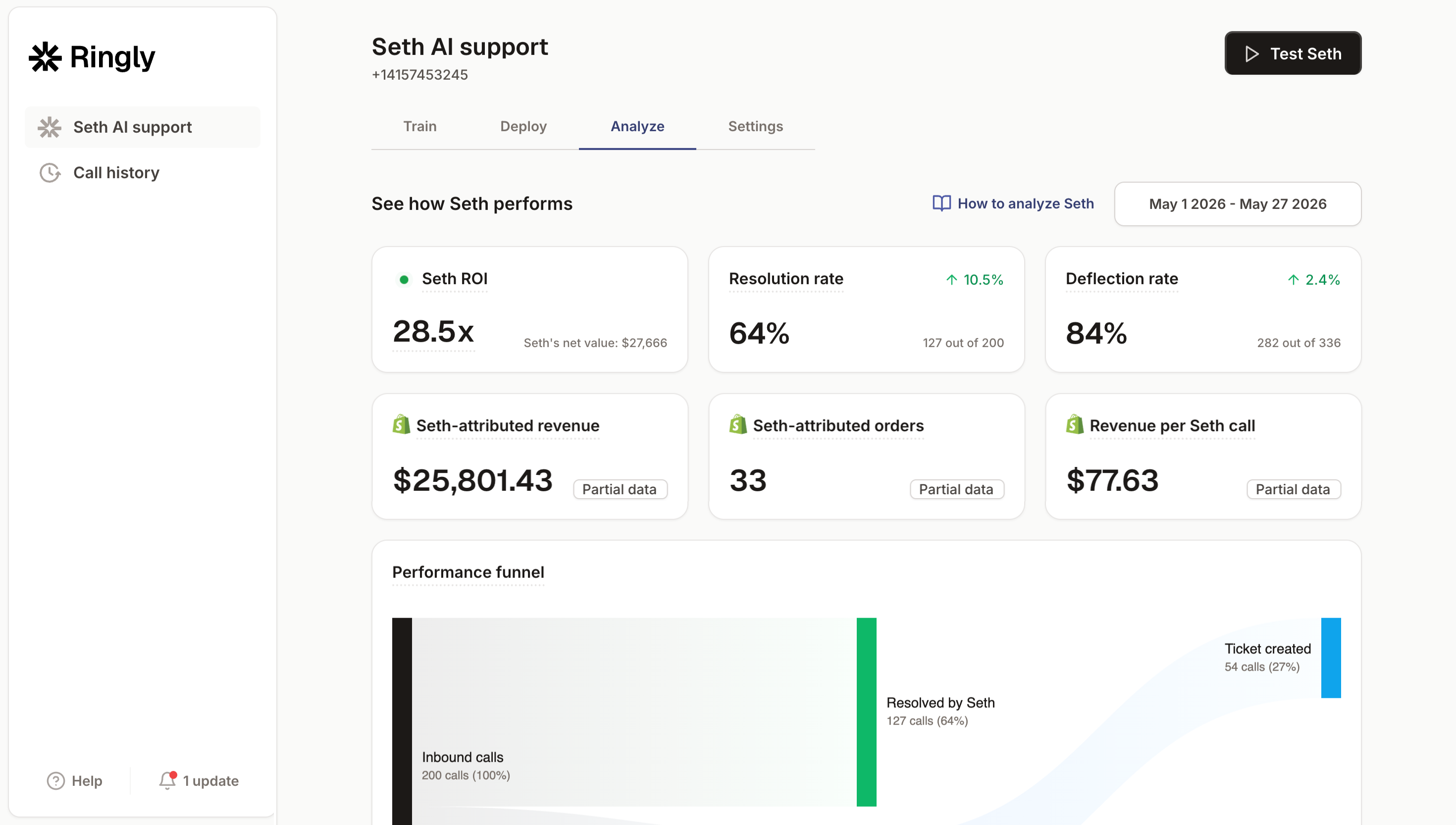
The AI answers inbound calls 24/7. It finds orders in your Shopify store, answers shipping and product questions from your knowledge base, and can text a checkout link to a caller who wants to finish an order. Seth resolves up to 90% of calls autonomously. Calls that need a human escalate cleanly to Gorgias, Richpanel, Reamaze, or whatever helpdesk you already run.
Pricing: $99 a month for the first 50 conversations, then $1.99 each. Live in under an hour. 65% resolution guarantee: if Seth resolves under 65% of your calls in a month, that month comes back as credit (after 90 days on Pay per call). If you're weighing it against a chat tool, our take on AI voice agents for ecommerce explains why phone is the harder, higher-value channel to get right, and the Shopify customer service app overview covers how it sits in your stack.
Frequently asked questions
Does Shopify have an abandoned cart report? Not under that exact name. The data is spread across the Orders > Abandoned checkouts list, the conversion reports in Analytics, and the abandoned checkout emails report in Marketing. Each shows a different slice, and you usually need all three to get the full picture.
What's the difference between an abandoned cart and an abandoned checkout? A cart is just items added to the bag. A checkout only counts as abandoned once the customer enters their email and then leaves it incomplete for more than ten minutes. Carts without an email never become "abandoned checkouts" in Shopify, which is why some lost sales never appear in the report.
Where do I find abandoned checkouts in Shopify? Go to Orders, then click Abandoned checkouts at the top. You'll see every incomplete checkout from the last three months with the customer, cart contents, total, and recovery status.
How long does Shopify keep abandoned checkout data? Three months. After that, Shopify automatically removes the records and there's no way to recover them, so export your data if you want a longer trend line.
What is a good cart abandonment rate? The 2026 average is about 70.19% across ecommerce, so anything near 70% is normal. If yours climbs past roughly 75%, that's a signal something in your checkout is fixable rather than just normal browsing.
Why do so many of my abandoned carts have no email? Because those shoppers left before entering one. The funnel report still counts them as a drop, but they never enter the abandoned-checkout list, so you can't reach them with a recovery email. Reading the funnel instead of just the list is how you catch them.
Can I see abandoned carts where the customer called instead of emailing? No. If a shopper gets stuck and calls you, that interaction lives in your phone system, not your abandoned cart report. Answering those calls (including after-hours) is how you recover sales the report can't show, which is the gap Ringly fills.
Talk to us

If you run a $10M-$100M Shopify brand and your abandoned cart data points at a checkout you've already optimized, the next leak is probably the phone. A 30-min call is the fastest way to see what those uncounted calls are worth.
Our 3 promises.
- Live in under 1 hour. Setup and test calls are free.
- 30-day money back on the $99 plan fee.
- 65% resolution guarantee: if Seth resolves under 65% of your support calls in a month, that month comes back as credit (after 90 days on Pay per call).
Ruben (Ringly co-founder) takes these calls personally.