

This post in 30 seconds.
- Five ready-to-paste return policy templates: a short version, a full version, and three variations for supplements, beauty, and pet brands. Fill the brackets and ship.
- The nine elements every policy needs, plus the restocking-fee and final-sale traps that quietly cost you sales.
- Built for founders, COOs, and Heads of CX at $10M-$100M Shopify brands who keep a visible phone line and want fewer "what's your return policy" calls hitting their reps.
You came here for a template, so the short one is two scrolls down. Take it, fill in the brackets, post it. Done. If you want the full walkthrough behind it, our guide on how to write an ecommerce return policy covers the reasoning, and our return policy examples page shows what real brands publish.
Before you do, one number worth knowing. US shoppers returned about $890 billion in merchandise in 2024, and online returns ran 17.6% of sales, according to the NRF and Happy Returns 2024 returns report. Your return policy is the document that decides whether all that movement is smooth or expensive. It is also the single cheapest way to cut the "can I return this" and "where's my refund" questions your support team answers over and over.
Most $10M-$100M Shopify brands I talk to have a return policy that was written once, buried in the footer, and never updated, which is exactly why the same return question keeps coming back through the phone line and the helpdesk. We run AI phone support for 50+ Shopify brands, and returns are a real slice of the calls those teams used to field by hand. If that sounds like your store, book a 30-min call and we'll look at what's actually hitting your queue. Now, the templates.
In this post:
The short return policy template (copy and paste)
If you sell mostly simple, non-perishable products and you want something clear that a customer reads in ten seconds, use this. A short, plain-language policy outperforms a long legal one, because 67% of shoppers check the return policy before they buy and most of them are skimming on a phone (ClickPost ecommerce return statistics).
Returns and refunds
We want you to love what you ordered. If something isn't right, here's how returns work.
Return window: You have [30] days from the delivery date to start a return.
Condition: Items must be unused, in their original packaging, with tags attached.
Who pays shipping: We cover return shipping on exchanges. For refunds, return shipping is [a flat $X / deducted from your refund].
What you get back: Choose a refund to your original payment method, an exchange, or [store credit]. Refunds land within [5-10] business days after we receive your return.
Exceptions: [Sale and clearance items, personalized products, and opened consumables] are final sale.
Start a return: Visit [yourstore.com/returns] or email [support@yourstore.com] with your order number.
That's it. Six labeled lines a customer can scan without thinking. If you'd rather answer a few questions and have it built for you, the return policy generator does that. If you want the longer one with every clause spelled out, it's next.
The full return policy template
Use this when you carry higher-value items, sell internationally, or want every edge case covered so your team isn't improvising on the phone. It maps one-to-one to the nine must-have elements below.
Return and refund policy
At [Your Brand], we stand behind what we make. If you need to send something back, here's exactly how it works.
1. Return window. You have [30] days from the date your order is delivered to request a return. Returns started after [30] days can't be accepted.
2. Condition. Items must be unused, unworn, and in their original condition with all packaging and tags. We reserve the right to refuse a return that arrives used or damaged beyond normal inspection.
3. How to start a return. Go to [yourstore.com/returns] and enter your order number and email, or email [support@yourstore.com]. We'll send a prepaid label or return instructions within [1-2] business days.
4. Who pays return shipping. [We cover return shipping on all returns. / Return shipping is a flat $X, deducted from your refund. / You're responsible for return shipping unless the item arrived defective or incorrect.]
5. Refund method and timeline. Once we receive and inspect your return, we'll process your refund to the original payment method within [5-10] business days. Your bank may take a few extra days to post it. You can also choose [store credit or an exchange] for a faster turnaround.
6. Exchanges. Want a different size or color? Start an exchange at [yourstore.com/returns] and we'll ship the replacement as soon as we receive the original.
7. Damaged, defective, or wrong items. If your order arrives damaged, defective, or incorrect, contact us within [7] days with a photo and we'll make it right at no cost to you.
8. Final sale and exceptions. [Sale and clearance items, gift cards, personalized products, and opened consumable or hygiene items] are final sale and can't be returned or exchanged.
9. Restocking fee. [We don't charge restocking fees. / A [X]% restocking fee applies to returns of [category], and it will be shown before you confirm the return.]
Questions? Reach us at [support@yourstore.com] or [phone number]. We're happy to help.
You don't need a lawyer to publish this, but you do need to keep your promises. There's no federal US law forcing you to offer returns on a change of mind, though some states (California, New York, and Connecticut among them) require you to post a policy or default to a return window if you don't, per FindLaw's state-by-state breakdown. Post it clearly and honor what it says.
What every return policy must include
Every template above is built from the same nine parts. If you're writing your own from scratch, hit all nine and you won't leave a gap your customers will call about.
- Return window. How long the customer has, and when the clock starts (delivery date is clearest). Nearly 63% of online shoppers expect at least 30 days, according to ReturnPrime's return-trends data, so anything shorter needs a good reason.
- Item condition. Unused, original packaging, tags on. Spell out what "returnable condition" means so it's not a judgment call later.
- Who pays return shipping. Free, a flat fee, or customer-paid. Free returns lift conversion but cost margin, so pick deliberately and state it once.
- Refund method. Original payment, store credit, or exchange. Many brands nudge toward store credit or exchange to keep the revenue in-house. If you process a lot of these, our notes on Shopify refunds and Shopify exchanges cover the mechanics.
- Refund timeline. When the money actually moves after you receive the item. Vague timelines are the number-one driver of "where's my refund" follow-ups.
- Exceptions and final sale. The carve-outs: clearance, personalized items, opened consumables or hygiene products. Skip this and you'll eat returns you never meant to accept.
- Restocking fee (optional). If you charge one, disclose it loudly and early. More on why this backfires below.
- How to start a return. A link, a portal, or an email. The fewer steps, the fewer "how do I send this back" messages.
- Contact. Where to ask. This is the line that decides whether a confused customer self-serves or calls your phone line.
A policy that names every one of these nine elements is a policy your team rarely has to explain twice. That's the whole point: the document does the answering so your reps don't have to.
Return policy templates by vertical
Generic templates miss the one clause that matters most in regulated or perishable categories: what's final sale and why. Here are three drop-in variations. If your goal is fewer returns in the first place, our guide on how to reduce product returns pairs well with any of these.
Supplements and wellness brands
Opened or consumed supplements can't go back on the shelf, and you can't make health claims in your policy. Keep it tight and safety-first.
Returns: Unopened, sealed products can be returned within [30] days of delivery for a refund or exchange. For safety reasons, opened or partially used supplements are final sale and can't be returned. If a product arrived damaged or you received the wrong item, contact [support@yourstore.com] within [7] days and we'll replace it. Subscription orders can be paused or canceled anytime before your next ship date at [yourstore.com/account].
Beauty and skincare brands
Hygiene rules the carve-out here. Unopened is returnable, used cosmetics are not.
Returns: Unopened, unused items in original packaging can be returned within [30] days for a refund or exchange. For hygiene reasons, opened or used cosmetics, skincare, and applicators are final sale. If a product arrived damaged, broken, or incorrect, send a photo to [support@yourstore.com] within [7] days for a free replacement. Shade not right? Start an exchange at [yourstore.com/returns].
Pet brands
Food safety drives this one. Unopened food and unused gear come back, opened food doesn't.
Returns: Unused gear and accessories can be returned within [30] days in original condition. For food safety, opened food, treats, and supplements are final sale and can't be returned. If your order arrived damaged or your pet had a reaction to a sealed product, contact [support@yourstore.com] within [14] days and we'll make it right. Autoship orders can be adjusted or canceled anytime at [yourstore.com/account].
How to fill in and display your policy
A template only works once it's filled in correctly and put where customers actually look. Here's the order I'd run it.
- Replace every bracket. Don't ship a policy with [30] or [Your Brand] still in it. Sounds obvious, happens constantly.
- Use plain language. Short sentences, no legalese. The clearer it reads, the fewer questions it generates. Save the dense terms for your terms-of-service page.
- Display it in five places. Footer link, the cart and checkout pages, the order confirmation email, the product page (a one-line summary plus a link), and your help center. Customers check the policy before buying, so don't hide it.
- Match it to your Shopify return rules. In Shopify, your return window, restocking fee, return shipping, and final-sale collections are set under Settings, then Policies, then Return rules (Shopify Help Center). The written policy and the system rules have to say the same thing, or the self-serve flow will contradict your own page. If you're standing up the self-serve flow, see Shopify self-serve returns and our broader ecommerce returns best practices.
- Be careful with restocking fees. They feel like a cost-recovery win, but they read as a penalty. Disclose any fee before the customer confirms the return, and use it sparingly. A fee that feels unfair is a fast route to a one-star review and an angry phone call.
If returns are already generating a steady stream of calls and tickets, the policy fix is step one, not the whole fix. Book a 30-min call and we'll look at how much of your phone volume is just the return question on repeat.
Make your phone answer the return question the same way every time
Here's the part the other return-policy guides skip. A great policy still generates calls. People who skim the page on mobile, older customers who'd rather talk to someone, anyone mid-checkout with a "wait, can I return this" hesitation: they call. Across the 50+ Shopify brands we run phone support for, "what's your return policy" and "where's my return" are a steady, predictable share of the inbound queue, right alongside the WISMO calls every store fields, and I've sat and read enough of those transcripts to know they're almost always the same handful of questions. It's the same pattern that makes ecommerce customer service feel like answering the same five things all day.
The fix is to make the phone answer with the exact words you already wrote. Ringly.io is AI phone support for Shopify brands. You load your knowledge base, including the return policy you just built, and the AI answers inbound calls 24/7: it reads your return window, your final-sale exceptions, and your refund timeline aloud, the same way every time, then escalates the genuinely tricky calls to your team in Gorgias, Richpanel, or whatever helpdesk you already run.
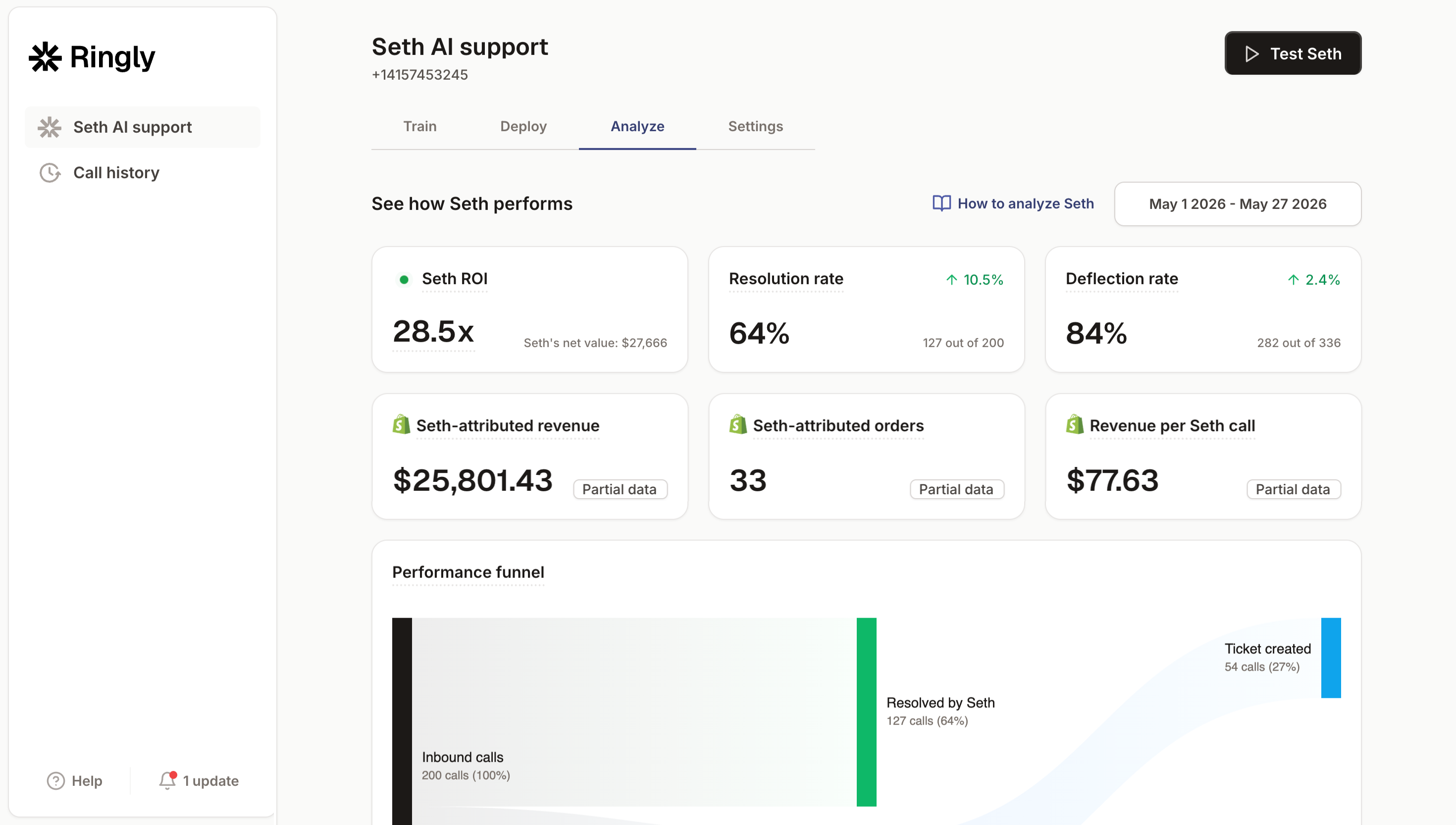
Across 50+ brands, the AI resolves 73% of inbound calls autonomously at roughly $0.42 per resolved call, which means the return question stops eating your reps' day. The point isn't to remove the human. It's to stop paying a human to recite the same policy fifty times so they're free for the calls that actually need them.
"My customers also feel like it's a normal person. They feel like they can communicate if they have questions."
Claudia Droge, TechCraft Studio
Common return policy mistakes to avoid
- Burying it. A policy nobody can find generates the exact calls it was meant to prevent. Footer plus cart plus product page.
- Writing it in legalese. If a customer needs to re-read a sentence, you've lost them. Plain language wins.
- Hiding a restocking fee. Surprise fees at the end of a return create complaints, not savings. Disclose up front or don't charge it.
- No final-sale carve-out. Without one, you accept returns on opened supplements, used cosmetics, and clearance items you never meant to take back.
- No refund timeline. "We'll process your refund" with no number is an open invitation for follow-up messages. Give a window.
- Contradicting your system rules. If your written policy says 30 days but your Shopify return rules say 14, the customer will catch it and you'll be on the phone explaining. The same discipline that makes a good policy is what makes good Shopify return policy best practices: say it once, say it clearly, keep every channel in sync.
Frequently asked questions
Do I legally need a return policy? There's no federal US law requiring returns on change-of-mind purchases, but several states require you to post a policy and may default to a return window if you don't. Post a clear one regardless, because it protects you and lifts conversion.
How long should my return window be? Thirty days is the expected standard, with nearly 63% of online shoppers expecting at least that. Sixty or 90 days can lift conversion further if your margins and return rate allow it.
Should I charge a restocking fee? Usually not. Fees feel like a penalty and tend to drive complaints rather than recover much cost. If you do charge one, disclose it before the customer confirms the return.
Do I have to offer free return shipping? No, but free returns increase conversion. A common middle ground is free shipping on exchanges and a small deducted fee on refund-only returns.
Where should I display my return policy? Footer, cart and checkout, order confirmation email, product page summary, and help center. Customers check it before buying, so visibility directly affects sales.
Can I make some items final sale? Yes. Opened consumables, used cosmetics, personalized products, clearance, and gift cards are common final-sale categories. Name them explicitly in your policy.
How do I stop the same return questions hitting my phone line? Post a clear policy, then load that same text into the system that answers your phone. An AI phone agent like Ringly reads your policy aloud on every call so the routine return question never reaches a rep.
Talk to us

If you run a $10M-$100M Shopify brand and the return question keeps landing on your phone line after you've already published a clear policy, a 30-min call is the fastest way to see how much of that volume an AI agent can take off your team.
The 3-layer guarantee.
- Live in 14 days or it's free until launched.
- 65% resolution in 90 days or we refund the last 3 months of subscription fees.
- We keep working free until we hit 65%.
Ruben (Ringly co-founder) takes these calls personally.