
This post in 30 seconds.
- The full product returns management workflow, broken into 7 stages with an owner and a metric for each, plus the grading step where most of your margin is recovered or lost.
- The one number to run the function on: RMA-to-refund cycle time. Top-tier ecommerce keeps it under 5 days (Nventory).
- Built for founders, COOs, and Heads of CX at $10M-$100M Shopify brands who already feel returns in both the margin line and the support queue.
Returns are not a policy problem. They are an operations line with a margin cost on one side and a payroll cost on the other, and most brands only ever document the policy.
US shoppers sent back $849.9 billion of merchandise in 2025, roughly 15.8% of everything sold, and 19.3% of online sales specifically, according to the NRF's 2025 Retail Returns Landscape. The margin math is worse than the headline. A 25% return rate can cut your unit contribution margin by 70% (Eightx, 2026). So if you run a $30M Shopify brand and returns feel like a tax you can't quite see, you're reading the right page.
If you run customer experience or operations at a $10M-$100M Shopify brand, you already know the part nobody writes about: every time you tighten the returns process, the phone backlog gets worse, because the same customers who shipped something back now call to ask where their refund is. I read those return-status calls across the brands we run phone support for, and "where's my refund" is the single most common one during a returns wave. If that queue is eating your team, book a 30-min call and we'll map your routing for you.
What product returns management actually is
Product returns management is the end-to-end system that moves an item from "I want to send this back" to a closed refund and a graded unit sitting in the right bin. It is not your return policy page, and it is not just the software that prints the label.
Think of it as three layers that have to work together: the policy, the workflow, and the comms. The policy sets the rules (window, condition, who pays for shipping). The workflow is the operational pipeline that moves the physical item and the money. The comms is everything the customer hears while they wait, which is the layer that decides whether they buy from you again.
Most brands obsess over the first layer and ignore the third. That's a mistake, because 84% of shoppers say they'll abandon a brand after a poor return experience (ReturnPro). And with 19.3% of online sales coming back, the returns experience isn't an edge case. It's a fifth of your customer relationships.
The point of formalizing returns management is simple. You want the resellable units back on the shelf fast, the refund out the door fast, and the customer feeling like the whole thing was easy. If you want the policy side dialed in first, start with a clean ecommerce return policy and the broader ecommerce returns best practices. This guide is about the workflow and the comms behind it.
The product returns management workflow, stage by stage
Here's the operational spine. Every return moves through seven stages, and each one has an owner, a job, and a number you can hold it to. The brands that run returns well aren't doing anything exotic. They just don't let a stage sit without an owner.
The single most useful thing you can do is assign an owner and a time target to every stage, so nothing parks in a queue while a customer waits.
- Stage 1: Request. The customer starts the return through a portal, an email, or a phone call. Owner: the returns portal plus your CS team. The job here is to capture the order number, the item, and a structured reason code, not a free-text blob you can't analyze later.
- Stage 2: Eligibility and RMA. The system checks the return window and condition rules, then approves or declines and issues a return merchandise authorization (RMA) number. Owner: your returns software. The RMA number is the thread that ties the physical item, the order, and the refund together for the rest of the trip.
- Stage 3: Label and ship. A prepaid or QR label goes to the customer, or they drop the item at a return bar. Owner: the returns software and your carrier. This is the most automated stage and the one software vendors compete hardest on.
- Stage 4: Receive and scan. The item lands at your warehouse or 3PL and gets scanned against its RMA, which updates the status instantly. Owner: the warehouse. If this scan is slow or manual, every downstream metric slips.
- Stage 5: Inspect and grade. Someone physically inspects the item and assigns it a condition grade. Owner: the warehouse. Nventory calls grading the most critical step in the whole pipeline, and they're right, because the grade decides how much of that unit's value you ever get back.
- Stage 6: Disposition. The grade routes the item: restock, refurbish, liquidate, returnless, or write off. Owner: operations. This is the margin-recovery step, and it's the one we'll spend a whole section on below.
- Stage 7: Refund, close, and notify. Finance issues the refund, exchange, or store credit, the RMA closes, and the customer gets told. Owner: finance plus CS. The number that matters here is RMA-to-refund cycle time: the elapsed time from the request to the money hitting the customer's account. Top-tier ecommerce operations keep it under 5 days (Nventory).
If your refunds run a swap instead of cash, the same spine applies, you're just resolving in Stage 7 with an exchange. Shopify operators can wire most of this directly through Shopify refunds and Shopify exchanges, and tie the status updates back to your ecommerce order tracking so the customer can self-serve the wait.
Grading and disposition: where the margin is won or lost
Stage 5 and Stage 6 are where returns management stops being logistics and starts being P&L. The reason is brutal: only 48% of returned items get resold at full price (Eightx). The other 52% lose value the second they come back, and how much they lose depends entirely on how you grade and route them.
Reverse logistics alone runs 20-30% of the original product value, so a unit can cost you a third of its retail price just to come home before you've recovered a cent.
Grading is the judgment call. A returned item is usually one of five things:
- Resellable as new. Unopened, undamaged, inside the window. Restock it and recover full value. This is the bucket you want to grow.
- Refurbish or repackage. Light wear or a damaged box. A small labor cost recovers most of the value through an open-box or B-stock channel.
- Liquidate. Used, dated, or off-season. You sell it in bulk for cents on the dollar to clear the space.
- Returnless. You refund the customer and tell them to keep the item. This sounds wasteful until you do the math.
- Write off. Hazmat, expired, or destroyed. It costs you the full unit plus the reverse-logistics fee to handle it.
The returnless-refund decision is the one operators get wrong most often. The rule is simple: if the cost to ship it back plus inspect and grade it is higher than what you'd recover by reselling it, refund and let the customer keep it. For a $25 supplement bottle or a $30 consumable, the return shipping and the grading labor usually exceed the resale value, so a returnless refund is the cheaper, faster, happier outcome. For a $300 jacket, you want it back. Getting this routing right is most of the work in reducing refunds in returns management, and it's a much bigger lever than tightening the policy by a few days.
The part nobody staffs: the return-status call layer
Here's what the warehouse-ops guides skip. A returns program is a customer-contact generator. Every return you process creates a small cluster of touches: did you get my item, when's my refund, where's my exchange, can I change my mind. Those touches land on the same CS team that's already drowning in "where's my order" all day.
I went through the return-status calls coming into the Shopify brands we run phone support for. During a returns wave, after a sale or a post-holiday window, "where's my refund" reliably becomes the second-most-common call after WISMO. And it spikes the moment a brand tightens its returns workflow, because faster processing means more refunds in flight at once, which means more customers checking on them. The better your returns pipeline gets, the more return-status calls you generate. That's the trap.
Most return-status calls are the same three questions, asked by anxious customers who just want a human to confirm the refund is coming. That's exactly the kind of repeatable, high-volume, low-complexity call you should not be paying a trained rep $4,000 a month to answer one at a time.
This is where an AI phone agent earns its place in the returns stack. Ringly.io is AI phone support for Shopify brands. When a customer calls to ask where their refund is, the AI finds their order in Shopify, reads the RMA and refund status, and tells them in plain language, 24/7, in their own voice. The calls that need a human (a damaged-item dispute, an angry escalation) get transferred cleanly to your team. Seth resolves up to 90% of inbound calls autonomously for $1.99 a call after the first 50, versus the $7-$16 a human BPO charges.
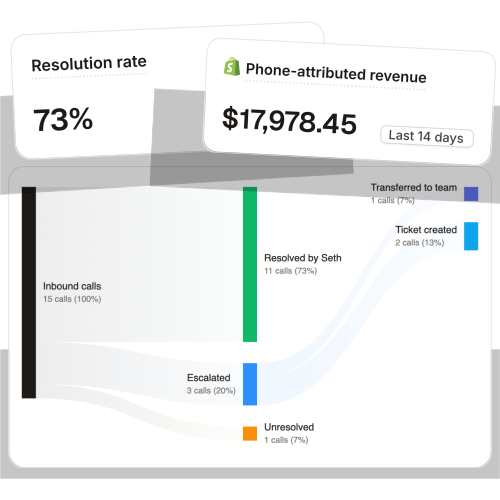
WashCo, a Shopify brand we launched, recovered $22,664 in attributed revenue in its first 7 days on the phone, much of it from the order and return-status calls that used to roll to voicemail. That's the other half of the equation: a return-status call answered well is a retention moment, not just a cost. If your return wave turns into a phone backlog you can't return, a returns management service built around the call layer is the missing piece, and it's the same muscle that handles your WISMO calls.
"My customers also feel like it's a normal person. They feel like they can communicate if they have questions."
Claudia Droge, TechCraft Studio
Want us to look at your last returns wave and what it did to your phone queue? Book a 30-min call and we'll review your missed calls live. This is the same operational layer covered in our guide to ecommerce phone support and what an AI receptionist for ecommerce actually does on a returns-heavy week.
The metrics that tell you if returns management is working
You can't manage returns on vibes. There are five numbers that tell you whether the function is healthy, and most brands track one of them.
If you only watch one, watch RMA-to-refund cycle time, because it's the metric your customer actually feels.
| Metric | What it measures | What good looks like |
|---|---|---|
| Return rate | Returns as a % of orders | Beat your category benchmark (apparel ~25%, supplements ~7%, pet ~10%, electronics ~11%) |
| RMA-to-refund cycle time | Request to refund-in-account | Under 5 days (Nventory top-tier) |
| Recovery rate | % of returned units resold at full price | Above the 48% industry baseline (Eightx) |
| Return-driven contact rate | Support touches generated per return | Falling as you automate status updates |
| Refund fraud rate | % of returns that are fraudulent | Below the 9% NRF 2025 benchmark |
Category context matters here, so don't panic at a number in isolation. Apparel runs a 25% return rate and shoes hit 31.4%, while supplements sit at 7% and pet products at 10% (Eightx). Benchmark against your own vertical, then track the trend. For the full set of operator numbers, the ecommerce return statistics for 2026 and the broader customer service KPIs for ecommerce are the two reference pages worth bookmarking. And if your rate itself is the problem, the lever is upstream in how to reduce product returns, not in the workflow.
What returns cost you, and what the call layer costs
Let's put numbers on it. Processing a single return costs between $10 and $65 once you add reverse logistics ($5-15), processing labor ($8-15), restocking ($2-10), and the value lost on whatever doesn't resell at full price (Eightx). Some of that is fixed physics. The labor and the contact layer are not.
The contact layer is where the spend hides. Take a typical $50M Shopify brand running a 6-rep CS team:
| Line item | Today | With Ringly |
|---|---|---|
| 6 reps x $4K loaded per rep | $24,000/mo | n/a |
| Ringly (illustrative) | n/a | $5,000/mo |
| Net monthly CS spend | $24,000/mo | $5,000/mo |
| Monthly savings | n/a | $19,000/mo |
| Annual savings | n/a | $228,000/yr |
Roughly 70% of those calls are repeatable: order status, return status, the same handful of questions over and over. Routing the return-status slice to an AI phone agent at $1.99 a call after the first 50, instead of $2.70 per human-handled call, is the cheapest line in the whole returns operation to fix. The 30% that need a human (the dispute, the exception, the genuinely upset customer) still go to your team, who now have the time to actually solve them. That's the same cost logic behind DTC returns best practices, applied to the phone.
Frequently asked questions
What's the difference between returns management and an RMA?
Returns management is the whole system, from the customer's request through grading, disposition, and refund. An RMA (return merchandise authorization) is one piece of it: the approval number assigned to a single return so you can track that item through the pipeline. You can't run returns management without RMAs, but the RMA is the ticket, not the process.
What are the stages of the returns management process?
Seven: request, eligibility and RMA, label and ship, receive and scan, inspect and grade, disposition, and refund-close-notify. Each stage should have one owner and a time target. The two that decide your margin are grading and disposition; the one that decides customer loyalty is how fast the refund and the comms close out.
How long should the returns process take?
Measure it as RMA-to-refund cycle time, the elapsed time from the customer's request to the refund hitting their account. Top-tier ecommerce operations keep it under 5 days (Nventory). If you're over 10, the bottleneck is almost always a slow receive-and-scan step or a manual refund approval.
Should we charge a return fee?
72% of US retailers now charge return fees, and 53% of them report a reduced return rate as a result (Eightx). It can work, but it's a CX trade-off, so test it on a segment first and watch your return-driven contact rate, because fees generate a wave of "why am I being charged" calls that land on the same queue as your refund-status calls.
What's a returnless refund and when does it make sense?
A returnless refund is when you refund the customer and let them keep the item instead of shipping it back. It makes sense whenever the cost to ship and grade the item is higher than what you'd recover by reselling it, which is common on low-ticket consumables where reverse logistics eats 20-30% of the unit value. For higher-value items you almost always want the unit back.
How do returns affect our support volume?
A lot, and it's predictable. Returns generate a cluster of status calls (did you get it, where's my refund, where's my exchange) that spike during post-sale and post-holiday windows. Across the brands we run phone support for, "where's my refund" is the second-most-common call after WISMO during a returns wave, and most of those are repeatable enough to route to an AI phone agent.
Do we need returns software or a returns process first?
Process first. Software like Loop or AfterShip handles the portal and the label beautifully, but it can't make the grading judgment, route the disposition, or answer the return-status phone call. If you want the tooling comparison, see our breakdown of the best returns management software for ecommerce. Nail the workflow above, then buy software to automate the parts that should be automatic.
Talk to us

If you run a $10M-$100M Shopify brand and your returns waves keep turning into a phone backlog you can't return, a 30-min call is the fastest way to see what those return-status calls are actually costing you, and what they're worth if you answer every one.
Our 3 promises.
- Live in under 1 hour. Setup and test calls are free.
- 30-day money back on the $99 plan fee.
- 65% resolution guarantee: if Seth resolves under 65% of your support calls in a month, that month comes back as credit (after 90 days on Pay per call).
Ruben (Ringly co-founder) takes these calls personally.