
If you are running an online store, you have probably realized that phone support is a double-edged sword.
Customers expect to reach you when they have questions about orders, returns, or shipping. But hiring full-time staff to answer calls gets expensive fast.
That is where virtual receptionist services come in.
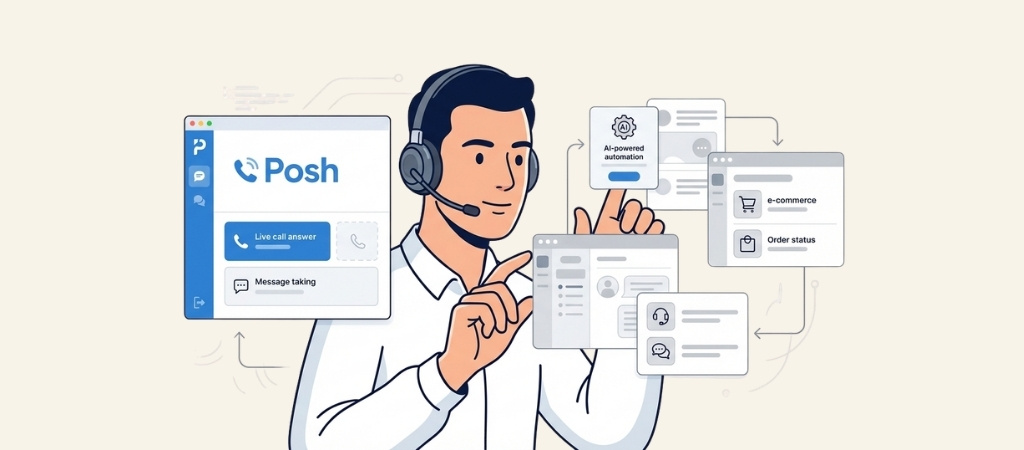
Posh has been a popular choice for businesses needing live call answering.
But it is not the only option, and depending on your store's needs, it might not even be the best fit. Some alternatives offer AI-powered automation.
Others focus on human touch. And a few specialize in e-commerce workflows that Posh simply does not handle.
This guide breaks down seven of the best Posh alternatives, comparing their pricing, features, and what makes each one unique.
Whether you need basic message taking or a full-service phone support solution, you will find an option that fits your budget and business model.
Editor’s note: Want to hear some sample AI support calls made for your Shopify store?
- Just paste your store URL
- Get sample calls in under 20 seconds (no email required)
- Listen to demo calls for my store
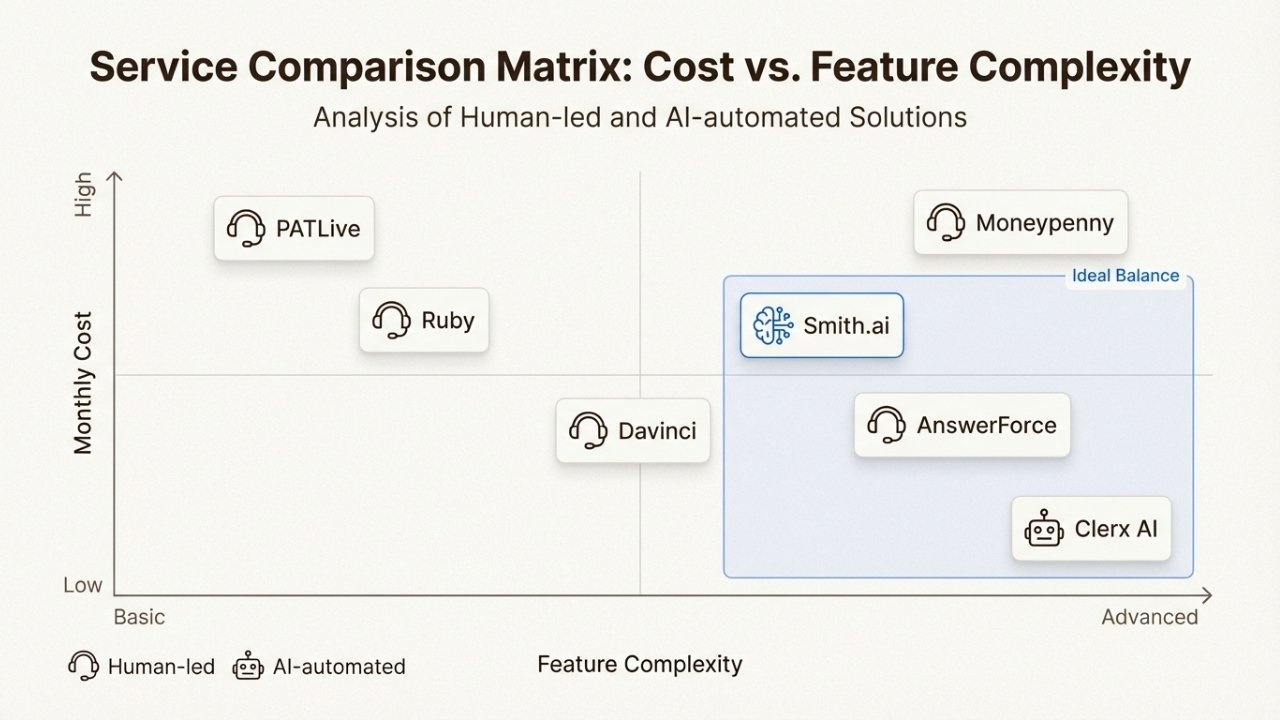
What is Posh and why consider alternatives?
Posh is a virtual receptionist service that provides 24/7 live call answering for businesses.
Their receptionists handle incoming calls, take messages, route calls to the right person, and schedule appointments.
It is a solid solution if you need a human voice answering your phone around the clock.
But here is the thing: Posh, like most traditional virtual receptionists, is primarily a message-taking service.
Their receptionists answer calls, collect information, and pass it along.
They do not actually resolve customer issues. If a caller asks "where is my order?" or "how do I return this item?" the receptionist takes a message and your team still has to follow up.
For e-commerce businesses, this creates a gap. You are paying for live answering, but your staff still ends up handling the same volume of support requests.
That is why many online stores look for alternatives that can:
- Integrate directly with Shopify or other e-commerce platforms
- Look up order status and shipping information automatically
- Handle returns and exchanges without human intervention
- Scale up during busy seasons without proportional cost increases
- Offer AI options for common questions while escalating complex issues
The alternatives below range from premium human services to AI-first solutions.
Each has strengths depending on what your store actually needs.
How we evaluated these Posh alternatives
To make this comparison useful, we looked at several factors that matter specifically for e-commerce businesses:
- Pricing transparency: Can you understand the cost structure without booking a sales call?
- E-commerce integrations: Does it connect to Shopify, WooCommerce, or other platforms?
- AI capabilities: Can it handle common questions automatically, or is every call handled by a human?
- Scalability: Does pricing scale reasonably as your call volume grows?
- Setup speed: How quickly can you get up and running?
We also considered general factors like customer reviews, feature breadth, and whether the service offers unique capabilities that set it apart from competitors.
The 7 best Posh alternatives compared
1. Smith.ai

Smith.ai takes a hybrid approach, combining AI-powered call handling with live North America-based agents.
This means simple requests get handled instantly by AI, while complex issues route to a human receptionist.
For e-commerce businesses, this hybrid model can work well.
Common questions like "what are your hours?" or "do you ship internationally?" get answered immediately. More complex issues, like custom order requests, get transferred to your team with full context.
Key features:
- AI + human hybrid answering
- 24/7 live coverage
- Lead qualification and intake
- Appointment scheduling ($1.50 per call add-on)
- CRM integrations (HubSpot, Salesforce, Clio, and more)
- Call recording and transcription ($0.25 per call)
- Payment processing ($1.00 per call)
- Dedicated local or toll-free number included
- Bilingual Spanish line available ($1.00 per call)
Pricing:
| Plan | Monthly Price | Calls Included | Additional Calls |
|---|---|---|---|
| Starter | $140 | 10 | $6.50 each |
| Basic | $300 | 30 | $6.50 each |
| Pro | $600 | 60 | $6.50 each |
Pros:
- Hybrid AI + human approach balances cost and quality
- Strong integration ecosystem
- North America-based agents
- Transparent per-call pricing
Cons:
- Add-ons can increase costs quickly
- Per-call model may not suit high-volume stores
- No native e-commerce platform integration
Smith.ai works best if you want the reliability of human receptionists but also want AI handling simple queries to control costs. It is particularly popular with professional services, but the feature set works for e-commerce too.
2. Ruby Receptionists

Ruby is one of the most established names in virtual reception.
They have been around for over two decades and have built a reputation for premium service quality.
If you want a white-glove experience where every caller feels like they are talking to your in-house team, Ruby delivers.
The trade-off is price. Ruby is the most expensive option on this list.
But for luxury brands or high-touch businesses where every customer interaction matters, the cost can be justified.
Key features:
- 100% live, personalized communication
- 24/7 coverage including weekends and holidays
- Bilingual Spanish support included
- Appointment scheduling
- Lead qualification and intake
- Payment collection over the phone
- Outbound call assistance
- Mobile app for iOS and Android
- Voicemail transcription
- Call and text from your business number
- Robocall filtering
- HIPAA-compliant services available
- Live chat add-on available
Pricing:
| Plan | Monthly Price | Minutes Included | Cost per Extra Minute |
|---|---|---|---|
| Starter | $250 | 50 | $2.50 |
| Basic | $395 | 100 | $2.35 |
| Most Popular | $720 | 200 | $2.20 |
| Growth | $1,725 | 500 | $2.10 |
Live chat can be added to any plan for $143-$520 per month depending on chat volume. Bundling chat with receptionist service saves 20%.
Pros:
- Premium service quality
- No setup or activation fees
- All features included in every plan
- 20+ years of experience
- Excellent mobile app
Cons:
- Most expensive option
- Per-minute pricing can be unpredictable
- Overkill for simple message-taking needs
Ruby makes sense if you run a high-end e-commerce store where customer experience is a key differentiator.
The premium price buys you peace of mind that every caller gets exceptional service.
3. Moneypenny

Moneypenny offers a unique hybrid: an AI Receptionist that handles calls with the option to transfer to real people when needed.
This gives you the cost benefits of AI with the safety net of human backup for complex situations.
Their AI Receptionist uses generative AI to create warm, conversational interactions. It understands verbal cues and can handle multi-turn conversations.
When a caller needs something beyond the AI's capabilities, it seamlessly transfers to a Moneypenny receptionist.
Key features:
- AI Receptionist with human fallback
- Phone answering service with experienced receptionists
- Managed live chat for websites
- 24/7 coverage available
- Lead management and qualification
- Appointment scheduling
- Bilingual answering (English/Spanish)
- Call handling and forwarding
- Contact center outsourcing options
- Omnichannel support (phone, chat, email)
Pricing:
| Service | Starting Price | Notes |
|---|---|---|
| Phone Answering | $349/month | Custom plans based on volume |
| AI Receptionist | Custom quote | Contact for pricing |
| Live Chat | Custom quote | Based on chat volume |
Moneypenny requires contacting sales for exact pricing based on your specific needs.
The $99 entry point makes it one of the more affordable human-answered options.
Pros:
- Affordable entry price for human service
- AI + human hybrid model
- Strong reputation (4.7/5 on Trustpilot)
- Flexible service options
Cons:
- Pricing not fully transparent online
- AI Receptionist pricing requires sales consultation
- Less e-commerce specific than some alternatives
Moneypenny is a good middle ground if you want human backup but are intrigued by AI cost savings.
The hybrid approach lets you test AI capabilities without fully committing.
4. AnswerForce
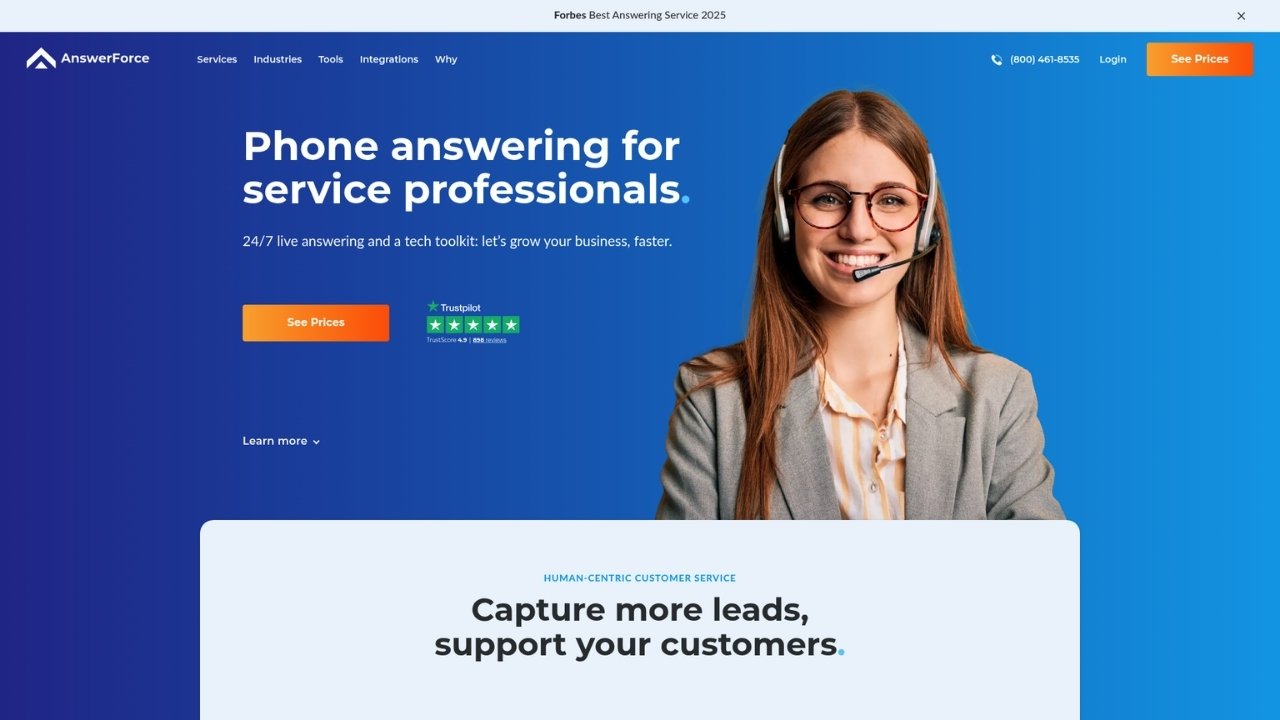
AnswerForce focuses specifically on service professionals and home services businesses, though their capabilities extend to e-commerce.
They combine 24/7 live answering with a "tech toolkit" that includes video meetings, team messaging, and live chat.
What sets AnswerForce apart is their focus on lead capture. Their receptionists are trained to qualify leads and gather detailed information, not just take messages.
For e-commerce stores that take custom orders or provide quotes, this can be valuable.
Key features:
- 24/7 live answering
- Virtual receptionists
- Call center solutions
- 24/7 appointment setting
- After-hours call answering
- Bilingual answering (Spanish/English)
- Video meeting capabilities
- Team messaging platform
- Business phone line
- Live chat widget
- Integration with popular business tools
Pricing:
AnswerForce does not publish specific pricing tiers. Plans are customized based on call volume and required features.
You need to register on their site or contact sales for a quote.
Pros:
- Forbes Best Answering Service 2025
- Excellent Trustpilot rating (4.9/5)
- Tech toolkit adds value beyond answering
- Strong focus on lead qualification
Cons:
- No transparent pricing
- Primarily focused on service businesses
- May be overkill for simple e-commerce needs
AnswerForce suits e-commerce businesses that also provide services (like custom installations, consultations, or B2B sales) where lead qualification matters as much as order support.
5. Davinci Virtual
Davinci Virtual focuses on providing professional phone presence for businesses.
Their standout feature is the availability of toll-free numbers (888, 855, 866, 877 prefixes) and comprehensive voicemail management.
While they offer live receptionist services, Davinci is particularly strong for businesses that want a professional phone infrastructure without the premium price of full virtual receptionist services.
Key features:
- Live virtual receptionists
- Toll-free and local business numbers
- Call screening and management
- Voicemail with email delivery
- Custom hold music
- Message transfer to email or fax
- Auto attendant for call routing
- Meeting room access (physical locations)
- Mail forwarding services
Pricing:
| Service | Starting Price | Notes |
|---|---|---|
| Live Receptionist | $99/month | Base plan |
| Additional Numbers | Variable | Per-number pricing |
| Virtual Office | Custom | Based on services needed |
Pros:
- Affordable entry point
- Professional toll-free numbers included
- Good voicemail management
- Physical meeting room access
Cons:
- Less focus on live receptionist quality
- Limited advanced features
- No AI capabilities
- Basic e-commerce integration
Davinci Virtual works well for smaller e-commerce stores that need a professional phone presence but do not yet have the call volume to justify premium receptionist services.
6. PATLive

PATLive offers straightforward, all-inclusive pricing with no contracts. Their standout feature is an 8-second average answer time, meaning callers rarely wait.
They also provide a 14-day free trial, making it easy to test the service risk-free.
All plans include the same comprehensive feature set. The only difference is the number of minutes included.
This transparency is refreshing compared to competitors with complex add-on structures.
Key features:
- 100% live US-based receptionists
- 24/7/365 coverage
- Call screening and transfers
- Appointment scheduling
- Lead collection
- Message taking
- Order processing
- Emergency dispatch
- New client intake
- Event registrations
- Bilingual support ($20/month add-on)
- Call recordings
- Spam call blocking
- Web and mobile apps
- CRM integrations
Pricing:
| Plan | Monthly Price | Minutes Included | Cost per Extra Minute |
|---|---|---|---|
| Basic | $75 | Pay as you go | $2.60 |
| Starter | $250 | 75 | $2.35 |
| Standard | $460 | 200 | $2.20 |
| Premium | $720 | 350 | $2.10 |
| Pro | $1,170 | 600 | $2.00 |
Web chat plans range from $100/month (10 chats) to $700/month (100 chats). Bilingual receptionists add $20/month.
Pros:
- No contracts or commitments
- All features included in every plan
- Fast answer times (8-second average)
- 14-day free trial
- Transparent pricing
Cons:
- Per-minute pricing can add up
- Bilingual support costs extra
- No AI automation options
PATLive is ideal if you want simple, transparent pricing and fast answer times without complex feature tiers.
The free trial makes it easy to test before committing.
7. Clerx AI
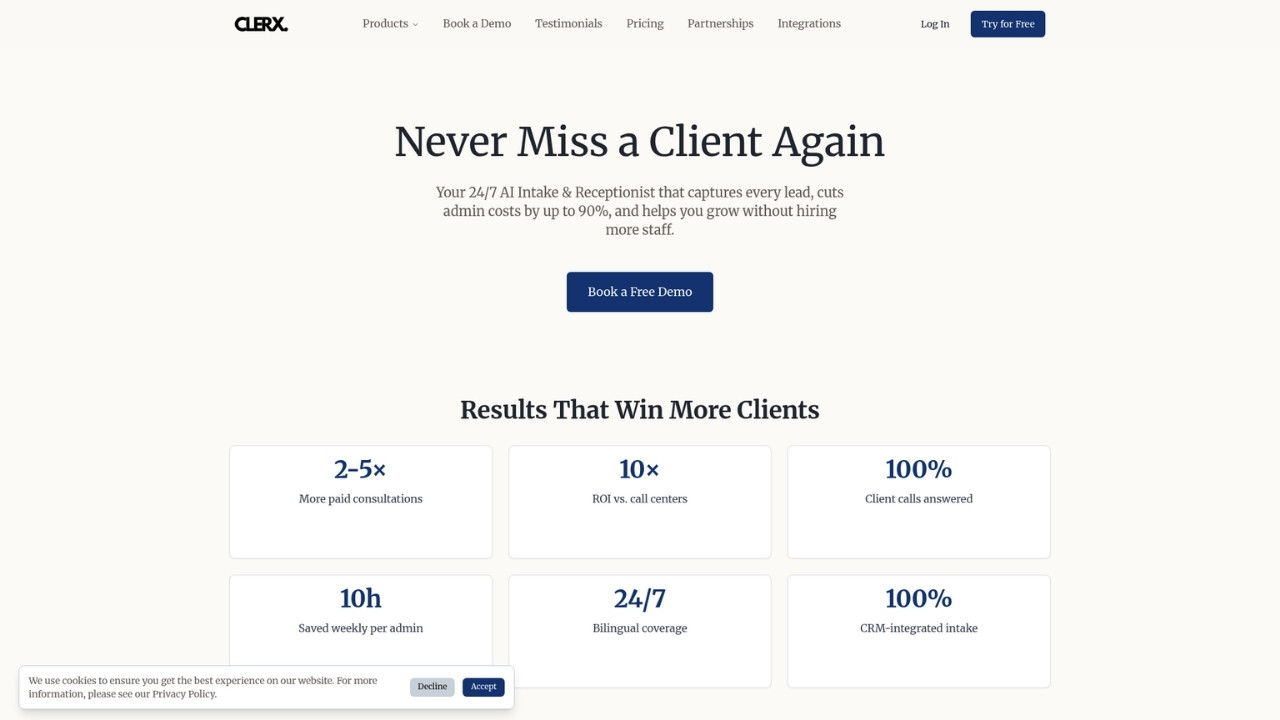
Clerx AI represents a new category: fully AI-powered receptionists that require no human intervention.
Their "Donna" AI handles incoming calls, screens and qualifies leads, schedules appointments, and routes calls autonomously.
Unlike hybrid services where AI hands off to humans, Clerx is designed to handle entire conversations independently.
It integrates with your CRM, understands your business workflows, and can even collect payments during calls.
Key features:
- 24/7 AI receptionist (no humans needed)
- Lead screening and qualification
- New client intake automation
- Appointment scheduling with payment collection
- Call transfer and escalation routing
- Call recordings and searchable transcripts
- Instant AI summaries after each call
- Analytics dashboard with performance insights
- Dedicated customer success manager
- Bilingual in English and Spanish
- Support for 35+ languages
- CRM integration
Pricing:
Clerx offers custom pricing based on business size and call volume. Plans are structured around:
| Plan Type | Target |
|---|---|
| Solo | Individual practitioners |
| Team | Small firms |
| Firm | Larger practices |
| Enterprise | Big organizations |
All plans include a 7-day free trial. Clerx claims businesses save $2,500-$25,000 monthly compared to human receptionists.
Pros:
- Fully autonomous AI (no human labor costs)
- Handles complete conversations
- 35+ language support
- Consistent service quality
- Detailed analytics
Cons:
- No human backup for complex emotional situations
- Custom pricing requires sales call
- Newer company with shorter track record
Clerx AI suits e-commerce businesses with high call volumes and predictable inquiry patterns.
If most of your calls involve order status, returns, or FAQs that can be scripted, an AI-only approach could dramatically reduce costs.
Feature comparison table
| Service | Starting Price | Answer Type | Best For | Standout Feature |
|---|---|---|---|---|
| Smith.ai | $140/month | AI + Human | Hybrid approach | North America-based agents |
| Ruby | $250/month | Human | Premium service | 20+ years experience |
| Moneypenny | $99/month | AI + Human | Affordable hybrid | AI with human fallback |
| AnswerForce | Custom | Human | Lead capture | Forbes 2025 winner |
| Davinci Virtual | $99/month | Human | Phone presence | Toll-free numbers |
| PATLive | $75/month | Human | Fast answers | 8-second answer time |
| Clerx AI | Custom | AI only | Full automation | 35+ languages |
AI vs human receptionists: Which is right for your store?
The divide between AI and human receptionists is not as clear-cut as it might seem. Here is how to think about which approach fits your business.
Choose AI if:
- You have high call volume with repetitive questions
- Most inquiries are informational (hours, policies, order status)
- You need 24/7 coverage but cannot afford round-the-clock staff
- Your customers prefer quick answers over personal interaction
- You have integrated systems (Shopify, CRM) that AI can query
Choose human if:
- You sell high-touch or luxury products
- Calls often involve complex problem-solving
- Building personal relationships drives repeat business
- Your customers are older or prefer speaking to people
- Emotional intelligence matters (complaints, special requests)
Hybrid approaches offer the best of both worlds for many e-commerce stores.
AI handles the routine stuff instantly. Humans step in when conversations require judgment, empathy, or complex decision-making.
One thing to consider: traditional virtual receptionists (including all the human options above) primarily take messages.
They answer calls, collect information, and pass it to your team. They do not actually resolve issues by looking up orders, processing returns, or accessing your e-commerce platform.
That is where specialized e-commerce phone support differs from general virtual reception.
What about Ringly.io for e-commerce phone support?
Most virtual receptionists treat e-commerce calls like any other business inquiry. They take a message and move on.
But what if your phone support could actually resolve customer issues?
That is where we come in. Ringly.io built the AI specifically for e-commerce businesses.
Unlike traditional receptionists who just take messages, the AI is an AI phone agent that integrates directly with your Shopify store and can:
- Look up order status and tracking information in real-time
- Process returns and exchanges automatically
- Answer product questions using your catalog data
- Handle "where is my order?" calls without human intervention
- Escalate only the complex issues that actually need your team
Our customers see about 73% of calls resolved without any human involvement.
That means your team only handles the 27% that truly require human judgment.
The difference is integration. Traditional virtual receptionists work from scripts. the AI works from your actual store data.
When a customer calls asking about their order, the AI pulls up their information and gives them an answer, not a promise to pass along a message.
For e-commerce stores doing $1M+ annually, this distinction matters. You are not just buying phone coverage. You are buying actual problem resolution.
If you are curious how AI phone support compares to virtual receptionists for your specific store, you can start a free trial and see the difference.
Choosing the right Posh alternative for your business
The best choice depends on your priorities:
If budget is your main concern: PATLive offers the lowest entry point at $75/month with transparent pricing. Moneypenny starts at $349/month for human answering.
If you want premium service: Ruby is the established leader with 20+ years of experience and all-inclusive pricing. You pay more, but there are no surprises.
If you are AI-curious: Smith.ai offers a true hybrid model. Moneypenny has an AI Receptionist with human fallback. Clerx AI goes all-in on automation.
If you need e-commerce-specific support: Traditional virtual receptionists handle calls generically. If you want order lookups, returns processing, and Shopify integration, specialized tools like Ringly.io handle what virtual receptionists cannot.
Most services offer free trials, so you can test how they fit your actual call volume and customer needs. Start with your top priority (cost, quality, or capabilities) and work from there.
Frequently Asked Questions
What is the most affordable Posh alternative for a small e-commerce store?
PATLive starts at $75 per month with pay-as-you-go pricing, making it the most affordable option. Davinci Virtual and Moneypenny both start around $349 per month for their base plans.
Do any Posh alternatives integrate directly with Shopify?
Traditional virtual receptionists like Smith.ai, Ruby, and PATLive do not offer native Shopify integration. They work from scripts and take messages. For direct Shopify integration with order lookups and returns processing, specialized e-commerce phone support like Ringly.io is designed specifically for that purpose.
Can AI receptionists handle complex customer service issues?
AI receptionists excel at routine inquiries like order status, store hours, and policy questions. For complex issues requiring empathy, negotiation, or creative problem-solving, human receptionists or hybrid models work better. Most AI services can escalate complex calls to your team when needed.
What is the difference between per-call and per-minute pricing for virtual receptionists?
Per-call pricing (like Smith.ai) charges a flat rate for each call regardless of duration. Per-minute pricing (like Ruby and PATLive) charges based on talk time. Per-call is predictable for short calls. Per-minute can be more economical for longer conversations but varies month to month.
Are there any Posh alternatives that offer a free trial?
Yes, PATLive offers a 14-day free trial with full features. Clerx AI offers a 7-day free trial. Most other services require speaking with sales, though many offer money-back guarantees or flexible cancellation policies.
Which Posh alternative is best for high-volume e-commerce stores?
For high volume, consider Clerx AI for full automation at scale, or PATLive's Pro plan at $1,170 per month for 600 minutes. If your calls involve many order lookups and returns, specialized e-commerce AI phone agents may handle volume more cost-effectively than traditional per-minute receptionists.