

Specialty food brands get a phone line that behaves like nothing else in your support stack.
- The mix is its own thing: ship-by dates, "will it arrive cold," allergen questions, gift logistics, plus the older customer who'd rather call than touch the website.
- One Shopify brand on Ringly handled 1,595 calls in 90 days without a phone rep on payroll.
- Written for founders, COOs, and Heads of CX at $10M-$100M Shopify specialty-food brands running a paid helpdesk and a visible phone line.
It's a Tuesday in mid-July, the middle of a heat wave, and the phone line for a specialty-food brand has been ringing since the office opened. Caller one wants to know if her order of artisanal chocolate will arrive before it melts in the back of a delivery truck. Caller two is asking whether the new hot sauce is made in a facility that handles nuts, because her kid has an allergy. Caller three is 68 and wants to read his card number to a person instead of typing it into checkout. None of these are angry. None of them are hard. They just don't stop, and there are two reps on the line.
If you run support or operations at a specialty-food brand on Shopify doing $10M-$100M, you already know this queue. The phone is mostly a delivery-timing and freshness desk with allergen questions and a gifting season layered on top, and the volume swings hard with the weather and the calendar. We've put AI phone agents live for 50+ Shopify brands with exactly this shape. Book a 30-min call and we'll pull your last week of missed calls and show you what they actually were.
In this post:
What specialty food customers actually call about
Before you decide how to cover a phone line, you have to know what's coming in on it. So I read through call logs from 50+ Shopify brands on Ringly and counted how many specialty-food calls were a routine delivery-timing, freshness, or gift question versus an actual problem. It was most of them. The phone for a food brand isn't a complaints desk. It's a logistics-and-reassurance desk, and the catalog breadth is what makes it noisy.
A specialty-food catalog is rarely one thing. You might ship a shelf-stable spice blend, a refrigerated cheese, a frozen meal kit, and a gift box all from the same store. Each one generates its own flavor of call.
Here's how the volume tends to break down:
- Order status and ship-by questions. Plain where's-my-order calls. "When does it ship, when does it land." WISMO runs 30-40% of all support tickets in normal periods and over 50% at peak, according to Salesforce. It's the single biggest bucket.
- Cold-chain and freshness calls. "Will it arrive cold? Is the chocolate going to melt? Is the cheese still good if it sat on my porch?" These spike with summer heat and with any perishable launch, and the customer is anxious because they can't inspect the product before it ships.
- Allergen and ingredient questions. "Is this gluten-free? Made in a nut-free facility? What's the sodium?" High-stakes, high-anxiety, and the customer wants a confident answer from a real source, not a guess.
- Gift logistics. Address changes, gift notes, "will it arrive by the date I need it." A gift order carries more worry than a self-purchase because the customer can't fix a problem on the receiving end.
- Phone orders from older buyers. A real slice of specialty-food customers won't place an order on the website at all. They call to read you the order and expect a person to take it.
- The genuinely hard one. A perishable arrives spoiled, melted, or late. Public reviews of large food brands are full of these: a perishable box ruined after 50 hours in transit, a cake that showed up late and not packed in dry ice (Trustpilot). That call needs a person, fast.
Roughly 70-80% of a specialty-food brand's phone volume is the routine logistics, freshness, or gift question, and the routine call is the one you're overpaying a trained rep to answer. The spoiled-order call is the 20% that actually needs your team's judgment.
This split is the whole reason the staffing question has a better answer than "hire more reps." Gear Rider, a specialty brand on Ringly, handled 1,595 calls in 90 days without a phone rep on the payroll. For the broader pattern across stores, our ecommerce phone support breakdown covers it, and the WISMO calls guide goes deep on the order-status piece.
Why this line is so hard to staff
The calls themselves aren't complicated. The pattern is. Specialty-food phone volume is bursty and it hits when you're least staffed.
Start with after-hours. Perishables ship on a clock, so a customer who gets a "your order is delayed" email at 8 p.m. on a Friday wants to talk to someone before the weekend kills the cold chain. The line is closed, the call rolls to voicemail, and 80% of voicemail-routed callers hang up without leaving a message (Eden). Worse, 78% of buyers abandon a brand after a single unanswered call (PCN). The voicemails we never return aren't neutral. They're churn.
Then there's the seasonal spike, except specialty food gets two. There's the Nov-Dec gifting rush every food brand braces for, and there's the summer heat window where cold-chain anxiety spikes on its own. You staff a small team year-round and scramble to add reps for two different peaks, and the math on those temps almost never works. Replacing a single CS rep costs $14,113 (Gartner, via Insignia), and the industry turns over 31.2% of its agents a year. The seasonal hire you train in October is gone by February.
And the calls need a real answer. Allergen questions and freshness guarantees aren't the kind of thing you want a rushed seasonal temp guessing at. The older demographic that calls instead of using the site has high expectations for who picks up. So you're hiring for quality, paying loaded cost ($4,000/month for a US rep once you count benefits, training, and churn), and still leaving the after-hours window uncovered.
The three ways to cover the phone
There are really only three ways to keep a specialty-food phone line answered. Most brands end up using some mix of them.
Hire in-house reps
The default. You get brand voice, control, and people who can learn your catalog. The cost is the part founders skip: a loaded US rep runs about $4,000 a month, you need enough of them to cover the peaks, and they sit idle the rest of the year. Turnover means you're always re-training. And unless you pay for a night shift, the after-hours and weekend window still rolls to voicemail.
Outsource to a call center (BPO)
Cheaper per hour, especially offshore. The trade is brand voice and food-specific knowledge. A general BPO agent doesn't know your roast dates, your allergen statements, or which SKUs ship cold, and training them costs you the same effort as training your own team without the loyalty. You're also still paying for idle capacity nine months out of twelve. For the full picture, our guide on outsourced customer service walks through where it works and where it breaks.
Put an AI phone agent in front of the line
The newer option, and the one that fits the 70-80% routine split. An AI phone agent answers every call 24/7, handles the order-status, ship-by, freshness, and gift-logistics calls end to end, and hands the spoiled-order or genuinely-complex call to your team. You keep your number, your helpdesk, and your reps. You just stop paying humans to answer "where's my order" at 11 p.m. More on the 24/7 ecommerce phone support angle if that's the gap you're trying to close.
The honest answer for most $10M-$100M specialty-food brands is a mix: AI on the routine volume and the after-hours window, your team on the calls that need a human. That's the split the rest of this playbook is built around.
What an AI phone agent does, and doesn't, for a food brand
Strip away the category jargon and it's simple. An AI phone agent picks up your inbound calls, around the clock, and handles the routine ones from start to finish. It finds the order in your Shopify store, reads back the shipping status, processes a return or exchange, and answers product and allergen questions from the knowledge base you already wrote. When a call needs a person, it hands off cleanly to your existing helpdesk.
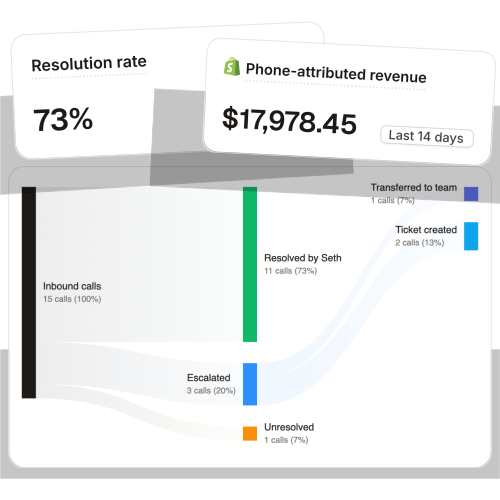
Across 50+ Shopify brands, the AI resolves about 73% of inbound calls on its own, at roughly $0.42 per resolved call. Compare that to the $7-$16 a human-handled call runs at most outsourced call centers. It answers in 40 languages, which matters more than you'd think when a customer ships a gift box to a relative abroad. And the tone on call 300 is the same as call one, which is not something you can promise a human team in the back half of December.
It plugs into the stack you already run. Keep your number, keep your order tracking setup, keep Gorgias or Zendesk or whatever helpdesk you've got. The agent sits in front of it and only escalates what it should.
"My customers also feel like it's a normal person. They feel like they can communicate if they have questions."
— Claudia Droge, TechCraft Studio
That reaction matters most in specialty food, because the demographic that calls is the most skeptical about talking to anything that sounds like a machine. The single most repeated thing customers say after a call with the AI is "you don't sound like AI."
What it doesn't do (the honest part)
Three things to be clear about, because pretending otherwise wastes everyone's time.
- It doesn't take orders by phone natively. This is the sharpest gap in specialty food, where a real slice of older customers call specifically to place an order by voice. The workaround is an SMS payment link the agent sends mid-call, or a clean transfer to a human for the customers who insist. If phone orders are the majority of your volume, AI isn't your fit yet, and we'll tell you that on the call.
- The spoiled or late perishable call escalates to a human. When a gift arrives melted or a perishable shows up late, that's an emotional call and an FTC-regulated refund situation. The agent recognizes it and hands it to your team with the context attached. That's by design.
- Inventory is a daily refresh, not real-time. If a customer asks whether a small-batch item is back in stock, the agent works off the most recent sync, not a live count.
This is AI phone support for Shopify brands, built to take the routine call off your team so they can be present on the one that needs them. It also works the abandoned-cart angle: if someone gets halfway through a $90 gift box and bails, the agent can follow up by phone to recover it.
What it costs vs covering it with Ringly
Here's the part founders skip. Add up what a specialty-food phone line actually costs and it's never just the reps on the org chart.
A typical $20M specialty-food brand runs a small team year-round and a much bigger one for the peaks:
| Cost line | What it really runs |
|---|---|
| 4 year-round reps × $4K loaded | $16,000/mo · $192,000/yr |
| 4 seasonal temps × $4K × 3 months | $48,000/yr at peak |
| True annual CS spend | ~$240,000/yr |
Ringly Enterprise runs roughly $3K-$5K a month, handles the roast-date, freshness, gift-order, and order-status calls year-round, and absorbs the spike without the seasonal hiring scramble. Net savings land around $140,000-$180,000 a year depending on your volume. The routine 70-80% goes to the AI. The 20-30% that needs a human still goes to your CS team, who now have time to actually solve it.
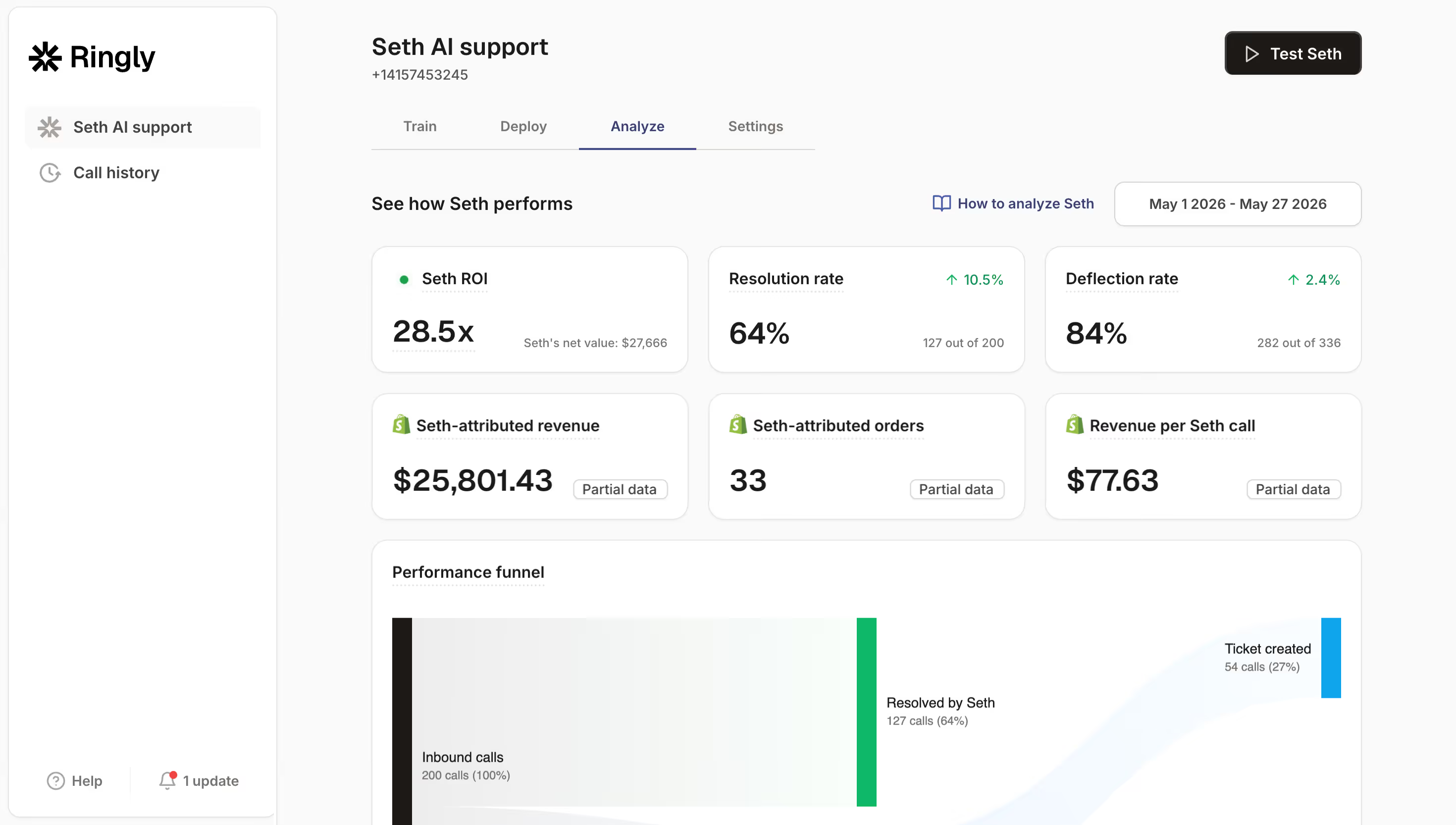
Real numbers from WashCo, a Shopify brand we launched recently:
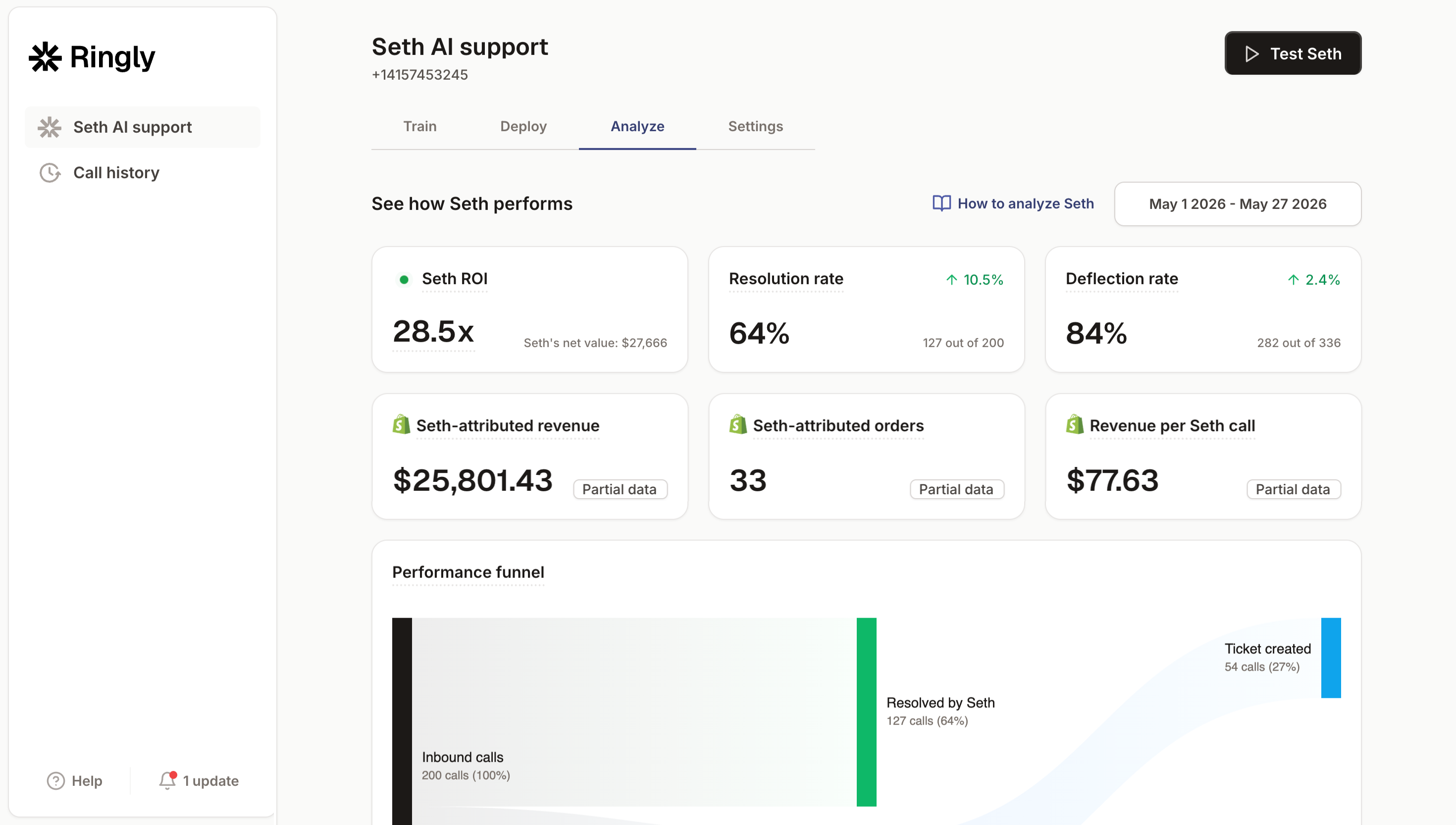
- $22,664 in attributed revenue, first 7 days post-launch
- 271 calls handled
- 85% deflection rate
- 66% resolution rate
- $0.91 per call vs $2.70 per human-handled call
Source: Ringly dashboard, verified live data.
The call makes sense if:
- You're a Shopify (or Shopify Plus) specialty-food brand doing $10M-$100M
- You run a paid helpdesk (Gorgias, Zendesk, Gladly, or Re:amaze)
- You have a visible phone number on your store
- Your CS team is 3-12 people
If that's you, the math usually works.
What happens on the call.
- We pull your last 7 days of missed calls live, on the call. No homework for you.
- We show you the recovered revenue at the resolution rates we see for food brands.
- You decide if it's worth going further. No deck, no follow-up sequence.
If you're sizing this against your current setup, book a 30-min call and we'll do the math live on your store.
Frequently asked questions
Can an AI phone agent take orders over the phone for my food brand? Not natively, and that's the honest gap for specialty food. The agent can send an SMS payment link mid-call or transfer the customer to a human for the ones who insist on ordering by voice. If phone orders are the bulk of your volume, we'll tell you on the call that you're not a fit yet.
How does it handle allergen and ingredient questions? It answers from the knowledge base you load, so the accuracy is only as good as your allergen documentation. For anything outside the documented facts, it escalates to your team rather than guessing. You control exactly what it's allowed to state.
What about cold-chain and freshness calls? Those are mostly order-status and ship-by questions in disguise, which the agent handles well: it reads back shipping status, estimated arrival, and any tracking detail. The "my perishable arrived spoiled" call is treated as an escalation and handed to a human.
Does it work with Gorgias or Zendesk? Yes. Ringly sits in front of your existing helpdesk and escalates cleanly to whatever you already run. You keep your number, your workflows, and your team. Nothing gets ripped out.
How fast can we get set up? Live in under an hour for self-serve plans, with a 14-day Launch Sprint for Enterprise where we build and tune it for you. You add your website, docs, and knowledge base, and the agent is ready.
How much does it cost? Grow is $349/mo (1,000 minutes), Pro is $799/mo (2,500 minutes), and Enterprise is set on a call for $10M-$100M brands. There's a 65% resolution guarantee: if the AI resolves under 65% of your calls in 90 days, we refund the last 3 months.
Talk to us

If you run a $10M-$100M Shopify specialty-food brand and you're losing calls after-hours or scrambling to staff the next seasonal spike, a 30-min call is the fastest way to see what you're leaving on the table.
The 3-layer guarantee.
- Live in 14 days or it's free until launched.
- 65% resolution in 90 days or we refund the last 3 months of subscription fees.
- We keep working free until we hit it.
Ruben (Ringly co-founder) takes these calls personally.