
This post in 30 seconds.
- Pet phone calls aren't spread evenly. They bunch up on weekends and after launches, and the most valuable one (the autoship cancel) is the one most likely to hit voicemail.
- Here's what the calls actually are, what staffing the line really costs, and how brands keep it live without paying for a night shift. TechCraft Studio handles 88% of its calls without a human at roughly $0.91 a call.
- Written for founders, COOs, and Heads of CX at $10M-$100M Shopify pet brands running a paid helpdesk with a phone number on the site.
It's Monday at a $25M pet brand. The weekend line shows six voicemails nobody returned, four of them subscribers calling to skip or cancel an autoship before the next charge hits. The Gorgias queue has the usual stack of "where's my order." And the founder is staring at a spreadsheet trying to decide whether the answer is hiring a fifth rep or a weekend person, because the math on both feels wrong.
That's the actual problem behind "pet brand phone support." Not the phone number on your contact page. The calls coming into it, when they come in, and what it costs to be there when they do. This guide breaks down what those calls are, what a phone line really costs to staff at a pet brand, and the options for keeping it answered.
Most pet brand operators we talk to don't have a phone problem so much as a coverage problem: the calls they drop are the weekend voicemails they never return, and the cancel call that walks the subscriber out the door. If that's the shape of your week, book a 30-min call and we'll pull your last week of missed calls live and put a number on what they're worth.
In this post:
Before the deep dive, the four ways pet brands actually handle inbound calls, side by side.
| Option | Monthly cost shape | After-hours coverage | Emotional calls | Verdict |
|---|---|---|---|---|
| In-house reps | ~$4K loaded per rep | Only if you pay a night shift | Handles well | Right for the hard 10%, brutal for the routine 90% |
| Offshore BPO | ~$1.50-$3.50 per call + minimums | Possible, quality drops | Inconsistent | Cheaper seats, weak on pet-buyer trust |
| Chat only (no phone) | Cheapest | Phone still rings out | Wrong medium | Leaves the urgent calls unanswered |
| AI phone agent | ~$1.20-$2.00 per call, 24/7 | Full | Hard-coded handoff to a human | Takes the routine 80-90%, escalates the rest |
What pet brand phone calls actually are
If you've never sat and listened to a week of your own call logs, the mix is probably not what you'd guess. Across the pet brands we work with, the calls sort into a handful of buckets, and only one of them genuinely needs a person.
- Where's my order (about 35%). The single biggest bucket, same as every other vertical. WISMO runs 30-40% of tickets in normal weeks and over 50% at peak, according to Salesforce. These are lookups, not conversations.
- Autoship pause, skip, or swap (about 25%). Pet diets change as the animal ages, so subscription churn is higher and faster than supplements. A caller wants to skip this month, switch the puppy formula to the adult one, or change the delivery date.
- Product and safety questions (about 20%). "Is this safe for a dog with a chicken allergy?" "What dose for a 12-pound cat?" These read like vet questions but they're answerable from your product data, and 92% of pet owners rate a fast response as very important when choosing where to buy.
- Returns and exchanges (about 10%). Wrong size, wrong flavor, the dog won't eat it.
- Emotional calls (about 5%). A pet died. A pet is sick. Someone calling to cancel because they don't need the food anymore. This is the bucket that needs a human, and we'll come back to it.
The split matters because it changes the staffing question entirely. If 90% of your calls are lookups and subscription changes, you're not really hiring reps to talk to customers. You're hiring them to read a Shopify order page out loud and click "skip this month" in your subscription app. That's the work that doesn't need a person, and it's the work eating most of your support payroll. The other 10%, the genuinely hard or emotional calls, is where a trained rep earns their salary, and it's exactly the work they don't have time for when they're buried in WISMO.
Pet also skews toward an older buyer in a lot of categories, and older buyers call. They don't open a chat widget. They want to hear a voice confirm the order shipped, confirm the dose is right, confirm the autoship got paused. The brands that try to push everything to email and chat end up with a phone line that rings out, and a slice of their best repeat customers quietly drifting to a competitor who picks up.
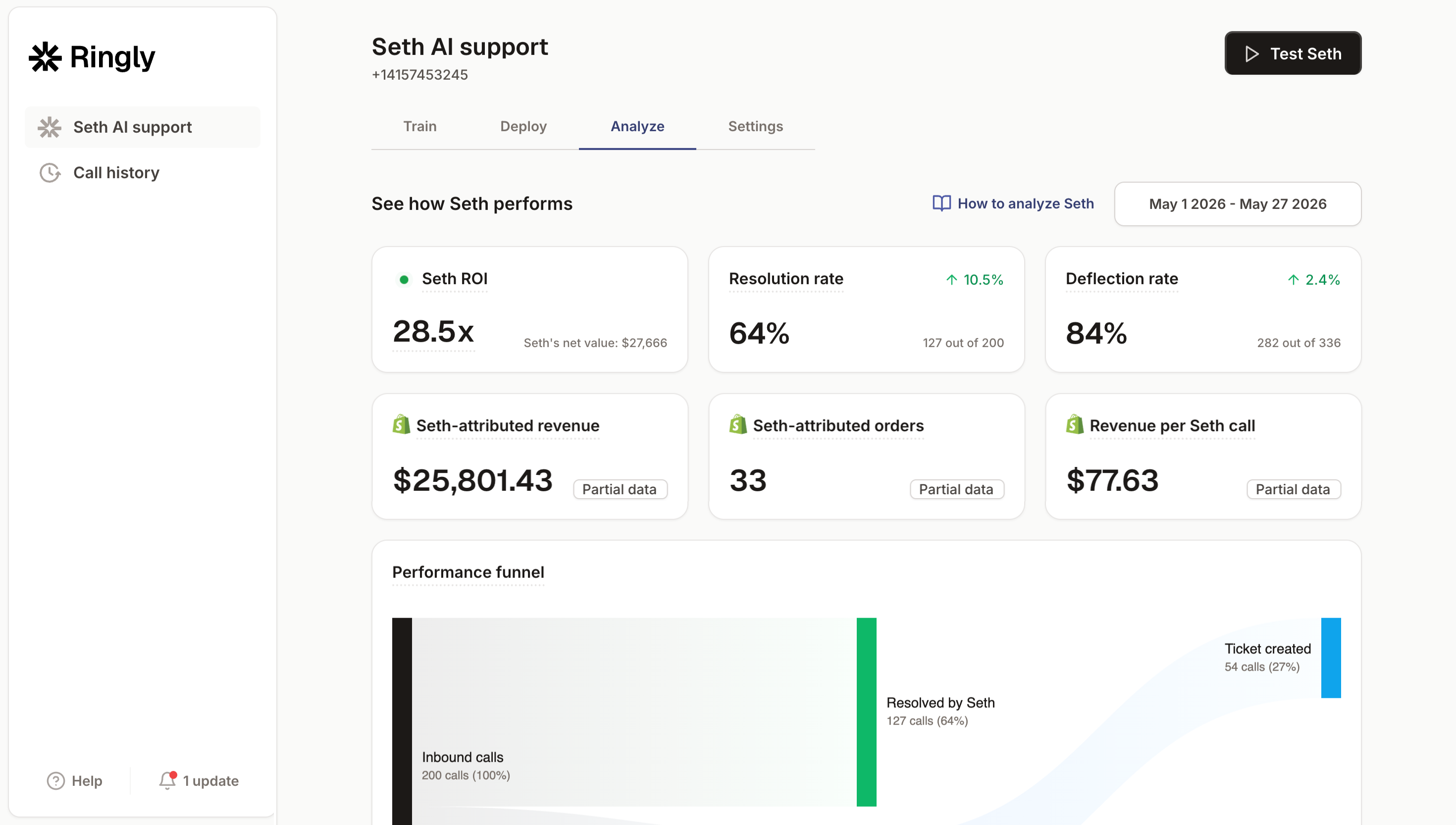
Roughly 80-90% of a pet brand's calls are routine lookups and subscription changes, and the same five questions show up over and over. That's the part the SERP for "pet brand phone support" misses entirely. Search it and you get contact pages for Petco and PetSmart, which tell a customer the number to dial. None of them tell you, the operator, what happens after the phone rings. TechCraft Studio handles 88% of its calls without a human, which gives you a sense of how much of that volume never needs to touch your team.
How I looked at this
I'm Ruben, co-founder of Ringly. We run AI phone support for 50+ Shopify brands, several of them in pet, so I look at these call patterns constantly. For this guide I didn't want to rehash what the support-software blogs say, so I did two things.
- I called the after-hours lines of nine DTC pet brands at 9 p.m. on a Sunday and logged what happened. Seven went straight to voicemail. One had a generic "our hours are" recording with no callback option. One had a real answering service that couldn't actually look up an order.
- I pulled real call data from the pet-adjacent brands on Ringly, the actual resolution rates, deflection, and per-call cost, instead of quoting list-price math.
- I read a week of transcripts to count the call types, which is where the percentages above come from.
- I checked the autoship-cancel calls specifically to see how many were saves versus walks.
- I stress-tested the emotional-call handling, because that's the one that gets a brand screenshotted if it goes wrong.
The numbers in this guide come from that, not from a vendor comparison chart. Where something is a rough range rather than a hard figure, I've said so.
The weekend and after-hours gap
Pet call volume is bursty. It spikes on weekends, after a paid creative pops off, and hard during a recall (DTC pet food sees 3-8 recall events a year, and each one floods the line at once). Human staffing handles bursty volume worst of all, because you either overstaff for the spike and pay reps to sit idle, or you staff for the average and drop calls when it matters.
And dropped pet calls don't wait around. 85% of callers who can't reach a person never call back, and 62% switch to a competitor. Voicemail doesn't save you either. 80% of voicemail-routed callers hang up without leaving a message. So the Monday-morning voicemail list isn't your backlog. It's the small fraction who bothered, and the rest already bought their dog food somewhere else.
The weekend is where a pet brand actually loses revenue on the phone, and it's the shift a single human can't cover without burning out. A weekend rep at $4K a month loaded is idle most of Saturday and slammed for two hours Sunday night. That's the after-hours coverage problem in one line, and it's why most pet brands quietly let the line go to voicemail after 6 p.m. and hope.
The hold-time math is just as unforgiving inside business hours. When volume spikes and your two reps are both on calls, the third caller waits, and 60% of callers hang up within 60 seconds on hold. For a pet brand that just ran a recall notice or a big launch email, that's not a slow afternoon. That's a hundred callers hitting a busy line in the same hour, most of whom give up and a chunk of whom don't come back.
Recalls are the worst version of this. DTC pet food sees several voluntary recalls a year, and when one hits, every affected customer calls at once, scared, wanting to know if their bag is part of it. That's the single moment your phone support matters most and the moment a human team is least able to scale. You can't hire for a spike that lands without warning. You can only have a system that absorbs it, or watch the line collapse on the day your brand can least afford it.
What it costs to staff a pet phone line
Let's do the honest math. A US customer service rep runs about $4,000 a month fully loaded once you count salary, benefits, payroll tax, training, and the cost of replacing them when they quit (turnover in support runs north of 30% a year).
Here's the shape for a typical $20M pet brand:
| Line item | Today | With an AI phone agent |
|---|---|---|
| 3 weekday reps × $4K loaded | $12,000/mo | $12,000/mo (kept for the hard calls) |
| 1 weekend rep × $4K loaded | $4,000/mo | not needed |
| AI phone agent | not present | ~$3,000-$5,000/mo |
| After-hours + weekend coverage | partial, lots of voicemail | full, 24/7 |
The weekend rep is the line item that never pencils out. You're paying $4K a month for someone who's busy maybe six hours of the week, and you still drop the Sunday-night autoship calls when two come in at once. Move the routine calls to an AI agent and you keep your weekday team for the calls that actually need them, according to the cost-displacement math we see across 50+ brands.
Real numbers from WashCo, a Shopify brand we launched recently:
- $22,664 in attributed revenue, first 7 days post-launch
- 271 calls handled
- 85% deflection rate
- 66% resolution rate
- $0.91 per call vs $2.70 per human-handled call
Source: Ringly dashboard, verified live data.
Run those per-call numbers against your own volume before you decide. Book a 30-min call and we'll do the math live on your store, using your actual call count instead of an illustrative one.
The autoship cancel call is a retention moment
This is the part most cost analyses get backwards. The autoship cancel call isn't a support ticket. It's the most valuable call your brand gets all week, and it's the one most likely to hit a weekend voicemail and never get returned.
The economics are stark. Online pet retailers churn around 18% a year, and roughly 30% of that churn traces to poor post-purchase support. For a brand where subscriptions drive most of revenue (Chewy's Autoship is 82% of its net sales), a saved cancel call is twelve more months of LTV, and a missed one is a subscriber gone for good. Phone handles that moment better than chat or email because the caller is on the edge of leaving and a real exchange ("want me to just skip this month instead?") saves more of them than a form does.
There's a reason phone wins this specific moment. A cancel form gives the customer one button and zero friction to leave. A conversation gives you one chance to ask why and offer the alternative they didn't know existed. "The vet changed her food" becomes "want me to swap the recipe instead of canceling?" "It's piling up in the garage" becomes "let me push your next delivery out three weeks." Those are saves a form can't make, and they're the difference between an 18% churn rate and a 12% one.
"My customers also feel like it's a normal person. They feel like they can communicate if they have questions."
Claudia Droge, TechCraft Studio
Pet subscriptions also swap faster than most verticals, two to three times the rate of supplements, because the food changes as the pet grows. So you're not just fielding cancels. You're fielding "switch me to the senior formula," "push my delivery a week," "add the joint chews." Every one of those is a autoship retention save, and every one is a call you don't want sitting in a voicemail box on Monday. The brand that answers the skip-or-cancel call on Sunday night keeps the subscriber the brand that doesn't loses them.
The one rule that makes AI safe on a pet line
Here's the thing pet operators worry about, and they're right to. Somewhere in that 5% emotional bucket is a caller whose dog just died, calling to cancel the food. If an AI handles that coldly, it gets screenshotted, and the brand wears it. Chewy built a reputation on getting these moments right (their pet-loss-flower stories pulled hundreds of thousands of likes), and your customers hold you to that bar.
The rule is simple: any call that trips an emotional trigger gets a warm transfer to your team, no exceptions. Words like "passed away," "put down," "sick," "vet said," "end of life" route straight to a human. The AI never tries to handle grief, and it never gives anything that sounds like veterinary advice. Medical questions get answered from product data or escalated, never improvised.
You let the AI handle the 90% that's routine so your humans are actually present for the 10% that matters, instead of being buried in "where's my order" when the hard call comes in. That's the framing that makes AI work on a pet line rather than against it. Set the handoff rules once, and the line is safe.
The compliance side is the other half of "safe." Pet support brushes up against medical territory constantly: dosing, allergies, ingredient interactions, "can my senior dog take this." You don't want any AI improvising an answer there, and you don't want a rep guessing either. The rule we hard-code is that anything that reads like a health question gets answered strictly from your own product data and documentation, or it gets routed to a person who can say "talk to your vet." No invented dosages, no "should be fine." That single guardrail is what keeps a pet phone line out of trouble, whether a human or an AI is the one picking up.
How to keep the line live without a night shift
Ringly.io is AI phone support for Shopify brands. The phone shouldn't be a tax on your support team, and hiring a rep every time call volume jumps doesn't scale the way the AI does. So the AI takes the routine inbound calls and your team gets the ones that actually need a person.
The AI answers inbound calls 24/7. It finds orders in your Shopify store and handles order status lookups, processes returns and exchanges, and answers product and safety questions from your knowledge base. Across 50+ brands it resolves 73% of calls autonomously at roughly $0.42 per resolved call. Calls that need a human escalate cleanly to Gorgias, Richpanel, Reamaze, or whatever helpdesk you already run. You keep your number, your helpdesk, and your workflows.
Be clear-eyed about the edges. Pausing or canceling an autoship runs through a custom action wired to your subscription app, not out of the box. It doesn't take card payments over the phone (it sends an SMS payment link instead). And inventory refreshes daily rather than in real time. If a feature is load-bearing for you, say so on the call and we'll tell you straight whether it fits.
The call makes sense if:
- You're a Shopify (or Shopify Plus) pet brand doing $10M-$100M
- You run a paid helpdesk (Gorgias, Zendesk, Gladly, Re:amaze, or Intercom)
- You have a visible phone number on your store
- Your CS team is 3-12 people
What happens on the call.
- We pull your last 7 days of missed calls live, on the call. No homework for you.
- We show you the recovered revenue at the resolution rates we see for pet brands.
- You decide if it's worth a deeper conversation. No deck, no follow-up sequence.
If that's your setup, book a 30-min call and we'll scope it against your actual call volume. Plans start at $349/mo with a 65% resolution guarantee, and you can be live in under an hour. There's a deeper breakdown of the tooling in our pet store customer service guide and the broader ecommerce phone support playbook, plus the Shopify pet brands page if you want the full picture.
Frequently asked questions
How much does phone support cost for a pet brand? A US rep runs about $4,000/mo fully loaded, and a weekend rep on top of that is mostly idle. An AI phone agent runs roughly $1.20-$2.00 per call (verified at $0.91 on one brand) with 24/7 coverage. The honest answer depends on your call volume, which is why we run the math live on a call.
Can AI handle a call about a sick or dying pet? No, and it shouldn't try. Any call that trips an emotional trigger word ("passed away," "sick," "vet said") routes straight to a human via a warm transfer. The AI handles the routine 90% so your team is free for exactly these calls.
We only get a handful of calls a day. Is a phone line worth it? For genuinely low volume, the self-serve plans or routing to your existing team may be the right call. The value isn't raw volume, it's never missing the high-value call: the after-hours order, the Sunday-night autoship save. If those are worth a lot to you, the line pays for itself fast.
Can the AI pause or cancel an autoship? Yes, through a custom action wired to your subscription app (Recharge, Skio, Stay, and similar). It's a setup step, not out of the box. We build it during onboarding so the cancel-or-skip call actually resolves on the phone instead of becoming a ticket.
Will customers know they're talking to AI? The most repeated thing pet brand customers say after a call is "you don't sound like AI." The voice is natural and the AI offers to help before any transfer, so most callers don't realize and don't care, because they got their answer.
Does it work with Gorgias or our helpdesk? Yes. Calls that need a human escalate cleanly to Gorgias, Richpanel, Reamaze, Zendesk, or whatever you already run. You control what escalates and what the AI handles. We sit in front of your helpdesk, we don't replace it.
Can it take an order over the phone? Not directly. Taking card details by phone is a regulatory and accuracy problem, so the AI sends an SMS payment link instead. For older pet-parent demographics who prefer to order by voice, this is the workaround we use.
How fast can we go live? Live in under an hour for the standard setup. Add your website, docs, and knowledge base and the AI is ready. Custom actions like autoship management take a bit longer because we wire them to your subscription app during onboarding.
Talk to us

If you run a $10M-$100M Shopify pet brand and your weekend line goes to voicemail, a 30-min call is the fastest way to see what those dropped autoship and after-hours calls are actually costing you.
The 3-layer guarantee.
- Live in 14 days or it's free until launched.
- 65% resolution in 90 days or we refund the last 3 months of subscription fees.
- We keep working free until we hit 65%.
Ruben (Ringly co-founder) takes these calls personally.