
Peak doesn't last long enough to hire your way out of it.
- A seasonal rep takes 4 to 8 weeks to get productive. Your peak is about four weeks long. The math doesn't work, and most stores never run it.
- 40 to 80 percent of your peak tickets are the same "where's my order" question, so most of the headcount you add is paying people to answer the routine call.
- Built for founders, COOs, and Heads of CX at $10M-$100M Shopify brands with a visible phone line and a CS team that's already stretched thin.
Every year it's the same reflex. Orders are about to triple, the queue is filling up, so you post a few seasonal CS roles and hope the new reps are useful by Black Friday. They usually aren't. By the time someone you hired in late October knows your return policy cold, the worst week is behind you and you're heading into the January returns wave with a team that's about to leave.
If you run support at a $10M-$100M Shopify brand, you already know the seasonal spike doesn't ask permission. The question isn't whether volume jumps, it's what you do about it before the phone backlog buries your team. This is how to size peak staffing properly, and where hiring is the wrong tool for the job. If you want the BFCM-specific version, we wrote a full Shopify peak support staffing playbook too.
We've launched AI phone agents for 50+ Shopify brands trying to get through peak without doubling their headcount, and the same pattern shows up every year: most of the calls don't need a new hire, they need a different plan. Book a 30-min call and we'll look at your last peak's call volume together.
Why the seasonal-hire model breaks on the math
Here's the part most peak plans skip. A seasonal customer service rep isn't productive on day one. Industry ramp guides put time-to-proficiency at four to eight weeks, and they're "partially productive at best" the whole way through (HelpSquad and GlobalResponse both land in that range). Peak itself, the genuinely brutal stretch, is roughly four weeks.
So if you start hiring in late October, your new reps hit real productivity right as the surge is ending. You paid to train them for a peak they mostly missed.
And training during peak is worse than training during a slow month. A 4-week structured onboarding gets a rep to proficiency 40% faster than ad-hoc training, but nobody has a calm 4-week window in November. So peak hires get the rushed version: a half-day of shadowing, a policy doc, and a thrown-in-the-deep-end shift. They take longer per ticket, escalate more, and pull your experienced reps off the queue to answer their questions. The new headcount actually drags your throughput down in week one, right when you need it up.
A seasonal hire ramps in 4 to 8 weeks for a peak that lasts about 4, which means you're paying full price for partial coverage during the only weeks that matter. That's before you count the cost. The direct cost to hire and train one call center agent runs about $6,000, and replacing one who washes out lands between $10,000 and $15,000 once you add recruiting and ramp.
Now put that against the volume. Inquiry volume during major shopping surges climbs 300 to 500 percent according to Conectys. Most Shopify stores see support land at 2.5x to 4x their normal baseline. Hiring linearly against a 4x spike means hiring a team you'll furlough in January, and a January returns wave that hits after they're gone. This is the trap behind the broader question of whether to scale customer service without hiring at all.
I pulled the peak-week call logs across the 50+ Shopify brands we run phone support for and counted what the extra seasonal hires were actually answering. Most of it was the same "where's my order" question, over and over. That's the real finding behind the math: the headcount you add at peak is mostly paying humans to do work that repeats.
The peak headcount formula nobody runs
Before you decide how to staff, you need a real number, not a gut feel. Start with your normal monthly contact volume per channel, then apply the surge multiplier, then back into seats from your reps' real handle rate.
The multipliers aren't uniform across channels, which is where most plans go wrong. Phone surges harder than email because anxious peak shoppers want a human, fast.
| Channel | Normal share | Peak multiplier | What to do with the spike |
|---|---|---|---|
| baseline | ~2.5x | Deflect with macros + status pages | |
| Chat | baseline | ~3x | Self-serve flows + AI for routine |
| Phone | baseline | 3-4x | Automate the routine, escalate the rest |
| Returns (Jan) | post-peak | 2-3x | Plan as a second peak |
Work a quick example. Say you handle 1,000 contacts a month and one rep clears about 250 a month at a sane pace. That's a 4-rep baseline. At a 3.5x peak surge you're looking at 3,500 contacts, which on the same handle rate is 14 rep-equivalents for the worst weeks.
That's the number that scares people, so they round it down and "make do." Don't. The point of the formula isn't to guilt you into hiring 10 reps, it's to make the gap visible so you stop pretending a couple of seasonal hires closes it. A 4-rep team trying to absorb 14 reps' worth of volume is how you get the 217-ticket Monday backlog, the voicemails nobody returns, and the burnt-out core team you spend Q1 trying to retain. Planning for the gap just means deciding where the overflow goes before it becomes a public review.
You can't hire ten extra reps in October and have them ready by November, so the formula isn't telling you to hire, it's telling you how much volume you have to route somewhere other than a new hire. The number is the point. Once you see it, the next decision gets obvious.
Split every peak contact into three buckets
Stop treating peak volume as one undifferentiated wave you throw bodies at. Every contact falls into one of three buckets, and only one of them is a hiring problem.
- Automate the repeatable. Order status, shipping timelines, return eligibility, "did my discount apply." During peak, WISMO alone runs 50 to 80 percent of all incoming tickets, up from 10 to 25 percent the rest of the year. This is the bulk of your surge and none of it needs a person. Each one costs $5 to $22 to answer manually, which is why getting WISMO calls off your team is the highest-return peak move there is.
- Absorb with your current team. Mid-complexity calls, light troubleshooting, anything your existing reps already handle well. You absorb these by deflecting the routine away so your team has the room, not by adding seats.
- Hire (or keep) for the hard 10 to 20 percent. The genuinely complex calls. Damaged high-value orders, the angry customer who screenshots, the relationship call where a human matters. This is the only bucket where a skilled person beats everything else, and it's small. (If you're weighing this against a BPO, our take on outsourcing Shopify customer service covers the trade-offs.)
WashCo, a Shopify brand we launched, recovered $22,664 in its first 7 days on the phone, mostly by catching the routine calls that used to roll to voicemail. That's the automate bucket doing its job: not deflecting customers away, capturing the orders hiding in the questions.
Once you've split the volume, the staffing decision stops being "how many seasonal reps" and becomes "how much of bucket one can I route off my team entirely." For most brands that's the majority of peak. If you want help drawing the line, book a 30-min call and we'll sort your last peak's calls into the three buckets live.
Phone is the peak channel everyone under-staffs
Most peak staffing plans obsess over chat and email and quietly forget the phone. Then orders triple, the phone surges 3 to 4x, and the line either rings out or dumps to a voicemail box nobody empties until January.
That's the worst place to leak. Peak callers are high-intent: they're checking on a gift that has to arrive by the 24th, or they're a first-time buyer who won't complete the order without talking to someone. A missed call at peak isn't a missed ticket, it's a missed order and a one-star review about "couldn't reach anyone." That's why 24/7 ecommerce phone support and a real after-hours answering plan matter most exactly when volume is highest.
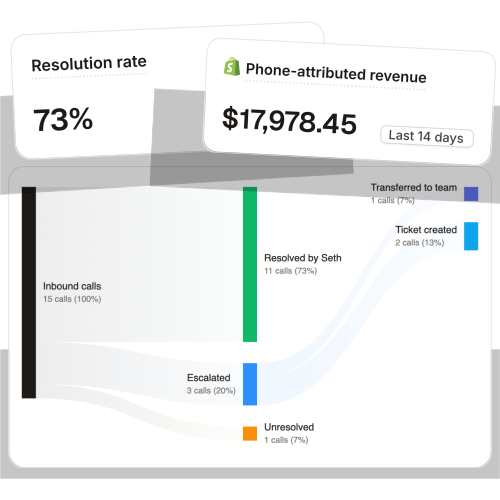
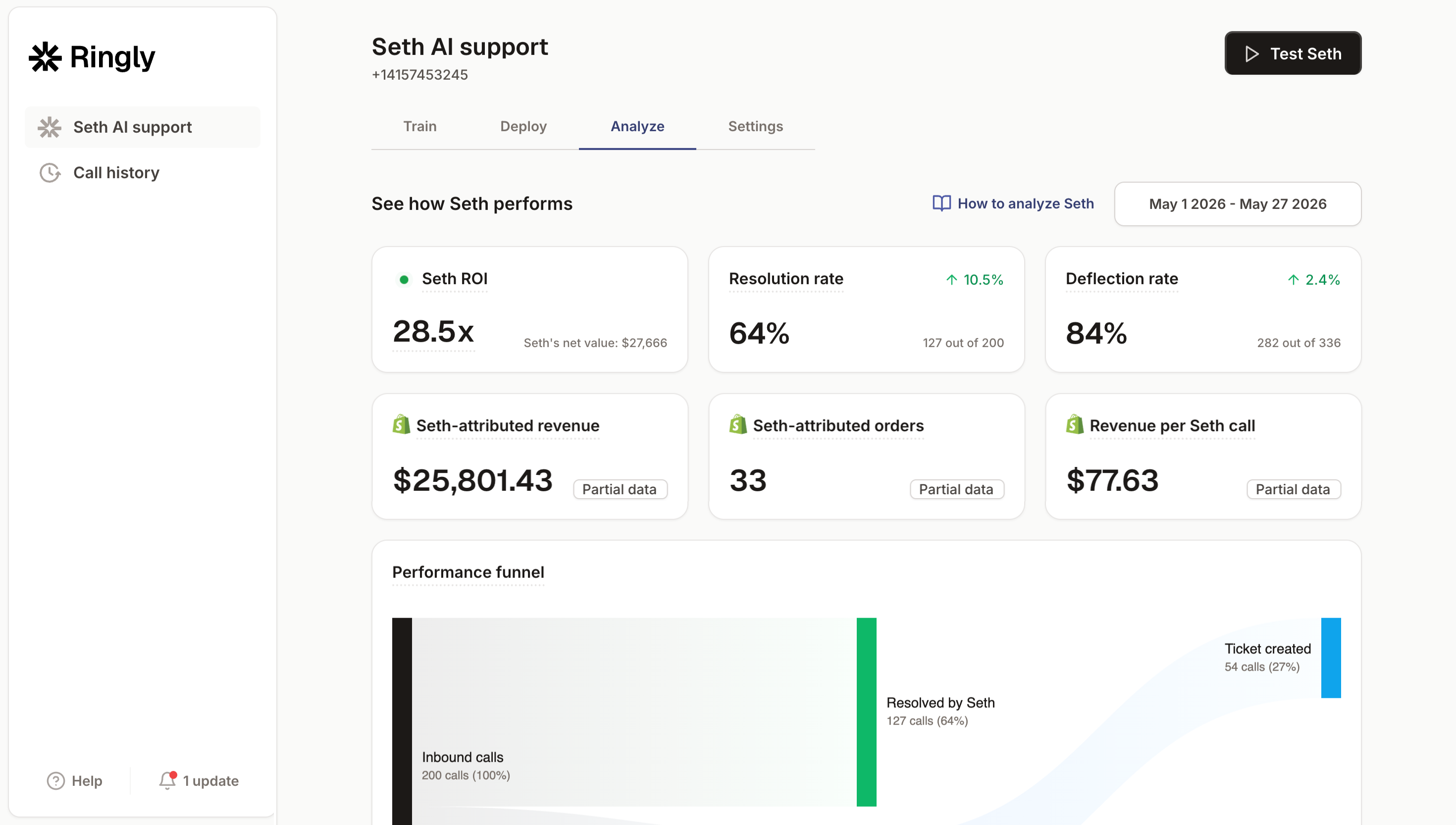
This is the bucket-one work, on the channel that's hardest to staff seasonally, which is exactly where an AI phone agent earns its place. Ringly is AI phone support for Shopify brands. It answers inbound calls 24/7, finds orders in your Shopify store, handles returns and product questions from your knowledge base, and escalates the genuinely hard calls cleanly to your team in Gorgias, Re:amaze, or whatever helpdesk you already run. Across 50+ brands it resolves 73% of calls on its own at roughly $0.42 per resolved call, which is the lever behind real Shopify support cost reduction.
The objection I hear most is whether customers will hate it. They don't, when it's built right.
"My customers also feel like it's a normal person. They feel like they can communicate if they have questions."
Claudia Droge, TechCraft Studio
The phone is where peak revenue actually leaks, and it's the one channel you can't fix by hiring three weeks before Black Friday. Here's the cost math against hiring instead.
Take a typical $50M Shopify brand running a 6-rep CS team that scrambles to add seasonal seats every peak:
| Line item | Today | With Ringly |
|---|---|---|
| 6 reps × $4K loaded per rep | $24,000/mo | n/a |
| Ringly (~$5K/mo) | n/a | $5,000/mo |
| Net monthly CS spend | $24,000/mo | $5,000/mo |
| Monthly savings | n/a | $19,000/mo |
| Annual savings | n/a | $228,000/yr |
That routes roughly 70% of the repeatable calls, order status, returns, the same five questions, to the AI. The other 30%, the genuinely complex calls, still go to your team, who now have room to actually solve them instead of drowning. Want the math run on your real numbers? Book a 30-min call and we'll do it live.
The January returns wave your seasonal team won't be there for
Here's the trap inside the trap. You finally get your seasonal team productive in early December, peak winds down, you let them go, and then the returns hit. Holiday returns ran roughly $181 billion in 2024 at about a 14% return rate, and that volume lands in January, after your seasonal hires have moved on.
So now your core team is processing a return spike alone, exhausted from peak, with no help and a fresh round of "where's my refund" calls that look exactly like the WISMO calls from December. Returns are a second peak. If you planned your staffing around one November sprint, you planned for half the season. Folding returns into your holiday customer service preparation from the start is the fix.
Treat November through January as one long surge, not a single Black Friday weekend, and the returns wave stops being a surprise that breaks your team. The same routing that handled order-status calls in December handles refund-status calls in January, which is the argument for fixing the routine bucket once instead of staffing it twice.
The peak staffing mistakes that cost the most
A few patterns show up again and again when we look at a brand's last peak. None of them are exotic. They're just expensive.
- Hiring on the calendar instead of the ramp. Posting roles in October feels proactive. It isn't. If a rep needs eight weeks and you've given them three, you funded a slow ramp, not coverage.
- Staffing the channels you can see. Chat and email queues are visible in the helpdesk, so they get the attention. The phone rings out of view, surges hardest, and leaks the highest-intent buyers.
- Treating the routine as work that "needs a person." If 60% of your peak calls are order status, putting a trained human on them is paying $4,000-a-month rates to recite tracking numbers.
- Planning for one weekend. Black Friday is a date. Peak is a season that runs into the January returns wave. Staffing for the date leaves you short for the season.
- No after-hours plan. Volume doesn't stop at 6 p.m. during peak, but your human team does. Whatever rings after close either gets answered automatically or becomes tomorrow's backlog.
Most peak failures come down to staffing mix, not staffing level: the right number of people pointed at the wrong work. Fix the mix and the headcount question gets a lot smaller.
The peak staffing numbers to watch
You can't manage what you don't measure, and most teams fly peak blind because their data is split across the helpdesk, Shopify, and a spreadsheet the lead rep maintains by hand. Track these five and you'll know whether your plan is holding.
- Resolution rate. What share of contacts get fully handled without bouncing around. If it drops at peak, you're understaffed on the hard bucket.
- Cost per contact. Loaded human cost per ticket vs your automated cost. This is the number your CFO asks about in Q1.
- Phone abandonment rate. Callers who hang up before reaching anyone. Anything climbing past 5 to 10% at peak is lost orders.
- After-hours coverage. What percentage of off-hours calls actually get answered. For most brands without automation, it's near zero.
- CSAT through the spike. The early-warning sign that your team is too thin and quality is slipping before the reviews show it.
Frequently asked questions
How many CS reps do I need for peak season? Start with your normal monthly contact volume, apply a 2.5x to 4x surge multiplier, and divide by your reps' real monthly handle rate. The honest answer is usually "more than you can hire in time," which is why the better question is how much of that volume you can route off your team instead of hiring against it.
Should I hire seasonal reps or outsource for the holidays? Hire or keep skilled people for the complex 10 to 20% of calls. For the repeatable majority, order status, returns, product questions, automation beats both hiring and outsourcing on cost and speed, because it's live in days instead of weeks and doesn't furlough in January.
When should I start staffing for peak season? If you're hiring humans, you needed to start 8+ weeks before peak to clear the ramp. If you've left it later than that, automating the routine bucket is the only path that's actually live before Black Friday, since an AI phone agent can be running in under an hour.
How much does a seasonal customer service rep cost? The direct cost to hire and train one call center agent is about $6,000, and replacing one who doesn't work out runs $10,000 to $15,000. A US rep's loaded monthly cost is roughly $4,000 once you add benefits, training, and attrition.
What percentage of peak support is repeatable? A lot. WISMO ("where's my order") alone jumps to 50 to 80% of tickets during peak, up from 10 to 25% the rest of the year. Add returns and product questions and the repeatable share is the clear majority of your surge.
Can AI handle phone support during peak season? Yes, for the repeatable calls, which are most of them. Ringly resolves 73% of inbound calls on its own across 50+ Shopify brands and escalates the rest to your team. The most common thing customers say afterward is that it didn't sound like AI. It's a fit for most $10M+ Shopify brands with a visible phone line.
How do I handle the January returns wave? Plan it as a second peak, not an afterthought. The refund-status calls in January look exactly like the order-status calls in December, so the same routing that handled WISMO through the holidays handles returns into the new year, without re-staffing.
Talk to us

If you run a $10M-$100M Shopify brand and peak season keeps turning into a hiring scramble, a 30-min call is the fastest way to see what you can route off your team before the next surge. If your phone goes to voicemail the week orders triple, that's the revenue you're staffing to protect.
The 3-layer guarantee.
- Live in 14 days or it's free until launched.
- 65% resolution in 90 days or we refund the last 3 months of subscription fees.
- We keep working free until we hit 65%.
Ruben (Ringly co-founder) takes these calls personally.