
This post in 30 seconds.
- About a third of your phone demand shows up when the lights are off, and most of it is orders and "where's my order" calls you can still catch.
- You have five real ways to cover it: voicemail, forwarding to a phone, overflow routing, a human answering service, or an AI phone agent. We compare all five.
- Written for founders, COOs, and Heads of CX at Shopify brands doing $2.4M+ a year with a visible phone number and a paid helpdesk.
We have handled more than 150,000 customer calls for 50+ Shopify brands, and for this guide we pulled 30 days of our own call data to see what actually happens after closing time. Out-of-hours call handling is how you cover the calls that come in when your team has clocked off: evenings, nights, weekends, holidays. For a Shopify brand, that is not a message-taking problem: it is an order and a "where's my order" question sitting in the dark, and 85% of the people asking will not call back the next day.
If you run a Shopify store past a few million a year, you already know the shape of it: a phone number in the footer, a small support team, and a line that rolls to voicemail at 6 p.m. That voicemail backlog is revenue you are handing to a competitor overnight, and it is fixable. Start a 14-day free trial and hear an AI agent answer your own store's calls, set up for you.
Want to skip the theory and just test it on real calls? Start the free trial and you get a free dedicated number to hear it live the same day.
What out-of-hours call handling actually means
There is a useful distinction the UK call-centre world draws, and it is worth borrowing. Call answering means someone picks up, takes a name and number, and passes you a message to deal with in the morning. Call handling means the call actually gets managed: the enquiry is qualified, the question is answered, the emergency is escalated, and the caller leaves with what they wanted.
For an ecommerce brand, "handling" only counts if whoever answers can see the order. A message that says "a customer called about their shipment" is not handling. Pulling up order #10432, telling the customer it ships tomorrow, and texting them the tracking link is handling.
That gap matters because most after-hours calls to a Shopify store are simple and repeatable: order status, a return, a quick product question, or a customer who would rather place the order by phone than trust the checkout at 11 p.m. Around 74% of consumers now expect 24/7 service as a baseline, so the caller does not think of 8 p.m. as "after hours." They think of it as now.
This is the whole job of an AI answering machine for Shopify stores: don't just log the call, resolve it. The rest of this guide is about which setup gets you there without hiring a night shift.
What those after-hours calls really cost you
Here is the number that reframes the topic: across 11,000+ calls handled by Ringly agents in the past 30 days, roughly 29% of inbound calls arrived after business hours (6 p.m. to 9 a.m. US Eastern). About 18% of support calls in our data land on weekends. Together that is close to a third of your phone demand hitting hours your team is not there.
A missed after-hours call is rarely a missed message, it is usually a missed order. The person calling at 9 p.m. wants to buy, check a shipment, or fix something before they give up on you.
The downstream math is unforgiving:
- 85% of callers who cannot reach a person never call back, and 62% switch to a competitor (PCN Answers, 2026).
- Businesses answer only 37.8% of inbound calls, with the rest going to voicemail or nothing at all (AmbsCallCenter).
- 80% of voicemail-routed callers hang up without leaving a message (Eden), so "we have voicemail" is not coverage.
Then there is the morning tax. Every unanswered evening call becomes a fresh ticket, and WISMO ("where's my order") already makes up 30-40% of support tickets in normal periods, more at peak. Your team walks in Monday to a queue that stacked up all weekend, most of it questions the caller could have resolved in 90 seconds the night before, the same thing a missed-call text-back tries to patch after the fact.
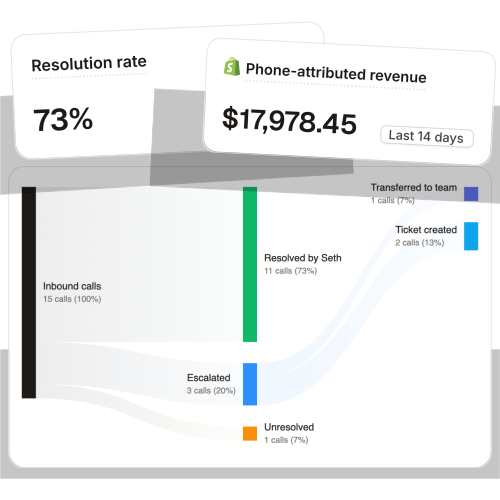
There is real money on the other side of this. WashCo, a Shopify brand we launched, recovered $22,664 in attributed revenue in its first 7 days once its phone was answered around the clock instead of rolling to voicemail. That is the difference between a caught order and a lost one, repeated across a month of evenings and weekends.
How we know what after-hours calls look like
The 29% and 18% figures above are not survey numbers. I'm Ruben, co-founder of Ringly, and I pulled the last 30 days of real production call data across the Shopify brands running on us to get them: 11,000+ phone calls, timestamped, bucketed by hour and day to see when calls actually arrive and what the agent did with each one.
Two honest caveats. The "after hours" window is a US-Eastern approximation, and callers span time zones, so treat 29% as a solid directional read, not a decimal-precise law. And these are brands that already answer the phone 24/7, so their after-hours share is real demand being met, not demand being guessed at.
The point stands either way: a large, steady slice of ecommerce phone volume happens when a normal support team is asleep.
The five ways to handle out-of-hours calls
Brands actually use five setups, and most start at the top of this list and move down as the missed-call cost grows. Here is the honest version of each.
| Option | Cost | Covers nights + weekends | Can see your Shopify order | Best for |
|---|---|---|---|---|
| Voicemail | Free | No | No | The earliest stores, very low volume |
| Forward to a phone | Free | Only if someone answers | No | Solo founders, briefly |
| Overflow routing | Low | Only to a live destination | No | Routing calls somewhere real |
| Human answering service | Per message or minute | Yes | Rarely | Message-taking, brand-agnostic calls |
| AI phone agent | Flat monthly | Yes | Yes | Shopify brands that want calls resolved |
1. Send them to voicemail
This is where every store starts because it costs nothing. Calls after hours hit voicemail, customers leave a message, you call back tomorrow.
The problem is that almost nobody leaves the message. With 80% of voicemail-routed callers hanging up, and rough industry data putting voicemail's conversion around 15%, you are catching a small fraction of the demand and delaying even that.
Voicemail is not out-of-hours call handling, it is a record of the calls you lost. For a store whose after-hours caller wants to buy, a next-morning callback usually lands after they have already ordered elsewhere.
2. Forward the line to your cell
The next move most founders make is forwarding the business number to a personal phone. It feels responsible, and for a week it is fine.
Then you never stop working. You are taking order-status calls during dinner, and the calls do not respect your calendar. We have seen a founder's personal cell end up on a customer's credit-card statement because that became the de-facto support line.
Forwarding does not scale past one or two people, and it burns out whoever holds the phone. If you have already lived this, the founder-as-phone-support trap is the exact thing to design your way out of.
3. Overflow and after-hours routing rules
A step up is setting rules on your phone system or helpdesk so calls route differently after hours or when the team is busy. Most business phone systems and platforms like Zendesk let you build overflow and after-hours call routing.
Routing is useful, but it is plumbing, not an answer. A rule that says "after 6 p.m., send calls here" still needs a here that picks up, or you have just moved the voicemail. It pairs well with the next two options, which give the routed call somewhere real to land.
4. A human answering service or BPO
Now you are into actual coverage. A live answering service or BPO staffs real people 24/7, so a human picks up at 2 a.m. Conversion climbs toward 40% in the options-guide data because a person is far better than a beep.
The catch for ecommerce is two-fold. First, the agent usually cannot see your Shopify order, subscription, or tracking, so many "handling" calls collapse back into "we took a message" your team finishes in the morning. Second, the cost model is per-message or per-minute, and the agents work off a generic script across many clients, so it can read off-brand.
It is a real option, especially if you weigh in-house against outsourced support honestly, but for order-status-heavy volume it often answers the phone without moving the ticket.
5. An AI phone agent
The last rung is an AI phone agent that answers every call 24/7 and actually resolves the routine ones. This is what Ringly does.
Ringly is AI phone support for Shopify brands. Instead of hiring a night shift or paying per message, the agent picks up on the first ring at any hour. It finds the order in your Shopify store, gives the shipping status, checks order status and sends the tracking link by text, processes returns and exchanges, and answers product questions from your knowledge base.
Across 50+ brands, it resolves 73% of inbound calls on its own at roughly $0.42 per resolved call. Calls that need a person escalate cleanly to Gorgias, Richpanel, Re:amaze, or whatever helpdesk you already run, so you keep your current number, stack, and workflows.
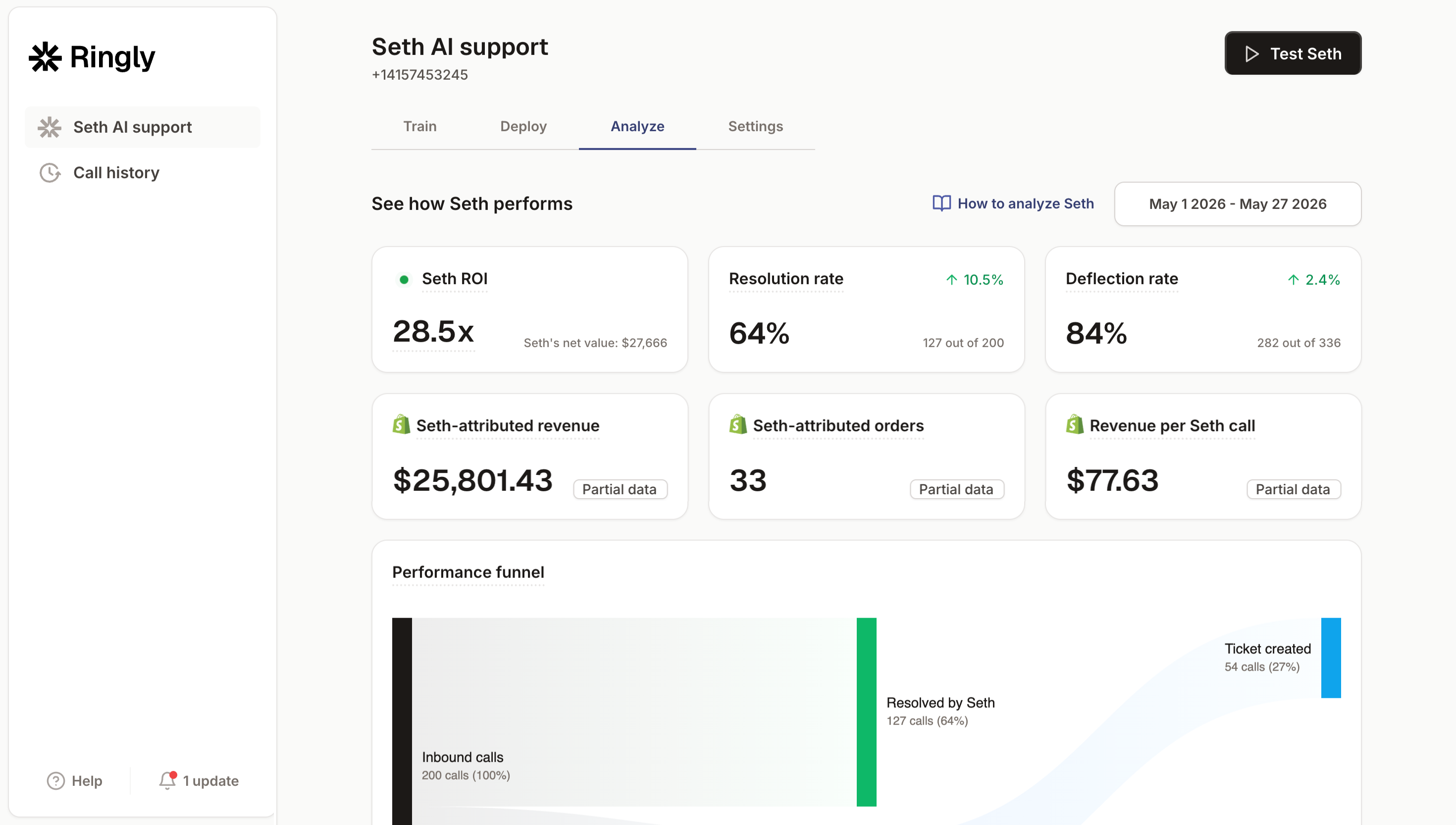
The reason an AI phone agent beats an answering service for a Shopify brand is that it can see the order, so the call gets resolved instead of logged. TechCraft Studio, a brand on Ringly, handles 88% of its calls without a human, which is exactly the overnight-and-weekend load you do not want landing in a morning queue.
"My customers also feel like it's a normal person. They feel like they can communicate if they have questions."
Claudia Droge, TechCraft Studio
The common worry is that customers will hate talking to a machine. The most repeated thing callers say about the agent is that it does not sound like one. If you want more depth on the category, our guide to 24/7 ecommerce phone support walks through how the always-on setup works in practice.
What 24/7 coverage costs vs a night-shift rep
The instinct when after-hours volume grows is to hire a weekend or overnight rep. The math is where that falls apart.
A US customer service rep runs about $4,000 a month loaded (salary, benefits, payroll tax, training, the churn when they quit). To cover evenings, weekends, and holidays with humans, you are staffing more than one, and most of those hours are quiet, so you pay for idle time waiting on a bursty call pattern.
| Line item | Today | With Ringly |
|---|---|---|
| 6 reps x $4K loaded per rep | $24,000/mo | n/a |
| Ringly, done-for-you (illustrative all-in) | n/a | $5,000/mo |
| Net monthly support spend | $24,000/mo | $5,000/mo |
| Monthly savings | n/a | $19,000/mo |
| Annual savings | n/a | $228,000/yr |
That is roughly 70% of the repeatable calls (order status, returns, the same handful of product questions) routed to the AI around the clock. The complex 30% still go to your team, who now start Monday without a weekend backlog. Exact pricing depends on your call volume, so treat this as the savings shape we see across 50+ Shopify brands, not a quote.
Plans start at $349/mo, and there is a 65% resolution guarantee behind it. If your evenings and weekends are where the calls pile up, start your 14-day free trial and hear it answer a real call before you decide.
How to choose the right setup
You do not need the fanciest option. You need the one that matches your volume and how much revenue is walking after hours. A quick way to decide:
- Choose voicemail if you are pre-revenue or taking a handful of calls a month and none of them are orders. It is a placeholder, not a plan.
- Choose call forwarding only as a stopgap while you set up something real, and only if one person genuinely does not mind being on call.
- Choose overflow routing as the connective layer once you have a live destination for the routed calls. On its own it just moves the voicemail.
- Choose a human answering service if your after-hours calls are brand-agnostic message-taking and rarely need order data. If most calls are "where's my order," you will still be finishing them in the morning.
- Choose an AI phone agent if you are a Shopify brand with real after-hours phone-support volume and you want those calls resolved, not logged. This is the fit for most brands past $2.4M a year with a visible phone line.
A simple test: pull last month's after-hours call log. If more than a handful are order status, returns, or product questions, an agent that can see your Shopify data will out-resolve everything above it, and it is the one setup that also gets your team their mornings back. It sits in front of your helpdesk, so scaling support without hiring stops meaning "add a night shift."
If you would rather not lift a finger, start the free trial and we build the agent for you, plugged into the helpdesk you already run.
Frequently asked questions
What is the difference between out-of-hours call answering and call handling?
Answering means someone takes a message you deal with later. Handling means the call is actually managed and resolved: the question is answered, the order is looked up, the emergency is escalated. For a Shopify store, only handling catches the order.
Do I have to give up my phone number or change my helpdesk?
No. You keep your current number and your existing helpdesk. An AI phone agent like Ringly sits in front of Gorgias, Richpanel, Re:amaze, or Zendesk, logs every call there, and escalates cleanly when a human is needed.
Is voicemail enough for after-hours calls?
Rarely, for an ecommerce brand. About 80% of voicemail-routed callers hang up without leaving a message, and 85% of people who cannot reach you never call back. Voicemail records the loss, it does not prevent it.
How much does out-of-hours call handling cost?
A human answering service usually bills per message or per minute, so cost scales with volume. An AI phone agent is a flat monthly plan: Ringly starts at $349/mo, resolves calls at roughly $0.42 each, and covers nights, weekends, and holidays without extra headcount.
Will customers know they are talking to AI?
Some will, some will not, and the most common reaction is that it does not sound like a machine. The agent speaks naturally, answers real questions, and hands off to your team on anything sensitive or complex.
How fast can I get after-hours coverage live?
You can be live in under an hour. Add your website, docs, or knowledge base, connect your Shopify store, and the agent is ready to answer calls the same day, including a free number to test on during your trial.
Talk to us

If you run a Shopify brand and calls are rolling to voicemail after 6 p.m., the fastest way to see what you're losing is to hear the agent answer your own store's calls. It covers the nights and weekends your team can't, and it keeps the calls that need a person going to a real person.
The 3-layer guarantee.
- Live in 14 days or it's free until launched.
- 65% resolution in 90 days or we refund the last 3 months of subscription fees.
- We keep working free until we hit 65%.
Ruben (Ringly co-founder) takes these calls personally.
Start your trial today and you get:
- A free dedicated phone number to test on, so you hear it answer real after-hours calls the same day.
- The agent built for you. We set it up, you lift zero fingers.
- It plugs into your helpdesk. Gorgias, Richpanel, Re:amaze, Zendesk, or whatever you already run.
Rather talk it through first? Book a 30-min call.