
This post in 30 seconds.
- The 9 real benefits of ecommerce customer service outsourcing, each with a number, plus the 3 traps the sales pages leave out.
- Outsourcing can cut support labor 40-70% and buy you 24/7 coverage, but your "dedicated" offshore team turns over 40-45% a year and your brand voice pays for it.
- Written for founders, COOs, and Heads of CX at Shopify brands past $2.4M a year with a visible phone number and a support team that's drowning.
We've handled more than 150,000 customer calls for 50+ Shopify brands, so we've watched a lot of founders wrestle with the same decision: outsource support, or keep it in-house. This post is about the real benefits of ecommerce customer service outsourcing, the numbers underneath them, and the parts nobody puts in the brochure.
The pitch is easy to like: hand the phone and the inbox to a team somewhere cheaper, get coverage around the clock, and stop hiring a rep every time call volume climbs. Most of that holds up.
What the sales pages skip is what happens to your brand voice, and to your margin, once the real bill lands. Start a 14-day free trial and hear an AI agent answer your own store's calls before you sign a single BPO contract.
If you run a Shopify brand past a couple million a year, you know the shape of the problem: the same five questions all day, the after-hours voicemails piling up, your CS team drowning through every launch. Outsourcing is one way out, and handing the routine calls to an agent that never clocks off is another. Try it free for 14 days on your own calls, and we set it up for you.
What outsourcing ecommerce customer service actually means
Outsourcing means paying an outside team, or an outside system, to handle inquiries your own staff would otherwise take. In practice it comes in a few flavors, and the label matters because the cost and the risk move with it.
- Offshore BPO. A business process outsourcer staffs agents in a lower-cost country (Philippines, India, and increasingly Latin America) who handle your tickets, chats, and calls. Cheapest per hour, furthest from your brand.
- Nearshore. Same idea, closer time zone (Latin America for US brands), usually $20-30 per loaded hour instead of offshore's $6-14.
- Onshore. US-based agents at $25-45 per loaded hour. Best cultural fit, weakest cost case.
- Hybrid software + agents. A helpdesk like Gorgias or Zendesk plus a small human team, often the setup a brand already has.
- AI phone and chat agents. Software that resolves the routine volume end to end and escalates the rest to your team. The newest option, and the one that reshapes the math below.
Whichever route you pick, the honest way to compare them is against what an ecommerce call center actually costs you today, not against a list price on a vendor's homepage. The benefit of any outsourcing model is only real if it survives that comparison after setup, management, and turnover are counted.
The 9 benefits of ecommerce customer service outsourcing
The benefit lists on the first page of Google all say roughly the same thing, and almost none of them attach a number. Here's the quantified version.
- Lower labor cost. Outsourcing support labor can cut 40-70% at the offshore end, with most companies landing a more modest 15-30% once management is counted (GigaBPO, 2026). An offshore rep runs $6-14 per loaded hour against $25-45 onshore.
- Coverage around the clock. A partner in another time zone answers at 2 a.m. without you paying overnight shift premiums. This matters more than founders expect: across 11,000+ calls handled by Ringly agents in the past 30 days, roughly 29% of inbound calls arrived after business hours (6 p.m. to 9 a.m. US Eastern).
- Scale for the spike. A good partner can add seats in days, so a holiday rush or a launch doesn't crater your response time. You rent capacity instead of over-hiring for a peak that lasts three weeks.
- Trained specialists. Established providers hire and train support people full time, so you skip the recruiting and the ramp for the routine work.
- Faster response times. More hands and 24/7 cover means shorter queues, and speed pays: 93% of customers say they'll buy again after a good service experience (HubSpot).
- Multilingual support. Global providers staff agents who cover your international customers in their own language without you sourcing that talent.
- Focus on the core. Every hour your team isn't answering "where's my order" is an hour it can spend on merchandising, retention, and the calls that actually move revenue.
- Predictable spend. Recruiting, benefits, sick days, and attrition become one line on an invoice instead of a moving internal cost.
- Less operational drag. You skip the desks, the headsets, the scheduling software, and the HR overhead for a function that isn't your product.
Every one of those is a genuine reason brands outsource. The contact-center outsourcing market is worth roughly $125.73 billion in 2026, and about 78% of companies globally outsource at least some slice of support (connextglobal, 2026). Outsourcing support is mainstream now.
The question worth asking isn't whether it has benefits, it's whether those benefits survive contact with your actual brand. If you want the deeper version of that trade-off, we broke it down in should I outsource customer service for my Shopify store and in the full customer service outsourcing statistics roundup.
Where these cost numbers come from
I pulled our own customer billing across 50+ Shopify brands on Ringly to sanity-check every cost figure in this post, then set it against the sourced BPO ranges so the comparison is apples to apples.
- In-house loaded cost. A US customer-service rep runs about $4,000 a month fully loaded (salary, benefits, payroll tax, training, shrinkage). That's the number CS leads actually use, not the base salary.
- BPO ranges. Per-hour rates come from published 2026 pricing (text.com, Helpware): $6-14 offshore, $20-30 nearshore, $25-45 onshore, per loaded hour.
- AI cost. Ours is measured, not modeled: across those 50+ brands the AI resolves calls at roughly $0.42 per resolved call, against $7-16 per call for a human BPO once you load the contract.
Where a figure is a range instead of one brand's exact number, I've said so. The point of grounding the numbers is that outsourcing math only works if you compare loaded cost to loaded cost, not list price to salary. For a full walkthrough, see how to reduce call center costs.
The 3 traps the brochure skips
Every benefit above is real. So are these, and no vendor deck leads with them.
Trap 1: your brand voice drifts
The agent taking your call is also taking calls for other brands in other industries that same shift. When volume gets heavy, the fastest path is a copy-paste macro and a generic tone, which is exactly what your customers notice.
For a brand whose whole edge is how it makes people feel, a support voice that sounds like nobody in particular is a slow leak. Loss of control over voice is the single most common regret operators report after outsourcing, and it's the hardest to claw back.
Trap 2: the "dedicated" team you onboard doesn't stay
Call-center turnover runs 40-45% a year in 2026 (callforce). That means the team you carefully trained on your product and your policies effectively rotates every 18-24 months. You're not onboarding a partner once, you're re-onboarding your brand into a churning roster forever, and every new agent starts the learning curve over on your customers.
Trap 3: the real cost isn't the hourly rate
The per-hour number on the quote is the start, not the total. Add implementation, quality assurance, your own manager's time riding herd on the partner, monthly minimums, and the security exposure of sending customer PII and card details offshore. That 40-70% headline saving is a ceiling most brands never touch. The median lands closer to 15-30% (GigaBPO), and that's before a bad partner costs you a churned customer. We laid out the honest version in in-house vs outsource support for Shopify.
What outsourcing actually costs
Strip it to per-call cost and the picture gets clearer.
| Channel | Cost per call (loaded) | Notes |
|---|---|---|
| In-house US rep | $2.70 | salary, benefits, overhead |
| Offshore BPO | $1.50 to $3.50 | plus setup, QA, minimums |
| AI phone agent | $0.42 to $2.00 | roughly $0.42 per resolved call at volume |
Now the whole-team version. Take a typical Shopify brand running a 6-rep CS team:
| Line item | Today | With a done-for-you AI agent |
|---|---|---|
| 6 reps x $4K loaded per rep | $24,000/mo | n/a |
| AI phone support (illustrative all-in) | n/a | $5,000/mo |
| Net monthly CS spend | $24,000/mo | $5,000/mo |
| Monthly savings | n/a | $19,000/mo |
| Annual savings | n/a | $228,000/yr |
That's roughly 70% of repeatable calls (order status, returns, product questions, the same five things over and over) routed to the AI. The other 30%, the genuinely complex calls, still go to your team, who now have time to actually solve them. WashCo, a Shopify brand we launched, recovered $22,664 in its first 7 days on the phone. Exact numbers depend on your call volume; these are the savings shapes we see across 50+ Shopify brands.
If your support cost is the thing keeping you up, start the free trial and we'll set it up on your own calls so you can watch the per-call number for yourself. Here's the side-by-side of the three models:
| In-house team | Outsourced BPO | AI phone agent | |
|---|---|---|---|
| Cost | Highest | 40-70% less (offshore) | ~$0.42 per resolved call |
| Ramp time | Weeks to months | Days to weeks | Live in under an hour |
| 24/7 coverage | Expensive | Yes, usually extra | Built in |
| Brand voice | Yours | Drift risk | Trained on your store |
| Turnover | Your problem | 40-45%/yr, churns your roster | None |
| Best for | Complex, high-touch calls | Mixed volume, hands-off | The 70% repeatable calls |
The modern alternative: a done-for-you AI phone agent
Ringly.io is AI phone support for Shopify brands. Your team wasn't hired to answer the same call 50 times a day. Instead of renting a rotating offshore roster or growing headcount every time volume climbs, the AI takes the routine inbound calls so your people can focus on the work that moves revenue.
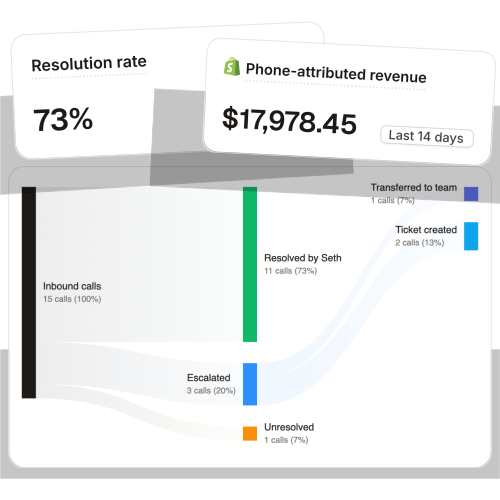
The AI answers inbound calls 24/7 in 40 languages. It finds orders in your Shopify store, processes returns and exchanges, answers product questions from your knowledge base, and rescues abandoned carts with outbound follow-up. Across 50+ brands the AI resolves 73% of calls on its own at roughly $0.42 per resolved call. The calls that need a human escalate cleanly to Gorgias, Zendesk, Richpanel, or whatever helpdesk you already run. You keep your number, your stack, and your workflows.
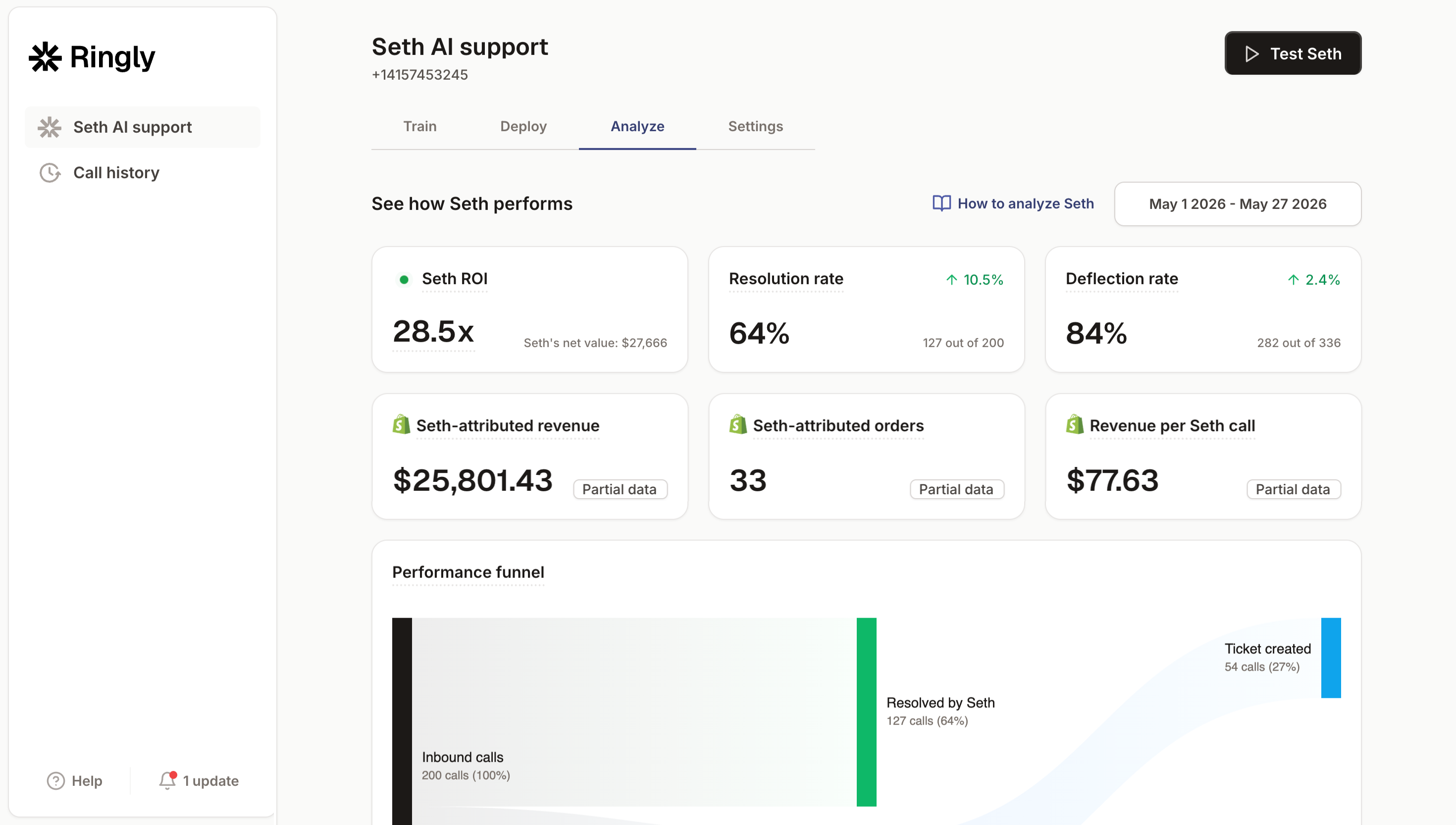
This is the honest reframe of the whole outsourcing decision. It captures the benefits founders actually want (24/7 cover, instant scale, lower cost) without the two traps that sink them: there's no ramp and no attrition, so the voice never drifts and the team never churns. The agent is trained on your store, so it sounds like your brand every time, not like a shared roster. The routine 70% goes to the AI, the human 30% stays with your team, and neither one is waiting on the other.
"My customers also feel like it's a normal person. They feel like they can communicate if they have questions."
Claudia Droge, TechCraft Studio
It's not a fit for everything. Genuinely complex, emotional, or high-touch calls still belong with a person, and we design the handoff so they get one. But the repetitive volume, the "where's my order" calls that eat your day, is exactly what an agent should own. More on that split in AI voice support vs human.
How to decide: outsource, keep in-house, or automate
There's no single right answer; there's a right answer for your volume and your brand. A quick way to sort it:
- Keep it fully in-house if: your call volume is low, every conversation is high-touch or high-stakes, and your margin can carry a US team. Small, premium, low-volume brands often should.
- Outsource to a BPO if: you have steady, mixed-complexity volume, you're comfortable managing a partner, and you'd rather hand off the whole function than build the muscle in-house. Just price in the turnover and the management time.
- Automate the routine and keep a small team if: most of your calls are the same repeatable questions, you want 24/7 cover without a night shift, and your brand voice is part of the product. This is where most $2.4M+ Shopify brands land now.
For a lot of brands the answer is a mix: an AI agent on the routine calls, a lean in-house or nearshore team on the complex ones. That's the setup we cover in how to scale customer service without hiring, and it's usually cheaper and steadier than either extreme. See the pricing if you want to run your own numbers.
Frequently asked questions
Is outsourcing ecommerce customer service actually cheaper? Often yes, but less than the headline. Offshore labor can cut 40-70%, though most brands see 15-30% once you count setup, quality assurance, management time, and minimums. Compare loaded cost to loaded cost, not a vendor's hourly rate to your rep's salary.
What are the biggest risks of outsourcing support? Loss of brand voice, quality that drifts under volume, and turnover: call-center attrition runs 40-45% a year, so your trained team rotates every 18-24 months. Sending customer PII offshore is also a real security consideration.
Can I outsource just part of my customer service? Yes, and it's usually the smart move. Route the repeatable 70% (order status, returns, simple product questions) to an AI agent or a partner, and keep the complex, emotional calls in-house. See our take in outsourced customer service.
How is an AI phone agent different from a BPO? A BPO rents you human agents by the hour with ramp time and turnover. An AI agent is trained once on your store, answers 24/7, resolves the routine calls at roughly $0.42 each, and escalates the rest to your team. No night shift, no attrition, no voice drift.
Do I have to give up my phone number or helpdesk to use AI? No. Ringly sits in front of your existing setup, keeps your number, and logs and escalates into Gorgias, Richpanel, Zendesk, or whatever helpdesk you run. You keep your stack.
How fast can I get set up? Live in under an hour. Add your website, docs, or knowledge base and the AI is ready to take calls, so you can test it against your current setup before you commit.
Talk to us

If your phone rings after 6 p.m. and nobody's there, that's the volume worth handing off first. The fastest way to see what outsourcing to an AI agent actually does is to hear it answer your own store's calls.
The 3-layer guarantee.
- Live in 14 days or it's free until launched.
- 65% resolution in 90 days or we refund the last 3 months of subscription fees.
- We keep working free until we hit 65%.
Ruben (Ringly co-founder) takes these calls personally.
Start your trial today and you get:
- A free dedicated phone number to test on, so you hear it answer real calls the same day.
- The agent built for you. We set it up, you lift zero fingers.
- It plugs into your helpdesk. Gorgias, Richpanel, Re:amaze, Zendesk, or whatever you already run.
Rather talk it through first? Book a 30-min call.