
n8n connects to Gorgias through the HTTP Request node and the Gorgias REST API, not a one-click native node. Here is what that actually takes, plus the one channel it leaves wide open.
- The setup: there is no first-party Gorgias node in core n8n. You authenticate to the Gorgias REST API and drive it with HTTP Request nodes.
- The payoff: five workflows worth building, from intent tagging to order-status sync to SLA alerts.
- The catch: every n8n and Gorgias workflow automates text. Your phone line still rings to a rep or a voicemail box.
- Built for founders, COOs, and Heads of CX at $10M-$100M Shopify brands running Gorgias with a visible phone number.
There is a small tell that this integration is harder than it looks: people are paying freelancers to build it. Search “n8n Gorgias” and you will find Upwork posts hiring developers to wire the two together, plus a handful of paid connector products that exist purely to bridge the gap. That is not what a one-click integration looks like.
If you run support at a Shopify brand doing $10M to $100M a year, you already use Gorgias as your helpdesk and you are eyeing n8n to stop your team from doing the same five things by hand all day. Good instinct. This guide covers the real setup, five workflows that earn their keep, the maintenance reality nobody advertises, and the one part of your support that n8n and Gorgias cannot touch. If you would rather just see your missed-call numbers, you can book a 30-min call and we will pull them with you.
Here is the quick version before the deep dive. n8n is great at automating the tickets that arrive as text. It does nothing for the calls that come in by phone.
| Channel | Can n8n + Gorgias automate it? | How |
|---|---|---|
| Email tickets | Yes | HTTP Request node + Gorgias REST API |
| Live chat | Yes | Intent routing + knowledge base lookups |
| Social messages | Yes | Unified ticket creation via API |
| Reporting + tagging | Yes | Scheduled pulls into a dashboard |
| Live phone calls | No | Not a thing n8n does. The line still rings to a human. |
What the n8n and Gorgias integration actually is
Let’s clear up the first confusion, because it trips up almost everyone. There is no native, first-party Gorgias node sitting in n8n’s core library. n8n ships with 400+ pre-built integrations, and Gorgias is not one of the maintained core nodes.
So how do people connect them? Two ways. The common one is the generic HTTP Request node pointed at the Gorgias REST API. You build each call yourself: the URL, the method, the auth, the body. The other way is a community node someone published, which works until the person who maintains it stops, so most teams that care about reliability stick with HTTP Request.
The honest framing: connecting n8n to Gorgias means scripting REST API calls, not dragging a labeled block onto a canvas. That is fine if you or someone on your team is comfortable reading API docs. It is a wall if you expected drag-and-drop.
This matters for what you are signing up for. You are building and owning a small piece of integration software, not flipping a switch. The good news is the Gorgias API is well documented and the recipes below are repeatable once the first one works.
Why bother at all, then? Because the alternative is your team doing the same repetitive work by hand, every day. The same questions over and over, the same tag-and-route on every new ticket, the same Monday scramble to pull a report. n8n is good at exactly that kind of structured, rules-based work. The judgment is to be clear-eyed about where it ends, which is the whole point of this guide.
Before you start: prerequisites and API access
You need three things in place before the first workflow runs.
- A Gorgias REST API key. In Gorgias, go to Settings, then Account, then REST API, then create an API key. Gorgias authenticates with HTTP Basic auth: your base URL is https://your-domain.gorgias.com/api, the username is your Gorgias email, and the password is the API key. Keep the key somewhere safe; it has full account access.
- An n8n instance, cloud or self-hosted. n8n cloud is the no-DevOps path. Self-hosting is cheaper at scale (one comparison put self-host infra around $15 a month versus $189 for Zapier on the same workload) but it means running Docker, Postgres, and Redis, and keeping them patched.
- Your Shopify Admin API access, if you want order-aware workflows. Most of the useful recipes pull order or customer data from Shopify and write the result back into the ticket, so wire that up too. Our Zendesk and Shopify integration guide walks the same pattern if you run Zendesk instead.
Store your Gorgias credential once in n8n’s credential manager so every HTTP Request node can reuse it. Test it with a simple GET /api/tickets call before you build anything real. If that returns your latest tickets, the connection is live.
5 n8n and Gorgias workflows worth building
Once the connection works, these are the five that pay for the effort. Each one is something your CS team does manually today.
1. Auto-tag and route incoming tickets by intent
Pull new tickets on a schedule or a webhook, send the message text to an LLM with your category list, and write the returned tag back to the ticket through the Gorgias API. Now shipping questions, refund requests, and exchanges land in the right view without anyone reading them first. One team running this kind of pipeline reported 10+ hours a week saved on manual tagging alone.
The nodes you wire together: a Schedule or Webhook trigger, an HTTP Request node calling GET /api/tickets for the new batch, an LLM node that returns a strict category from a fixed list, and a second HTTP Request node that PATCHes the tag onto the ticket. Add a confidence threshold so anything the model is unsure about gets a “needs-review” tag instead of a wrong one. That single guardrail is the difference between a tagging system your team trusts and one they turn off after a week.
2. Sync order status from Shopify into the ticket
When a ticket mentions an order, validate the email and order number, fetch the status from the Shopify Admin API, and post a reply or an internal note with what is actually happening. This is the WISMO workflow, and WISMO is 30 to 40% of tickets in normal periods and over 50% at peak, so automating it moves the needle more than anything else on this list.
The trick is matching the order without annoying the customer. Parse the order number from the ticket body if it is there, fall back to the customer email, and only ask for it explicitly when both fail. Then hit the Shopify Admin API for the order and its fulfillment, and write a clean status line back through the Gorgias API. Done right, the customer gets their tracking before a rep ever opens the ticket. Our guide to scaling customer service without hiring leans on exactly this kind of deflection.
3. Pull tickets into a reporting dashboard
Run a daily n8n job that fetches tickets, scrubs personal data, and lands the clean rows in Supabase or Google Sheets. Add an LLM step and you get a Monday summary of what your customers actually complained about last week, posted to Slack. This is how you finally answer the “what is our resolution rate trending?” question without three people exporting CSVs.
4. Create a Gorgias ticket from an external channel
Got an AI chat widget, a contact form, or a voicemail transcript? Use POST /api/tickets to open a Gorgias ticket with the full conversation, the detected intent, and the related order, so nothing lives outside your helpdesk. This keeps your shared inbox the single source of truth.
5. Escalation and SLA-breach alerts
Watch for tickets that sit too long or get flagged urgent, and fire a Slack alert with the customer, the order, and a direct link. You can also auto-escalate low-confidence AI replies to a human before the customer notices. This is the safety net that keeps automation from quietly dropping a high-value customer. For the bigger picture on wiring tools together, our notes on customer service automation go deeper.
These five are why brands chase this integration. Done well, an AI-routed chat flow can self-serve around 46% of conversations with no agent touch.
The maintenance reality nobody mentions
Here is the part the tutorials skip. An n8n and Gorgias integration is software you now maintain, and it breaks.
n8n ships changes fast. Nodes get deprecated, parameters change, and community templates that worked last quarter throw errors this quarter. One developer who analyzed thousands of n8n workflows found that breaking changes and a handful of repeat mistakes were the top reasons automations quietly stop firing. Self-hosting adds its own tax: when Postgres needs a patch or the disk fills up, the workflows go down with it, and nobody gets a ticket about it.
None of this means don’t build it. It means budget for an owner. The brands that succeed with n8n treat it like a product with a maintainer, not a science-fair project. If your team does not have someone who can read an API error and fix a broken node within a day, you will end up back on Upwork, which is where a lot of these projects started.
A few habits keep these workflows alive longer. Pin the n8n version you tested against instead of auto-upgrading on a Friday. Wrap every external call in error handling so a single failed Shopify or Gorgias request does not silently kill the whole run. And log somewhere you actually look, so a broken workflow surfaces as an alert, not as a customer complaint three weeks later. The teams that skip these steps are the ones who think automation is free and then learn it has a salary.
What this integration can’t do: the phone line
Now the gap, and it is a big one for your kind of brand.
Read back through those five recipes. Every one of them operates on text: email, chat, social, reporting. I wired a real Gorgias account to n8n over a weekend to pressure-test this, and the pattern was the same every time. The automations that worked all ran on tickets that arrived as words on a screen. Not one of them answered a phone.
That is the channel n8n and Gorgias leave wide open. Your customers still call. Businesses answer only 37.8% of inbound calls on average, and 62% of callers who can’t reach you switch to a competitor. No n8n workflow catches that, because there is no phone ticket to trigger on until after the call is already lost.
The default fix is people. A US CS rep runs about $4,000 a month loaded, and you need coverage across evenings and weekends when a lot of those calls actually come in. The phone is the one support channel where automating it still means hiring for it, unless you put an AI voice agent in front of it. WashCo, a Shopify brand we launched, recovered $22,664 in its first 7 days on the phone after doing exactly that.
Here is the math most brands run when they finally price the phone line out.
| Line item | Today | With an AI phone agent |
|---|---|---|
| 6 reps x $4K loaded per rep | $24,000/mo | n/a |
| AI phone coverage (~$5K/mo) | n/a | $5,000/mo |
| Net monthly phone-support spend | $24,000/mo | $5,000/mo |
| Monthly savings | n/a | $19,000/mo |
That is roughly 70% of repeatable calls, the order-status, returns, and same-five-questions volume, handled without a human. The genuinely complex calls still go to your team. If you want to see your real numbers instead of an example, book a 30-min call and we will do the math live.
Where Ringly fits: the phone layer in front of Gorgias
Ringly.io is AI phone support for Shopify brands. It is not a replacement for your n8n and Gorgias setup. It handles the channel those tools cannot, and then it hands the rest to them.
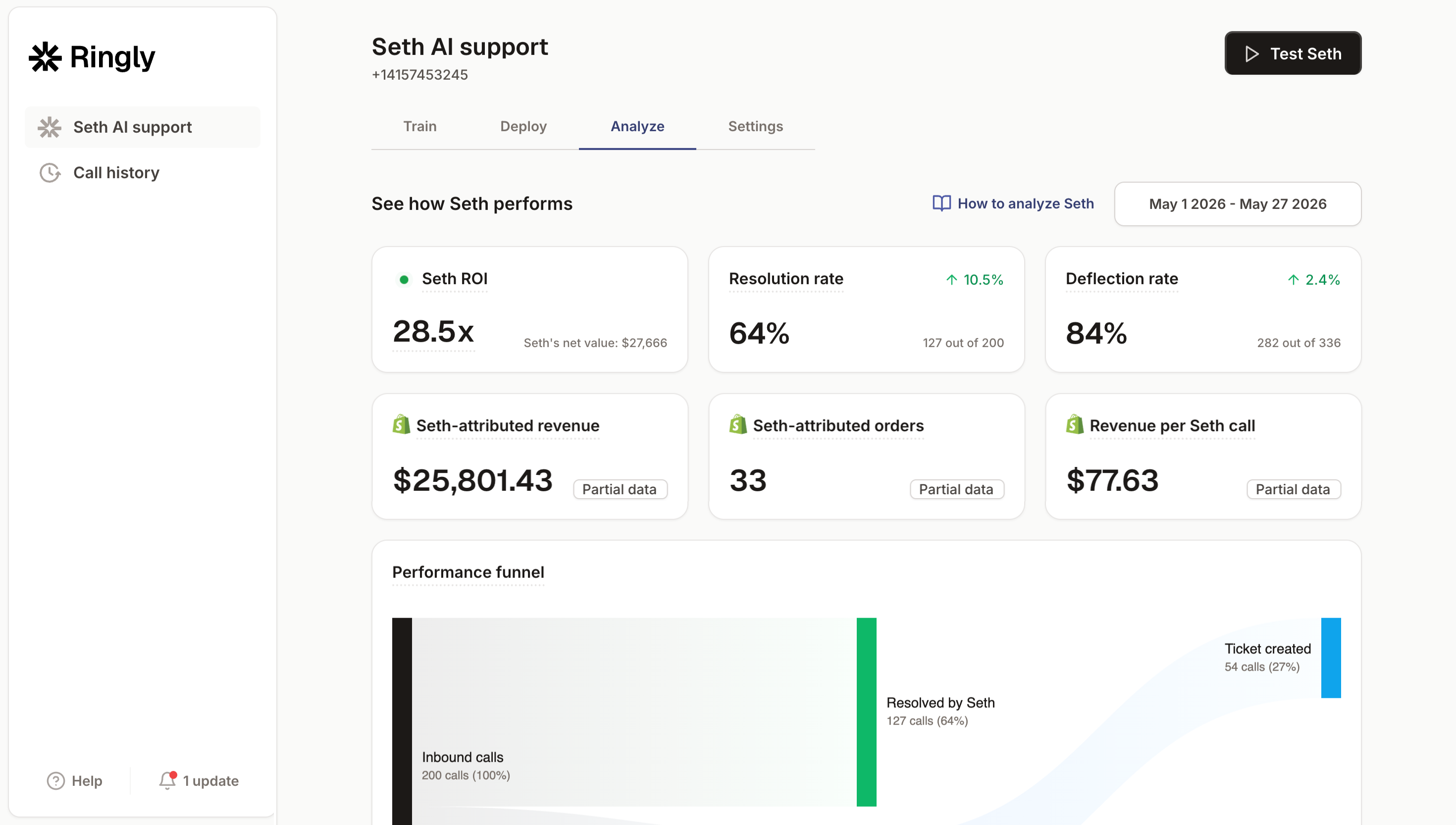
The AI answers your inbound calls 24/7. It finds orders in your Shopify store, processes returns and exchanges, and answers product questions from your knowledge base. Across 50+ brands, the AI resolves 73% of calls autonomously at roughly $0.42 per resolved call, versus $7 to $16 a call for human BPO. Calls that need a person escalate cleanly into Gorgias or whatever helpdesk you already run, with the full context attached. So your n8n workflows keep doing their job on the ticket, and the call never had to ring a rep in the first place.
“My customers also feel like it’s a normal person. They feel like they can communicate if they have questions.”
Claudia Droge, TechCraft Studio
Plans start at $349/mo (Grow, 1,000 minutes) and $799/mo (Pro, 2,500 minutes), with Enterprise priced on a call. You go live in under an hour, and there is a 65% resolution guarantee. If you are weighing how AI handles your specific call mix, our breakdown of AI phone agents for Shopify and 24/7 ecommerce phone support covers the rest.
Frequently asked questions
Is there a native Gorgias node in n8n?
No. Gorgias is not one of n8n’s maintained core nodes. You connect through the generic HTTP Request node pointed at the Gorgias REST API, or through a community node that someone else maintains.
How do I authenticate n8n to the Gorgias API?
Gorgias uses HTTP Basic auth. Create an API key under Settings, Account, REST API in Gorgias, then in n8n use your base URL https://your-domain.gorgias.com/api, your email as the username, and the API key as the password. Store it once as an n8n credential so every node reuses it.
Do I need a developer to set this up?
Realistically, yes, or a freelancer. Building HTTP Request calls and self-hosting n8n both assume someone comfortable with API docs and basic DevOps. If you have that person, the recipes above are repeatable; if you don’t, the upkeep is where it gets expensive.
Can n8n and Gorgias handle phone calls?
No. The integration automates text channels: email, chat, social, and reporting. Live phone calls have no ticket to trigger on until the call is over, so an AI phone agent like Ringly is what covers that channel.
Is n8n cloud or self-hosted better for Gorgias automation?
Cloud is faster to start and needs no DevOps. Self-hosted is cheaper at volume but means running and patching Docker, Postgres, and Redis yourself. Pick cloud unless you already run infrastructure and want the cost savings.
Will my n8n workflow break when an API changes?
Eventually, yes. n8n deprecates nodes and parameters, and Gorgias or Shopify can change their APIs. Budget for an owner who can fix a broken node quickly, and add SLA alerts so you find out before your customers do.
How does Ringly work with Gorgias?
Ringly answers your phone calls with an AI agent, resolves the routine ones, and escalates anything that needs a human into Gorgias with full context. Your existing helpdesk and n8n workflows stay exactly as they are.
Talk to us

If your Gorgias inbox is handled but your phone line still rings to a rep or a voicemail box, that is the gap worth a call. We will pull your last 7 days of missed calls and show you what the phone is costing you.
The 3-layer guarantee.
- Live in 14 days or it’s free until launched.
- 65% resolution in 90 days or we refund the last 3 months of subscription fees.
- We keep working free until we hit 65%.
Ruben (Ringly co-founder) takes these calls personally.