


Magento (now Adobe Commerce) has been a powerhouse in e-commerce for years.
But here's the reality: it's overkill for most businesses. The complexity, the costs, the constant need for developers... it adds up fast.
Many merchants are realizing they can get the same results (or better) with platforms that don't require a full-time dev team just to change a product description.
Let's break down seven alternatives that actually make sense for modern e-commerce.
Whether you're running a fast-growing DTC brand or managing complex B2B operations, there's something here that fits.
Editor’s note: Want to hear some sample AI support calls made for your Shopify store?
- Just paste your store URL
- Get sample calls in under 20 seconds (no email required)
- Listen to demo calls for my store
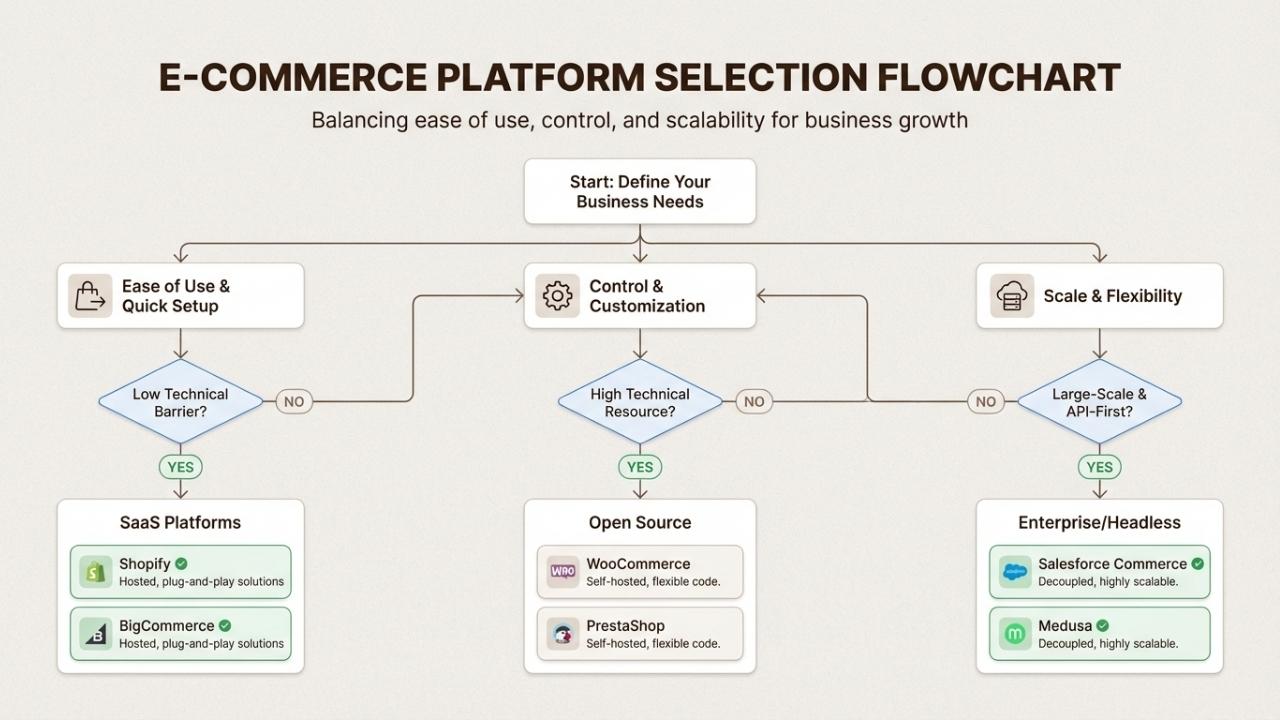
Why businesses are moving away from Magento
The numbers tell a clear story. Running Magento can cost anywhere from $22,000 to $125,000 annually when you factor in hosting, development, security, and maintenance. That's not including the hidden cost: time.
Every small change needs technical expertise. Want to update your homepage? You'll likely need a developer.
Need to integrate a new payment gateway? More dev time.
The self-hosted nature of Magento means you're responsible for security patches, SSL certificates, backups, and server maintenance.
Version upgrades are notorious for breaking extensions, requiring extensive testing before going live.
The talent pool is another issue. Finding experienced Magento developers is harder than finding Shopify or WooCommerce experts.
When you do find them, they command premium rates. The result? Slower time-to-market and higher operational costs.
That said, Magento still has its place. Large enterprises with in-house development teams and complex product rules may find the flexibility worth the overhead.
For everyone else, there are better options.
Quick comparison: Magento alternatives at a glance
| Platform | Best for | Starting price | Free trial | Key differentiator |
|---|---|---|---|---|
| Shopify | Fast-growing DTC brands | $39/mo | 3 days | Fully hosted, massive app ecosystem |
| BigCommerce | B2B and mid-size brands | $39/mo | 15 days | No transaction fees, built-in features |
| WooCommerce | Content-heavy WordPress sites | Free + hosting | N/A | Full ownership, SEO-friendly |
| PrestaShop | Cost-conscious European merchants | Free or €24/mo | N/A | Lightweight, EU-focused |
| Shopware | Complex catalogs, B2B | Free or custom | Yes | Modern architecture, AI features |
| Salesforce Commerce Cloud | Enterprise Salesforce users | Custom | No | Deep CRM integration |
| Medusa JS | Developer-led teams | Free | N/A | Composable, headless architecture |
The 7 best Magento IT solutions alternatives
1. Shopify

Shopify is the market leader for a reason.
It's an all-in-one commerce platform built for independent business owners who want to start, run, and grow without wrestling with technical details.
Millions of merchants have collectively made over $1 trillion in sales on the platform.
Why it replaces Magento: You get fully managed hosting, security, and updates. No dev ops needed.
The platform handles the technical heavy lifting so you can focus on selling.
Key features:
- Online store builder with product collections, pages, and blogs
- Shopify Checkout (converts 15% higher than other platforms according to their data)
- Multi-channel selling on Instagram, TikTok, Amazon, and Google
- Shopify POS for in-person sales
- Shopify Markets for international selling with localization
- AI-powered content generation with Shopify Magic
Pricing:
| Plan | Monthly | Annual | Key features |
|---|---|---|---|
| Basic | $39/mo | $29/mo | 10 inventory locations, 24/7 chat |
| Grow | $105/mo | $79/mo | 5 staff accounts, 88% shipping discount |
| Advanced | $399/mo | $299/mo | 15 staff accounts, 3rd-party calculated rates |
| Plus | $2,300/mo | Custom | Unlimited staff, 200 locations, B2B features |
Transaction fees apply unless you use Shopify Payments: 2.9% + 30¢ online for Basic, decreasing on higher tiers.
Third-party payment providers incur additional fees (2% Basic, 1% Grow, 0.6% Advanced).
Pros: Fast setup, reliable hosting, optimized checkout, massive app ecosystem
Cons: Transaction fees without Shopify Payments, limited customization without apps
2. BigCommerce
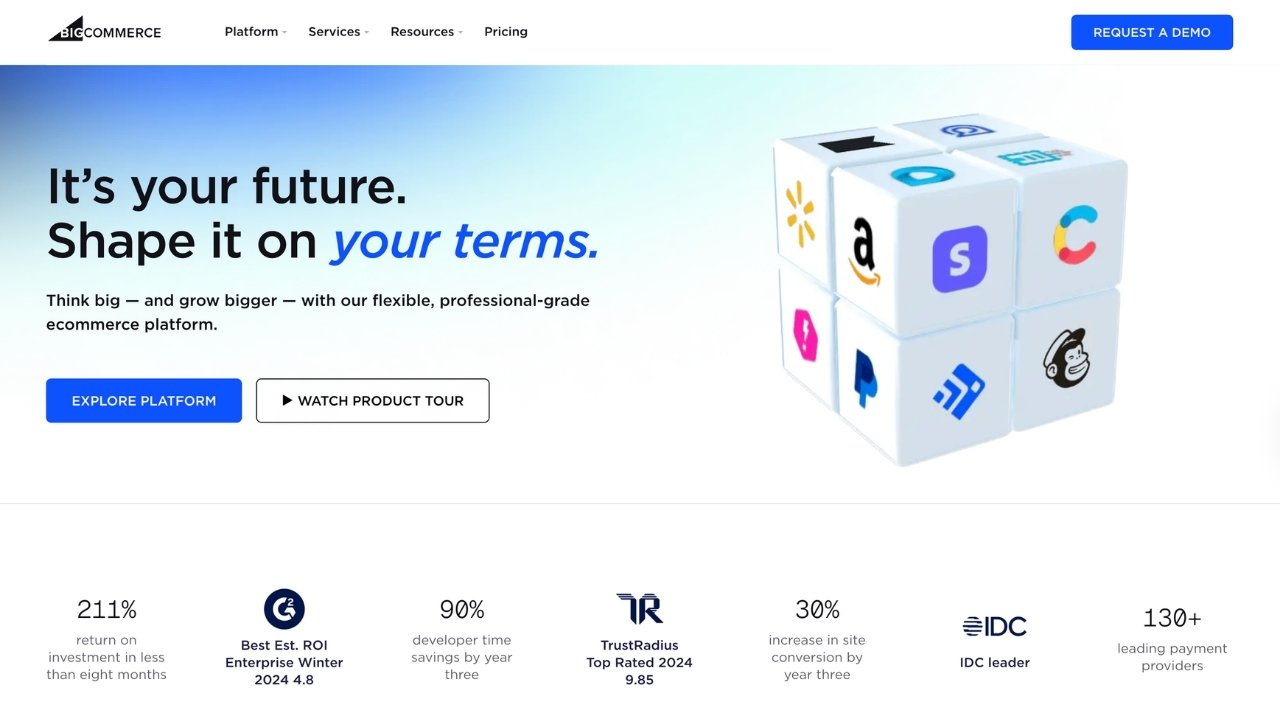
BigCommerce positions itself as an Open SaaS platform for mid-market and enterprise brands.
It offers powerful, flexible solutions with extensive built-in features that reduce your dependency on third-party apps.
Why it replaces Magento: You get strong native B2B features without the complexity. Multi-storefront capabilities let you operate B2B and B2C from one platform.
The API-first architecture means it's headless-ready when you need it.
Key features:
- Award-winning B2B Edition with wholesale pricing and custom payment terms
- Multi-Storefront for operating multiple brands from one backend
- Page Builder with drag-and-drop visual editing
- 130+ payment providers with no penalty fees
- Catalyst for one-click optimized storefront launches
- Makeswift integration for visual website editing
Pricing:
| Plan | Price | Features |
|---|---|---|
| Standard | $39/mo | Full-featured online store, unlimited products |
| Plus | $105/mo | Customer groups, abandoned cart saver |
| Pro | $399/mo | Google Customer Reviews, faceted search |
| Enterprise | Custom | Multi-storefront, unlimited API calls, 24/7 support |
The key differentiator: no additional transaction fees on any plan.
Security certifications include PCI DSS 4.1 Level 1, ISO/IEC 27001:2022, ISO/IEC 27701:2019, and several others.
Pros: Built-in features reduce app dependency, excellent B2B tools, no transaction fees
Cons: Theme customization can require developer help, fewer apps than Shopify
3. WooCommerce
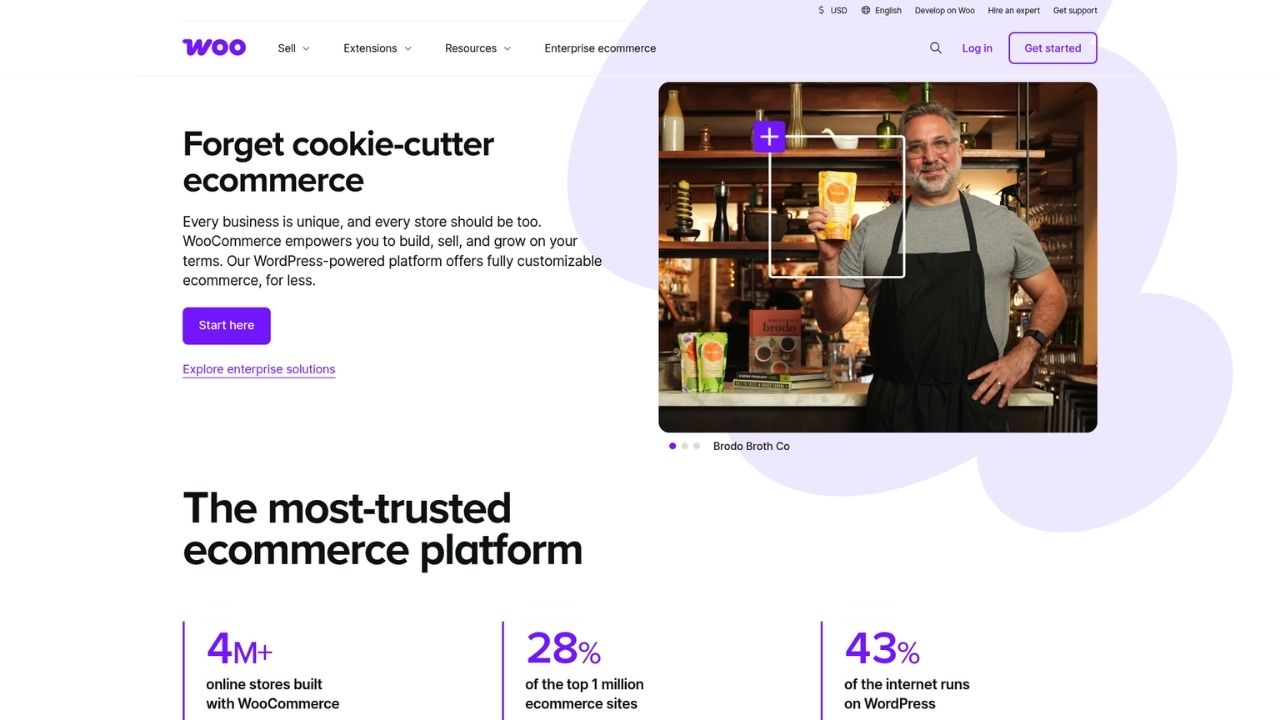
WooCommerce is the open-source e-commerce platform built on WordPress.
With 80+ million online stores and 23% market share among the top 1 million e-commerce sites, it's the go-to choice for content-heavy businesses.
Why it replaces Magento: You get full control and ownership without Magento's complexity.
Since it's built on WordPress (which powers 43% of the internet), the learning curve is gentler and the talent pool is massive.
Key features:
- Seamless WordPress integration for content + commerce
- Block themes for modern customizable storefronts
- WooPayments for integrated payment processing (2.9% + 30¢)
- Multi-channel selling on marketplaces and social media
- Extensions marketplace with hundreds of trusted add-ons
- Full code ownership and control
Pricing:
| Component | Cost | Notes |
|---|---|---|
| WooCommerce Plugin | Free | Open source |
| Hosting | $10-50/mo | Self-hosted requirement |
| Premium Extensions | Varies | Payment gateways, shipping, etc. |
| WooPayments | 2.9% + 30¢ | Integrated payment processing |
Pros: Complete ownership, excellent content marketing integration, massive WordPress ecosystem
Cons: Self-hosted (security and backups are your responsibility), plugin conflicts possible
4. PrestaShop

PrestaShop is an open-source e-commerce platform with 250,000+ merchants worldwide, 250+ experts, and a community of over 1 million members.
It offers full ownership of your online store with extensive customization options.
Why it replaces Magento: It's a lighter open-source alternative that's easier to manage while still giving you complete control.
Strong EU presence makes it particularly attractive for European businesses.
Key features:
- Full ownership of store and data
- Thousands of modules and themes for customization
- Scalability from hundreds to millions in revenue
- Dedicated support team available
- MIT-licensed, community-driven development
Pricing:
| Component | Cost | Notes |
|---|---|---|
| PrestaShop Software | Free | Open source, self-hosted |
| Hosted Solution | From €24/mo | Cloud-hosted option |
| Modules/Themes | Varies | Marketplace pricing |
| Expert Services | Custom | Implementation support |
Pros: No vendor lock-in, strong international features, cost-effective
Cons: Developer support needed for customization, paid modules can add up
5. Shopware
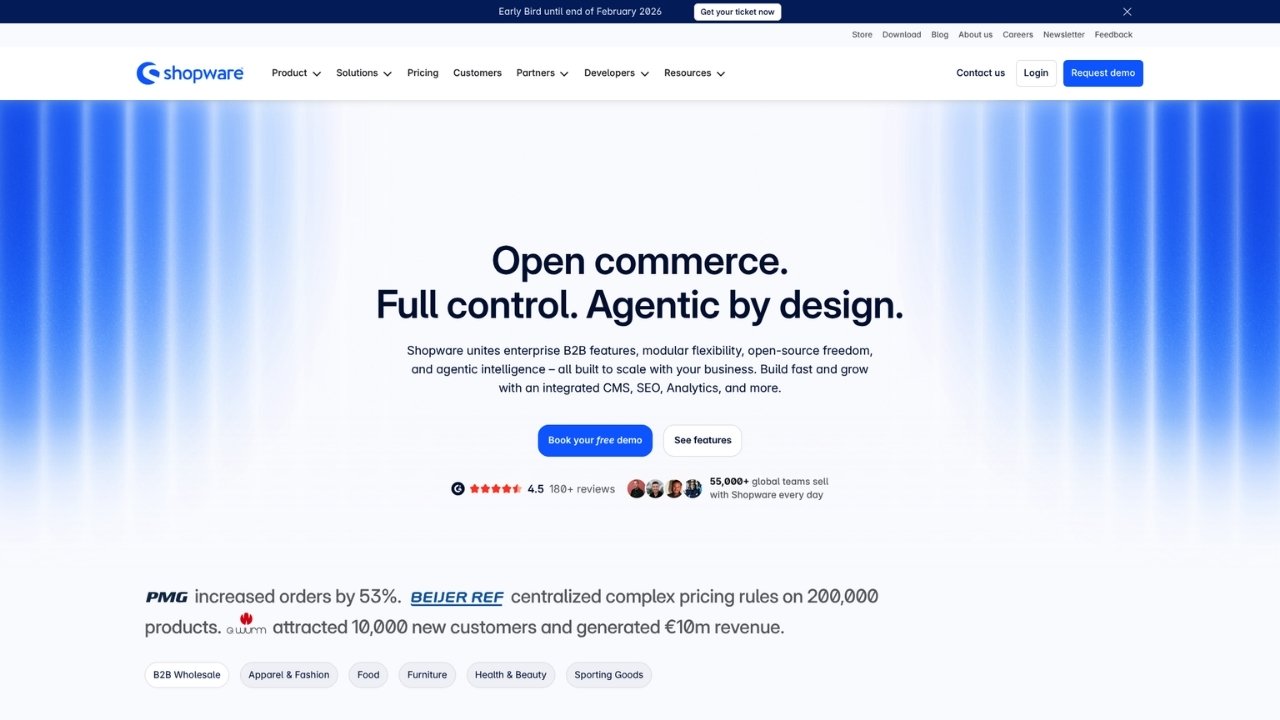
Shopware is an open commerce platform uniting enterprise B2B features, modular flexibility, and agentic intelligence.
It serves 55,000+ global teams daily and holds a 4.5/5 rating on G2 with 180+ reviews.
Why it replaces Magento: You get modern architecture with similar flexibility but a cleaner admin interface.
The platform is designed for complex catalogs and B2B operations without the legacy baggage.
Key features:
- AI Copilot for content and operations
- B2B Suite for enterprise commerce at scale
- Rule Builder for complex commerce on no-code flows
- Drag-and-drop CMS for composable content management
- 30+ languages and local tax rules for multi-regional selling
- API-first, headless-ready architecture
Pricing:
| Edition | Pricing | Features |
|---|---|---|
| Community | Free | Open source, self-hosted |
| Rise | Custom | Cloud-hosted, AI features |
| Evolve | Custom | Advanced B2B, multi-store |
| Beyond | Custom | Dedicated account manager |
Security includes SOC 2 Type II, ISO 27001, GDPR compliance, AES-256 encryption at rest, and TLS 1.2 in transit.
Pros: Cleaner admin than Magento, good native feature coverage, AI-powered tools
Cons: Expensive paid plans, ecosystem concentrated in Europe
6. Salesforce Commerce Cloud
Salesforce Commerce Cloud (formerly Demandware, acquired in 2016) is built for large enterprises managing multi-brand, multi-site operations.
It's part of the broader Salesforce ecosystem, enabling deep CRM integration.
Why it replaces Magento: If you're already invested in Salesforce, the integration is seamless.
You get unified customer data across sales, service, marketing, and commerce.
Key features:
- Einstein AI for AI-driven personalization
- Omnichannel capabilities for unified B2C and B2B experiences
- End-to-end order management
- Native Salesforce CRM and Marketing Cloud integration
- Global scale with multi-site, multi-currency support
- API-first headless architecture
Pricing:
| Component | Pricing |
|---|---|
| B2C Commerce | Custom quote |
| B2B Commerce | Custom quote |
| Order Management | Custom quote |
Pricing is based on GMV and business requirements. Notable customers include Adidas, L'Oreal, and Coach.
Pros: Enterprise-grade, integrated with Salesforce stack, AI personalization
Cons: High implementation costs, long deployment timelines, requires agency or technical team
7. Medusa JS

Medusa is an open-source commerce platform for developers and agents.
It's the most popular open-source platform for commerce on GitHub (#1 of 15,000 commerce projects), powering over $10 billion in GMV worldwide with 14,000+ developers in the community.
Why it replaces Magento: You get a composable architecture without the legacy baggage.
Built on Node.js with a modern tech stack, it's designed for developers who want full control.
Key features:
- Headless architecture separating backend and frontend
- Modular design with each function as an independent module
- Commerce modules for products, pricing, orders, and fulfillment
- Bloom AI for AI-powered webshop building
- Multi-regional support with multiple currencies and local tax rules
- B2B support with company accounts and custom pricing
- Pre-built React starters for DTC, B2B, and POS
- 100+ integrations from community and core team
Pricing:
| Component | Cost | Notes |
|---|---|---|
| Medusa Core | Free | Open source, MIT license |
| Medusa Cloud | Custom | Hosted infrastructure |
| GMV Tax | $0 | No revenue-based fees |
Notable customers include Heineken, Thoughtworks, and Mitsubishi.
Pros: Full developer control, lightweight, modern tech stack, no GMV fees
Cons: Requires development team, smaller ecosystem, not plug-and-play
How to choose the right Magento alternative
The best platform depends on your specific situation. Here's how to think through the decision:
SaaS vs open source: Do you want to manage hosting, security, and updates yourself? SaaS platforms (Shopify, BigCommerce) handle this for you.
Open source (WooCommerce, PrestaShop, Medusa) gives you more control but requires more responsibility.
Total cost of ownership: Look beyond the monthly subscription. Factor in transaction fees, app costs, development time, and hosting.
A "free" platform can become expensive quickly if you need extensive customization.
Your team's technical capacity: Be honest about what your team can handle. If you don't have developers, lean toward SaaS platforms with visual editors.
If you have a technical team, open source or headless options become viable.
Migration complexity: Moving from Magento is not trivial. Plan for data migration, URL redirects, SEO preservation, and staff retraining.
Budget 3-6 months for a full migration depending on complexity.
Customer support burden: Every platform shift affects your customer service team. New interfaces mean new questions.
Consider how you'll handle the transition period when both your team and customers are learning the new system.
Reducing support costs on any platform
Here's something most platform comparisons miss: customer support.
Whether you choose Shopify, BigCommerce, or WooCommerce, you'll still need to handle phone calls.
Order tracking questions, return requests, product inquiries... these don't disappear when you switch platforms.
The common issues stay the same across platforms:
- "Where's my order?" tracking requests
- Return and exchange processing
- Product questions and recommendations
- Account and password issues
This is where we can help. At Ringly.io, our AI phone agent The AI handles 70-73% of customer calls automatically.
He answers questions, looks up orders, processes returns, and only escalates to your team when necessary.
The best part? the AI works across any e-commerce platform, whether you're on Shopify, BigCommerce, WooCommerce, or anything else.
If you're already planning a platform migration, consider how you'll handle the support transition.
A tool like the AI can maintain consistent phone support during the move and reduce your team's workload afterward. Start a free trial to see how it works for your store.
Frequently Asked Questions
What are the most affordable Magento IT solutions alternatives for small businesses?
For small businesses on a budget, WooCommerce and PrestaShop offer the lowest entry costs since both are free open-source platforms. You'll pay for hosting (around $10-50/month) but avoid subscription fees. Shopify and BigCommerce start at $39/month but include hosting and support, making them predictable options as you scale.
How long does it typically take to migrate from Magento to another platform?
Migration timelines vary based on complexity. A simple store with a few hundred products might take 4-6 weeks. Larger catalogs with custom functionality, integrations, and historical data can take 3-6 months. Plan for data export, cleanup, import testing, theme development, and staff training.
Which Magento IT solutions alternative is best for B2B e-commerce?
BigCommerce and Shopware both offer strong native B2B features. BigCommerce's B2B Edition includes wholesale pricing, custom payment terms, and company account management. Shopware's B2B Suite is built for enterprise B2B operations at scale. Salesforce Commerce Cloud is also excellent for B2B if you're already in the Salesforce ecosystem.
Can I keep my existing integrations when switching from Magento?
It depends on the platform and the integration. Popular tools like payment processors, email marketing platforms, and shipping providers usually have integrations across all major platforms. Custom-built integrations will need to be rebuilt. Check each platform's app marketplace or integration documentation before deciding.
Do I need a developer to manage these Magento alternatives?
SaaS platforms like Shopify and BigCommerce are designed for non-technical users. You can manage day-to-day operations without coding. Open-source platforms like WooCommerce, PrestaShop, and Medusa require more technical knowledge for setup, customization, and maintenance. Complex customizations on any platform typically need developer help.
How do transaction fees compare across Magento IT solutions alternatives?
BigCommerce charges no transaction fees on any plan. Shopify charges 2% on Basic, 1% on Grow, and 0.6% on Advanced if you don't use Shopify Payments. WooCommerce and PrestaShop don't charge platform transaction fees, but payment processors (Stripe, PayPal) still take their standard cut (typically 2.9% + 30¢).
What happens to my SEO when migrating from Magento?
SEO is a major consideration during migration. You'll need to set up 301 redirects from old URLs to new ones, maintain your metadata, and ensure product descriptions transfer correctly. Some platforms offer migration tools that help preserve SEO data. Plan for a temporary traffic dip (usually 2-4 weeks) while search engines reindex your new site.