


This post in 30 seconds.
- What syncs: Gorgias support events (opened, resolved, satisfaction) flow into Klaviyo; Klaviyo SMS, WhatsApp, and low-rating reviews flow into Gorgias as tickets, plus optional profile sync.
- What slips through: Klaviyo email replies do not create Gorgias tickets (verified in Klaviyo's docs), and the phone line is outside the integration entirely.
- Who this is for: founders, COOs, and Heads of CX at $10M-$100M Shopify brands running Gorgias and Klaviyo with a visible phone number.
The Gorgias and Klaviyo integration gives your support and marketing teams one shared view of the customer. Two channels still slip through it. One you can see in Klaviyo's own documentation. The other never comes up in any setup guide, because it sits outside the whole loop.
If you run customer experience at a Shopify brand doing $10M-$100M, you already connected these two so the support queue and the email program stop talking past each other. That part works. But the calls your team is still picking up, and the marketing emails customers reply to expecting a human, those don't show up anywhere in this integration. This is what 50+ Shopify brands we work with do about the channel it can't see. Book a 30-min call and we'll map your routing for you.
What the Klaviyo Gorgias integration actually does
It's a two-way bridge, but the two directions do different jobs. Support events flow one way and message events flow the other, which is why the integration is worth more than the "SMS sync" most people think it is.
Going from Gorgias into Klaviyo, three support events land on the customer's Klaviyo profile and can trigger flows or build segments: opened ticket, resolved ticket, and satisfaction survey responded. According to Gorgias, these "push events" are the half of the integration most accounts never use. That's the lever. Once Klaviyo can see a support interaction, your flows can react to it.
Going the other way, from Klaviyo into Gorgias, inbound messages turn into tickets. A consented SMS subscriber who texts your number creates a ticket. An inbound WhatsApp message creates a ticket. A review that lands at or below your rating threshold creates a ticket. And if you turn on profile sync, the customer's email, phone, location, consent status, and segment membership show up right in the ticket, so a rep isn't answering blind.
Here's the full picture in one table.
| Direction | What crosses | Becomes |
|---|---|---|
| Gorgias to Klaviyo | Opened ticket, resolved ticket, satisfaction survey responded | Profile metric + flow trigger + segment |
| Klaviyo to Gorgias | Inbound SMS (consented), inbound WhatsApp | New Gorgias ticket |
| Klaviyo to Gorgias | Review at or below your threshold | New Gorgias ticket |
| Klaviyo to Gorgias | Profile sync (optional) | Email, phone, location, segments shown in ticket |
The two-way part matters because it means support context and marketing context finally live in the same place. Your reps see the campaigns a customer is in. Your flows see whether someone is mid-complaint. That's the whole pitch, and for email, SMS, WhatsApp, and reviews, it delivers.
One thing worth getting right up front: the value isn't in the SMS sync everyone leads with. It's in the support events. Most teams install the integration to consolidate text replies, then never build a single flow off an opened or resolved ticket. That's leaving the better half on the table. A resolved-ticket event is a clean signal that a customer just had a real interaction with your brand, and a satisfaction score tells you whether it went well. Both are things your marketing program almost never knows, and both are now sitting in Klaviyo waiting to be used.
How to set it up (the verified steps)
Setup runs from the Klaviyo side, and it's a few minutes of clicking, not a project. The connection is Klaviyo-initiated, so you start in Klaviyo and authorize from inside Gorgias once.
Per the Klaviyo Help Center, here's the path:
- Install from Klaviyo. Go to Integrations, search for Gorgias, and click into the app card to install.
- Connect your helpdesk. Enter your Gorgias helpdesk URL and click Connect to Gorgias.
- Authorize in Gorgias. A new tab opens. Log into Gorgias, select All resources, and click Authorize.
- Choose your sync scope. Sync all tickets, or only tickets with specific tags if you want to keep the volume tight.
- Toggle the channels. Turn on SMS sync and WhatsApp sync with the checkboxes.
- Set the reviews threshold. Enable reviews sync and pick a rating threshold. The default is 3, which means any review rated 3 or lower creates a Gorgias ticket for your team to follow up on.
- Optional: profile sync. Check "Sync customer profile information from Klaviyo to Gorgias" to push contact details and properties into the ticket view.
- Complete setup. Click the button, and the two are connected.
That's it. The reviews threshold is the one setting worth thinking about before you click. A threshold of 3 catches the genuinely unhappy reviews without flooding your queue with neutral ones, which is why Klaviyo ships it as the default.
Four things the integration is actually good for
I connected this on a test Shopify store and watched which events actually crossed, because the feature list and the real behavior aren't always the same thing. Here's what earns its keep once it's live.
1. Suppress promotions for anyone with an open ticket. Build a Klaviyo segment of customers who currently have an open Gorgias ticket, and exclude them from your next sales send. Nobody mid-refund should get a "20% off, today only" email an hour later. Gorgias also offers a campaign-pause on its side, but the cleaner move is the Klaviyo segment, because it travels across every flow, not just one campaign.
2. Post-resolution flows branched on satisfaction. Once the resolved-ticket and satisfaction events are in Klaviyo, you can split the follow-up. A high-satisfaction resolution can trigger a review request or a related-product flow. A low one can trigger a recovery touch instead of a sales push. This is the most underused trigger in most Klaviyo accounts, and it's free once the integration is on.
3. Real customer context in the ticket. With profile sync, a rep opening a ticket sees the customer's segments, campaign membership, and consent status without leaving Gorgias. That turns a cold "how can I help" into a reply that already knows the customer is a repeat subscriber or a first-time buyer.
4. SMS, WhatsApp, and review replies in one queue. Instead of a separate inbox for text and another for reviews, the inbound messages and low-rating reviews become tickets in the same Gorgias queue your team already lives in. One place, one workflow. For the channels it covers, that's a real reduction in tab-switching, and it's the part of the ecommerce customer service stack that this integration genuinely tidies up.
A quick note on the review threshold, because it's the lever most teams set once and forget. At the default of 3, you're catching the reviews that signal a real problem without burying your queue in neutral three-and-four-star feedback. If your team is small and you only want to chase the genuinely angry ones, drop it to 2. If you're using reviews as a proactive winback channel and you have the staffing, raise it. The point is to match the threshold to how much follow-up your team can actually do, not to leave it at the default and then wonder why the queue filled up.
What the integration does not capture
Now the honest part, because the setup guides skip it. Two channels never enter the Gorgias and Klaviyo loop, and one of them is where your highest-intent customers are.
The first gap is documented. Klaviyo's own help center states it plainly: the integration does not automatically create Gorgias tickets when a customer replies to an email you sent from Klaviyo. Only SMS, WhatsApp, and review events create tickets. So if a chunk of your customers hit reply on a marketing email expecting a person, those replies sit in Klaviyo, not in your support queue. Responses inside the Klaviyo Inbox don't surface in Gorgias either, and there are smaller caveats on the SMS side (images and GIFs in inbound SMS won't render in Gorgias, and you can't send MMS from Gorgias).
The second gap isn't in any document, because it's simply out of scope: the phone line. No inbound call becomes a Klaviyo support event. No call context lands in Gorgias as structured data. The integration unifies email, SMS, WhatsApp, and review touchpoints, and then stops at the one channel where customers call because they're frustrated, confused, or ready to buy something expensive.
That matters more than it looks. For a brand at this size, phone is rarely the highest-volume channel, but it's often the highest-stakes one. The WISMO calls that clog every queue spike to 50% of contacts at peak, and a real share of them come in by phone from customers who don't trust the tracking page. When those calls go to voicemail, the data backs up what it costs. 85% of callers who can't reach a person never call back, and 62% switch to a competitor, according to PCN's 2026 missed-call study. Most brands only answer about 37.8% of their inbound calls in the first place, per AmbsCallCenter. The integration you just set up can't see any of that.
The channel the integration can't see: phone
This is where Ringly.io fits, and it's not a replacement for either tool. Ringly is AI phone support for Shopify brands. It takes the calls your Gorgias and Klaviyo integration was never built to catch, and it hands the hard ones back to your team inside the helpdesk you already run.
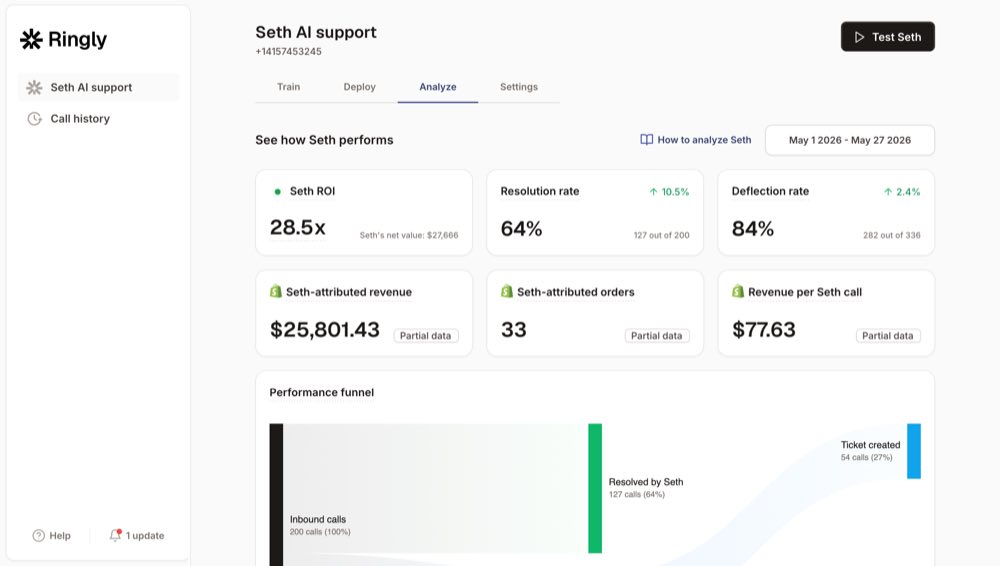
Here's what it does on the calls themselves. The AI answers inbound calls 24/7. It finds orders in your Shopify store, processes returns and exchanges, answers product questions from your knowledge base, and rescues abandoned carts with an outbound follow-up. Calls that need a human escalate cleanly into Gorgias, so the call doesn't disappear into a voicemail box, it becomes a ticket your team can act on. The order-status calls in particular get resolved end to end, the same check order status job your reps do all day.
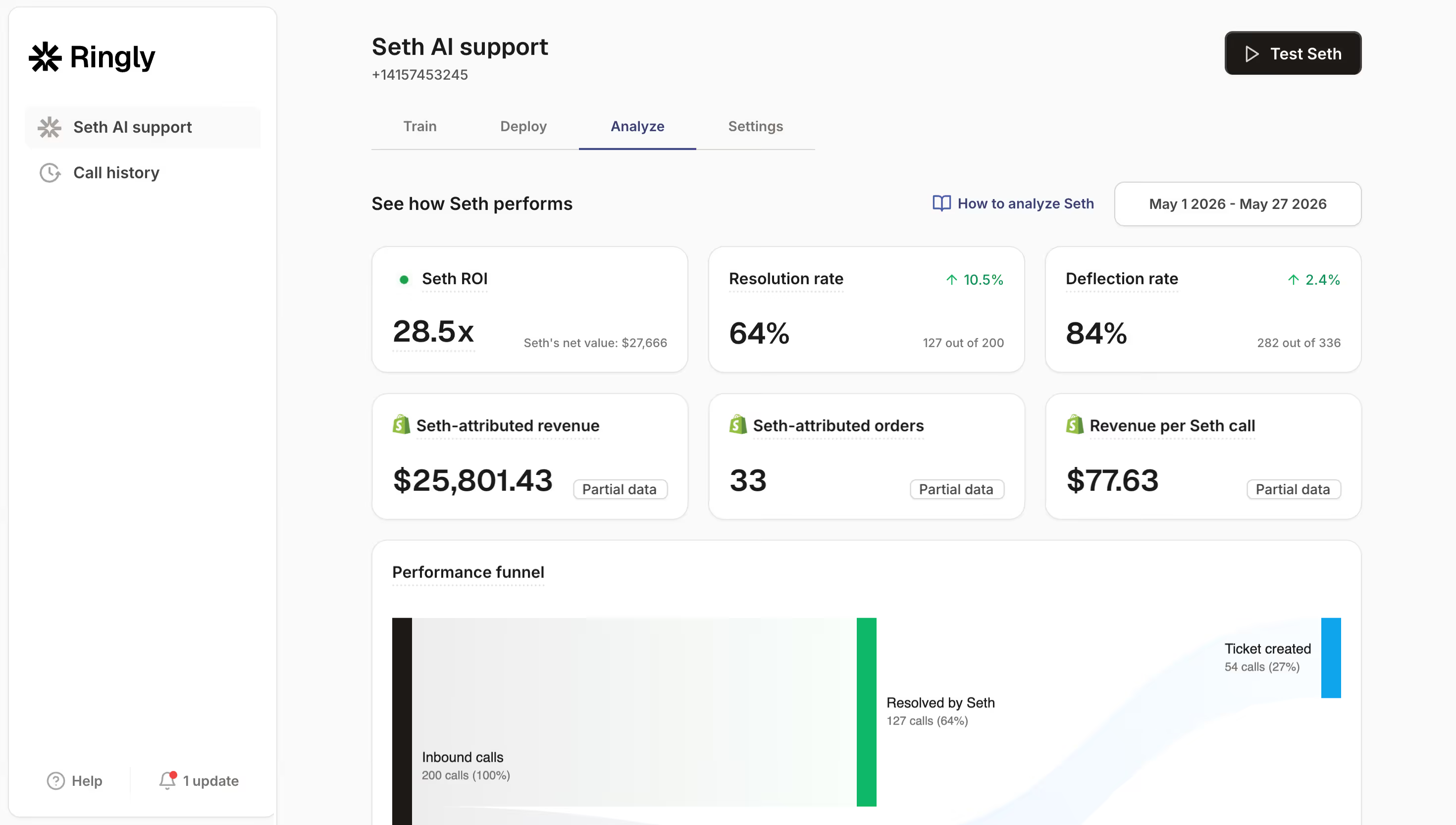
Across 50+ brands, the AI resolves 73% of inbound calls on its own at roughly $0.42 per resolved call, versus the $7-$16 a human-handled call runs at most BPOs. WashCo, a Shopify brand we launched, recovered $22,664 in its first 7 days on the phone. That's the channel the integration can't measure, turned into a number you can.
It pairs with the stack you already built, it doesn't compete with it. Gorgias stays your helpdesk. Klaviyo stays your marketing engine. Ringly stays in front of the phone, taking the routine calls and routing the rest. If you've read our Gorgias Klaviyo integration operator's guide, this is the missing third piece. Plans run Grow $349/mo (1,000 minutes), Pro $799/mo (2,500 minutes), and Enterprise by call, all backed by a 65% resolution guarantee. You can be live in under an hour.
What it costs you to leave phone uncovered
The math is the part that usually moves a decision, so here it is straight. The phone calls you're routing to people are the same routine questions the AI handles, which is why the cost gap is this wide.
Take a $50M Shopify brand running a 6-rep CS team:
| Line item | Today | With Ringly |
|---|---|---|
| 6 reps at $4K loaded per rep | $24,000/mo | n/a |
| Ringly (illustrative) | n/a | $5,000/mo |
| Net monthly CS spend | $24,000/mo | $5,000/mo |
| Monthly savings | n/a | $19,000/mo |
| Annual savings | n/a | $228,000/yr |
That's roughly 70% of repeatable calls, the order-status and return and "is this in stock" questions you hear over and over, routed to the AI. The other 30%, the genuinely complex calls, still go to your team, who now have time to actually solve them instead of reading tracking numbers aloud. If you want to scale support without hiring the next rep, this is the lever.
If you're running a $10M-$100M Shopify brand, book a 30-min call and we'll review your missed calls live.
Frequently asked questions
Does the Klaviyo Gorgias integration sync email replies to Gorgias? No. Klaviyo's documentation is explicit that the integration does not create Gorgias tickets when a customer replies to an email sent from Klaviyo. Only inbound SMS, WhatsApp, and qualifying reviews create tickets.
Which Gorgias events flow into Klaviyo? Three support events: opened ticket, resolved ticket, and satisfaction survey responded. They appear on the Klaviyo profile and can trigger flows or build segments, which is what lets you suppress promos for open tickets and run post-resolution flows.
What's the reviews ticket threshold? The default is 3. Any review rated 3 or lower creates a Gorgias ticket so your team can follow up on the unhappy ones. You can raise or lower it during setup.
Does the integration handle phone calls? No. The integration covers email-program data, SMS, WhatsApp, and reviews. The phone line sits entirely outside it, which is the gap an AI phone agent like Ringly fills by answering calls and escalating into Gorgias.
Do I need to pay for both Klaviyo and Gorgias? Yes, if you want both jobs done. They do different things: Klaviyo is your email and SMS marketing engine, Gorgias is your helpdesk. The integration makes them share context, but it doesn't replace either one.
How long does the integration take to set up? Minutes. It's a Klaviyo-initiated install: connect your Gorgias URL, authorize from inside Gorgias, toggle the channels you want, and you're done. There's no engineering work for a standard Shopify Plus stack.
Does Ringly replace Gorgias or Klaviyo? No. Ringly sits in front of your phone line and escalates calls that need a human into Gorgias. Your helpdesk and your marketing stay exactly where they are. Ringly just covers the 24/7 phone channel the integration was never built for.
Talk to us

If a $10M-$100M Shopify brand is running Gorgias and Klaviyo but the phone line still rolls to voicemail after 6 p.m., that's the gap worth a 30-minute call. We'll look at what your store is actually losing on the calls you're missing, and what it would take to close it.
The 3-layer guarantee.
- Live in 14 days or it's free until launched.
- 65% resolution in 90 days or we refund the last 3 months of subscription fees.
- We keep working free until we hit it.
Ruben (Ringly co-founder) takes these calls personally.