

The short version.
- No. Gorgias is an ecommerce helpdesk with a customer-context sidebar, not a CRM tool. People mix them up because that sidebar shows order history and looks CRM-shaped.
- What it owns: the support conversation. It borrows identity and order data from Shopify and keeps none of the sales-pipeline or relationship layer a real CRM is built for.
- Who this is for: founders, COOs, and Heads of CX at $10M-$100M Shopify brands deciding what their support and customer-data stack should actually be.
No, Gorgias is not a CRM tool. It's an ecommerce helpdesk: a place to run support conversations across email, chat, SMS, and social, with the customer's Shopify order history pulled into the ticket. The reason this question gets asked at all is that context sidebar. It shows who the customer is and what they bought, so it feels like a CRM even though the job it does is different.
If you run support at a Shopify brand, the distinction matters when you're deciding what to buy. You can spend real money stacking a helpdesk, an email tool, and a CRM that all half-overlap, especially once Gorgias pricing climbs with ticket volume, or you can figure out which system owns which job and stop paying twice. This post is the decision guide: what Gorgias does that looks like a CRM, what it can't do, and when a $10M-$100M Shopify brand actually needs a real CRM next to it. If you want the deeper definition, we also wrote on whether Gorgias is a CRM or a customer support platform.
If you're sorting out your stack and your phone line is the part nobody's covering, book a 30-min call and we'll map where each tool fits for your store. We run AI phone support for 50+ Shopify brands, so the same WISMO and "the same questions over and over" patterns show up everywhere.
The short answer, and why everyone asks
Gorgias is a helpdesk built for ecommerce. It pulls email, live chat, SMS, WhatsApp, Instagram, and Facebook into one inbox, and its Shopify integration lets a rep see an order, edit it, or issue a refund without leaving the ticket. That's the product. It rates 4.6 out of 5 on G2 across roughly 1,879 reviews, and most of the praise is about exactly that: ecommerce support in one place.
The mix-up comes from one feature: the customer-context sidebar that sits next to every ticket. It shows contact details, past orders, lifetime spend, and previous conversations. That looks like a customer record, so people reasonably wonder if Gorgias is doing a CRM's job. It isn't. It's showing you enough context to answer a support question well, then handing the heavy data lifting back to Shopify.
So the literal answer to "is Gorgias a CRM tool" is no. The more useful answer is that it's a helpdesk that borrows CRM-style context, which is a different thing than being your customer system of record.
What a CRM actually does that Gorgias doesn't
A CRM is the system of record for the relationship. It's where identity, full purchase history, lifecycle stage, segments, sales opportunities, and cross-team notes live. Marketing, sales, and service all read and write to the same customer record. That's the job: hold who the customer is over time, not just the open ticket in front of you.
A helpdesk like Gorgias has a narrower job. It runs the conversation. A ticket opens when a customer reaches out, moves through your team, and closes when the issue is resolved. The context sidebar is there to make that one conversation good, not to be the place your whole company manages the relationship from.
That's why WISMO sits so naturally in Gorgias. "Where's my order" questions are 30-40% of support tickets and over 50% at peak, according to Salesforce, and they're conversation-shaped: a customer asks, you check the order, you answer. Gorgias is excellent at that loop. It just doesn't carry the parts of the customer relationship that happen outside a ticket.
Here's the practical gap, in plain terms:
- No sales pipeline. Gorgias has no concept of leads, deals, or opportunities. If you run any sales motion (wholesale, B2B, high-touch), that lives elsewhere.
- No marketing automation. It doesn't run your email and SMS flows. That's Klaviyo's job for most DTC brands.
- No single cross-team record. Service sees the ticket. It isn't the shared source of truth that sales and marketing build on too.
The CRM-like things Gorgias actually does well
None of this means Gorgias is thin. For the support job, the customer context it surfaces is genuinely strong, and a lot of brands never feel the CRM gap because Gorgias plus Shopify covers what their reps touch day to day.
What it does well:
- Order history in the ticket. A rep sees every past order, status, and tracking without switching tabs. This is the single biggest reason teams love it.
- Customer profiles and tags. Contact info, prior conversations, internal notes, and tags you can automate against. Enough to recognize a repeat buyer and route them well.
- Support-driven revenue tracking. It attributes sales that came out of support conversations, which is more than most help desks bother to measure. See the full feature set for the rest.
- CRM integrations. It connects to HubSpot and Salesforce, so lifecycle and deal data from a real CRM can show up inside the ticket.
That last point is the tell. Gorgias integrates with CRMs rather than being one. We run AI phone support for 50+ Shopify brands, and the thing you notice fast is how much of a customer's signal is scattered across tools that each hold one slice and lean on the others for the rest. Gorgias holds the support slice well and is honest about handing the relationship slice to a CRM that's built for it.
The three buckets of customer data, and which ones Gorgias owns
The cleanest way to settle the "is Gorgias a CRM tool" question is to split customer data into three buckets and see who owns each one.
Identity, what they bought, and what they said are three different data jobs, and no single ecommerce tool owns all three for most brands.
- Identity (who they are). Name, contacts, channel preferences, segment. Gorgias borrows this from Shopify and shows it in the sidebar. Shopify is where it actually lives.
- Transactional (what they bought). Orders, refunds, AOV, lifetime value. Gorgias surfaces this inside the ticket, pulled from Shopify. A CRM would store it and let you segment and sell against it.
- Conversational and relationship (what they said, where they are in the journey). This splits. Gorgias owns the support-ticket part. A CRM owns the sales-pipeline and cross-team relationship part. And the richest piece of all, the actual phone conversation, usually lands in no system at all.
That third bucket is where the confusion clears up. Gorgias owns one corner of it, the support ticket. It doesn't own the rest, and it was never trying to. For a sense of scale on what's slipping: at a $250 average order value, 12-18% of orders generate a phone call, versus around 3% at a $40 AOV. The higher your AOV, the more relationship data is arriving by voice, and neither your helpdesk nor your CRM is built to catch it.
When you actually need a real CRM alongside Gorgias
Most pure-DTC Shopify brands don't run out and buy a standalone CRM, and they're not wrong to skip it. Shopify holds the customer and order record, Klaviyo covers the email and SMS relationship, and Gorgias runs support. For a lot of brands, that stack is the CRM, spread across three tools that each do their part well. Shopify itself frames a CRM as an integration layer, not a separate empire.
Add a real CRM alongside Gorgias when:
- You run an actual sales motion. Wholesale, B2B accounts, or high-touch deals need a pipeline. Gorgias has none, and tickets aren't deals.
- You need one record across marketing, sales, and service. When three teams keep asking "who is this customer" and getting three different answers, a shared system of record earns its cost.
- Klaviyo isn't enough. If you've outgrown email-and-SMS segments and need lifecycle, lead scoring, or attribution that ties everything together, that's CRM territory.
- Reporting is breaking down. When the customer story is split across Shopify, Gorgias, and a spreadsheet a lead CSR maintains by hand, the data silo itself is the problem.
You probably don't need a standalone CRM if you're pure DTC, your sales happen on-site, and Shopify plus Klaviyo already answer "who is this customer and what have they bought." Adding a CRM in that case just gives your team another login to ignore.
Here's where each tool fits in a typical $10M-$100M Shopify stack:
| Tool | What it owns | When you need it |
|---|---|---|
| Shopify | Customer + order record | Always (it's your store) |
| Gorgias | Support conversations + ticket context | When support volume justifies a real helpdesk |
| Klaviyo or a CRM | The relationship: email, SMS, lifecycle, pipeline | Klaviyo for DTC; a CRM when you run sales or need one cross-team record |
| Ringly | The phone conversation + resolution | When calls go unanswered and the data never lands anywhere |
The customer data both Gorgias and your CRM miss
There's one record that neither your helpdesk nor your CRM is capturing for most brands: the phone call. It's the richest relationship signal you get, a real person talking through a real problem, and for most Shopify brands it rolls to voicemail or a rep who's already underwater, then disappears. No ticket, no CRM note, no segment update. Just gone.
That matters more than it sounds. 85% of callers who can't reach a person never call back, and 62% switch to a competitor, per a 2026 PCN Answers study. The average business answers only 37.8% of inbound calls. So the channel carrying your highest-intent customers is also the one leaking the most data and revenue, and no amount of helpdesk or CRM features fixes a phone that doesn't get picked up.
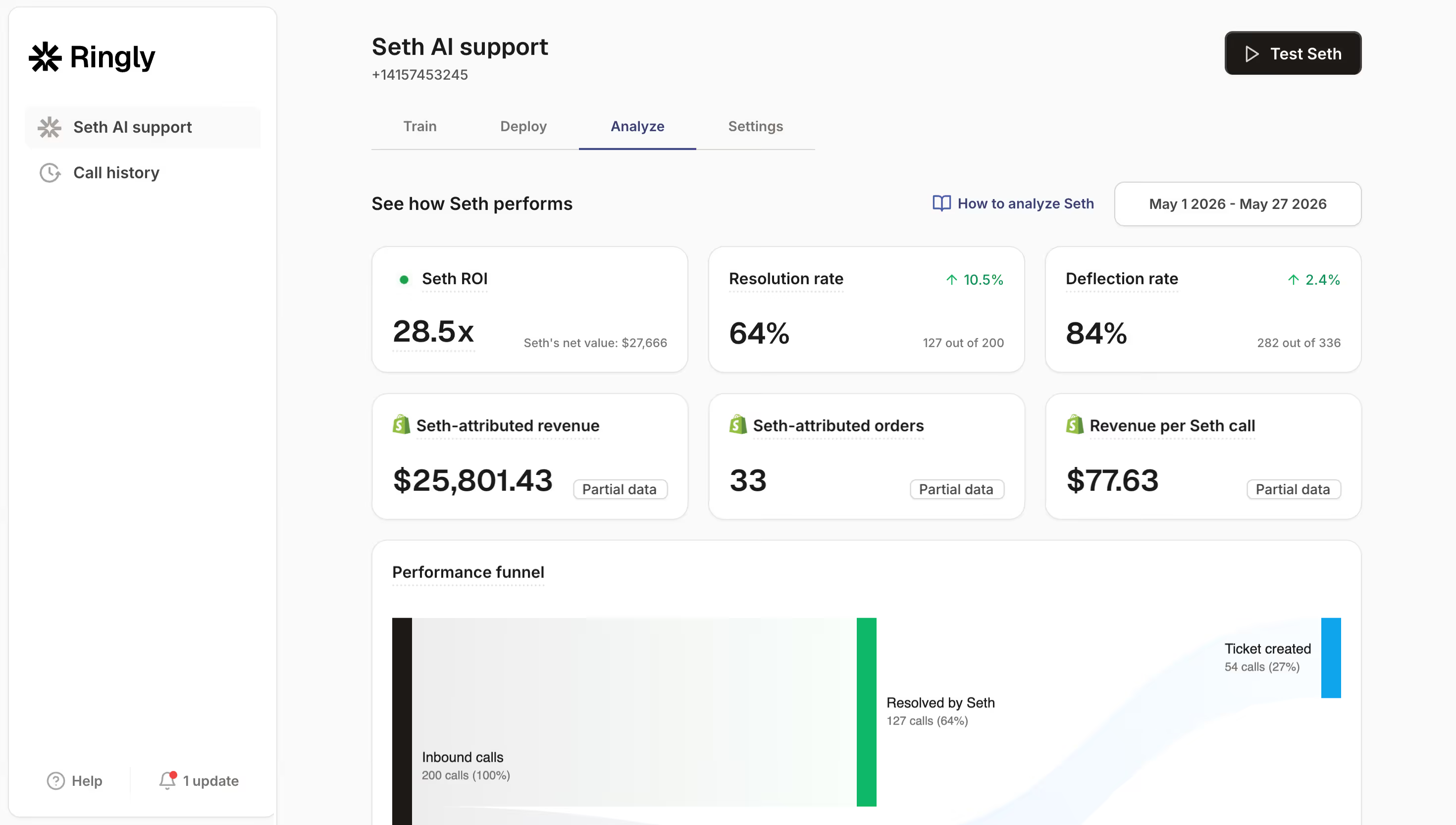
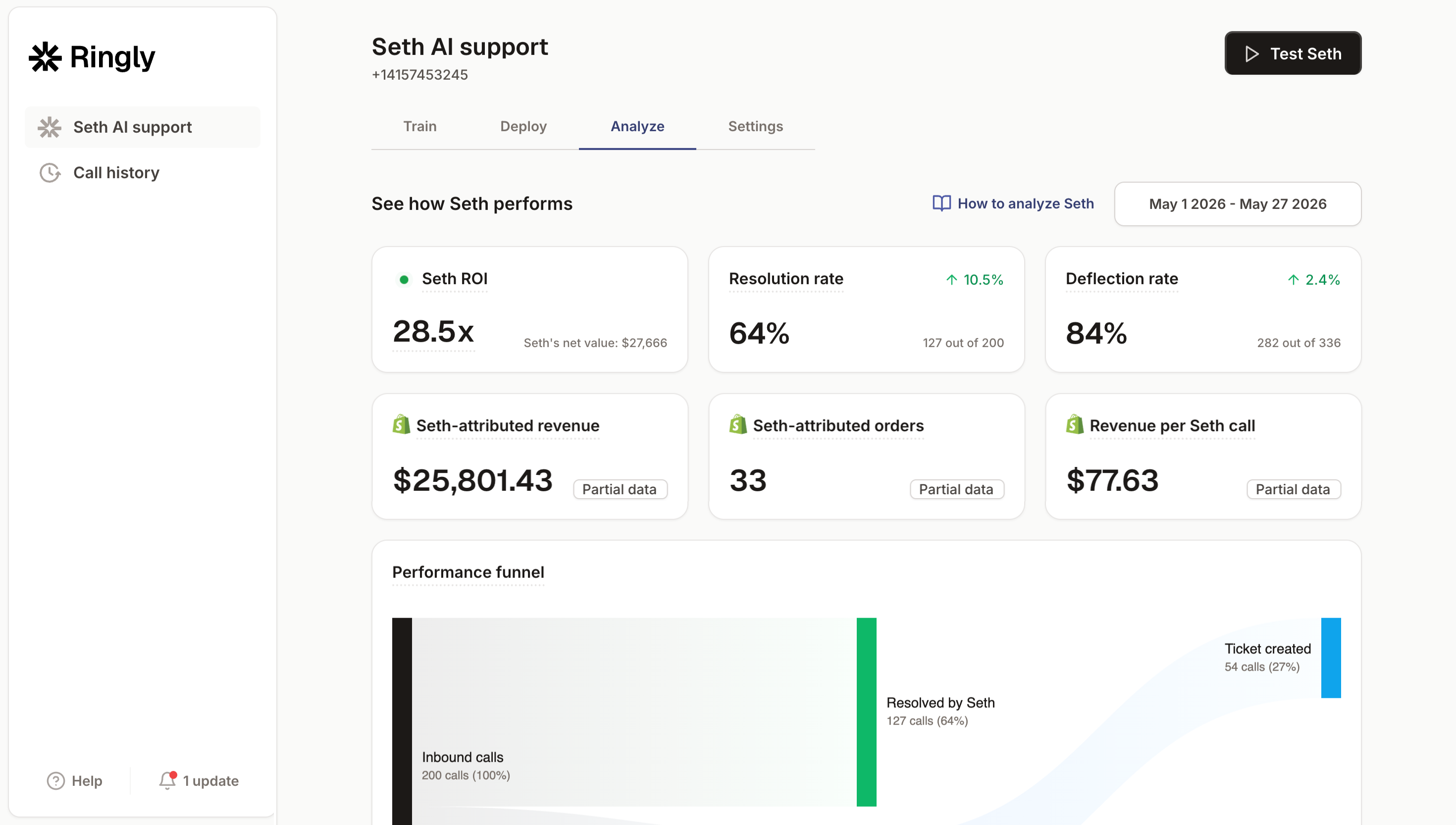
This is the gap Ringly.io closes. Ringly is AI phone support for Shopify brands. Instead of hiring and training a phone support team, the AI answers inbound calls 24/7: order status, returns, product questions, abandoned-cart rescue. Across 50+ brands, it resolves 73% of calls autonomously at roughly $0.42 per resolved call, and calls that need a human escalate cleanly to Gorgias or whatever helpdesk you already run. The conversation becomes a record instead of a missed call.
The math is straightforward once the phone is actually covered. Take a typical $50M Shopify brand running a 6-rep CS team:
| Line item | Today | With Ringly |
|---|---|---|
| 6 reps at $4K loaded per rep | $24,000/mo | n/a |
| Ringly (Enterprise, ~$5K/mo) | n/a | $5,000/mo |
| Net monthly CS spend | $24,000/mo | $5,000/mo |
| Monthly savings | n/a | $19,000/mo |
| Annual savings | n/a | $228,000/yr |
That's roughly 70% of repeatable calls (order status, returns, the same five questions over and over) handled by the AI, while your team keeps the genuinely complex 30%. WashCo, a Shopify brand we launched, recovered $22,664 in its first 7 days on the phone, money that used to leave as a missed call.
If your phone is the unowned channel in your stack, book a 30-min call and we'll show you what your store is leaving on the table after-hours.
"My customers also feel like it's a normal person. They feel like they can communicate if they have questions."
Claudia Droge, TechCraft Studio
Frequently asked questions
Is Gorgias a CRM? No. Gorgias is an ecommerce helpdesk that manages support conversations, not a CRM that manages the full customer relationship and sales pipeline. It shows CRM-style context in the ticket sidebar, which is why the two get confused.
What's the difference between a CRM and a helpdesk? A helpdesk runs support tickets: a customer reaches out, your team resolves it, the ticket closes. A CRM is the system of record for the relationship over time, holding identity, purchase history, lifecycle, and sales pipeline that marketing, sales, and service all use.
Does Gorgias store customer data? Yes, but a specific slice. It stores support conversations, tags, internal notes, and the order history it pulls from Shopify. It doesn't store a sales pipeline or act as your cross-team customer record.
Can Gorgias replace Salesforce or HubSpot? No. It integrates with both rather than replacing them. If you run a real sales motion or need one shared customer record across teams, you keep the CRM and connect Gorgias to it.
Do I need a CRM if I use Gorgias and Klaviyo? Often not, if you're pure DTC. Shopify holds the order record, Klaviyo covers the email and SMS relationship, and Gorgias runs support, which together act as a distributed CRM. Add a standalone CRM when you run sales or need one unified record.
Does Gorgias integrate with a CRM? Yes. Gorgias connects to HubSpot and Salesforce so lifecycle and deal data appear inside the support ticket. That integration is the clearest sign it's a helpdesk built to sit next to a CRM, not be one.
What does Gorgias not do? It doesn't run a sales pipeline, marketing automation, or a single cross-team relationship record. And like every helpdesk and CRM, it doesn't capture the phone conversation, which for high-AOV brands is where a lot of the relationship actually happens.
Talk to us

If you run a $10M-$100M Shopify brand and your phone goes unanswered while your helpdesk and CRM stay busy, that's the gap worth a look. A 30-min call is the fastest way to see what the phone channel is costing you and how the data gets recovered.
The 3-layer guarantee.
- Live in 14 days or it's free until launched.
- 65% resolution in 90 days or we refund the last 3 months of subscription fees.
- We keep working free until we hit it.
Ruben (Ringly co-founder) takes these calls personally.