
This post in 30 seconds.
- Returns are an operating problem, not a policy PDF. Managing them well means running five connected pillars: policy, systems, team and roles, metrics, and a governance loop that traces every return back to its cause.
- The hidden cost is the call load. Returns generate their own wave of inbound, "where's my refund", "can I return this", "did you get my return", on top of regular WISMO, and almost no returns guide treats that as part of the operation.
- Built for $10M-$100M Shopify brands running a paid helpdesk and a visible phone number, where returns already eat a real slice of CS payroll.
Returns aren't a policy problem. They're an operating problem, and most $10M-$100M DTC brands run them with no clear owner. The policy lives in a Shopify page nobody updated since launch, the warehouse grades returns however the shift lead feels that day, finance reconciles refunds a week late, and your CS team fields the same five return questions all day long.
If you're a founder, COO, or head of CX at a Shopify brand doing eight figures, you already feel this. Return rate creeps up, margin quietly leaks, and nobody on the org chart actually owns the whole thing. The good news is that returns management is a system you can build on purpose. If you want to see what the return-call slice of that system is costing you specifically, book a 30-min call and we'll do the math on your numbers.
Most returns guides hand you a checklist of tactics. This one hands you the operating model: who owns returns, what runs on what, which numbers you watch, and how the loop closes. The same questions over and over, "where's my refund", "is the return window still open", are part of that model, not a side issue, so we treat the phone load as a real pillar. If you run customer experience at a Shopify brand losing time to that, book a 30-min call and we'll map where it's going.
What "managing returns" actually means (and what it doesn't)
Returns management is the end-to-end operating model for everything that happens after a customer decides to send something back. It starts at the return request and runs through inspection, refund or exchange, restock or write-off, and the data you learn from all of it.
It is not the same as your return policy. The policy is one input. And it's not the same as a reduce-returns campaign, though reduction is one of the outputs. Managing returns well means running the whole loop on purpose, not reacting to each return as it lands.
There's also a distinction worth keeping straight. Returns management is the customer-facing and decision side: the policy, the approvals, the refunds, the communication. Reverse logistics is the physical side: getting the item back, inspecting it, and routing it to resale or disposal. You need both, but they're different jobs with different owners.
The numbers say why this matters now. The average DTC return rate sits around 14%, with overall ecommerce closer to 19-20.5%, up from roughly 11% in 2020. Apparel runs 25-40%. And processing a single online return costs somewhere between $10 and $65 once you add inbound shipping, warehouse labor, inspection, and restocking. At a 25% return rate on $10M in revenue, that's around half a million dollars a year in direct handling alone, before you count anything you can't resell at full price.
So managing returns is really about controlling a cost center that scales with your revenue. Left alone, it grows exactly as fast as your top line does, which is why brands that 3x their sales often find their returns operation falling apart at the same moment everything else is going right.
The five pillars below are how you put a handle on it: policy, systems, team and roles, metrics, and governance. They're connected on purpose. A great policy with no system to enforce it is just a nice page. A clean workflow with no owner drifts within a quarter. Numbers with no governance loop are a dashboard nobody acts on. You build them together, or you don't really have a returns operation, you have a pile of returns.
Pillar 1: the return policy is the operating spec
Your return policy isn't a legal footer. It's the spec that drives every downstream action your team takes. A vague policy means every return becomes a judgment call, which means more tickets, more escalations, and more inconsistency between the rep who said yes and the rep who said no.
A policy that actually runs the operation spells out:
- The return window. How many days, and from what date (order, ship, or delivery). Be specific so nobody has to ask.
- Eligible condition. Unworn, tags on, original packaging, final-sale exclusions. The warehouse grades against this exact list.
- Refund, exchange, or store credit. What the customer gets, and the default you steer toward. Exchanges and credit keep the revenue; refunds give it back.
- Who pays return shipping. You, the customer, or a deducted fee. This single line drives a huge share of customer reaction.
- Restocking fees and fraud guardrails. When they apply, and how repeat or abusive returns get flagged.
This stuff isn't busywork. 84% of shoppers read the return policy before they buy, and a bad returns experience pushes a big chunk of them to stop shopping with you entirely. So the policy is both a conversion tool and the rulebook your whole operation grades against.
A clear policy turns thousands of one-off judgment calls into one consistent, fast workflow. If you haven't rewritten yours in a year, start there. Our return policy generator gives you a clean starting draft, and these ecommerce return policy and return policy examples walk through what good ones look like in practice.
Pillar 2: the systems and workflow that move a return
Once the policy is set, you need the machinery that executes it the same way every time. Every return runs through five stages, and your systems should carry it from one to the next without a human re-keying anything.
- Initiate. The customer submits a request and gets clear instructions or a label. A self-serve returns portal handles most of this without a ticket.
- Authorize and label. An RMA gets issued and a return label generated, scan-based so the item re-enters inventory cleanly.
- Receive and inspect. The warehouse grades the item against the policy's condition rules and decides resale suitability.
- Disposition. Resale, refurbish, liquidate, or write-off. This is where margin is saved or lost.
- Resolve. Refund, store credit, or exchange, and the customer stays informed at every step.
Stage 4, disposition, is where the money actually lives, and it's the stage most brands run on autopilot. Every returned item is a decision: back to full-price stock, discount or outlet, refurbish, donate, or write off. A scan-based label that re-enters good stock automatically protects your margin. An item that sits in a "returns" bin for three weeks because nobody graded it is margin you've already lost. The healthier your return-to-resale rate, the more of your returns revenue you keep, so disposition deserves a real rule set, not a shift lead's gut call.
The systems behind this are your order tracking, your OMS or inventory system, a returns platform, your helpdesk, and Shopify itself. The classic failure mode is that the data lives in four places that don't talk, so nobody can answer "what's our real return rate" without an afternoon of spreadsheet work. The Shopify returns process gets you part of the way, but the connective tissue is on you.
Here's the part most returns guides skip entirely. Returns generate a phone-call surface of their own. When you read through a week of a DTC brand's inbound call logs, return and refund-status questions sit right behind order status as the most repeated calls: "can I return this", "where's my refund", "did you get my return yet", "can I swap the size instead". These are the returns version of WISMO, and they cluster after hours and on weekends when your team is offline.
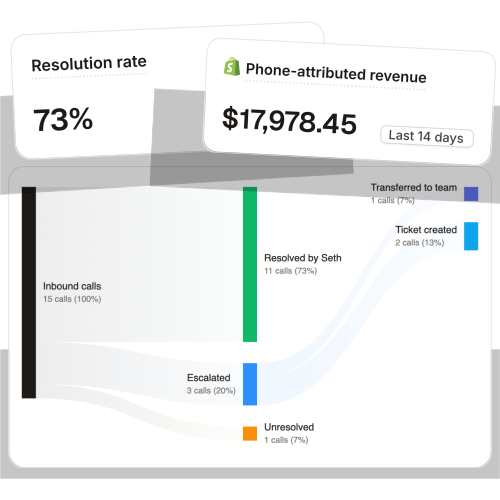
That call load is part of the returns operation, so route it like one. Ringly.io is AI phone support for Shopify brands: the AI answers inbound calls 24/7, looks up the order, checks return eligibility against your policy, starts the return or exchange, and reads back the refund status, all from your knowledge base. Across 50+ brands it resolves 73% of calls on its own, and the ones that need a human escalate cleanly to Gorgias, Richpanel, or whatever helpdesk you already run. WashCo, a Shopify brand we launched, recovered $22,664 in its first 7 days on the phone. The routine "where's my refund" call shouldn't cost a trained rep ten minutes when the answer is already in your system.
Pillar 3: who owns returns (the team and roles)
This is the pillar nobody writes about, and it's the one that quietly breaks most returns operations. Ask a brand "who owns returns" and you usually get a pause, then "well, kind of everyone". That's the problem. When everyone owns it, no one does.
At a $10M-$100M brand, returns touch four or five functions, and each needs a defined job:
- Program owner (Head of CX or COO). Owns the policy, the targets, and the monthly review. The single throat to choke.
- Customer service (3-12 reps). Front line for return requests, exceptions, and communication. This is where the call and ticket load lands.
- Warehouse and ops. Receives, inspects, grades, and dispositions. Works off the policy's condition rules.
- Finance. Issues refunds, reconciles them against returned inventory, and watches the cost-per-return line.
- Data (often the program owner moonlighting). Owns the dashboard and the return-reason mix.
The cost hides in the CS function. A US support rep runs about $4,000 a month loaded once you count salary, benefits, training, and the churn of replacing them. If returns and refund-status questions are a third of their day, you're paying a meaningful slice of that headcount to answer the same handful of questions. That's why scaling support without just hiring matters here. A returns program with no named owner doesn't have a returns problem, it has an accountability problem. Assign the five roles, write them down, and the chaos drops before you change a single tool. For the broader picture of how the support side fits, our guide to ecommerce customer service covers the staffing model.
Pillar 4: the metrics that actually run the program
You can't manage what you don't measure, and most brands measure exactly one returns number: the headline return rate. That's not enough to run anything. Here's the metric set that actually tells you where the program is leaking.
| Metric | What it tells you | Healthy target |
|---|---|---|
| Return rate | Demand-side health, by SKU and category | Below your category benchmark (apparel 25-40%, beauty 4-12%) |
| Return-to-resale % | How much returned inventory you recover at value | 70%+ back to sellable stock |
| Processing time | Days from receipt to resolution | Under 5 days |
| Cost per return | All-in handling spend per return | Trend it down quarter over quarter |
| Refund speed | Days from receipt to money back | Within 5 days (72% of shoppers expect this) |
| Return-reason mix | Why items come back, ranked | Track so you can fix the top cause |
| Fraud / abuse rate | Repeat and policy-abusing returns | Watch closely |
Two numbers deserve extra attention. Return fraud and abuse hit $103 billion in 2024, about 15.14% of all returns, so a rising repeat-return rate is a real signal, not noise. And the return-reason mix is your most actionable data, because it points straight at the fix. The brands that win at returns watch the reason mix as closely as the return rate, because that's the number you can actually do something about. For the full benchmark set, see our ecommerce returns KPIs breakdown and the 2026 return statistics.
"My customers also feel like it's a normal person. They feel like they can communicate if they have questions."
Claudia Droge, TechCraft Studio
Pillar 5: governance and reducing returns at the source
The first four pillars are the machine. Governance is the loop that improves it. Without it, you're just processing returns forever at whatever rate they come in.
The loop is simple to describe and hard to keep doing: review the metrics on a set cadence (weekly for the reason mix, monthly for the full set), trace the top return reasons back to their source, and fix the source. Then check next month whether the fix moved the number.
The cadence is what separates a real program from good intentions. Put the monthly returns review on the calendar with the program owner, one person from ops, and one from finance in the room. Twenty minutes. Walk the reason mix, pick the single biggest fixable cause, assign one fix with one owner and one due date, and confirm last month's fix actually landed. That's it. The brands that hold this meeting religiously are the ones whose return rate drifts down over a year instead of up.
Most of what you'll find traces to a handful of causes. Fit and size is the runaway #1, around 44% of returns and even higher in apparel, according to return-reason data. Damaged or defective items, "didn't match the description", and the wrong item shipped fill out most of the rest. Bracketing, where shoppers order multiple sizes meaning to return some, now runs at 58% of consumers, so part of your "returns problem" is really a sizing-confidence problem on the product page.
Fixing the source means better size guides, sharper PDP photos and copy, tighter QA, and better packaging. Our guides to reducing product returns and returns best practices go deep on the tactical side.
Now the cost side of the loop. Take a typical brand running a 6-rep CS team where returns and refund-status questions are a big share of the volume:
| Line item | Today | With Ringly |
|---|---|---|
| 6 reps × $4K loaded per rep | $24,000/mo | n/a |
| Ringly (~$5K/mo) | n/a | $5,000/mo |
| Net monthly CS spend | $24,000/mo | $5,000/mo |
| Monthly savings | n/a | $19,000/mo |
| Annual savings | n/a | $228,000/yr |
That's roughly 70% of repeatable calls, order status, return eligibility, refund status, the same things over and over, routed to the AI. The other 30%, the genuinely complex returns and the upset customer who needs a human, still go to your team, who now have the time to actually handle them well.
If returns calls are quietly funding a chunk of your support payroll, book a 30-min call and we'll run those numbers against your real call volume.
Frequently asked questions
What is ecommerce returns management? It's the full operating model for handling products customers send back, from the return request through inspection, refund or exchange, and restock or disposal. Done well, it runs as a system across policy, tools, team, and metrics rather than as a one-off response to each return.
Who should own returns in a DTC brand? One person, usually the Head of CX or COO, should own the policy, the targets, and the monthly review. The actual work spreads across CS, warehouse, and finance, but a single named owner is what keeps it from turning into "everyone's job, so nobody's job".
What's a good ecommerce return rate? It depends heavily on category. Overall ecommerce averages 19-20.5%, DTC sits around 14%, apparel runs 25-40%, and beauty stays closer to 4-12%. Compare yourself to your category, not the blended average.
What does it cost to process a return? Between $10 and $65 per return once you add inbound shipping, warehouse labor, inspection, and restocking. The hidden cost on top is the support time spent answering return and refund-status questions, which most brands never put a number on.
Returns management vs reverse logistics, what's the difference? Returns management is the decision and customer side: policy, approvals, refunds, communication. Reverse logistics is the physical side: getting the item back, inspecting it, and routing it to resale or disposal. You need both, run by different owners.
How do you handle the volume of return and refund-status calls? Route the repeatable ones to an AI phone agent that can look up the order, check eligibility, and read back refund status 24/7, and escalate the complex ones to your team. That keeps trained reps off "where's my refund" and on the calls that actually need judgment.
How do you reduce returns without making the policy stingy? Fix the source instead of tightening the policy. Most returns trace to fit, damage, or description mismatch, so better size guides, sharper PDP content, and tighter QA cut returns without punishing good customers, which protects repeat purchase.
Talk to us

If returns and refund-status calls are eating your team's day, a 30-min call is the fastest way to see what that load is actually costing you. We'll look at your real call volume and show you what an AI phone agent would take off your reps' plates.
The 3-layer guarantee.
- Live in 14 days or it's free until launched.
- 65% resolution in 90 days or we refund the last 3 months of subscription fees.
- We keep working free until we hit 65%.
Ruben (Ringly co-founder) takes these calls personally.