
Three ways to wire Gorgias into the rest of your stack, and the one channel its AI still can't touch.
- Native App Store: one-click installs for Shopify, Klaviyo, Recharge, and 100+ tools that already have an official app.
- HTTP integration and Zapier/Make: connect anything with a public API, or chain Gorgias to 9,000+ apps with no code.
- The gap nobody calls an integration: Gorgias's AI works on text, not voice. Built for $10M-$100M Shopify brands running Gorgias with a visible phone number.
If you run support at a Shopify brand doing $10M-$100M, your Gorgias instance is rarely the problem. The problem is everything it doesn't talk to yet: the OMS, the 3PL, the loyalty tool, the phone line ringing while your reps answer the same five questions over and over. Gorgias gives you three real ways to fix that. Most teams only know about one of them.
Most $10M-$100M Shopify brands run Gorgias plus a paid stack around it, and the connections between them are where the time leaks. We build AI phone agents for 50+ Shopify brands trying to close one specific leak: the calls. Book a 30-min call and we'll map which of these connections actually moves your numbers.
The three ways to connect Gorgias to other apps
There are exactly three. Pick by how much the app you're connecting already meets Gorgias halfway.
| Method | Code needed? | Best for | Example |
|---|---|---|---|
| Native App Store | None | Tools with an official Gorgias app | Shopify, Klaviyo, Recharge, Loop |
| Zapier / Make | None | Tools with no native app | Google Sheets, Slack, custom OMS |
| HTTP integration / API | Light | Public API, no native app, or a custom sidebar widget | In-house 3PL, loyalty platform |
The rule of thumb: try the App Store first, fall back to Zapier, and reach for the HTTP integration only when you need a custom sidebar widget or there's an API but no Zapier path. Everything below is just the detail under that one sentence.
How I tested each connection method
I'm Ruben, co-founder of Ringly. I set up all three connection types on a test Gorgias account and timed each one against a real Shopify ops workflow.
- Native app: under five minutes, no credentials beyond a login.
- Zapier zap: about fifteen minutes once I had the third-party account connected.
- HTTP integration: roughly thirty minutes, mostly spent finding the third-party API key and mapping fields.
One thing stood out, and none of the official docs frame it as an integration: the phone line. Gorgias's AI Agent only fires on text channels, so every inbound call still rings straight to a human. More on that below, because for a brand with real call volume it's the connection that matters most.
1. Native App Store integrations
This is the path Gorgias wants you to use, and for good reason. The App Store has 100+ plug-and-play apps that connect in a few clicks with no code.
To install one: open Settings, go to App Store, then All apps, find the tool you want, and click to connect. That's the whole process for anything with an official app (Gorgias App Store docs).
For a DTC ops stack, the native apps that earn their place are the ones that put live data in the ticket sidebar:
- Shopify: pulls order, fulfillment, and customer data into every ticket so reps stop tab-switching. See our Gorgias Shopify integration guide for the full setup.
- Klaviyo: surfaces a customer's email and flow history next to the conversation. (If you're reevaluating it, see our Klaviyo alternatives.)
- Recharge: lets reps see and manage subscription status without leaving Gorgias.
- Loop, Yotpo, Attentive, and 3PL connectors: returns, reviews, SMS, and shipping data, all in the sidebar.
If the tool you need has a native app, stop here. The App Store is faster, more stable, and easier to hand to a non-technical teammate than anything you'd build yourself.
2. HTTP integration: connect any app with a public API
When the app you want isn't in the App Store but has a public API, the HTTP integration is your path. It connects any third-party tool to Gorgias and can pull that tool's data into a custom sidebar widget.
To set one up: click the Settings icon at the bottom-left, go to Account, then HTTP integration, open the Manage tab, and choose Add HTTP integration (Gorgias HTTP integration docs). You'll configure:
- URL: the third-party endpoint you're calling.
- HTTP method: GET, POST, PUT, or DELETE, depending on what the API needs.
- Request content type: application/json or application/x-www-form-urlencoded for anything that isn't a GET.
- Authentication: either a header like Authorization: Bearer
or full OAuth2 with a token URL, client ID, and client secret. - Trigger events: pick which ticket events fire the call, such as Ticket created, Ticket updated, or Ticket message created.
The part that makes this useful for ops: you can drop Gorgias template variables like {{ticket.customer.email}} straight into the URL or body, so each call carries the right customer's data. The response can then render as a widget in the ticket sidebar.
Under the hood this is the same surface as the Gorgias REST API, which exposes tickets, customers, messages, events, and integrations as objects you can read and write.
Reach for the HTTP integration when you have an in-house tool, a custom 3PL, or a loyalty platform with an API but no native app. It's the only method that gets custom data into the sidebar where your reps actually look.
3. Zapier and Make: connect to thousands of apps
If the app has no native Gorgias app and you'd rather not touch an API directly, Zapier is the middle path. Gorgias connects to 9,000+ apps on Zapier, and a ticket being created or updated can fire a zap automatically (Zapier Gorgias integrations).
It works in both directions:
- Out of Gorgias: set up an HTTP integration that POSTs to a Zapier webhook URL, then let Zapier do the rest. Log every ticket to Google Sheets, post a Slack alert when a VIP writes in, or push a refund into your OMS.
- Into Gorgias: grab your Base API URL, username, and password from Settings, then You, then REST API. In Zapier, use Webhooks by Zapier with a Custom Request set to POST to {{base API URL}}/tickets with Basic Auth (Gorgias Zapier docs).
Make works the same way and often costs less at high zap volume. Use Zapier or Make when you want to chain Gorgias to a tool nobody's built a native app for, and you don't need anything showing up inside the ticket sidebar.
The one connection most brands miss: the phone line
Here's what the integration docs leave out. Gorgias's AI Agent only works on text channels, so email, chat, and social get automated while every phone call still needs a human to pick up (eesel's Gorgias phone guide). The Voice add-on exists, but it's basic: no AI on calls, no answering from the mobile app, and geographic dialing limits.
For a brand with real call volume, the phone line is the connection worth fixing, because it's the one your helpdesk's own AI can't touch. WISMO alone is 30-40% of support tickets and over 50% at peak (Salesforce), and a big share of that comes in by phone from customers who don't want to dig through a tracking page.
This is where an AI phone agent connects alongside Gorgias instead of replacing it.
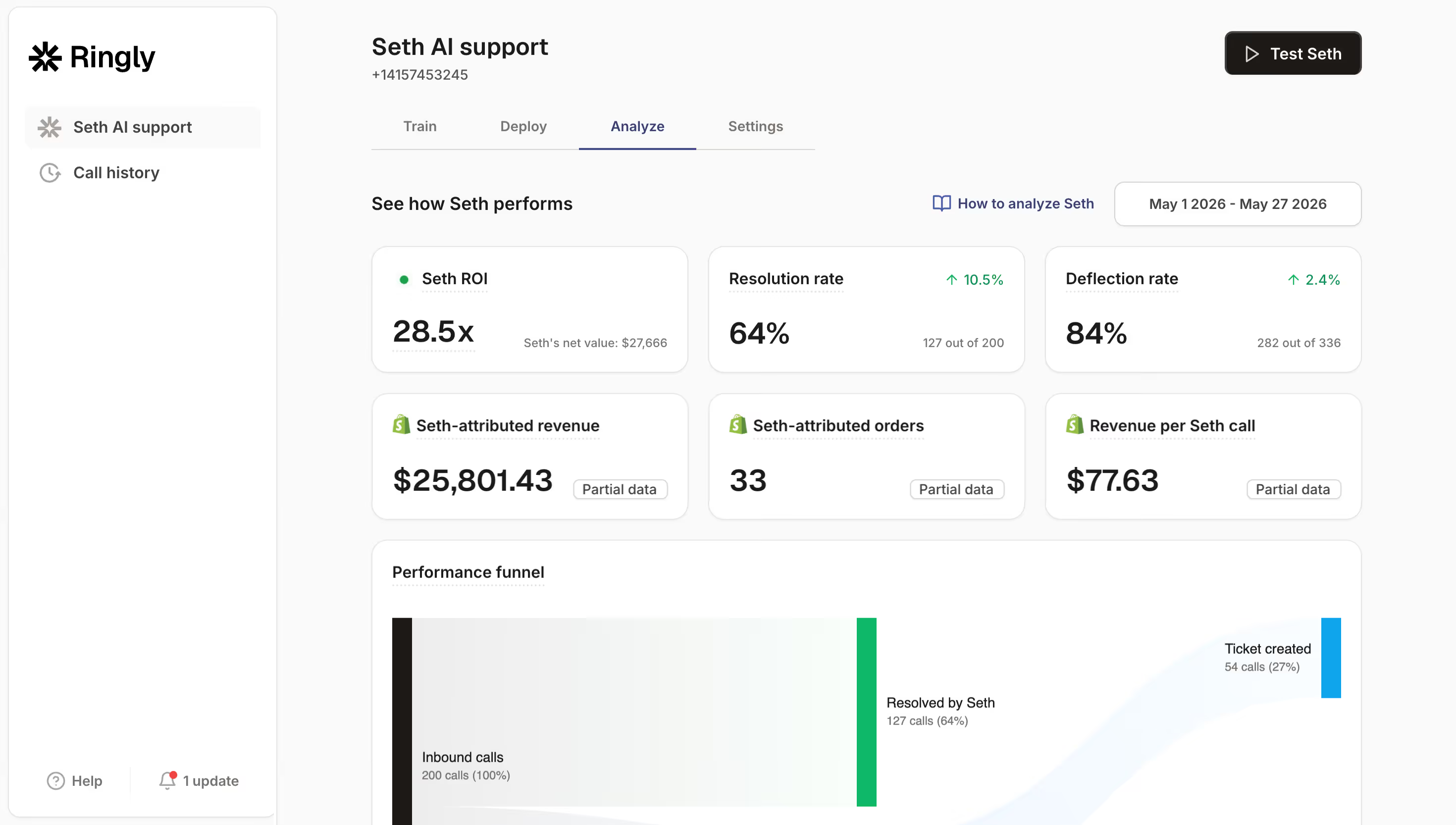
Ringly.io is AI phone support for Shopify brands. Instead of routing every call to a rep, the AI answers inbound calls 24/7: order status, returns, product questions from your knowledge base, and abandoned-cart follow-up. Across 50+ brands, the AI resolves 73% of calls autonomously at roughly $0.42 per resolved call. The calls that need a person escalate cleanly into Gorgias, so you keep your number, your helpdesk, and your workflows.
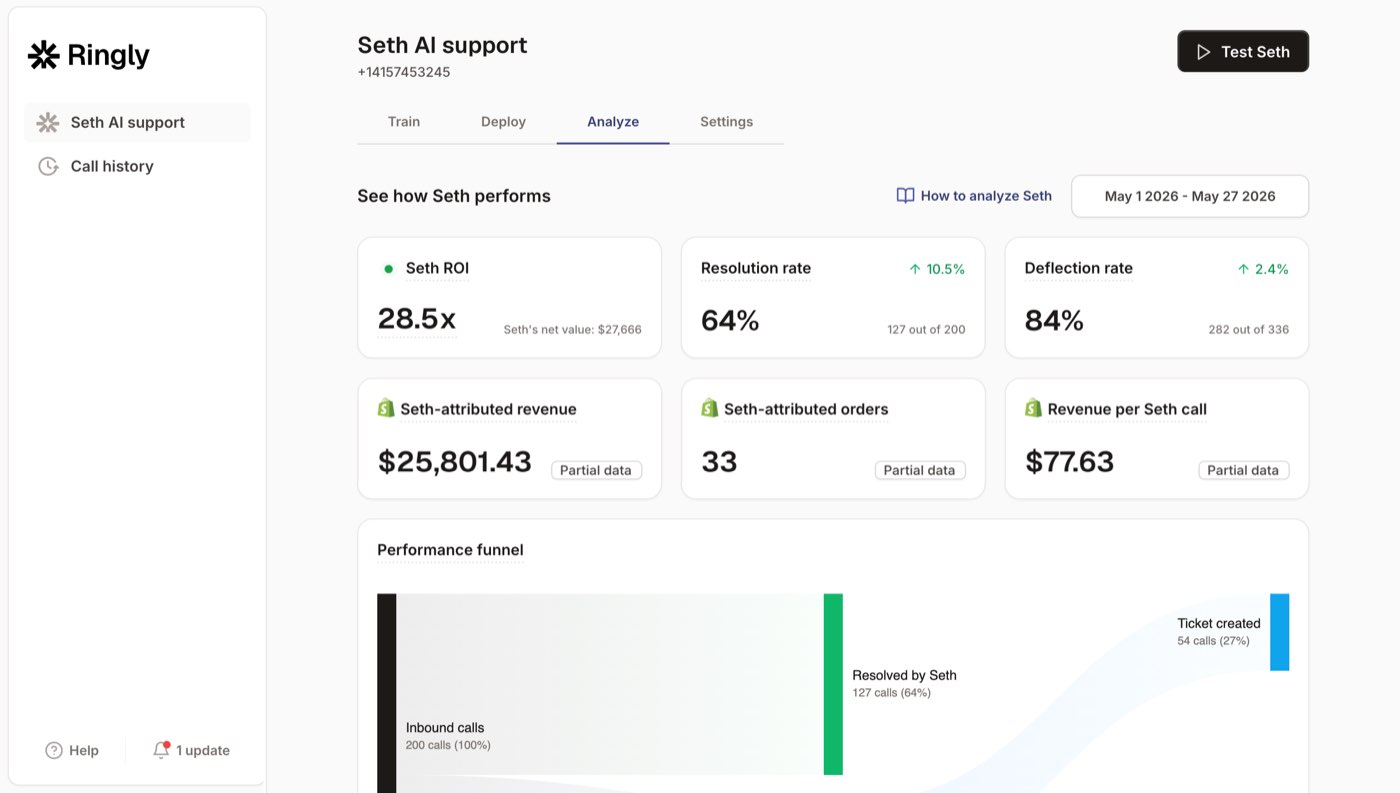
WashCo, a Shopify brand we launched, recovered $22,664 in its first 7 days on the phone. It sits in front of Gorgias the same way a native app does: the routine calls get handled, the hard ones land in the ticket queue you already run. If you've been bolting on voice agents for Shopify one Zapier hack at a time, this is the cleaner connection. Our Gorgias Sidekick alternatives breakdown covers why text-channel AI and phone AI are different problems.
What connecting the phone actually saves you
Connecting integrations is about saving your team time. The phone connection is where that turns into real money. Take a typical brand running a 6-rep CS team:
| Line item | Today | With a phone AI |
|---|---|---|
| 6 reps × $4K loaded per rep | $24,000/mo | n/a |
| AI phone agent (illustrative) | n/a | ~$5,000/mo |
| Net monthly CS spend | $24,000/mo | $5,000/mo |
| Monthly savings | n/a | $19,000/mo |
| Annual savings | n/a | $228,000/yr |
That's roughly 70% of repeatable calls (order status, returns, the same five questions all day) routed to the AI. The other 30%, the genuinely complex ones, still go to your CS team, who now have time to actually solve them. For reference, the industry comparison on a resolved call is $0.42 with an AI versus $7-$16 per call for human BPO.
Want to run these numbers against your real call volume? Book a 30-min call and we'll do the math live.
How to choose the right method
Most brands need two or three of these, not one. The quick decision:
- Choose the native App Store if the tool has an official Gorgias app. It's the fastest, most stable path and any teammate can do it.
- Choose Zapier or Make if there's no native app and you just need data moving between systems, not showing in the sidebar.
- Choose the HTTP integration if the tool has a public API but no native app, or you need its data in a custom ticket-sidebar widget.
- Connect a phone AI if you get meaningful call volume, because that's the channel Gorgias's own AI won't cover. Start with how AI phone agents for Shopify handle 24/7 ecommerce phone support.
Frequently asked questions
How do I connect an app that isn't in the Gorgias App Store? Use Zapier or Make if the app is on those platforms, which covers 9,000+ apps through Zapier alone. If it has a public API but no Zapier path, build a Gorgias HTTP integration instead.
Do I need a developer to connect Gorgias to other apps? Not for native apps or Zapier, both of which are no-code. The HTTP integration is light technical work: you'll need the third-party's API key and to map a few fields, but no actual coding.
Will adding integrations break my existing Gorgias setup? No. Integrations sit alongside your current setup and pull or push data based on ticket events. Your tickets, macros, and rules keep working exactly as they did.
Can Gorgias handle phone calls with AI? Not on its own. Gorgias's AI Agent works on text channels only, and its Voice add-on has no AI, so calls still need a human. To automate the phone line you connect a dedicated AI phone agent that escalates into Gorgias.
How do I connect a phone AI to Gorgias? A phone AI like Ringly sits in front of your number, handles the routine calls, and escalates anything complex into Gorgias as a ticket. You keep your phone number, your helpdesk, and your existing customer service workflows.
What's the difference between an HTTP integration and the REST API? The HTTP integration is a no-deploy way to call another tool's API from inside Gorgias and show the result in the sidebar. The Gorgias REST API is the broader programmatic surface for reading and writing tickets, customers, and events from your own code.
Talk to us

If you run a $10M-$100M Shopify brand on Gorgias and the phone line is still eating rep hours after-hours, a 30-min call is the fastest way to see what you're leaving on the table.
The 3-layer guarantee.
- Live in 14 days or it's free until launched.
- 65% resolution in 90 days or we refund the last 3 months of subscription fees.
- We keep working free until we hit 65%.
Ruben (Ringly co-founder) takes these calls personally.