
The short version.
- Tighten the policy on high-risk SKUs, wire four detection red flags into your process, and put one verification step in front of every refund or return you approve.
- The step almost everyone skips is the contact itself: the call or ticket where the customer asks for the money back. That is where fraud gets caught, or waved through.
- Built for founders and Heads of CX at $10M-$100M Shopify brands who already run a support team and a phone line.
Refund fraud is the easiest money to take from a DTC brand. No break-in, no stolen card, just a refund request your team approves on autopilot because the queue is long and the order is only $60. Multiply that by a few hundred a month and it stops being rounding error.
If you run support at a $10M-$100M Shopify brand, you already feel this. Returns climb every year, the policy says "no questions asked" because marketing wanted a frictionless checkout, and your reps wave through worn-once dresses and "the box was empty" claims because nobody has time to argue over a $40 order on a Monday.
Here is the operator version of the fix, written for the brand that has a real support team and a real phone line, not a generic "install fraud software" pitch. Most $10M+ Shopify brands run a support queue that catches calls all day and a refund process that nobody screens after 6 p.m. We've built AI phone agents for 50+ Shopify brands trying to close that gap. Book a 30-min call and we'll walk through where your refund queue is leaking.
The short answer
You prevent refund fraud on Shopify with three layers that stack: a policy that does not invite abuse, a short list of detection red flags that route risky returns to a human, and a verification step on the contact before you approve the refund.
The reason this matters: fraudulent returns cost retailers $103 billion in 2024, and 15.14% of all returns were deemed fraudulent, up from 13.7% the year before, according to the Appriss Retail and Deloitte 2024 Consumer Returns report. For every $100 in returned merchandise, retailers lose $10.30 to fraud, per Shopify's own return-fraud research.
No single layer stops refund fraud on its own. The policy sets the rules, the red flags decide who gets screened, and the verification step on the contact is where the screen actually happens. Skip the third one and the first two are just paperwork.
The 4 kinds of refund fraud you actually see
Shopify lists ten types of return fraud. You do not need all ten. At a DTC Shopify brand, four of them account for almost everything that hits your phone and your returns queue.
Wardrobing. The customer buys it, wears it once, and sends it back for a full refund with the tags conveniently missing. It is the single most common form of return fraud, roughly 60% of cases by most industry counts. Apparel, formalwear, and seasonal gear get hit hardest.
Empty box and open box. The customer claims the parcel arrived empty, or returns a used item as new. The tell is almost always the weight. A return that should weigh two kilos shows up as 200 grams on the inbound scan, and you know before anyone opens it.
Friendly fraud. The customer gets the product, then files a chargeback with their bank claiming they never got it, or never authorized it. They keep the item and the money. This one bypasses your return process entirely and lands as a dispute, which is why chargeback prevention is its own workflow.
Serial returns. One person who returns far more than they keep, often running several accounts off the same address, card, or device to dodge your per-customer return limit. Each individual return looks fine. The pattern is the fraud, and it is the hardest to catch without a process for spotting fraudulent returns.
The four types share one trait: each one is cheap to commit and, for most brands, free to get away with, because nobody is screening the refund before it goes out. That is the gap the rest of this playbook closes.
Detection red flags to wire into your process
Before you can screen anything, you need to know which returns deserve a closer look. You are not screening every refund. You are routing the risky ones to a human and auto-approving the rest, which is the core of any workable ecommerce fraud prevention setup.
Here are the flags worth wiring into your returns process:
- Time-to-return under 48 hours on a use-once category. A formal dress returned two days after a Saturday delivery is the wardrobing signature.
- More than three returns in 90 days from one account. Three is the line where a good customer becomes a serial returner worth a manual look.
- Address, payment, or device clustering. Several "different" accounts sharing one address or card means someone is gaming your per-customer limit.
- Weight mismatch on the inbound parcel. The empty-box tell, caught at the warehouse scan before anyone opens the box.
- No receipt or order confirmation. Non-receipted returns are fraudulent 16.6% of the time versus 3.6% with a receipt, per Shopify. Always require proof of purchase.
One return hitting one flag is noise. One return hitting two or more should never auto-approve. Route those to a human and let everything clean pass through untouched, so you are not adding friction for the 90% of customers who are honest.
Fix the policy first
The policy is the cheapest layer and the one most brands get wrong, because the marketing team wrote it to remove checkout friction, not to stop abuse. You do not need a scorched-earth no-refunds policy. You need a few targeted levers, most of which Signifyd and Shopify both recommend.
- Shorten the window on high-risk SKUs. Thirty to ninety days is typical, but use 15 to 30 days on apparel, electronics, and anything wardrobing-prone.
- Default to store credit or exchange, not cash, on worn items. If the tags are off, the customer gets credit, not their money back. This kills most wardrobing economics.
- Require a photo for damage claims. A real customer sends the photo in 20 seconds. A fraudster goes quiet. That one ask clears a big slice of fake damage claims for free.
- Add a restocking fee on high-value goods and exclude final-sale, personalized, and perishable items from returns entirely.
- Require return authorization on high-ticket orders so you can look at the order before the refund is in motion, not after.
Here is the honest part. Policy alone loses you good customers if you go too far, and it does nothing about the friendly-fraud chargeback that skips your return flow. A tight Shopify refund policy plus a clean self-serve returns flow is the floor, not the whole house. The screening has to happen on the contact.
The step everyone skips: verify on the contact
We listened to refund and return calls across 50+ Shopify brands on Ringly. The fraud almost never gets caught at the warehouse. It gets caught, or waved through, on the contact, by whether the rep asked the qualifying questions or not.
Think about how a refund actually happens at your brand. The customer calls or opens a ticket. They ask for the money back. And somewhere in that 90-second exchange, a person on your team decides whether to approve it. That moment is your real fraud filter, and most brands have no script for it.
A consistent verification step on the refund contact looks like this:
- Confirm identity and pull the order number out loud. You'd be surprised how often "I never got it" softens once the caller hears you reading their delivery confirmation back.
- Ask the return reason in their own words. A genuine reason is specific. A vague one ("it just didn't work out" on a two-day-old electronics return) is a flag.
- Request the photo for any damage or empty-box claim, on the call. Same filter as the policy, applied live.
- Check return history before you commit. If this is their fourth return in 90 days, that changes the answer.
- Flag, don't accuse. The honest customer never notices the questions. The serial returner hears them and quietly disappears.
The problem is not that your team can't do this. It is that they can't do it consistently when the queue is 200 deep and two reps called out sick. Under load, the script is the first thing that gets dropped, and that is exactly when fraud walks through.
This is where an AI phone agent changes the math. Ringly.io is AI phone support for Shopify brands. Instead of growing your support headcount every time call volume goes up, the AI takes the routine inbound calls, including the refund, return, and where's-my-order calls, and it asks the same qualifying questions on every single one.
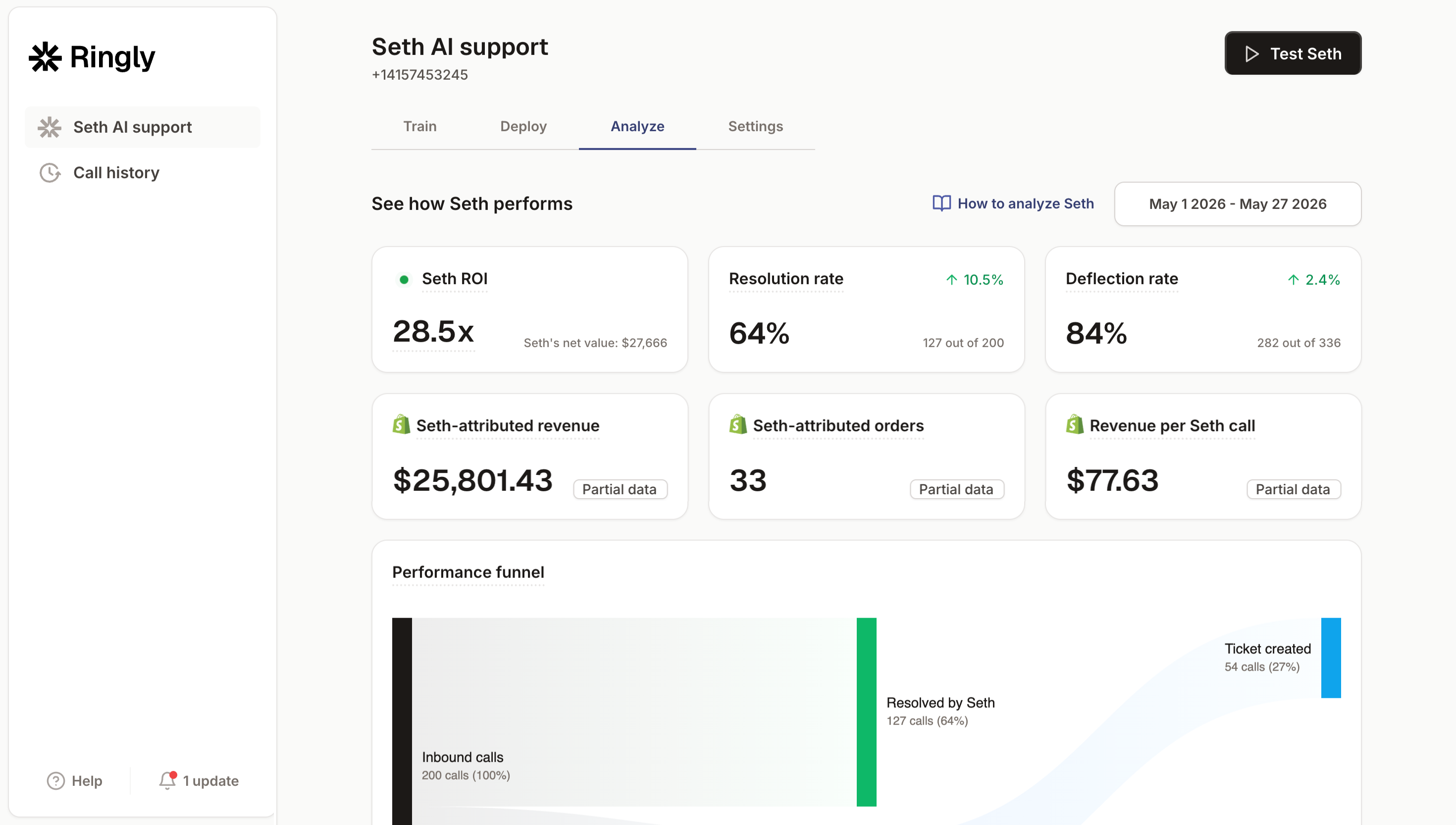
The AI answers calls 24/7, finds the order in your Shopify store, confirms identity, reads back the delivery status, asks the return reason, and applies your rules the same way at 2 a.m. as it does at 2 p.m. When a call hits your flags, it escalates cleanly to a human on your team via Gorgias, Richpanel, Reamaze, or whatever helpdesk you already run. Across 50+ brands, the AI resolves 73% of inbound calls autonomously at roughly $0.42 per resolved call. It is not a fraud-software replacement. It is the consistent human-side filter that sits in front of the refund button, on every call, even when your team is buried.
"My customers also feel like it's a normal person. They feel like they can communicate if they have questions."
Claudia Droge, TechCraft Studio
If your refund queue runs on autopilot after hours, book a 30-min call and we'll review where it's leaking.
What this costs you versus what it saves
Refund fraud is half the math. The other half is what you pay a team to handle the refund and return calls in the first place. Take a typical $50M Shopify brand running a 6-rep support team:
| Line item | Today | With Ringly |
|---|---|---|
| 6 reps x $4K loaded per rep | $24,000/mo | n/a |
| Ringly (illustrative) | n/a | ~$5,000/mo |
| Net monthly support spend | $24,000/mo | $5,000/mo |
| Monthly savings | n/a | ~$19,000/mo |
That is roughly 70% of repeatable calls, including refund status, return requests, and order questions, routed to the AI with the fraud-screen questions baked in. The other 30%, the complex or flagged calls, still go to your team, who now have time to actually work them. Each return already costs $25 to $30 to process once shipping and handling are counted, so the screening pays for itself fast when it stops even a handful of fraudulent refunds a week.
WashCo, a Shopify brand we launched, recovered $22,664 in its first 7 days on the phone, which is the kind of money that walks out the door when the refund queue runs unscreened.
Want the version with your numbers? Book a 30-min call and we'll do the math live.
Frequently asked questions
How do I prove wardrobing on a Shopify return? You usually cannot prove it outright, so you make it not worth their while. Require items to come back with tags on and in resellable condition, default worn items to store credit instead of a cash refund, and flag any use-once item returned within 48 hours for a manual look. The economics, not a courtroom, are what stop it.
Can I refuse a refund for return fraud on Shopify? Yes, if your published return policy supports it and you apply it consistently. You can deny returns that fall outside your window, lack proof of purchase, or violate a stated condition like "tags removed." The key is that the rule has to exist in writing before the return, not get invented at the moment you want to say no.
What is the best return window to stop fraud? For high-risk categories like apparel and electronics, 15 to 30 days is the sweet spot. It is long enough to feel fair to honest buyers and short enough to make wardrobing and bracketing harder to pull off. Lower-risk SKUs can keep a longer window without much added fraud exposure.
How do I stop friendly-fraud chargebacks? Friendly fraud skips your return flow, so the defense is documentation: delivery confirmation, the verification-call record, and clear order notes you can submit to the bank. A chargeback guarantee or dispute-management tool helps recover the funds after the fact, but confirming identity and order on the original contact is what prevents the easy ones.
Does a phone agent really catch refund fraud? It catches the fraud that depends on inconsistency. A human team skips the qualifying questions when the queue is full, which is exactly when fraudsters call. An AI phone agent asks identity, order, and return-reason questions on every call and logs the flag, so the screen never drops just because it is a busy Monday.
Should I use fraud-detection software too? For high-risk, high-AOV SKUs, yes. Software is good at the data-pattern flags, like device clustering and velocity, that a human cannot eyeball. Just know that only about 45% of retailers find their fraud tools effective on their own, so pair the software with the policy and the verification step rather than treating it as a silver bullet.
How does Ringly handle refund and return calls? Ringly answers inbound calls 24/7, finds the order in your Shopify store, confirms identity, reads back delivery status, asks the return reason, and applies your return rules consistently. Flagged or complex calls escalate to your team via your existing helpdesk. It resolves 73% of calls autonomously across 50+ brands and goes live in under an hour.
Talk to us

If you run a $10M-$100M Shopify brand and your refund queue runs on autopilot after 6 p.m., a 30-min call is the fastest way to see where the leaks are. We'll look at how your refund and return calls get handled today and where a consistent verification step would catch what you're currently waving through.
The 3-layer guarantee.
- Live in 14 days or it's free until launched.
- 65% resolution in 90 days or we refund the last 3 months of subscription fees.
- We keep working free until we hit 65%.
Ruben (Ringly co-founder) takes these calls personally.