

Running a phone line for a gourmet brand has a price tag most founders never actually add up.
- Most of the calls are not complaints. They're ship-by, gift-ETA, and order-status questions, plus older customers who want to place an order by voice.
- The true cost isn't your year-round reps. It's the year-round reps plus the seasonal temps you hire every Q4 plus the after-hours calls that roll to voicemail and never get returned.
- Built for $10M-$100M Shopify specialty-food and gourmet brands with a visible phone line. There are three ways to cover it, and we'll do the math on all three.
It's the second week of December. A specialty-food brand's phone line is lit up from the moment the office opens. Caller one wants to know if the gift box ships in time for the 24th. Caller two ordered the dark roast for her dad and wants to change the address. Caller three is 71 and would rather read his card number to a person than type it into a checkout page. None of these are angry. None of them are hard. They're just constant, and there are only two reps on the line.
If you run customer experience or operations at a gourmet or specialty-food brand on Shopify doing $10M-$100M, you already know this queue. The phone is mostly a logistics-status line that goes quiet in February and triples in December, and the seasonal spike is the part nobody budgets for honestly. We've launched AI phone agents for 50+ Shopify brands with exactly this pattern. Book a 30-min call and we'll pull your last week of missed calls and show you what they actually were.
What gourmet customers actually call about
Here's the thing most cost conversations skip: before you can decide how to cover a phone line, you have to know what's coming in on it.
I read through 50+ real call logs from specialty-food and coffee brands running Ringly and counted how many were a simple ship-by, gift-ETA, or order-status question versus an actual problem. It was most of them. The phone for a gourmet brand isn't a complaints desk. It's a delivery-timing desk with a gifting season bolted on.
The recurring calls break down into a handful of buckets:
- Ship-by and freshness questions. "When does the coffee ship and will it still be fresh when it lands?" Roast date, harvest, cold-chain. These spike hard from November on.
- Gift-order logistics. Address changes, "will it arrive by the 24th", gift notes. A gift order carries more anxiety than a self-purchase because the customer can't fix a problem themselves on the other end.
- Order status, the same questions over and over. Plain where's-my-order calls. WISMO is 30-40% of all support tickets in normal periods and over 50% at peak, according to Salesforce.
- Phone orders from older buyers. A real slice of gourmet customers won't place an order on the website at all. They call to read you the order, and they expect a person.
- The genuinely hard one. A perishable gift arrives spoiled or late. Public reviews of large food brands are full of these: a cake that showed up late and not packed in dry ice, a perishable box ruined after 50 hours in transit. That call needs a human, fast.
The math that matters: roughly 70-80% of a gourmet brand's phone volume is the routine logistics call, and the routine call is the one you're overpaying a trained rep to answer. The spoiled-gift call is the 20% that actually needs your team's judgment.
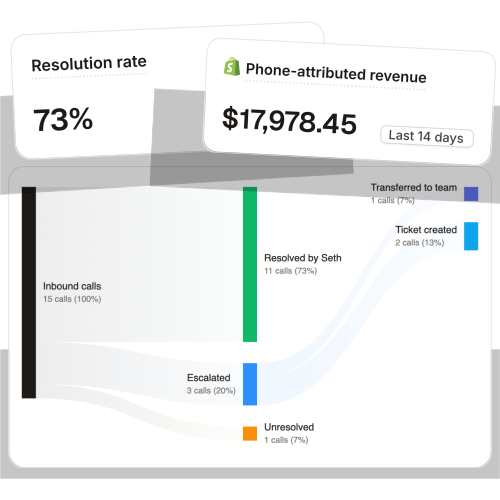
This split is the whole reason the cost question has a better answer than "hire more reps." For the broader pattern across stores, our ecommerce phone support breakdown covers it, and the WISMO calls guide goes deep on the order-status piece specifically.
The real cost of staffing that line
Now the part founders skip. Add up what a phone line actually costs a specialty-food brand and it's never just the reps you see on the org chart.
A loaded US customer service rep runs about $4,000 a month once you count salary, benefits, payroll tax, training, and the shrinkage from sick days and ramp time. Industry benchmarks put a fully-loaded rep at $55,000 to $73,000 a year. A small gourmet brand might run three or four reps year-round to keep the line covered.
Then comes the layer nobody budgets honestly: the seasonal temps. The true cost of a gourmet phone line isn't your steady-state team. It's that team plus the four temps you scramble to hire every Q4, plus the replacement cost when half of them churn out by February. Replacing a single CS rep costs $14,113 (Gartner, via Insignia), and the industry turns over 31.2% of its agents a year.
If you outsource instead of hiring, US-based call center agents run $29 to $42 an hour in 2026, offshore $7 to $16. Cheaper per hour, but you trade away brand voice and you're still paying for idle capacity nine months out of twelve.
| Cost line | What it really runs |
|---|---|
| Year-round reps (4 × $4K loaded) | $16,000/mo · $192,000/yr |
| Seasonal Q4 temps (4 × $4K × 3 mo) | ~$48,000/yr |
| Replacing churned reps (31.2% turnover) | $14,113 each |
| True annual phone-support spend | ~$240,000/yr |
That $240K is the number to keep in your head for the rest of this post. It's the real cost of the line, not the line item finance sees.
The after-hours and gifting-spike leak
There's a second cost, and it doesn't show up on payroll at all. It shows up as revenue you never see.
Between 30 and 40% of missed business calls happen outside business hours. Your gourmet customer placing a last-minute gift order at 9pm on a Tuesday in December hits voicemail. And here's the brutal part: 85% of callers who can't reach a person never call back, and 62% switch to a competitor, per the PCN missed-call study. Most businesses answer only 37.8% of their inbound calls in the first place (AmbsCallCenter).
For a gift brand that sting is double. A missed gift-ETA call at 9pm isn't just a lost sale. It's often a refund AND a customer who tells the recipient the gift was late. The FTC's gift-delivery rule says if you can't ship within the window you promised, you owe the buyer the choice to cancel for a full refund. During gifting season, that voicemail you never returned can turn into a chargeback.
This is where the recovered-revenue math gets concrete. WashCo, a Shopify brand we launched recently, generated $22,664 in attributed revenue in the first 7 days post-launch, handling 271 calls at 85% deflection and $0.91 per call versus $2.70 for a human-handled one. Those were calls that used to leak. If you want to see what an after-hours answering service looks like when it's built for ecommerce, that's the shape of it.
Three ways to cover a gourmet phone line
So you've got the routine-call problem and the after-hours leak. There are really only three ways to solve them, and they cost very different things.
1. Staff it year-round plus seasonal temps
The default. You hire for the December peak and eat the idle cost the rest of the year. It keeps your brand voice and your older callers get a person. But it's the ~$240K/yr path, the temps churn, and the line still goes dark after 6pm and on weekends unless you pay a night shift to sit mostly idle.
2. Outsource to a BPO
You hand the line to a call center at $29-42/hr (US) or $7-16/hr (offshore). Cheaper than hiring, scales for the holidays. But you lose control of the voice, the agents don't know roast dates from harvest dates without a training cycle, and quality drops exactly when volume spikes. Our outsourced Shopify customer service and BPO for Shopify guides cover the trade-offs in full.
3. Put an AI phone agent in front of your helpdesk
The AI answers 24/7, handles the routine ship-by, gift-ETA, and order-status calls, and escalates the spoiled-gift call to your team. You keep your phone number, your helpdesk like Gorgias, and your workflows. It doesn't churn and it doesn't go idle in February.
| Option | Cost shape | After-hours? | Seasonal scaling | Best fit |
|---|---|---|---|---|
| Year-round + temps | ~$240K/yr | No (unless night shift) | Manual hiring scramble | Brands that must have a person on every call |
| BPO outsource | $29-42/hr US | Optional, extra | Contract-based | Brands fine trading voice for cost |
| AI phone agent | ~$3K-$5K/mo | Yes, built in | Automatic | $10M-$100M brands keeping a helpdesk + phone line |
The honest read: for a $10M-$100M gourmet brand, option 3 covers the 70-80% routine volume and frees your team for the calls that actually need them. You stop paying full freight for someone to read tracking numbers out loud.
How Ringly handles the gourmet phone line
Best for: $10M-$100M Shopify specialty-food and gourmet brands that want phone coverage without hiring a seasonal team every Q4. Ringly.io is AI phone support for Shopify brands.
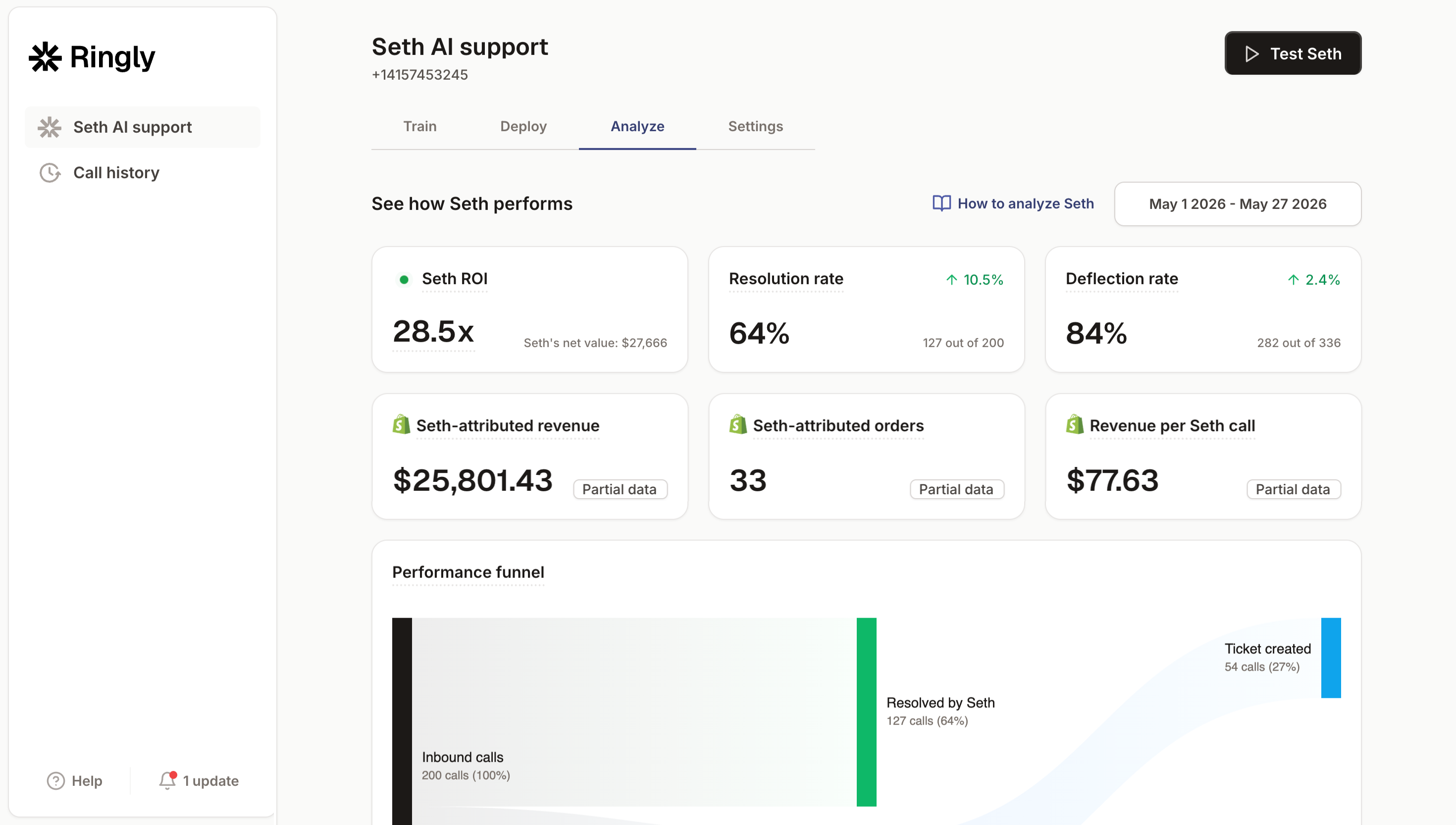
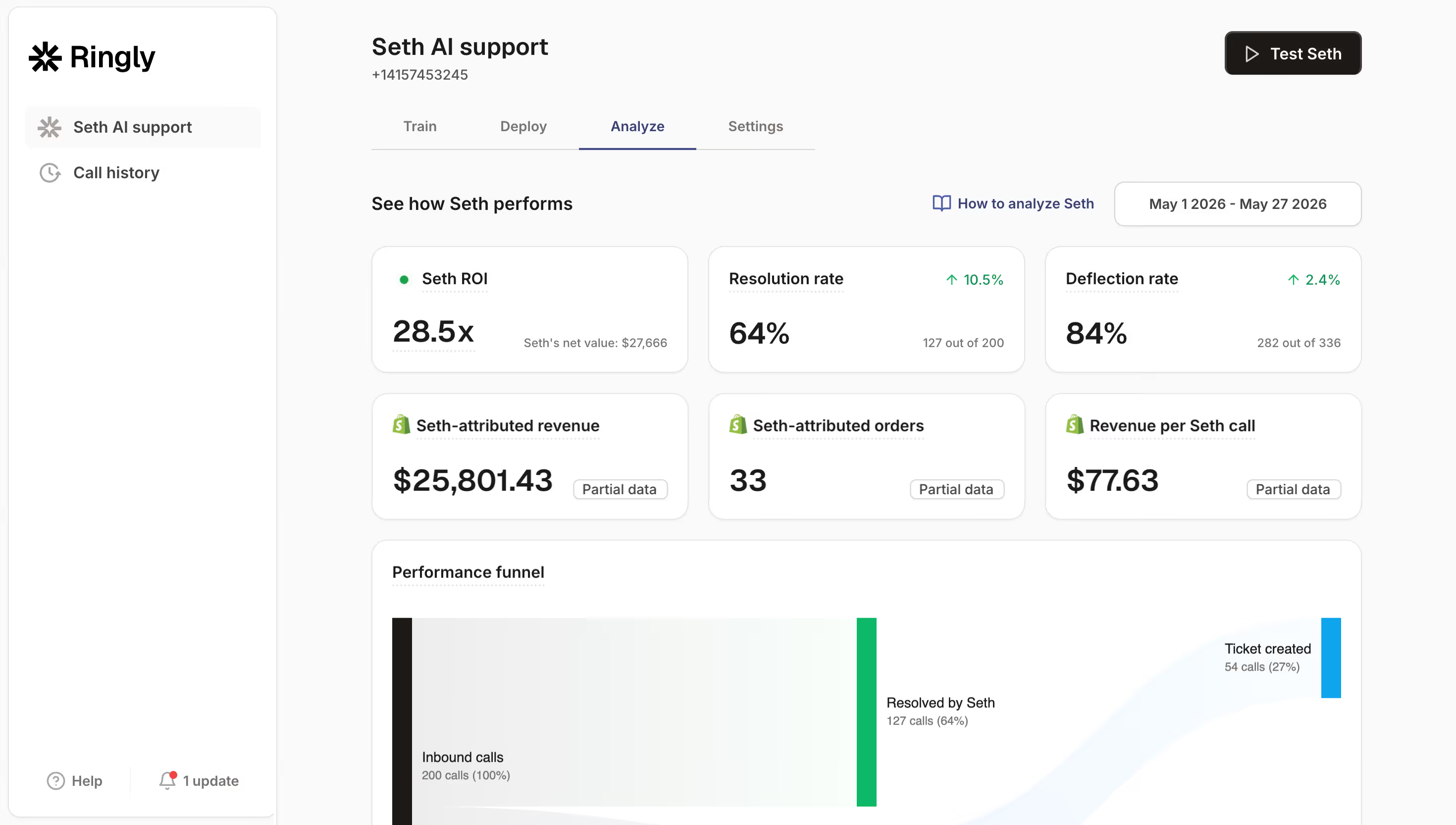
The AI answers your inbound calls 24/7 in 40 languages. It finds orders in your Shopify store, gives ship-by and tracking status, handles returns and exchanges, answers product questions from your knowledge base, and rescues abandoned carts with an outbound follow-up. Across 50+ brands, it resolves 73% of calls autonomously at roughly $0.42 per resolved call. The calls that need a human, the spoiled gift, the genuinely upset customer, escalate cleanly to Gorgias, Richpanel, Reamaze, or whatever helpdesk you already run.
Gear Rider, a Ringly customer, handled 1,595 sales and support calls in 90 days without a phone rep. That's the volume proof for anyone wondering whether an AI can carry a real gifting-season load.
On the older-buyer worry, which is the real one in this vertical, the most repeated thing customers say after a Ringly call is that it doesn't sound like AI.
"My customers also feel like it's a normal person. They feel like they can communicate if they have questions."
— Claudia Droge, TechCraft Studio
What works
- Handles the routine 70-80% without a human: ship-by, gift-ETA, order status, returns, product questions, all day and all night.
- Keeps your stack: it sits in front of your helpdesk, not instead of it. Keep your number, your Gorgias instance, your workflows.
- Scales for the gifting spike automatically: no temp-hiring scramble in November, no idle reps in February.
- Goes live fast: in under an hour for self-serve, and we run the full build for Enterprise brands.
What doesn't
- Native phone-ordering: the AI doesn't take a full card-over-the-phone order yet. For that older caller who wants to place by voice, it transfers to a human or sends an SMS payment link. If more than half your revenue is phone orders, we're not your fit yet, and we'll tell you on the call.
- Real-time inventory: stock data refreshes daily, not to the second.
Why it's the right call for most gourmet brands
For a brand whose phone is mostly a delivery-status line with a Q4 spike, the AI covers the volume you're overpaying for and hands your team the calls that need them. It's the cheapest of the three options and the only one that's awake at 9pm.
If you're weighing this against your current setup, the AI phone support for supplement stores playbook is the closest neighbor (same older-demo, subscription-and-reorder pattern), and the 24/7 ecommerce phone support guide covers the coverage model.
What this costs vs what it saves
Let's put the $240K number to work. Take a typical $20M specialty-food brand running four reps year-round and four seasonal temps for the gifting quarter:
- 4 reps × $4K loaded year-round = $16,000/mo ($192,000/yr)
- 4 seasonal reps × $4K × 3 months = $48,000/yr at peak
- True annual phone-support spend: ~$240,000/yr
Ringly at roughly $3K-$5K/mo handles the roast-date, gift-order, and order-status calls year-round and absorbs the gifting spike without the temp scramble. Net savings land around $140,000-$180,000/yr depending on volume, and your team stops working nights in December. The routine 70-80% goes to the AI. The other 20-30%, the calls that actually need a human, still go to your reps, who now have time to handle them well. (Exact Enterprise pricing is set on a call. These are the savings shapes we see across 50+ Shopify brands.)
The call makes sense if:
- You're a Shopify (or Shopify Plus) gourmet or specialty-food brand doing $10M-$100M
- You run a paid helpdesk (Gorgias, Zendesk, Gladly, Re:amaze, or Intercom)
- You have a visible phone number on your store
- Your CS team is 3-12 people and you staff up every holiday season
What happens on the call.
- We pull your last 7 days of missed calls live, on the call. No homework for you.
- We show you the recovered revenue at the resolution rates we see for food and gifting brands.
- You decide if it's worth a deeper conversation. No deck, no follow-up sequence.
If you're staring at this year's holiday staffing plan, book a 30-min call and we'll do the math live on your numbers. You can also compare the full pricing against your current spend.
Frequently asked questions
Can AI take phone orders for my gourmet brand? Not a full card-over-the-phone order, not yet. For the older customer who wants to place by voice, the AI transfers to a human or sends an SMS payment link. If most of your revenue comes from phone orders, we'll be honest on the call that you're not our fit yet.
Will my older customers actually accept talking to AI? This is the real worry in gourmet, and it's why voice quality is the whole game. The most repeated thing customers say after a call is that it doesn't sound like AI. The fastest way to judge is to hear it yourself on a call.
What happens when a gift arrives spoiled and the customer is angry? That call escalates to your team on a hard-coded rule. The AI handles the routine 70-80% so your reps have the time and headspace to handle the emotional 20% well, instead of being buried in tracking-number requests.
How much does AI phone support cost compared to hiring a rep? A loaded US rep is about $4,000/mo and you need several plus seasonal temps. Ringly resolves calls at roughly $0.42 each across 50+ brands, versus $2.70 for a human-handled call. For a brand spending ~$240K/yr on the line, the net savings usually land in the $140K-$180K/yr range.
Does it work with our existing helpdesk? Yes. It sits in front of Gorgias, Zendesk, Gladly, Re:amaze, or Intercom. You keep your phone number and your workflows, and you control exactly what escalates to a human.
How fast can we go live before the holiday season? Self-serve is live in under an hour. For Enterprise brands we run the full build inside a 14-day Launch Sprint, so starting in the early fall gives you plenty of runway before the gifting spike.
Talk to us

If you run a $10M-$100M gourmet or specialty-food brand on Shopify and you're about to repeat last year's holiday staffing scramble, a 30-min call is the fastest way to see what the phone line is really costing you and what an AI agent would carry.
The 3-layer guarantee.
- Live in 14 days or it's free until launched.
- 65% resolution in 90 days or we refund the last 3 months of subscription fees.
- We keep working free until we hit 65%.
Ruben (Ringly co-founder) takes these calls personally.