
This post in 30 seconds.
- Eight ready-to-build Gorgias Zaps that kill the manual steps your team keeps doing by hand, plus the exact setup path for each.
- The gotcha nobody tells you upfront: the Gorgias Zapier app only has two write actions and no instant trigger. The real trigger comes from Gorgias HTTP Integrations.
- Built for founders and Heads of CX at $10M-$100M Shopify brands running Gorgias who want automation without a developer.
If you run support on Gorgias, you already have a list of small manual jobs that eat the morning. Copy a refund into a sheet. Ping the logistics team in Slack when a VIP order goes sideways. Paste a wholesale form into a ticket. None of it is hard. All of it adds up. Zapier is the no-code glue that makes those jobs run themselves, and Gorgias plugs into roughly 8,000 other apps through it (Zapier).
One thing most guides skip trips people up immediately: the native Gorgias Zapier app can write into Gorgias, but it can't watch Gorgias for events out of the box. Across the 50+ Shopify brands we run phone support for, the Zaps that actually stick aren't the ticket-creation ones, they're the alerting ones. This post hands you both, with the setup for each. If you're a founder or Head of CX at a $10M-$100M Shopify brand drowning in the same five manual steps every day, book a 30-min call and we'll map which of these are worth your tasks and which aren't.
How the Gorgias Zapier integration actually works
Two pieces, and they work in opposite directions. Get this straight before you build anything or you'll waste an afternoon hunting for a trigger that isn't there.
The native Gorgias app on Zapier gives you actions, not triggers. There are exactly two: Create Ticket and Create Ticket Message (eesel). That means Zapier can push data INTO Gorgias (turn a form into a ticket, log a note onto a conversation) but the native app won't fire a Zap when something happens inside Gorgias. There's no instant "new ticket" trigger in the app itself, which is the single most common point of confusion in the Zapier community.
So how do you start a Zap from a Gorgias event? You use Gorgias HTTP Integrations, an outbound-webhook feature inside Gorgias. It fires on three events: Ticket Created, Ticket Updated, and Ticket Message Created (Gorgias docs). You point that webhook at a Zapier Catch Hook, and now you've got a real Gorgias trigger feeding your Zaps.
Quick way to hold it in your head:
- Push data into Gorgias (form, sheet, order becomes a ticket): use the native Gorgias app, action = Create Ticket or Create Ticket Message.
- React to something in Gorgias (a tag, a new ticket, an update): use Gorgias HTTP Integrations to send a webhook to a Zapier Catch Hook, then do whatever you want with it.
Once that distinction clicks, every recipe below is just one of those two patterns. The Gorgias API can do more if you have a developer, but for a no-code team these two paths cover most of what you'll want. For the wider strategy view, our support-ops automation playbook goes deeper on sequencing.
8 Gorgias Zaps worth building
Each Zap below is one trigger plus one (or two) actions. The "Job it does" column is the part that matters: build the ones that map to a manual step your team actually repeats, skip the rest. A Zap you don't need still burns tasks.
| # | Zap | Trigger | Action | Job it does |
|---|---|---|---|---|
| 1 | Form to ticket | Typeform / Google Forms submission | Gorgias Create Ticket | Wholesale + returns intake lands in the queue |
| 2 | Sheet row to ticket | New Google Sheets row | Gorgias Create Ticket | Ops requests become tracked tickets |
| 3 | VIP tag to Slack | Gorgias webhook (Ticket Updated) | Slack message | High-value heads-up for the team |
| 4 | Refund to log | Gorgias webhook (Ticket Created) | Google Sheets add row | Refund log without manual export |
| 5 | Detractor to escalation | Survey low score | Slack + Gorgias ticket | Catch unhappy customers fast |
| 6 | Big order to proactive ticket | Shopify new order over threshold | Gorgias Create Ticket | White-glove the top orders |
| 7 | Ticket to reporting | Gorgias webhook (Ticket Created) | Sheets / warehouse | Reporting outside Gorgias |
| 8 | After-hours alert | Gorgias webhook + time filter | SMS by Zapier | Night alert, no night shift |
The alerting Zaps (3, 5, 8) deliver more value per task than the ticket-creation ones, because they put a human on the right conversation at the right moment. Here's each in detail.
1. Form submission to a Gorgias ticket
Wholesale requests, damaged-item reports, and B2B inquiries usually land in a form, then somebody copies them into Gorgias by hand. Wire a Typeform or Google Forms submission straight to a Gorgias Create Ticket and the intake handles itself. Use a Zapier filter so only real submissions (not test rows) create tickets.
2. New Google Sheets row to a Gorgias ticket
A lot of teams run a side spreadsheet for one-off tasks: refund approvals, replacement requests, a list a warehouse lead maintains by hand. New row in, Gorgias ticket out. Now those "the same questions over and over" tasks live in your queue with an owner and an SLA instead of rotting in a tab nobody opens.
3. VIP or urgent tag to a Slack alert
This is the one most teams underuse. Set a Gorgias HTTP Integration on Ticket Updated, filter for your "VIP" or "urgent" tag, and fire a Slack message to the channel your logistics or product team watches. When a top customer's order goes sideways, the right person sees it in seconds instead of when the ticket bubbles up an hour later.
WashCo, a Shopify brand we launched, recovered $22,664 in its first 7 days on the phone, and the pattern is the same on chat: the faster a human reaches the high-value conversation, the more revenue stays. A Slack alert is the cheapest version of that.
4. Refund or return ticket to a tracking sheet
Finance always wants a refund log, and exporting it from Gorgias by hand is nobody's favorite Friday. Set an HTTP Integration on Ticket Created, filter for your refund or return tag, and append a row to a Google Sheet with the customer, order, and amount. The log builds itself and your team stops the weekly export ritual.
5. Negative CSAT or NPS detractor to escalation
Connect your survey tool (Delighted, Typeform, whatever you run) so a low score fires a Slack message AND opens a Gorgias ticket assigned to a senior rep. The detractor gets a real human reply same-day instead of a survey result nobody reads. This is the Zap that quietly protects your Trustpilot rating.
6. New high-value Shopify order to a proactive ticket
For your top orders, you may want to reach out before anything goes wrong. Trigger on a Shopify new order, add a Zapier filter for orders above a dollar threshold, and create a Gorgias ticket so a rep sends a quick "we've got you" note. Light touch, big effect on repeat-purchase rate.
7. Ticket created to a reporting log or warehouse
If you do real analytics outside Gorgias, push every Ticket Created event into Google Sheets or a data warehouse via the webhook. You get ticket volume by tag, by hour, by channel, in whatever tool your ops team already lives in. No more "what's our resolution rate trending?" with no clean number to answer it.
8. After-hours ticket to an on-call SMS
Set an HTTP Integration on Ticket Created, add a Zapier filter for the hours your team is offline, and route a text via SMS by Zapier to whoever's on call. It's a night-shift alert without a night shift. Just know this catches the tickets, not the phone calls, and the phone is the channel that bleeds the most after hours. More on that below.
How to set up your first Gorgias Zap
There are two setup paths depending on which direction your Zap runs. Both are no-code.
Path A, push data into Gorgias (Create Ticket). This is point-and-click:
- Start a new Zap and pick your trigger app (Google Forms, Typeform, Sheets, Shopify).
- Add an action step, search Gorgias, and choose Create Ticket or Create Ticket Message.
- Connect your Gorgias account and map the fields (customer email, subject, body, tags).
- Add a Zapier filter so only the rows or submissions you want create tickets, then turn it on.
Path B, react to a Gorgias event (the webhook trigger). I wired this path on a test Gorgias account to confirm the steps, and it's three moves:
- In Zapier, start a Zap with Webhooks by Zapier, pick Catch Hook, and copy the custom URL.
- In Gorgias, go to Settings, Integrations, HTTP Integrations, Create integration. Pick the event (Ticket Created, Updated, or Message Created), set the method to POST, and paste the Catch Hook URL.
- Fire a test ticket, watch the payload land in Zapier, then add your action steps (Slack, Sheets, SMS).
That second path is the one people miss, and it's the unlock for half the recipes above. For more on chaining Gorgias into the rest of your stack, see how to connect Gorgias to other apps and the native Gorgias features you may not need Zapier for at all. If you already use Klaviyo, some of these flows have native versions worth checking first.
What Zapier with Gorgias actually costs
Gorgias doesn't charge extra for the Zapier connection. Zapier does, and the bill is easy to misread.
| Plan | Price | Tasks per month |
|---|---|---|
| Free | $0 | 100 (2-step Zaps only) |
| Professional | from $19.99/mo billed annually ($29.99 monthly) | 750 |
| Professional (higher tier) | ~$49/mo billed annually | 2,000 |
| Team | $103.50/mo | 2,000 |
Source: Zapier pricing breakdowns, 2026.
A task is one action step that runs successfully. Triggers cost nothing, and so do filters and basic formatting (Activepieces). That sounds generous until you remember a single Zap run often fires several action steps. The widely cited warning: most teams underestimate their task burn by three to five times. So a 750-task plan can feel like 200 if your Zaps are multi-step and high-volume.
Two ways to keep the bill sane. Build only the Zaps that replace a real manual step, and lean on filters (they're free) to stop Zaps running on rows you don't care about. The eight above are deliberately single-purpose for this reason.
Here's the honest ROI framing. A typical $50M Shopify brand runs a 6-rep CS team at roughly $4,000 loaded per rep, so $24,000 a month. Zapier won't touch that number. What it does is hand a few hours a week back to each rep by killing the copy-paste work, which is real but small. The big CS cost is the calls and tickets themselves, not the glue between tools. To move the $24,000, you have to change who handles the volume, and a Zap can't pick up a phone. Which brings us to the gap.
Where Gorgias and Zapier stop (and the call keeps ringing)
Zapier is a data-mover. It routes information between tools beautifully and it never, ever answers a phone.
That matters because the channel leaking the most revenue at a Shopify brand isn't the ticket queue, it's the call that comes in at 8 p.m. and rolls to voicemail. 85% of callers who can't reach a person never call back, and 62% switch to a competitor (PCN). No Zap fixes that. Your after-hours SMS alert (recipe 8) tells someone a ticket came in, but the customer who actually dialed your number is already gone.
This is the part automation can't reach with a webhook. Someone, or something, has to pick up.
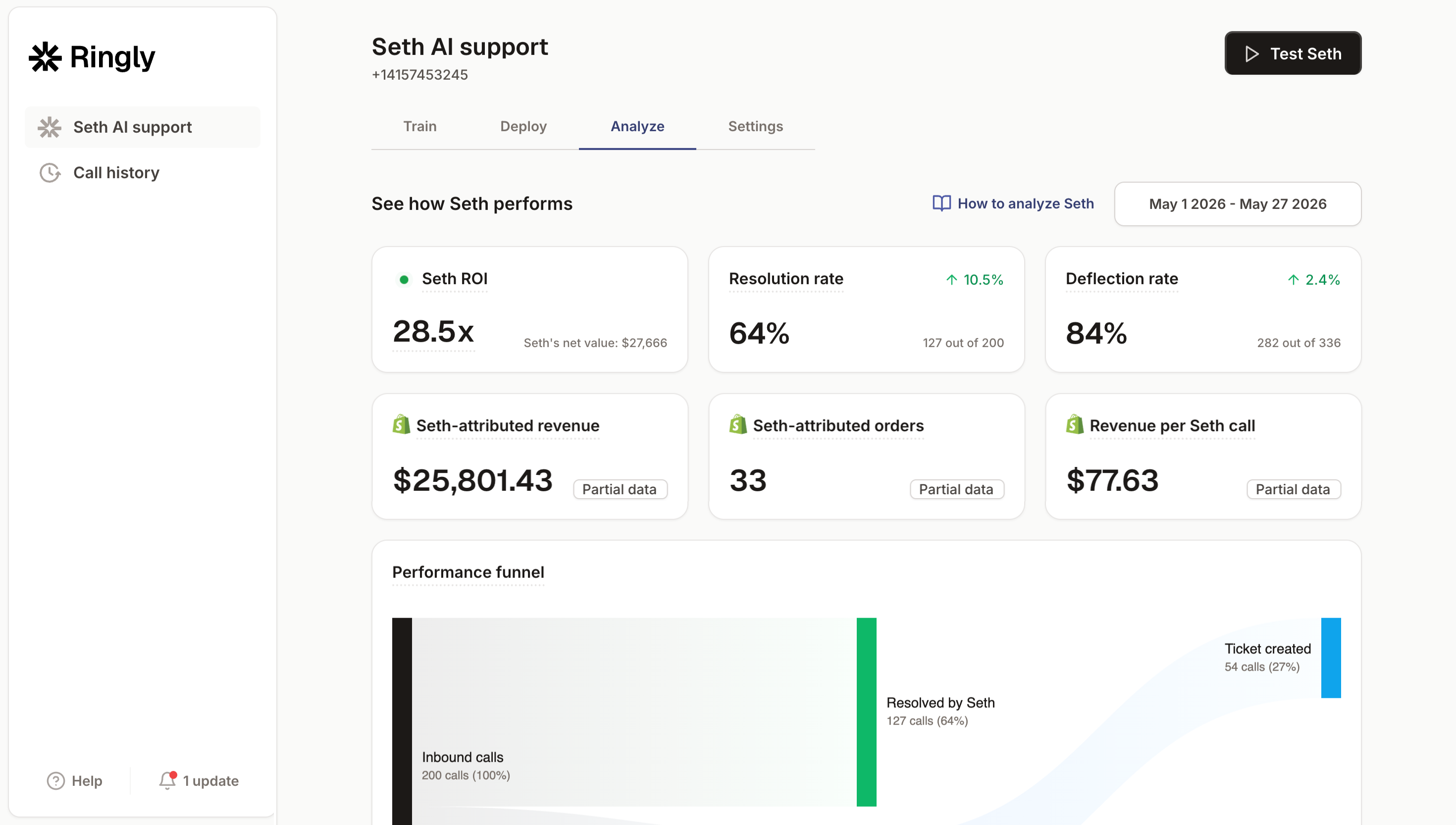
That's where Ringly fits next to your Gorgias and Zapier setup. Ringly.io is AI phone support for Shopify brands. It answers inbound calls 24/7, finds orders in your store, handles returns and product questions, and escalates the calls that need a human cleanly to Gorgias, which you keep running exactly as is. Across 50+ brands, the AI resolves 73% of calls autonomously at roughly $0.42 per resolved call. Zapier keeps moving your data. Ringly handles the call Zapier was never built to take.
"My customers also feel like it's a normal person. They feel like they can communicate if they have questions."
Claudia Droge, TechCraft Studio
If your phone goes to voicemail after 6 p.m. while your Zaps hum along happily, book a 30-min call and we'll show you what that after-hours queue is actually costing you. It pairs well with the rest of your 24/7 phone coverage plan and any move to scale support without hiring.
Frequently asked questions
Does Gorgias have a native Zapier trigger?
No. The native Gorgias app on Zapier only offers actions (Create Ticket and Create Ticket Message), not triggers. To start a Zap from a Gorgias event, use Gorgias HTTP Integrations to send a webhook to a Zapier Catch Hook.
What actions can the Gorgias Zapier app do?
Two: Create Ticket and Create Ticket Message. Both push data into Gorgias from another app. For anything more advanced you'd use the Gorgias API directly, which needs a developer.
How do I get a real Gorgias event into Zapier?
Use Gorgias HTTP Integrations (Settings, Integrations, HTTP Integrations). It fires on Ticket Created, Ticket Updated, and Ticket Message Created. Point the webhook at a Zapier Catch Hook URL and your Zap will run on that event.
How much does the Gorgias Zapier integration cost?
Gorgias doesn't charge for the connection. Zapier's free plan covers 100 tasks a month with 2-step Zaps; the Professional plan starts around $19.99 to $29.99 a month for 750 tasks. Remember one Zap run can spend several tasks, so budget for three to five times your first guess.
Can Zapier create a Gorgias ticket from a form?
Yes, that's one of the most common Zaps. Trigger on a Typeform or Google Forms submission and use the Gorgias Create Ticket action. Add a filter so only real submissions create tickets.
Does Zapier replace Gorgias automation rules?
No. Gorgias rules and macros handle automation inside Gorgias (tagging, routing, replies). Zapier handles automation between Gorgias and your other tools. Use Gorgias rules first; reach for Zapier when you need to cross into another app.
Can Zapier answer phone calls for my Shopify store?
No. Zapier moves data between apps; it can't pick up a ringing phone. For inbound calls, an AI phone agent like Ringly answers 24/7 and escalates to your Gorgias queue when a human is needed.
Talk to us

If you run a $10M-$100M Shopify brand and the after-hours calls are still rolling to voicemail while your Zaps hum along, a 30-min call is the fastest way to see what that queue is costing you.
The 3-layer guarantee.
- Live in 14 days or it's free until launched.
- 65% resolution in 90 days or we refund the last 3 months of subscription fees.
- We keep working free until we hit 65%.
Ruben (Ringly co-founder) takes these calls personally.