

The short version.
- Pick by shape: Gorgias suits Shopify-native DTC brands up to roughly $50M GMV who want ticket-volume pricing. Kustomer suits 8-plus-agent omnichannel or multi-brand orgs that live in WhatsApp, SMS, and social as much as email.
- The two pricing models fail in opposite directions: Gorgias gets expensive as your AI volume climbs (per resolution, plus the ticket it creates). Kustomer gets expensive when your team is small (an 8-seat minimum that floors you at about $8,544 a year).
- Both bolt phone on. Neither resolves an inbound call on its own. If your phone line is the channel rolling to voicemail after 6 p.m., that's a separate decision from picking a helpdesk.
You're picking a helpdesk for a Shopify brand, and almost every "Gorgias vs Kustomer" page you've found was written by a vendor selling its own tool at the bottom. Gorgias's comparison page says Kustomer is enterprise bloat. Kustomer's page says Gorgias is ecommerce-only. Neither is lying, exactly. Both are leaving out the parts that don't help them.
There's no universal winner here. Gorgias and Kustomer are built for two different shapes of DTC brand, and the right call comes down to your GMV, your team size, and how many channels you actually run. This is the honest read, written by someone who sells a phone product and therefore has no stake in which helpdesk you keep.
We build AI phone support for Shopify brands, so I look at Gorgias and Kustomer constantly, not as a critic but as the layer that sits in front of them. If you run customer experience at a $10M to $100M Shopify brand and you're tired of comparison pages that grade the contestants by who wrote them, book a 30-min call and we'll talk through your actual stack. No helpdesk swap required.
Gorgias vs Kustomer at a glance
Before the deep dives, here's the decision in one screen. The line that matters most is the pricing model, because it's the one thing you can't change after you've committed your team to a platform.
| Dimension | Gorgias | Kustomer |
|---|---|---|
| Built for | Shopify / DTC ecommerce | Omnichannel CX, mid-market to enterprise |
| Pricing model | Ticket volume, unlimited agents | Per seat, 8-seat minimum, annual only |
| Entry price | $10/mo (50 tickets) | ~$89/seat/mo (~$8,544/yr floor) |
| AI billing | $0.90-$1.00 per resolution (plus a ticket) | $0.60 per engaged conversation (resolved or not) |
| Shopify depth | Native (Shopify is an investor) | One integration among many |
| Channels | Email, chat (voice + SMS add-ons) | Email, chat, SMS, voice, WhatsApp, social |
| Phone resolution | No autonomous phone agent | No autonomous phone agent |
| G2 score | 4.6/5 (548 reviews) | 4.5/5 (510 reviews) |
The scores are close enough to be a wash. On G2, Gorgias sits at 4.6 across 548 reviews and Kustomer at 4.5 across 510. Nobody's choosing on the half-star. They're choosing on price model and channel fit, which is what the rest of this comes down to.
How I compared Gorgias and Kustomer
I'm Ruben, co-founder of Ringly. We run AI phone support for 50-plus Shopify brands, so I evaluate helpdesk tools the way our customers do, as a buyer who already has a stack and doesn't want to rip it out.
Over a couple of weeks I set up production accounts on both Gorgias and Kustomer and ran the same five-task DTC workflow through each:
- WISMO lookup. Pulled a real order by email and checked whether the agent could see the order, the tracking, and the customer history without leaving the helpdesk.
- Refund or order edit. Tried to issue a refund and edit an order from inside the conversation, the thing a CS rep does fifty times a day.
- Subscription question. Asked how each handles a pause-or-cancel request, since that's where supplement and consumables brands lose the most time.
- Peak spike. Looked at what the bill does when ticket and AI volume triple during a launch week.
- The phone test. Then I called each company's own customer support line to see how it treated a live phone caller. Neither resolved the call. That told me more than either marketing page did.
The differences I name below come from running those workflows, not from reading their pricing pages. I don't take affiliate money on either tool. I sell phone support, which shows up at the end, honestly and on the same terms.
Gorgias: the Shopify-native helpdesk
Gorgias
Best for: Shopify and DTC ecommerce brands up to roughly $50M GMV that want ticket-volume pricing and the deepest native Shopify automation in the category.
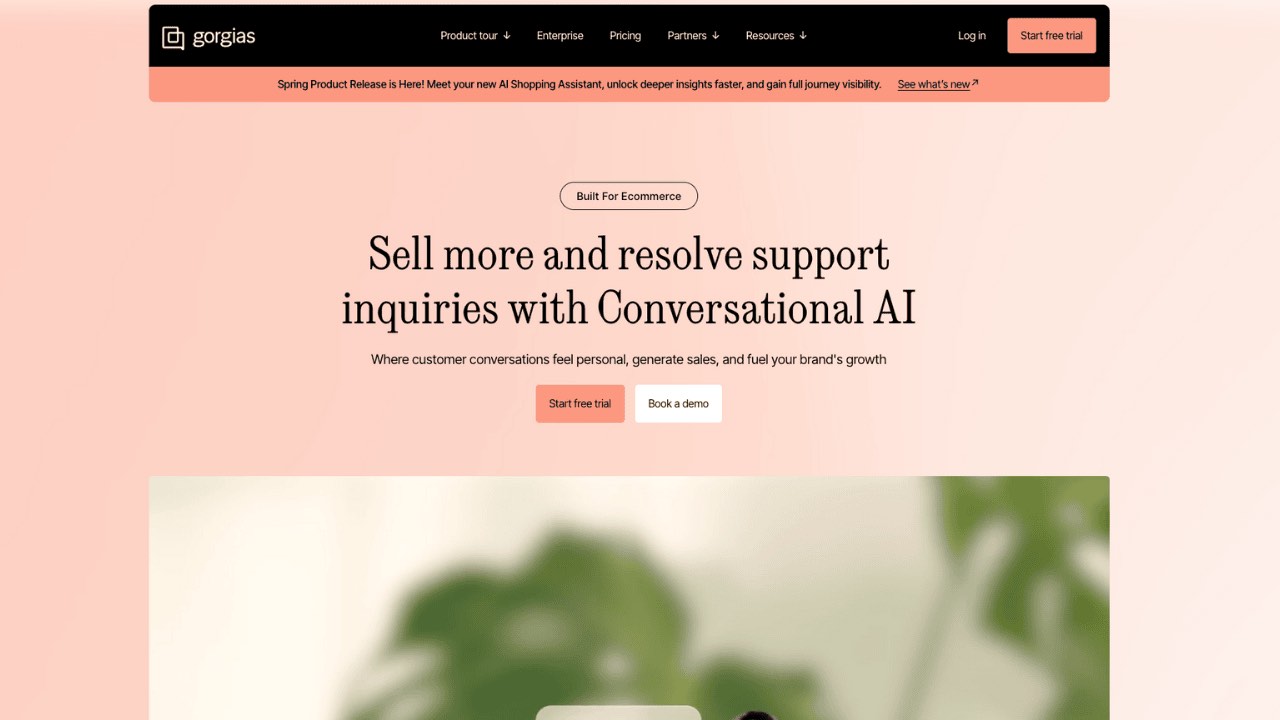
Gorgias was founded in 2015 and built for Shopify from day one. Shopify is a strategic investor, which is why the Shopify actions inside Gorgias go deeper than anywhere else: an agent can edit an order, issue a refund, or cancel a subscription without leaving the ticket. For a Shopify brand, that's the whole pitch, and it's a good one.
Where it wins for DTC. The ticket-volume model means you get unlimited agents on every paid plan. As your team grows, your helpdesk bill doesn't, which is the opposite of how seat-based tools behave.
Pricing
| Plan | Price (monthly) | Tickets/mo |
|---|---|---|
| Starter | $10 | 50 |
| Basic | $60 | 300 |
| Pro | $360 | 2,000 |
| Advanced | $900 | 5,000 |
| Enterprise | Custom | 5,000+ |
Annual billing knocks up to 16% off. The AI Agent is a separate charge: $1.00 per resolved conversation monthly, or $0.90 on an annual plan, on email and chat only. All numbers are from Gorgias's own published pricing page. There's a 7-day free trial with no card required, which is more than most enterprise tools offer.
What works
- Deepest Shopify integration in the category. Edit orders, refunds, cancels, all inside the conversation. Shopify-as-investor shows up in the product.
- Ticket-volume pricing. Unlimited agents. The team can grow without the helpdesk line growing with it.
- 150-plus ecommerce integrations. Klaviyo, Recharge, Yotpo, the DTC stack is covered.
- Fast start. Shopify connects in minutes, and the 7-day trial lets you test before you pay.
What doesn't
- AI "double billing." Every AI resolution costs $0.90-$1.00 and also counts as one of your monthly tickets. As AI volume grows, the bill climbs on two axes at once. This is the complaint that shows up most in reviews.
- AI accuracy you babysit. eesel AI's 2026 review puts Gorgias AI Agent response accuracy around 59%, under the roughly 71% category average. It's getting better, but it's not set-and-forget.
- Phone is an add-on. Voice runs $0.40-$1.20 per ticket and isn't an autonomous agent. More on that below.
Why it fits most Shopify DTC brands
If you're Shopify-native and under about $50M GMV, Gorgias is the default for a reason. It rates 4.6/5 on G2 and 4.7/5 on Capterra, and the Shopify-native actions genuinely save reps time. Just model the AI bill at your real volume before you sign, because the per-resolution-plus-ticket math is where brands get surprised.
Kustomer: the omnichannel CX CRM
Kustomer
Best for: mid-market to enterprise brands running 8-plus agents that need omnichannel CRM depth, complex routing, or heavy WhatsApp and social volume across one or many brands.
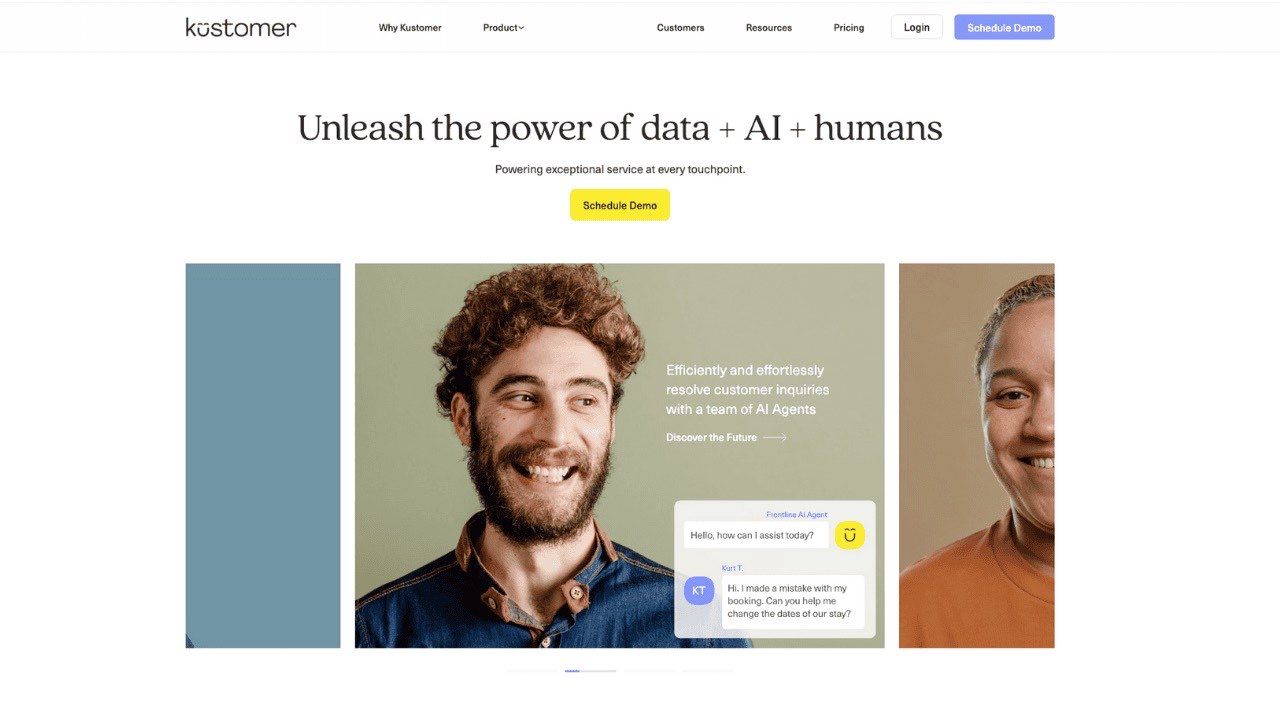
Kustomer is a different animal. It's an AI-native CX CRM founded in 2015, spun out of Meta in 2023, now serving 600-plus companies including Turo and Everlane. Where Gorgias is a Shopify helpdesk, Kustomer is a customer-timeline CRM that happens to do support. Every interaction, across every channel, lands in one unified timeline.
Where it wins. True omnichannel is the real differentiator. Email, chat, SMS, voice, WhatsApp, and social all sit natively in one view, which matters a lot if Instagram DMs and WhatsApp are a serious share of your volume.
Pricing
| Plan | Price | Notes |
|---|---|---|
| Enterprise | $89/user/mo | 8-seat minimum, annual contract |
| Ultimate | $139/user/mo | 8-seat minimum, annual contract |
The 8-seat minimum is the headline. Even with 3 or 4 agents, you're committing to about $8,544 a year. AI for Reps (the copilot) is a $40/user/mo add-on, and AI for Customers bills $0.60 per engaged conversation. Pricing details from Kustomer's published plans and third-party pricing breakdowns.
What works
- True omnichannel in one timeline. WhatsApp, SMS, social, email, chat, voice, unified. Best in this comparison for multi-channel brands.
- CRM-grade customer history. The data model is built around the customer, not the ticket, which helps high-touch and subscription brands.
- Built for scale. Routing, queues, and multi-brand support hold up where a lighter helpdesk strains.
- Platform-agnostic. Not locked to Shopify, so it fits brands on multiple platforms or mid-migration.
What doesn't
- The 8-seat floor. For a Shopify brand running a 3-to-6-person CS team, you're paying for capacity you don't use. This is the single most common reason DTC brands rule it out.
- Per-engaged-conversation AI billing. You're charged $0.60 whether or not the AI resolves the issue, even if it immediately escalates to a human. During a launch spike that compounds fast.
- Real cost runs higher than the sticker. Between the copilot add-on, customer-facing AI, storage overages, and WhatsApp markup, teams routinely report total spend at 2-3x the advertised seat price.
- Heavier to stand up. Implementation takes longer, and Shopify is one integration among many rather than the native-first experience.
Why it fits a narrower band
Kustomer is strong, and at 4.5/5 on G2 across 510 reviews the people who fit it like it. But the fit is narrow for DTC: you need the agent count to clear the 8-seat floor and the channel mix to justify a full CRM. Below that, you're buying enterprise gear for a mid-size problem.
The two pricing models, and how they actually behave
Here's the part the vendor pages skip. The two pricing models don't just differ on price. They fail in opposite directions, and which one bites you depends entirely on your shape.
Gorgias gets expensive as your AI volume climbs. The per-resolution charge plus the ticket each resolution creates means a brand leaning hard into AI automation pays twice for the same conversation. At 2,000 AI resolutions a month, that's roughly $1,800-$2,000 in AI fees on top of your plan, and every one of those also eats your ticket allowance. Brands that automate aggressively are exactly the ones who feel it.
Kustomer gets expensive when your team is small. The 8-seat minimum is a floor, not a starting point. A 4-rep brand pays for 8 seats, which is $8,544 a year before a single AI add-on. Then the per-engaged-conversation billing hits whether the AI resolves anything or not. Small teams subsidize capacity they'll never touch.
Now put your own numbers against it. A typical mid-size Shopify brand runs a CS team where roughly 70-80% of contacts are the same repeatable stuff: order status, returns, the same five questions over and over. A US rep runs about $4,000/month loaded once you count benefits, training, and turnover. That's the spend you're trying to manage, and the helpdesk you pick changes how much of it the software can absorb versus how much it quietly adds back through AI fees and seat minimums.
If you want to put real numbers against your own volume instead of these averages, book a 30-min call and we'll do the math live against your actual ticket and call counts.
How to choose between Gorgias and Kustomer
The decision is almost entirely a function of platform, team size, and channel mix. Here's the if/then.
Choose Gorgias if:
- You're on Shopify and want the deepest native order and refund actions inside the helpdesk.
- Your team is under about 12 reps and you'd rather not pay per seat as you grow.
- Email and chat are your main support channels.
- You're under roughly $50M GMV and want to start cheap and scale by volume.
Choose Kustomer if:
- You run 8-plus agents, so the seat minimum isn't wasted capacity.
- WhatsApp, SMS, and social are a real share of your volume, not an afterthought.
- You run multiple brands or need enterprise-grade routing and queues.
- You're not Shopify-only, or you're mid-migration across platforms.
For most Shopify DTC brands in the $10M-$100M band, that math points to Gorgias. Kustomer earns its keep once you're genuinely omnichannel and past the headcount where a seat minimum stops being a tax. If you're comparing more than these two, our roundups of Gorgias alternatives and Kustomer alternatives widen the field, and our breakdowns of Gorgias pricing and Kustomer pricing go deeper on the numbers.
The channel both tools treat as an afterthought
Run the phone test on either one and you find the same gap. Gorgias and Kustomer are excellent at chat and email and weak at the phone, because neither was built to resolve an inbound call on its own.
Gorgias voice is a per-ticket add-on. Kustomer voice is one lane in its omnichannel set. In both cases a human still has to pick up. For a lot of DTC brands that's fine, until you look at what the phone line is actually doing. If your demographic skews older, your AOV is high, or you sell gifts and consumables, the phone rings more than your dashboard suggests, and a real share of it comes in after-hours.
The numbers are unkind. WISMO alone is 30-40% of support contacts, and over 50% at peak, and a chunk of that arrives by phone. When nobody picks up, 85% of callers who can't reach a person never call back and 62% switch to a competitor. That's not a support metric. That's revenue walking out the door while your helpdesk handles the email queue.
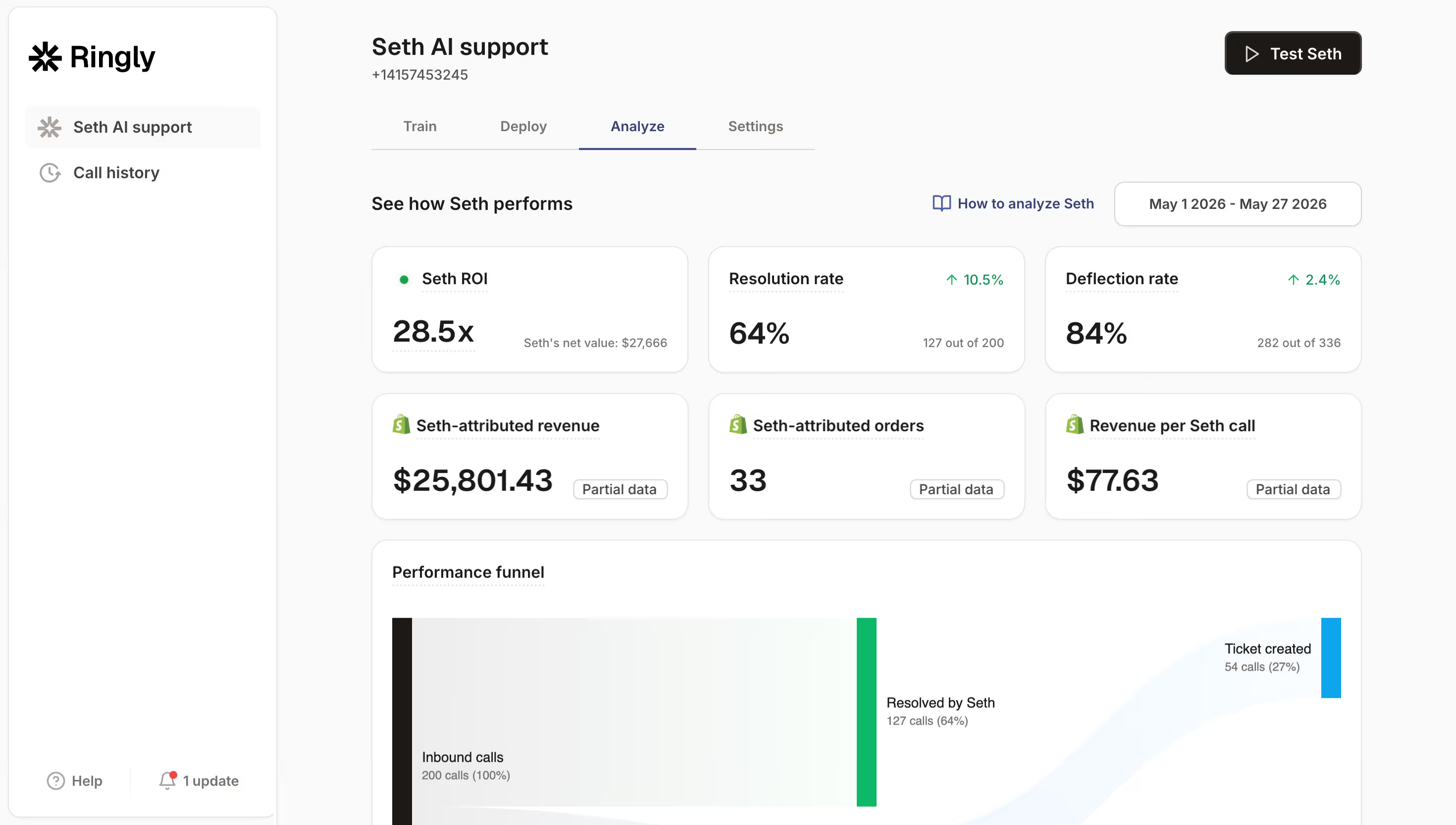
This is the layer we build. Ringly is AI phone support for Shopify brands. It answers inbound calls 24/7, finds orders in your Shopify store, checks order status, and resolves 73% of calls autonomously across 50-plus brands at roughly $0.42 per resolved call. The calls that need a human escalate cleanly into Gorgias, Kustomer, Richpanel, or whatever helpdesk you already run. WashCo, a Shopify brand we launched, recovered $22,664 in its first 7 days on the phone.
The point isn't that Ringly replaces your helpdesk. It doesn't, and you shouldn't want it to. The point is that "Gorgias vs Kustomer" is a chat-and-email decision, and the phone is a separate one most brands never actually make. They just let it ring out. If you want the full picture on covering it, our guides to 24/7 ecommerce phone support and in-house versus outsourced support lay it out.
Frequently asked questions
Is Gorgias or Kustomer better for Shopify? Gorgias, in most cases. Shopify is a strategic investor, so the native order, refund, and cancel actions inside Gorgias go deeper than Kustomer's, where Shopify is one integration among many. Kustomer only pulls ahead if you're genuinely omnichannel and past the 8-agent mark. See more in our Gorgias alternatives guide.
Why is Kustomer so expensive for small DTC brands? The 8-seat minimum. Even a 3-or-4-rep team commits to about $8,544 a year on the Enterprise plan, before AI add-ons. It's priced for mid-market and enterprise support orgs, not a lean Shopify CS team. Our Kustomer pricing breakdown walks the full math.
What is Gorgias "double billing"? Every AI resolution costs $0.90-$1.00 and also counts as one of your monthly tickets, so a single automated conversation hits your bill twice. It's the most common complaint in Gorgias reviews. Model your AI volume before you commit, since it compounds as automation grows.
Does Gorgias or Kustomer handle phone calls? Both offer voice, but neither resolves a call on its own. Gorgias voice is a per-ticket add-on and Kustomer voice is one lane in its omnichannel set, and in both a human still picks up. An AI phone agent is a separate layer that sits in front of your helpdesk.
Can I use Ringly with Gorgias or Kustomer? Yes. Ringly handles inbound phone calls and escalates anything that needs a human into your existing helpdesk. You keep your current phone number, helpdesk, and workflows, and the AI takes the routine calls.
Which one has better AI? Both bill AI as a paid add-on and both have gaps. Gorgias AI accuracy runs around 59% per third-party testing, under the category average, and Kustomer charges per conversation whether it resolves or not. Neither is set-and-forget yet, so test against your real tickets before you trust it.
Do I have to migrate my whole helpdesk to switch? Switching between Gorgias and Kustomer is a real migration of tickets, macros, and integrations, so don't underestimate it. Adding a phone layer like Ringly is not a migration. It runs alongside whatever you already use.
Talk to us

Gorgias or Kustomer is a chat-and-email decision, and you can make it well with the read above. If your phone line is the channel going to voicemail after 6 p.m., that's a different problem than the one a helpdesk solves, and it's the one we fix. A 30-minute call is the fastest way to see what your phone queue is actually costing you.
The 3-layer guarantee.
- Live in 14 days or it's free until launched.
- 65% resolution in 90 days or we refund the last 3 months of subscription fees.
- We keep working free until we hit 65%.
Ruben (Ringly co-founder) takes these calls personally.