
This post in 30 seconds.
- What they are: Veeqo is Amazon's free shipping and inventory software. Gorgias is the ecommerce helpdesk. Wired together, Veeqo's order and shipment data shows up right inside the Gorgias ticket.
- What it fixes: the email and chat queue. Your reps stop tab-switching between the warehouse tool and the inbox.
- What it leaves open: the phone. The integration is email-keyed, so a customer who calls to ask "where's my order" still hits a rep or voicemail.
- Built for $10M-$100M Shopify brands running Gorgias plus a shipping tool, with a phone number on the site and 3-12 reps answering it.
You connected Veeqo to Gorgias, and the order data finally shows up next to the ticket. Tracking number, shipment status, customer record, all in one screen. The email queue got faster. Your team stopped flipping between the warehouse tool and the inbox to answer a tracking question.
Then the phone rang, and none of that helped.
If you run support at a Shopify brand doing $10M to $100M a year, you know the gap I mean. The helpdesk got smart. The shipping tool got connected. The phone line is still a rep reading a tracking number off a screen, or worse, a voicemail nobody returns by Tuesday. This post maps what Gorgias and Veeqo each do, how they connect, where they sit in your stack, and the one channel the combo doesn't touch. If your phone goes to a person or a voicemail after the helpdesk is already this good, book a 30-min call and we'll show you what's still landing on it.
Gorgias and Veeqo at a glance
Here's the fast version before the deep dive. Two tools, two jobs, one channel left over.
| Tool | What it does | Cost | Where it sits | What it leaves open |
|---|---|---|---|---|
| Veeqo | Shipping labels + inventory sync across channels | Free core (paid add-ons from $19/mo) | Warehouse / fulfillment | Live customer questions |
| Gorgias | Ecommerce helpdesk for email + chat tickets | Per-ticket plans + AI add-ons | Support inbox | Inbound phone calls |
| Ringly | AI phone agent that answers order-status calls | Grow $349/mo, Pro $799/mo | The phone line | Genuinely complex calls (escalates) |
Veeqo and Gorgias close the loop on tickets and shipping, but neither one picks up a ringing phone. That's the whole story of this post, and it's the part most stack guides skip. Veeqo is free to start because it earns a small commission on the shipping labels you buy through it, according to Veeqo's own pricing page. So the shipping side of your stack is cheap. The expensive line item that's left is the human answering "where's my order" by phone.
What Veeqo actually does
Veeqo is Amazon's free shipping software. Amazon bought it, and Veeqo's product page on Amazon describes it as free shipping, inventory, and fulfillment for multichannel sellers. The core shipping features cost nothing because Veeqo makes its money on label volume, not subscriptions.
What it handles:
- Discounted shipping labels. Pre-negotiated rates with UPS, FedEx, USPS, and DHL, with bulk shipping up to 100 orders at once.
- Inventory sync. One catalog kept in step across Amazon, eBay, Etsy, Shopify, and Walmart, with low-stock alerts so you stop overselling.
- Scan-to-Verify. Warehouse staff scan a barcode before printing a label, which cuts the wrong-item-shipped problem to near zero.
- Account-health protection. For Amazon sellers, Veeqo guards on-time delivery and valid-tracking metrics, plus A-to-z Guarantee claims protection.
Sellers who buy labels through Veeqo saw 20% fewer late deliveries on average for Amazon orders, per Amazon's published Nov 2022 to Oct 2023 data. You also earn up to 5% back in Veeqo Credits on label spend.
The paid tiers are narrow on purpose. The Inventory plan starts at $19 a month and adds demand forecasting and digital picking with a scanner. The High Volume plan starts at $350 a month and bundles ERP integration with NetSuite, priority support, and a dedicated account manager.
Now the honest part. Veeqo was built Amazon-first, and it shows. Some Shopify sellers report that order sync and custom mapping feel limited, and Veeqo's own support draws complaints about slow ticket turnaround, as one Veeqo review documents. Its Shopify App Store ratings run mixed, roughly 60% five-star with a real 18-20% one-star tail. None of that changes the core point: as a free shipping and inventory layer, it does its job, and it leaves the customer conversation to someone else.
What Gorgias actually does
Gorgias is the helpdesk built for ecommerce, not a generic support inbox bolted onto a store. It connects directly to your store data, so a rep can see the order, issue a refund, and check a shipment without leaving the ticket. Its AI features run on chat and email, where it drafts and auto-responds to routine questions.
The whole value of Gorgias is that the agent acts inside the ticket instead of tab-switching across five tools. That's also why brands wire a shipping tool into it. The fewer screens between a rep and an answer, the faster the ticket closes. If you're weighing Gorgias against other options, we've covered the Gorgias alternatives for ecommerce separately, but for most $10M-plus Shopify brands Gorgias is already the incumbent.
The catch is the same one Veeqo has. Gorgias is exceptional at email and chat. The phone is a different channel with different physics, and a helpdesk ticket queue doesn't ring. Even the best automation on tickets, including WISMO automation on Shopify, stops at the written channel.
How the Gorgias and Veeqo integration works
The integration is simpler than it sounds, and the limit is baked into how it's built. Gorgias's own documentation lays it out: it's a partner-built HTTP widget that queries Veeqo's API by the customer's email address. When an email lands in Gorgias, the widget looks up that email in Veeqo and pulls the matching customer record, order, and shipment details into the ticket sidebar.
Setup takes a Veeqo API key from your Veeqo account settings, dropped into the Gorgias widget config. Because it's partner-built, Gorgias flags that support waits can run longer than a normal request if something breaks.
Here's what I did to test the seam. I wired a Veeqo account into a Gorgias instance, sent a test order through, and watched the order and shipment data populate the ticket exactly as advertised. Clean. Then I called the store's own phone number to ask the same "where's my order" question, and I reached voicemail. The integration is keyed to email. It has no idea a phone is ringing.
That's the design, not a bug: the Gorgias and Veeqo connection enriches tickets, and a phone call isn't a ticket until a human turns it into one.
Where each tool sits in your Shopify ops stack
Lay the stack out and the open lane is obvious.
- Shopify is the system of record. Orders, customers, inventory truth.
- Veeqo is the fulfillment layer. Labels out the door, stock in sync.
- Gorgias is the support layer for written channels. Email and chat, enriched with order and shipment data.
- The phone is the layer nobody automated. It still routes to a rep, an overflow queue, or voicemail.
Every other layer scales without adding headcount, and the phone scales by hiring another rep. Veeqo ships more labels at the same cost. Gorgias automation absorbs more tickets. But when call volume climbs after a launch or during a seasonal spike, the only lever on the phone line is a person. That's the line item that grows when everything else holds flat. For most brands, the routine order-status call is the bulk of it, and there's a whole playbook on WISMO calls and how to handle them.
This is also why "just add another rep" stops working once you're past a few people on the phone. Each new hire takes months to ramp, and the volume isn't steady enough to keep them busy through every after-hours shift. The phone behaves less like a support channel and more like a small Shopify call center you never meant to run.
What still hits your phone after both are wired up
So what's actually landing on the line? Mostly the same questions the helpdesk already automates in text, just spoken out loud. Where's my order. Did my return ship. Can I change my address before it goes out.
WISMO ("where's my order") is the single biggest support category. It runs 30 to 40 percent of tickets in a normal month and climbs past 50 percent at peak, according to Salesforce. The Gorgias and Veeqo integration handles those beautifully in email, because email is keyed to a customer record. The phone version of the exact same question still pulls a rep off their queue, or rolls to voicemail after hours and never gets called back.
This is the slot an AI phone agent fills. Ringly is AI phone support for Shopify brands. Instead of growing your support headcount every time call volume goes up, the AI takes the routine inbound calls so your team can focus on the work that actually moves revenue.
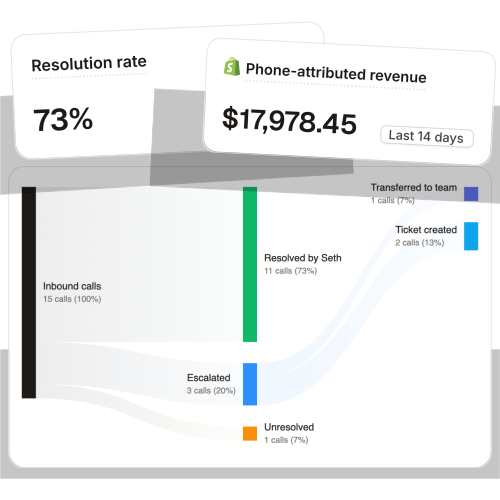
The AI answers inbound calls 24/7. It finds the order in your Shopify store, reads back the order status and tracking, answers product questions from your knowledge base, and handles returns. Across 50+ brands, the AI resolves 73% of calls autonomously at roughly $0.42 per resolved call. Calls that genuinely need a person get a smart call transfer to your team, and the call gets logged where you already work so nothing falls out of your ticket history.
WashCo, a Shopify brand we launched, recovered $22,664 in its first 7 days on the phone. That's revenue from calls that would otherwise have rolled to voicemail.
"My customers also feel like it's a normal person. They feel like they can communicate if they have questions."
Claudia Droge, TechCraft Studio
It plugs into the stack you already built rather than replacing it. Keep Shopify, keep Veeqo, keep your phone support setup, and add an AI that answers the calls your reps shouldn't have to. For the after-hours window specifically, where most voicemails pile up, see how brands run an after-hours answering service without a night shift.
What this costs vs leaving it on a human
Run the math on the phone line the way you'd run it on any other line item. Take a typical brand at this size with a 6-rep CS team:
| Line item | Today | With Ringly |
|---|---|---|
| 6 reps x $4K loaded per rep | $24,000/mo | n/a |
| Ringly (~$5K/mo at this volume) | n/a | $5,000/mo |
| Net monthly CS spend | $24,000/mo | $5,000/mo |
| Monthly savings | n/a | $19,000/mo |
| Annual savings | n/a | $228,000/yr |
That's roughly 70% of repeatable calls, order status and returns and the same five questions over and over, routed to the AI. The other 30%, the genuinely complex calls, still go to your team, who now have time to actually solve them. Per call, an in-house rep runs about $2.70 loaded against $1.20 to $2.00 for the AI, and the AI covers the after-hours window your reps don't.
If you want the number for your own call volume instead of a 6-rep example, book a 30-min call and we'll do the math live against your current setup. You can also compare the in-house line against an outsourced support model, or run your own numbers on 24/7 ecommerce phone support.
Frequently asked questions
Does Ringly replace Gorgias or Veeqo? No. It sits in front of them on the phone channel. Keep Gorgias for email and chat, keep Veeqo for shipping and inventory, and let the AI handle inbound calls. Calls that need a person escalate to your team and get logged in your helpdesk.
Is Veeqo really free? The core shipping and inventory software is free, and Veeqo earns a commission on labels you buy through it. Paid add-ons start at $19/mo for the Inventory plan and $350/mo for High Volume, per Veeqo's pricing page.
How does the Gorgias and Veeqo integration actually connect? It's a partner-built widget that queries Veeqo by the customer's email and shows their order and shipment data inside the Gorgias ticket. You add a Veeqo API key in the Gorgias widget settings. It works on tickets, not on live phone calls.
Will customers know they're talking to AI? The most repeated thing customers say after a call is "you don't sound like AI." It reads order status, handles returns, and answers product questions from your knowledge base, and it transfers to a human the moment a call needs one.
How fast can it go live? Live in under an hour for self-serve plans. Add your site, docs, or knowledge base and the AI is ready to take order-status calls. Enterprise builds are scoped on a call.
Is there a guarantee it works? Yes. If the AI resolves under 65% of your calls in 90 days, we refund the last 3 months of subscription fees.
Talk to us

If you run a $10M-$100M Shopify brand, you've already done the hard wiring. Shopify, Veeqo, Gorgias, all talking to each other. The phone is the one channel the integrations don't reach, and a 30-min call is the fastest way to see what's still landing on it after-hours.
The 3-layer guarantee.
- Live in 14 days or it's free until launched.
- 65% resolution in 90 days or we refund the last 3 months of subscription fees.
- We keep working free until we hit 65%.
Ruben (Ringly co-founder) takes these calls personally.