

Gorgias turns every customer conversation into a ticket. That part works.
- You'll see exactly how the ticketing system handles tickets, tags, macros, rules, SLAs, and Shopify order context, told straight, no vendor spin.
- The one channel it can't de-staff is the phone: the Voice add-on creates a ticket, but a human still has to pick up.
- Built for a $10M-$100M Shopify brand on Gorgias with a visible phone line and 3-12 reps.
The Gorgias queue on a Monday is a wall of tickets. Email, chat, a few Instagram DMs, and the voicemails nobody got to over the weekend, all stacked in one inbox. If you run support at a $10M-$100M Shopify brand, you already live in this thing, and most of what's in the queue is the same five questions on repeat.
So I did the obvious test. I set up a Gorgias trial on a fresh Shopify store, pushed an email, a chat, and a phone call through it, and watched which tickets a macro or a rule could clear on their own, and which still needed a person to pick up. The ticketing system is genuinely good. The catch is narrower than the marketing makes it sound, and it lives entirely on the phone line.
Most Heads of CX on Shopify run Gorgias and a phone number nobody answers after 6 p.m. We build AI phone agents for 50+ Shopify brands trying to close that exact gap. Book a 30-min call and we'll show you what the phone slice of your ticket queue is actually costing you.
What a ticket actually is in Gorgias
In Gorgias, a ticket is "a customer's request raised to seek help in resolving issues concerning services, and products, or to respond to any questions they might have," per the Gorgias docs. Every conversation becomes a ticket. There's no separate inbox for email and another for chat. It's all one object type, sitting in one queue.

Every ticket lives in one of three states, and that's the whole lifecycle: open, closed, or snoozed. Open means it needs attention. Closed means it's resolved. Snoozed means you've set it aside while you wait on the customer or a follow-up. Snooze is the one most teams underuse, and it's the difference between a queue that reflects real work and one that's padded with tickets waiting on someone else.
You don't dig through the raw queue. You work from Views, which are filtered lists of tickets by status, priority, or whatever fields you've set up. A few that earn their keep:
- Open and unassigned: the tickets actively falling through the cracks. This is the View your lead checks first.
- By tag: every "refund" or "damaged-item" ticket in one place for the person who owns that workflow.
- SLA breach: tickets open longer than your response target (more on this below).
Bulk actions let you tag, assign, or close a stack of tickets at once. Custom fields let you require structured data before a ticket can close, so your reporting isn't built on free-text guesses. None of this is flashy. It's the boring infrastructure that keeps a 200-ticket Monday from turning into chaos, and it's the reason Gorgias is the default helpdesk for serious Shopify brands.
Every channel becomes one ticket
Here's the part that makes Gorgias feel like a single system instead of five tools. Email, chat, social (Facebook and Instagram), SMS, and phone (through the Voice add-on) all create the same kind of ticket. A customer can email on Monday, chat on Tuesday, and call on Friday, and your rep sees one chronological thread, not three disconnected records.
Email-to-ticket is the workhorse. Every message sent to your support address becomes a trackable ticket the moment it lands, so nothing sits in a shared Gmail inbox getting double-replied or ignored.
But "every channel becomes a ticket" hides an important distinction: a ticket getting created and a ticket getting resolved are two different things, and they cost very different amounts. Here's the honest breakdown by source:
| Ticket source | What creates it | Who clears it | Cost shape |
|---|---|---|---|
| Customer emails support@ | Macro, rule, or rep | Low, mostly automatable | |
| Chat | Customer opens the widget | AI agent, macro, or rep | Low to medium |
| Social / SMS | DM or text | Rule-routed to a rep | Medium |
| Phone (Voice add-on) | Customer calls | A human rep, live | High, a person picks up |
Email and chat tickets can be cleared by a macro or an automation. A phone ticket still ends with a human holding a headset. That single row in the table is the whole story of this article. Keep it in mind.
Tags, macros, and rules: the automation layer
This is where the system stops being a shared inbox and starts saving payroll, at least on the channels that can be automated.
Tags categorize tickets for filtering and reporting. Things like "damaged-item," "wrong-order," "refunded," or "exchange-sent." On their own, tags are just labels. Paired with rules, they become routing logic.
Macros are the daily driver. Per the Gorgias docs, "Macros enable your agents to respond to customers and take actions on tickets in a single click." A macro can drop in a templated reply, add tags, change the status, and assign the ticket, all at once. With a Shopify store connected, macros go further: they can "duplicate, cancel, refund, and edit orders," and pull dynamic Shopify variables (order number, tracking link, customer name) straight into the reply. Connect Shopify and Gorgias auto-generates a starter set of these. For a WISMO ticket, a single macro can look up the order, paste the tracking number, tag it, and close it.
Rules are the if-this-then-that brain. A rule watches for ticket details (subject line, channel, words in the message) and fires an action. If a ticket contains "refund," auto-apply the refund tag. If it comes from Instagram, route it to the social team. If it's been open past your SLA window, escalate it. According to eesel's automation guide, this is how teams keep a high-volume queue organized without a human triaging every ticket by hand.
The math on automation is simple: anything that's text can be templated, routed, or auto-tagged. That's why 70-80% of an email-and-chat queue (order status, returns, sizing, the same questions over and over) can run with very little human touch. SLA management rides on the same machinery: build a View of tickets open longer than X minutes, auto-tag the ones approaching the threshold, and escalate the overdue ones before they turn into a one-star review.
If you want the full helpdesk-vs-helpdesk picture, our Gorgias alternatives breakdown covers where it wins and where it doesn't.
Shopify order context lives on the ticket
The reason Gorgias beats a generic helpdesk for Shopify brands isn't the ticketing model. It's that the order lives next to the conversation. Per the Gorgias Shopify integration overview, the sidebar on every ticket surfaces order status, customer information, transaction history, shipping address, product details, real-time inventory, and even the customer's current cart.
Your rep never tabs over to the Shopify admin. They act from inside the ticket:
- Order edits: create, duplicate, cancel, or refund an order without leaving the ticket.
- Shipping fixes: edit the shipping address on an unfulfilled order before it ships to the wrong place.
- Product links: insert a product card so the customer can add it to their cart from the conversation.
- Adjustments: change quantities, apply a discount, or process a partial refund.
This is the feature that makes a Gorgias ticket worth more than an email: the answer and the action live in the same place. It's also why most Shopify operators tolerate the per-ticket pricing. The context is real, and it's a genuine time-saver on the channels where a human is already typing. The question is whether you should be paying a human to type at all on the channels that don't need one. You can see how this connects to order-status calls in our check order status feature and our Shopify ticketing system guide.
What it costs: plans and the billable-ticket model
Gorgias prices on tickets, not seats, which is the thing to understand before you scale. A "billable ticket" is any conversation where the customer receives a response, from an agent or from automation. Here's the 2026 lineup (Lindy and Capterra):
| Plan | Price (monthly) | Tickets / month |
|---|---|---|
| Starter | $10 | 50 |
| Basic | $60 | 300 |
| Pro | $360 | 2,000 |
| Advanced | $900 | 5,000 |
| Enterprise | Custom | 5,000+ |
A few things that bite at volume:
- Overage runs roughly $0.36 to $0.40 per ticket once you pass your monthly cap.
- AI Agent automated resolutions are billed separately, around $1.00 per resolved conversation.
- Annual billing knocks off roughly two months.
Gorgias rates 4.6/5 on Capterra across 134 reviews and 4.3 stars on the Shopify App Store, with the most common gripe being the per-ticket bill climbing faster than expected at scale. The bill scales with ticket count, so the channel that generates the most expensive tickets deserves the most scrutiny. For the full tier-by-tier breakdown, see our Gorgias pricing post.
The one channel the ticketing system can't de-staff: the phone
Now the seam. Gorgias does answer the phone, through the Voice add-on. It's a supplementary subscription that adds a Voice channel: you create phone numbers, take inbound calls, and make outbound calls from inside the helpdesk. When a customer calls, per the Gorgias Voice docs, "a ticket is automatically created, giving you a complete, chronological timeline of every single customer interaction." Your agent sees the full cross-channel history and the Shopify order data on screen during the call. It's a clean implementation.
Read that again, though. The Voice add-on creates the ticket. A human still answers the call. Every other channel in Gorgias has an automation path: a macro for email, a rule for routing, an AI agent for chat. The phone is the one place where the ticket gets created and a rep still has to be sitting there to talk.
That matters because the phone is where the money leaks:
- WISMO is 30-40% of all tickets, and 50% at peak, per Salesforce. A lot of that arrives by phone from customers who don't trust the tracking page.
- 62% of callers who can't reach a person switch to a competitor, per PCN. A voicemail-routed phone ticket isn't a saved customer. It's a lost one with a paper trail.
- After 6 p.m. and on weekends, those calls roll to voicemail, the voicemails never get returned, and the tickets sit in the queue as evidence of revenue you didn't catch.
When I ran my own test through Gorgias, the email and chat tickets were clearable with the starter macros in a couple of clicks. The call ticket just sat there, open, waiting for me to be a person. That's the gap. The ticketing system is doing its job. It's logging a problem it can't staff its way out of without you hiring reps. Our deeper look at after-hours WISMO calls and 24/7 ecommerce phone support walks through what that costs.
What the phone slice of your queue actually costs
Put a number on it. Take a $50M Shopify brand running a 6-rep CS team, with the phone line eating a meaningful chunk of their hours.
| Line item | Today | With AI on the phone |
|---|---|---|
| 6 reps at $4,000 loaded per rep | $24,000/mo | n/a |
| AI phone agent (illustrative) | n/a | $5,000/mo |
| Net monthly CS spend | $24,000/mo | $5,000/mo |
| Monthly savings | n/a | $19,000/mo |
| Annual savings | n/a | $228,000/yr |
That's roughly 70% of repeatable calls (order status, returns, the same five things over and over) handled without a rep. The genuinely complex calls still go to your team, who now have the time to actually solve them instead of reading tracking numbers off a screen all day. WashCo, a Shopify brand we launched, recovered $22,664 in its first 7 days on the phone.
If the phone is the line item you can't get off your headcount budget, book a 30-min call and we'll do the math live against your real call volume.
How Ringly turns inbound calls into Gorgias tickets
Ringly.io is AI phone support for Shopify brands. The phone shouldn't be a tax on your support team, and it doesn't have to be the one channel Gorgias can't automate. Instead of hiring a rep to sit on the Voice add-on, the AI answers the call.
Here's how it sits in your stack. A customer calls. The AI picks up 24/7, finds their order in your Shopify store, answers the question from your knowledge base, and resolves the call. Then it does the part that makes the phone behave like every other ticket source: it writes the structured ticket back into Gorgias, with the tag, the order context, and the transcript attached. Calls that genuinely need a human escalate cleanly into your existing queue. You keep your phone number, your helpdesk, your tags, and your workflows. You just stop paying a person to answer "where's my order" at 11 p.m.
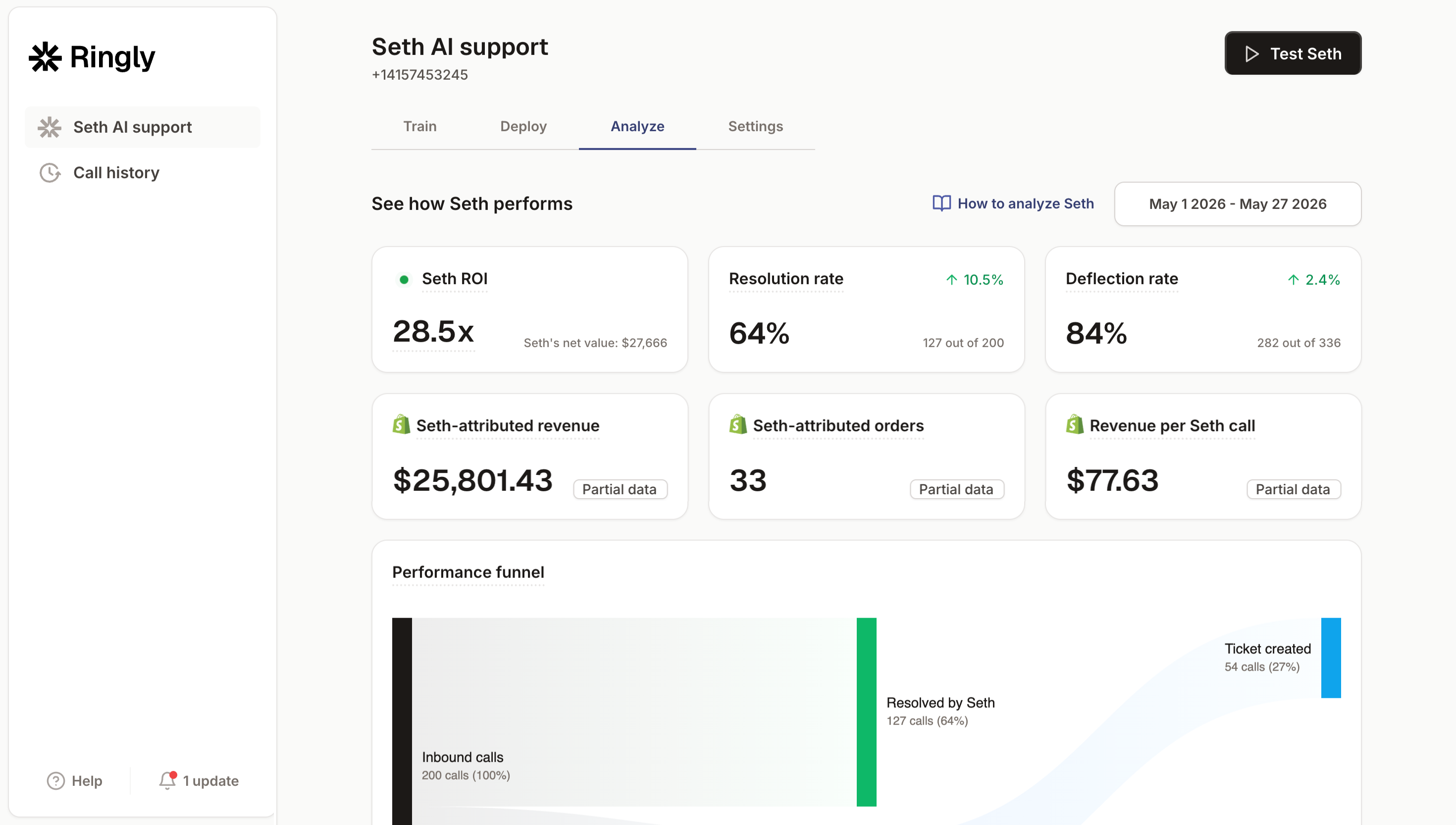
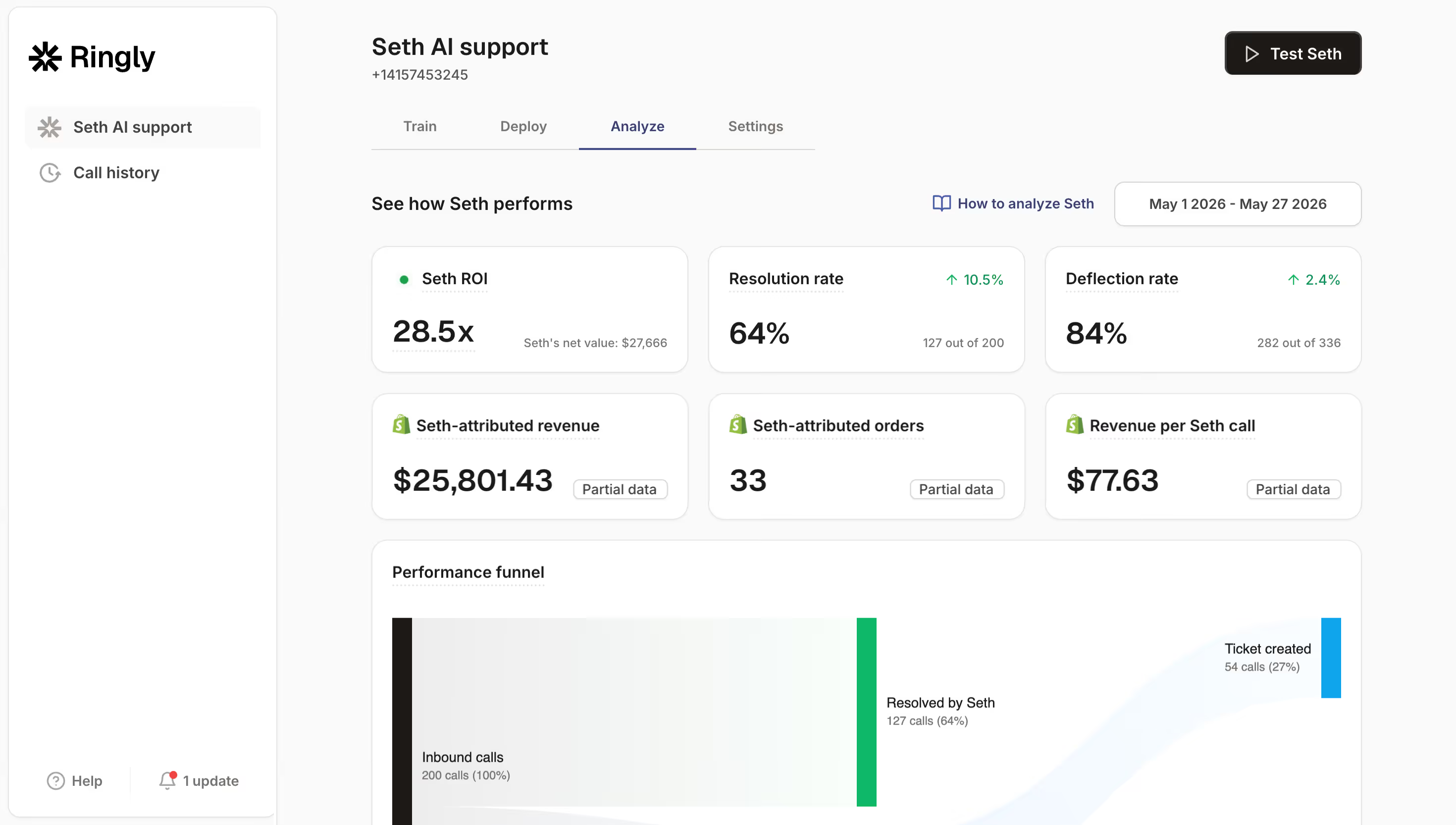
Across 50+ brands, the AI resolves 73% of inbound calls on its own, at roughly $0.42 per resolved call versus $7 to $16 per call for a human BPO. The phone stops being the expensive ticket source and becomes the one that fills itself in. Plans run Grow at $349/mo and Pro at $799/mo, with Enterprise scoped on a call. It's live in under an hour, and it's backed by a 65% resolution guarantee. You can see how the handoff works in our smart call transfer and knowledge base pages, or the full AI phone agent for Shopify overview.
"My customers also feel like it's a normal person. They feel like they can communicate if they have questions."
Claudia Droge, TechCraft Studio
Frequently asked questions
What is a ticket in Gorgias? A ticket is a single customer request, and every conversation in Gorgias becomes one. It can be open, closed, or snoozed, and it carries the full thread plus the customer's Shopify order context in the sidebar.
Does the Gorgias ticketing system work with Shopify? Yes, and the Shopify integration is the main reason to use it. The sidebar shows order status, history, inventory, and the customer's cart, and reps can refund, cancel, or edit orders without leaving the ticket.
How much does Gorgias cost, and what's a billable ticket? Plans run from $10/mo (Starter, 50 tickets) to $900/mo (Advanced, 5,000 tickets), with custom Enterprise pricing above that. A billable ticket is any conversation where the customer gets a response, and overage runs about $0.36 to $0.40 per ticket over your cap.
Does Gorgias handle phone calls? Yes, through the Voice add-on, which creates a ticket automatically when a call happens. But a human rep still has to answer the phone, so the phone is the one channel the ticketing system can't fully automate on its own.
What's the difference between macros and rules? A macro is a one-click action a rep applies (a templated reply plus tags, status, and Shopify actions). A rule is automatic if-this-then-that logic that fires on its own to tag, route, or escalate tickets based on their content.
How does an AI phone agent fit with Gorgias? It sits in front of your phone line, answers and resolves inbound calls, then writes the structured ticket back into Gorgias with the tag, order context, and transcript. You keep Gorgias as your helpdesk and stop staffing the phone channel with humans.
Talk to us

If you run a $10M-$100M Shopify brand and the phone line is the channel your ticketing system can't de-staff, a 30-minute call is the fastest way to see the recovered hours. We'll look at your real call volume and your Gorgias setup together.
The 3-layer guarantee.
- Live in 14 days or it's free until launched.
- 65% resolution in 90 days or we refund the last 3 months of subscription fees.
- We keep working free until we hit 65%.
Ruben (Ringly co-founder) takes these calls personally.