

A Gorgias ticket is just a customer message plus everything Shopify knows about that customer, in one screen.
- You'll see the anatomy of one ticket, then three worked examples: a where's-my-order ticket, a return, and a damaged item.
- The same three or four ticket types make up most of every queue. WISMO alone is 18% of support volume for Shopify brands.
- Built for founders, COOs, and Heads of CX at $10M-$100M Shopify brands already running Gorgias.
Most people who search this want to see an actual ticket, not read another feature list. So this post shows you real ones.
I read Gorgias ticket exports next to the call logs from the 50+ Shopify brands we run phone support for. Two things jump out every time. The same three or four ticket types repeat all day. And most of them also come in by phone, where they hit voicemail instead of a clean ticket.
If you run customer experience at a Shopify brand doing $10M to $100M, you already know the Monday queue: WISMO, WISMO, a return, "where is my order???", WISMO. This walks through what those tickets contain, how a rep works each one, and the part nobody shows you, which is where the phone version of that same question disappears. Most brands running Gorgias have a phone line that nobody picks up after 6 p.m., and the calls rolling to voicemail are the same questions sitting in the queue. Book a 30-min call and we'll show you what your after-hours line is leaving on the table.
The anatomy of a Gorgias ticket
A ticket gets created the moment a customer reaches out. Email, chat, SMS, a social comment, or a phone call: each one opens a ticket, and a ticket can't exist without at least one message (Gorgias docs).
Open any ticket and the screen splits in two. On the left is the conversation. On the right is the Shopify sidebar, which is the part that makes Gorgias different from a plain inbox. The sidebar is what turns a customer email into a ticket your team can actually resolve, because it shows the order without anyone opening a second tab.
Here's what every ticket carries:
- Messages: the full back-and-forth with the customer. This is the ticket's spine.
- Status: Open, Closed, or Snoozed. Snoozed is for when you're waiting on the customer and don't want it cluttering the open queue.
- Assignee: who owns it. Assign manually, or let a rule auto-assign by tag or channel.
- Tags: lightweight labels like "wismo", "return", "damaged-item", or "refunded". Tags are how you see what your queue is actually made of.
- Internal notes: team-only messages the customer never sees. You @mention a teammate to pull them in.
- Macros: saved replies with actions attached. One click can send the response, tag the ticket, change the status, and edit the Shopify order (Gorgias docs).
- The Shopify sidebar: order history, current order status with fulfillment and tracking, contact info, location, and any metafields you've imported. Internal notes here ("super fan, comped shipping twice") follow the customer across every channel.
- Ticket fields and event history: structured data for automations, plus a log of who did what and when.
From inside the sidebar your team can also act on the order without leaving the ticket: refund an order, cancel an order, duplicate an order, edit the shipping address, or create a draft order (Gorgias docs). That's the whole point of the Gorgias ticketing system: the answer and the action live in the same place. If you're newer to the tool, the Gorgias helpdesk overview covers how the inbox and the macro library fit together.

Now let's look at the three tickets you'll see most.
Example 1: the WISMO ticket
WISMO means "where is my order". It is the single most common ticket in ecommerce, full stop. Gorgias' own data puts it at 18% of support volume for Shopify brands, and across DTC it runs 30-40% of tickets in a normal week and past 50% at peak (Salesforce). These are the tickets that fill the WISMO calls side of your queue too.
Here's what one looks like in the queue:
- Customer message: "Hi, I ordered 10 days ago (#1043) and the tracking hasn't moved. Where is my order?"
- Shopify sidebar: order #1043, fulfilled 8 days ago, carrier shows in transit, last scan 3 days ago.
- Tag: "wismo" (or "shipping").
- The reply: a macro pulls the tracking link and the last scan into a pre-written response. The rep adds one line: "Looks like it's stuck at the carrier sort facility. I've flagged it. If it doesn't move by Friday I'll ship a replacement."
- Status: Closed (or Snoozed until Friday if they're waiting on the carrier).
A trained rep closes this in under two minutes. A WISMO macro closes it faster. The reason WISMO tickets pile up isn't that they're hard. It's that there are so many of them, and each one still needs a human to read the sidebar and pick the right macro. That's the trap: easy work, enormous volume.
Example 2: the return or exchange ticket
Second most common, and a little more involved. The customer wants money back or a different size.
- Customer message: "The medium runs small. Can I exchange for a large, or just get a refund?"
- Shopify sidebar: order #2210, delivered 4 days ago, inside the 30-day window.
- In-ticket action: the rep refunds the order or duplicates it with the new size, straight from the sidebar. Gorgias lets agents refund an order, edit an order, or create a draft order without ever opening Shopify (Gorgias docs).
- Tag: "return" or "exchange-sent".
- Internal note: "second exchange this month, watch for serial returner" so the next rep has context.
- Status: Closed once the label is sent.
The work here is judgment, not lookup. Is it inside the window? Does the policy cover fit issues? Should this customer get free return shipping? A human handles the gray area well, which is exactly where you want your CS team spending their time. The problem is they don't get to, because the queue is buried under WISMO.
Example 3: the damaged-item ticket
This is the one that actually deserves a person. Something arrived broken.
- Customer message: "My order came shattered." (photo attached)
- Shopify sidebar: order #3188, delivered yesterday.
- Internal note: rep @mentions the warehouse lead to confirm it's a packing issue, not a carrier issue.
- Tag: "damaged-item".
- Resolution: replacement shipped (a duplicate order from the sidebar) plus a short apology, or a refund if the item is out of stock.
- Event history: shows the rule that triggered, the note, and who closed it.
A damaged-item ticket carries emotion and needs a real reply. Get it right and the customer becomes more loyal than they were before the breakage. Get it wrong, or leave it sitting because the team is drowning, and you get a Trustpilot one-star and a complaint that spreads. These are the tickets your team was hired for, and they're the ones that get the least attention because the routine stuff eats the day.
The pattern: the same tickets pile up
Look at those three plus product questions ("is this in stock?", "is it gluten free?") and you've described most of every Gorgias queue. Tag your tickets for a week and the chart is always the same shape: a wall of WISMO, a stack of returns, a handful of product questions, and a thin slice of genuinely hard cases.
That's the operational truth behind every "gorgias ticket example" you'll find. The tickets aren't varied. Three or four types repeat all day, which is why merchants describe their queue as "the same questions over and over". When 70-80% of your inbound is repeatable, your reps spend most of their day on work that doesn't need their judgment, and the hard tickets wait.
Run the tag report and the shape barely changes month to month. A "wismo" tag count that dwarfs everything else. A solid block of "return" and "exchange-sent". A scattering of product questions. Then the small, important pile of "damaged-item" and escalations that your best reps should own. The volume isn't the problem. The mix is. You're paying skilled people to do unskilled work because the unskilled work shows up by the hundred.
Here's the part the ticket view hides. Those same questions don't only come in by email and chat. They come in by phone too. And the phone version doesn't become a clean ticket. It becomes a missed call. WashCo, a Shopify brand we launched, recovered $22,664 in its first 7 days once the phone was actually answered. The repeatable tickets you can see in Gorgias are only half the story, because the phone version of the same questions never makes it into the queue at all.
Book a 30-min call and we'll show you which of your call types are pure WISMO.
Where the phone version of these tickets goes
A customer who emails "where's my order" creates a tidy ticket. The same customer who calls at 7 p.m. gets your voicemail. They don't leave a message and they don't email later. 85% of callers who can't reach a person never call back, and 62% switch to a competitor (PCN). That call never shows up in your ticket queue, so it never shows up in your numbers either.
This is the gap Ringly.io fills. Ringly is AI phone support for Shopify brands, and it sits in front of Gorgias rather than replacing it.
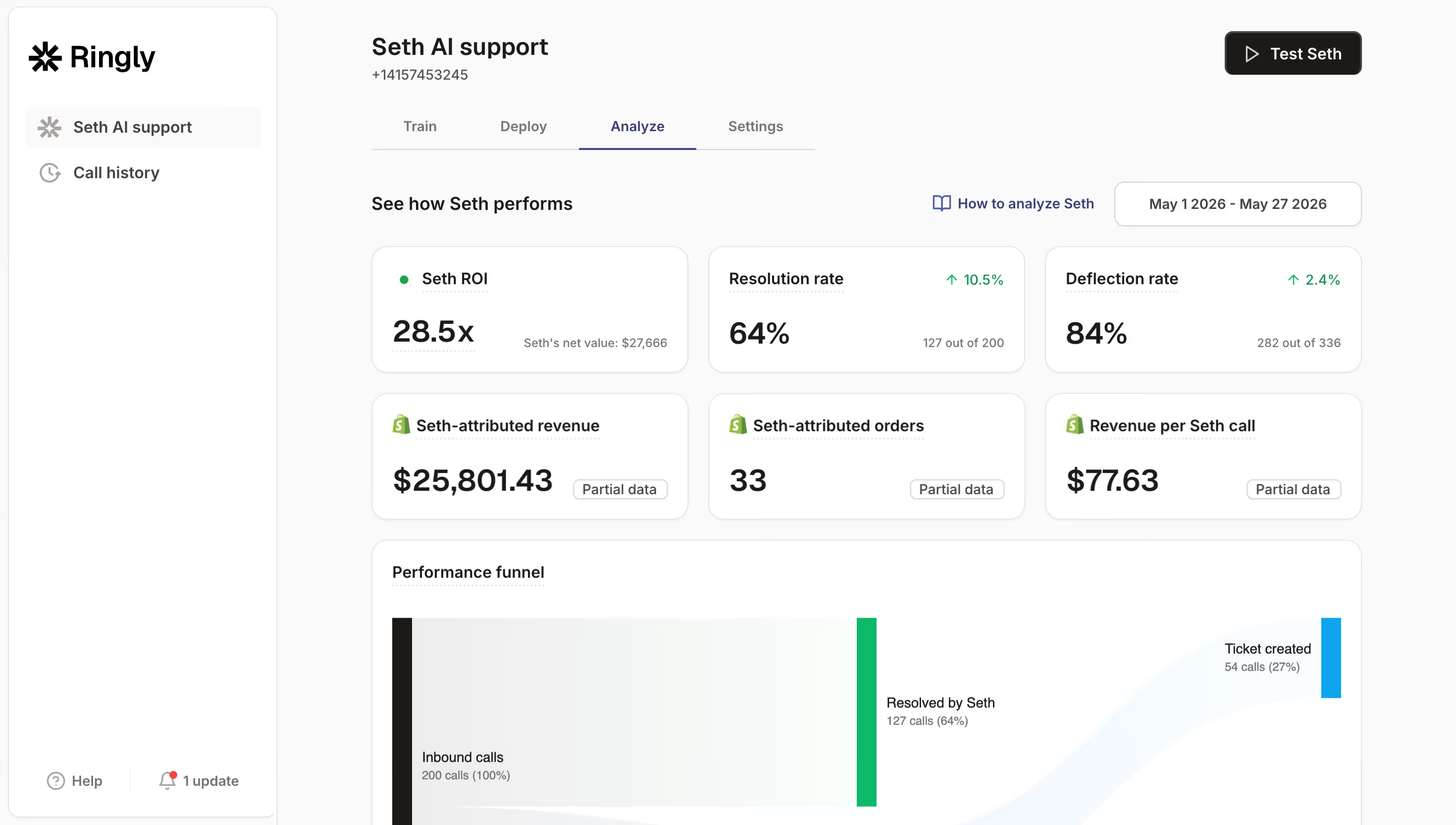
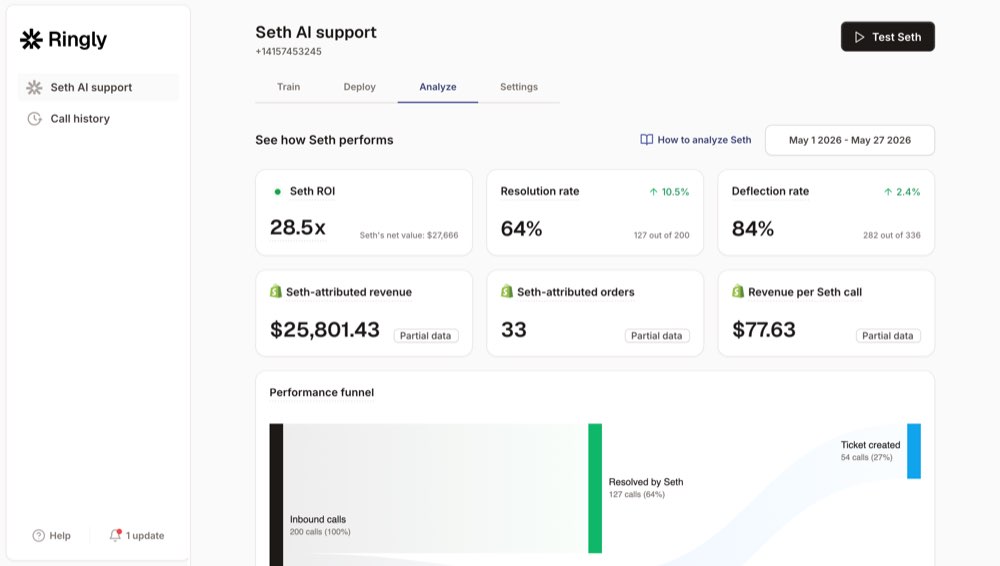
The AI answers inbound calls 24/7. It finds the order in your Shopify store, reads back the tracking, processes a return or exchange, and answers product questions from your knowledge base (check order status included). The routine call, the phone WISMO, gets resolved live instead of dying in voicemail. The hard call, the damaged-item or the angry escalation, gets handed to your team as a proper ticket in Gorgias, with the call summary attached. You keep your number, your helpdesk, and your workflows.
Across 50+ brands, the AI resolves 73% of calls on its own at roughly $0.42 per resolved call, against $7 to $16 for a human at a BPO. And it doesn't sound like a robot.
"My customers also feel like it's a normal person. They feel like they can communicate if they have questions."
Claudia Droge, TechCraft Studio
Every routine call the AI handles is a ticket that never had to be created, and every hard call it escalates lands in Gorgias clean. That's the difference between a phone line that leaks revenue and one that feeds your queue only the work that needs a person. If you've been treating phone support as a tax on your team, this flips it.
What this costs you vs putting an AI agent in front of Gorgias
Take a typical $50M Shopify brand running a 6-rep CS team.
| Line item | Today | With Ringly in front of Gorgias |
|---|---|---|
| 6 reps x $4K loaded per rep | $24,000/mo | $24,000/mo |
| Ringly (~$5K/mo) | none | $5,000/mo |
| Routine calls handled by a human | most of them | the AI takes ~70% |
| Net monthly CS spend | $24,000/mo | the AI offsets most of a rep's load |
The math the buyer actually runs is simpler. Roughly 70% of your repeatable calls (order status, returns, product questions, the same five things) get answered by the AI. Your reps keep the 30% that need judgment, plus every ticket Gorgias was already handling. The routine phone work stops costing you a hire, and the after-hours calls stop costing you customers. Most brands we run the numbers with are sitting on $19,000 a month of CS load doing work that no longer needs a person on the phone.
This is also why 24/7 phone support pays for itself rather than adding cost. The weekend WISMO call you used to miss now closes itself, and the customer who would have switched stays. You're not buying a second helpdesk. You're closing the one channel your current customer service setup leaks through.
Frequently asked questions
What is a Gorgias ticket? A ticket is a single customer conversation inside Gorgias, created when someone emails, chats, texts, comments on social, or calls. It bundles the message thread with the customer's Shopify order data so your team can answer and act in one place.
What does a Gorgias ticket actually contain? The message thread, a status (Open, Closed, or Snoozed), an assignee, tags, internal notes, and the Shopify sidebar showing order history, tracking, and contact info. Macros let a rep reply, tag, change status, and edit the order in one click.
What's the most common type of Gorgias ticket? WISMO, "where is my order". It's about 18% of support volume for Shopify brands per Gorgias, and 30-50% of tickets across DTC depending on the season. It's easy to answer but it's the bulk of the queue.
Can Gorgias create a ticket from a phone call? Gorgias supports voice, but a call only becomes a useful ticket if someone answers it. After-hours and overflow calls usually roll to voicemail, and most of those callers never leave a message or follow up by email.
How does Ringly work with Gorgias? Ringly answers your inbound calls, resolves the routine ones (order status, returns, product questions), and escalates anything complex into Gorgias as a ticket with the call summary attached. It sits in front of your helpdesk, it doesn't replace it.
Do I have to replace Gorgias to use Ringly? No. You keep Gorgias, your phone number, and your workflows. Ringly handles the phone channel that was rolling to voicemail and hands the hard calls to your existing queue.
How many of my tickets are actually repeatable? For most Shopify brands, 70-80% of inbound is the same handful of questions. Tag your tickets for a week and the WISMO, return, and product-question slices will dwarf everything else.
Talk to us

If you run a Shopify brand on Gorgias and your phone still rolls to voicemail after 6 p.m., a 30-minute call is the fastest way to see what that's costing you. We'll look at your call types live and show you how many are the exact tickets you're already drowning in.
The 3-layer guarantee.
- Live in 14 days or it's free until launched.
- 65% resolution in 90 days or we refund the last 3 months of subscription fees.
- We keep working free until we hit it.
Ruben (Ringly co-founder) takes these calls personally.