
Open your helpdesk on a Monday and the email queue tells you exactly how the weekend went. Two hundred-some tickets stacked since Friday at 6 p.m., most of them some version of "where's my order." If you run Gorgias, that queue is also the part of support you have the most control over. You can route it, tag it, template it, and watch first response time drop.
This is for the founder, COO, or Head of CX at a $10M-$100M Shopify brand running Gorgias with a visible phone number on the site. The goal here is to make you genuinely good at running Gorgias email support, and then to be honest about the one thing an email-first inbox can't do for you. If your phone goes to voicemail after your team logs off, book a 30-min call and we'll show you what's happening on those calls.
This post in 30 seconds.
- Setup: how to connect email to Gorgias two ways (Gmail/Outlook connector under 500 emails a day, or forwarding to a support-123@email.gorgias.com address above that), plus the macros and rules that cut response time.
- The gap: Gorgias runs your email queue beautifully. It does not answer your phone. That's the channel still leaking after-hours, and it's where an AI phone agent picks up.
- Who this is for: $10M-$100M Shopify brands running Gorgias with a visible phone line and 3-12 reps.
What "Gorgias support email" actually means
The phrase splits two ways, and you probably landed here meaning one of them.
The first is the common one: setting up and running your support email inside Gorgias, so messages from support@yourbrand.com turn into tickets your team can triage. The second is narrower: you're trying to reach Gorgias's own support team about your account. Both are real searches, so this covers both. We'll spend most of the time on the first, because that's the one that actually moves your numbers, and close with the second.
Either way, email is where the pressure shows up first. The average customer-service email now takes around 8.5 hours to get a reply, and one 2026 analysis found 62% of businesses never reply at all (EmailAnalytics). Meanwhile roughly 90% of customers say they expect a response within an hour. The gap between what your inbox delivers and what your customer expects is the whole game in support, and email is where you can actually close it.
How to set up email support in Gorgias
There are two ways to get email into Gorgias, and which one you use depends on your volume.
- Direct connector (Gmail or Outlook). If your brand sends fewer than 500 emails a day, you can connect Google Workspace or Microsoft 365 straight to Gorgias. Authorize the account, and new mail starts landing as tickets (Gorgias docs).
- Forwarding (higher volume, Advanced and Enterprise). Above that threshold, Gorgias generates a base address that looks like support-123@email.gorgias.com. You forward your real support@yourbrand.com to it, and everything routes through the helpdesk.
Once email is connected, every message to your support address shows up as a ticket. From there you can connect it to your store so all your brands inherit the same Shopify context, add custom signatures so replies look consistent, and import up to about two years of past email history so your team isn't starting from an empty inbox.
I set this up on a real test Shopify store to check the steps were still accurate. Forwarding took a few minutes, tickets appeared cleanly, and the Shopify order data showed up next to each one. That part of Gorgias is genuinely good, and the deep Shopify integration is the reason most DTC brands pick it over a general-purpose email help desk. One thing to flag before you scale: the Gmail and Outlook connectors are capped at that under-500-a-day volume, so if you're a $30M+ brand you'll likely be on forwarding from the start.
A clean five-minute version of the setup, if you want a checklist:
- Pick your method by volume. Under 500 emails a day, use the Gmail or Outlook connector. Above it, use forwarding to the generated support-123@email.gorgias.com address.
- Forward, don't migrate cold. Set the forward on your real support inbox so nothing in flight gets dropped during the switch.
- Connect your store first. Wiring Shopify in before you go live means every ticket lands with order context attached, which is the whole point.
- Import history. Pull in the back catalog so reps can see prior conversations instead of treating every customer as new.
- Set the signature once. Brand-consistent replies, no per-rep drift.
A couple of setup mistakes show up over and over, and they're the part the official docs gloss over. The most common is leaving the old inbox connected somewhere else, so the same email lands in two places and your team double-replies. The second is forwarding without verifying the domain, which can quietly route a slice of mail to spam. And if you run a third-party ERP alongside Shopify, test the order-data sync before you trust it. Reviewers consistently flag that integration as the flaky one (Capterra).
Managing the inbox: macros, rules, and response time
Connecting email is the easy part. Running it well is where the time goes.
Two features do most of the work. Macros are templated replies with Shopify variables baked in, so a single click pulls the customer's name and order number into a personalized response. Rules are if-then workflows: if an email subject contains "refund," tag it "Refund Request" and assign it to the billing team. Used together, macros and rules can automate a meaningful slice of repetitive tickets, with vendor estimates putting it around 40%.
The trap is treating macros like a vending machine. A macro that fires the same canned paragraph regardless of context reads as a canned paragraph, and customers can tell. The macros that actually move CSAT are the ones with variables doing real work: the order number, the tracking link, the customer's first name, the specific product. Start with your top five email reasons, build a macro per reason, and let rules route each one to the right person automatically. That's the 70-80% of email that's the same questions over and over, handled without a rep typing the same sentence for the hundredth time.
Rules are where teams overbuild. The flexibility is the feature and the failure mode at once. Reviewers note the rules builder gets complicated fast once you're running dozens of them (TrustRadius), so keep the first pass simple: tag by keyword, assign by tag, escalate by priority. You can layer complexity later once you can see which rules earn their keep.
Why bother? Because response speed is worth real money. Sub-one-hour email responses correlate with 71% customer retention, versus 48% for replies that take a full day, a 23-point gap (Stealth Agents). Gorgias's own case studies point the same direction: Beardbrand reports 34% single-reply tickets, and SuperATV reports an 84% drop in first response times after building out their workflows (Gorgias).
The honest read: if 70-80% of your email volume is the same handful of WISMO questions, macros and rules are the single best thing you can set up this week. Build a macro for order status, one for returns, one for shipping, and route everything else by tag. If you want to benchmark where you land, our response-time benchmarks post has the numbers by channel.
One caveat reviewers raise consistently: the cost climbs. Gorgias's 2026 plans run up to roughly $900 a month for Advanced, and each fully automated AI resolution adds about $0.90 to $1.00 on top, while still counting against your ticket limit (Chatarmin). Worth modeling before you turn automation all the way up.
What email-first support can't catch (the phone)
Here's where the honesty has to kick in. Everything above makes your email queue faster, cleaner, and cheaper to run. None of it answers a ringing phone.
Gorgias is an email-and-ticketing helpdesk. It routes written messages, tags them, and templates the replies. A phone call isn't a written message. When a customer dials your number at 9 p.m. because they don't trust the website with a $200 order, Gorgias has nothing to do with that call. It rings, it rolls to voicemail, and the voicemail joins the pile your team never gets back to.
That's not a knock on Gorgias. It's just a different channel. And for a $10M-$100M brand it's usually the leakiest one. Phone calls skew toward the highest-intent, highest-AOV moments: the pre-purchase question, the "did my order ship" panic, the older customer who would rather talk to a person. When those go unanswered, you don't see them in the queue. You see them as a competitor's order or a one-star review that says "couldn't reach anyone."
I tested this directly. After setting up that Gorgias email channel on the test store, I called the store's own number to see what an email-first inbox does with a live caller. Nothing happened. The email side was humming, and the phone just rang. That's the gap, and it doesn't show up on any Gorgias dashboard.
WashCo, a Shopify brand we launched, recovered $22,664 in attributed revenue in its first 7 days once the phone was actually being answered. Those were calls that, on an email-first stack, would have gone to voicemail.
If your phone is the channel still leaking, book a 30-min call and we'll pull your last week of missed calls and show you what's in there. For the bigger picture on why this leaks, our after-hours coverage and founder-on-the-phone posts go deeper.
Where an AI phone agent fits with Gorgias
Ringly.io is AI phone support for Shopify brands. Your team wasn't hired to answer the same call 50 times a day, and the AI takes the routine inbound calls so they don't have to.
The important part for a Gorgias shop: this doesn't replace anything. Ringly sits in front of your phone line. It answers inbound calls 24/7, finds orders in your Shopify store, handles returns and product questions from your knowledge base, and the calls that actually need a human escalate cleanly to Gorgias or whatever helpdesk you already run. Your email setup, your macros, your rules, all of it stays exactly where it is. You're just adding the channel Gorgias was never built to cover.
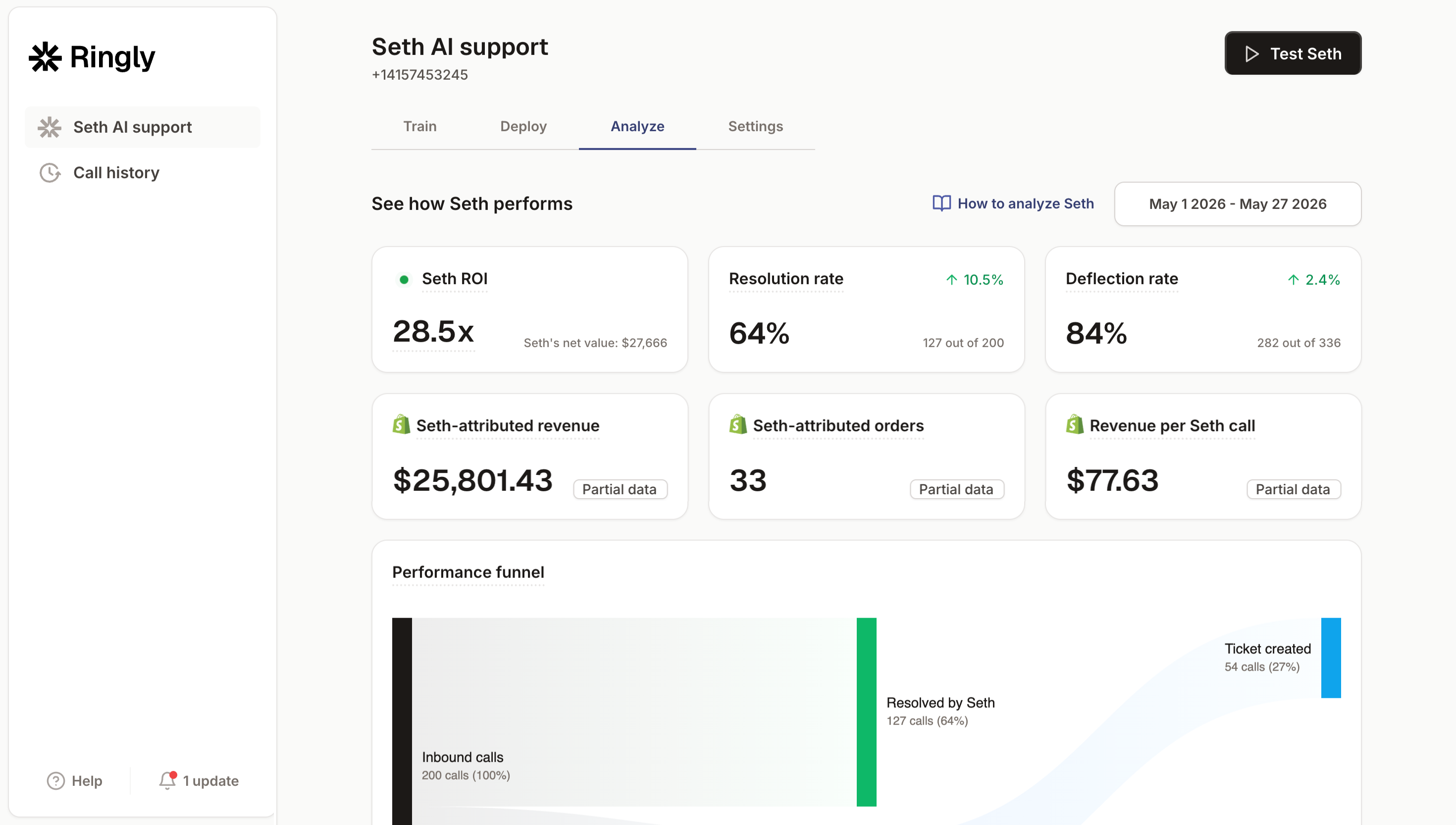
Across 50+ brands, the AI resolves 73% of inbound calls on its own at roughly $0.42 per resolved call, versus the $7 to $16 a human-handled call runs at industry BPO rates. BioLongevity Labs, a Shopify brand on Ringly, hits 79% end-to-end resolution with one agent handling the full call.
"My customers also feel like it's a normal person. They feel like they can communicate if they have questions."
Claudia Droge, TechCraft Studio
Here's the math most brands run. Take a $50M Shopify brand with a 6-rep CS team:
| Line item | Today | With Ringly |
|---|---|---|
| 6 reps × $4K loaded per rep | $24,000/mo | n/a |
| Ringly Enterprise (~$5K/mo) | n/a | $5,000/mo |
| Net monthly CS spend | $24,000/mo | $5,000/mo |
| Monthly savings | n/a | $19,000/mo |
| Annual savings | n/a | $228,000/yr |
That's roughly 70% of repeatable calls, the order-status and returns and product questions that don't need a human, routed to the AI. The genuinely complex calls still go to your team, who now have time to actually solve them. Plans start at $349/mo on Grow and $799/mo on Pro, with Enterprise quoted by call, all backed by a 65% resolution guarantee. If you want to see it against your own setup, book a 30-min call and we'll do the math live. More on how it works on the Shopify AI voice support and AI customer support phone agent pages, and the order-status feature shows the WISMO handling specifically.
How to contact Gorgias's own support
If you came here for the other meaning of "Gorgias support email," reaching Gorgias about your own account, here's the honest version.
Gorgias points you to their Help Center contact page rather than a single public support inbox. From inside your account you can open the Help Center and submit a request there, which is the official route. One thing reviewers flag worth knowing going in: response quality tends to track your plan tier, and several teams on lower plans report slow replies and limited onboarding. If you're evaluating the platform, factor support access into the plan you pick, not just the ticket count. For the full breakdown of what each tier actually costs, see our Gorgias pricing post.
Frequently asked questions
What is the Gorgias support email or forwarding address? When you connect email via forwarding, Gorgias generates a base address that looks like support-123@email.gorgias.com. You forward your real support inbox to it, and incoming mail becomes tickets. Brands sending fewer than 500 emails a day can use the Gmail or Outlook connector instead.
How do I contact Gorgias support directly? Use the Help Center contact page inside your Gorgias account to submit a request, which is their official support channel. Be aware that response speed often tracks your plan tier, so budget for it if support access matters to you.
Can Gorgias answer phone calls? No. Gorgias is an email, chat, and ticketing helpdesk. It manages written conversations and routes them to your team, but it doesn't answer a ringing phone. That's a separate channel, which is where an AI phone agent like Ringly fits.
How much does Gorgias email support cost? Gorgias 2026 plans run up to roughly $900/mo for Advanced, and each fully automated AI resolution adds about $0.90 to $1.00 while still counting toward your ticket limit. Overages on tickets land around $0.36 to $0.40 each, so model your real volume before turning automation up.
Does Ringly replace Gorgias? No. Ringly sits in front of your phone line and handles inbound calls, then escalates the ones that need a human into Gorgias. Your email queue, macros, and rules stay exactly as they are.
How fast can email response times get with Gorgias? With macros and rules handling the repetitive WISMO and returns volume, many brands cut first response time dramatically. Gorgias cites case studies like SuperATV at an 84% reduction. The lever is templating the 70-80% of email that's the same questions over and over.
Talk to us

If you run a $10M-$100M Shopify brand and the phone keeps ringing after your team logs off, a 30-min call is the fastest way to see what you're leaving on the table. We'll pull your missed calls and run the numbers against your current setup.
The 3-layer guarantee.
- Live in 14 days or it's free until launched.
- 65% resolution in 90 days or we refund the last 3 months of subscription fees.
- We keep working free until we hit 65%.
Ruben (Ringly co-founder) takes these calls personally.