
This post in 30 seconds.
- A Gorgias MCP server lets an AI tool like Claude or ChatGPT read and act on your Gorgias account directly, and there are four real ways to get one.
- The official Gorgias MCP server went to open beta in May 2026. It is free on every Helpdesk plan and takes about five minutes to connect.
- Built for CX and ops leaders at $10M to $100M Shopify brands running Gorgias, who already talk to Claude or ChatGPT every day.
If you searched for a Gorgias MCP server, you are probably one step ahead of most of your team. You want an AI tool to look at your helpdesk and actually do something with it, not just chat about it in the abstract. The good news is that this is real now, and you have options. The official one shipped, the community built a few, and the Gorgias API has been there the whole time.
The confusing part is figuring out which of those four paths you actually want. They differ in how they sign in, what they cost, and who they are built for. This guide walks all four, shows you how to connect the official server, and is honest about the one thing none of them do.
That last part matters more than it sounds. An MCP server runs your helpdesk. It does not answer your phone.
If you run customer experience at a Shopify brand on Gorgias and your team is still answering the same questions over and over while the after-hours line rolls to voicemail, the second half of this post is for you. We build AI phone support for 50+ Shopify brands trying to fix exactly that. Book a 30-min call and we will show you what your phone line is leaking.
Here are the four ways to get a Gorgias MCP server at a glance.
| Path | What it is | How it signs in | Cost | Best for |
|---|---|---|---|---|
| Official Gorgias MCP | First-party server from Gorgias, in open beta | OAuth in the browser | Free on every Helpdesk plan | Most teams. Safe default, zero setup. |
| Community server | Open-source server built on the Gorgias API | Gorgias API key | Free, but you self-host | Developers who want to extend or self-run it. |
| Managed platform | Gorgias exposed as MCP through Composio, Zapier, or Improvado | Platform account plus API key or OAuth | Platform subscription | Teams bundling Gorgias with many other apps in one agent. |
| Custom on the API | Your own thin server over the REST API | Gorgias API key | Your build time | Specific actions the others do not expose. |
What is the Gorgias MCP server, exactly?
Start with the protocol, because the name does most of the work once you understand it. The Model Context Protocol is an open standard Anthropic released in November 2024. The cleanest description comes straight from the official MCP announcement: think of it as a USB-C port for AI applications. Before USB, every device needed its own cable. After USB, you plug anything in and it works. MCP is trying to do that for the connections between AI assistants and the tools where your data actually lives.
It caught on fast. OpenAI adopted it in March 2025, and Google and Microsoft followed by the middle of that year, which is why you now see "MCP server" attached to half the software you use.
A quick vocabulary note so the rest of this makes sense. An MCP server is the side that exposes one system's data and actions. The MCP client is the AI tool you already use, like Claude, ChatGPT, or Cursor. So a Gorgias MCP server is the piece that lets your AI client reach into your Gorgias workspace, read your tickets, and take actions on your behalf.
The official Gorgias MCP server is a first-party connector, currently in open beta, that plugs your helpdesk into any MCP-compatible AI tool. Per the Gorgias documentation, it lives at https://mcp.gorgias.com/mcp, it is available on every Helpdesk plan, and it does not cost extra. You bring your own AI subscription, and Gorgias provides the server.
If you want the conceptual version of all this, we wrote a companion piece on what Gorgias MCP is and how to use it. This post is about the server itself, the options, and the setup. And if you would rather work at a lower level, the same data is reachable through the Gorgias API, which is what the non-official servers are built on. New to the platform itself? Start with our Gorgias helpdesk overview.
The four ways to get a Gorgias MCP server
You have four genuinely different paths. Most teams should take the first one, but it helps to know why the others exist.
1. The official Gorgias MCP server
This is the default, and for good reason. Gorgias announced the open beta in May 2026, and it is the lowest-friction way in.
- How it signs in: OAuth in your browser. You enter your Gorgias subdomain, click Allow Access, and sign in. There are no API keys to copy and paste anywhere.
- What it can reach: only what your own Gorgias user role already permits. If you cannot see something in the helpdesk, the server cannot either. Nothing gets pushed anywhere in the background.
- Cost: free on every Helpdesk plan.
Choose this if you want a Gorgias MCP server and you do not want to think about hosting, keys, or maintenance.
2. A community server
Before the official one shipped, the community filled the gap. The most visible is the Gorgias helpdesk MCP server by cacosat, a community-built server listed on PulseMCP and released in March 2026. It handles ticket management, customer lookup, CX metrics, and tag operations. There is also an unofficial Gorgias MCP server on GitHub that wraps the helpdesk API for tickets and customers.
These run on the Gorgias REST API, which means they authenticate with an API key rather than the OAuth flow, and you host or run them yourself. They made a lot of sense when there was no first-party option. Now they are mostly for developers who want to read the code, self-host, or extend the server with their own actions before the official write features fully ship.
3. A managed platform
If you live inside a connector platform already, you can get Gorgias as one MCP surface among many. Composio exposes a Gorgias toolkit you can wire into the OpenAI Agents SDK, Claude Code, LangChain, and others, either through a direct connect or its SDK. Zapier offers Gorgias through its MCP, and Improvado leans into the analytics side.
The trade-off is straightforward. You add a connector layer and usually a platform subscription, but you get Gorgias sitting next to hundreds of other apps in a single agent. If you want one assistant that can touch Gorgias, Shopify, and Slack in the same breath, this is the path.
4. A custom server on the API
If none of the above expose the exact action you need, you build a thin MCP server over the Gorgias REST API yourself. The API uses HTTP Basic authentication with your base URL, your email, and an API key you create in Settings, then gives you create, read, update, and delete on tickets, customers, messages, tags, and events, per the Gorgias developer docs.
This is the most work and the most control. Most teams never need it. It is the right call only when you have a specific workflow the official and community servers do not cover. Our guide on how to connect Gorgias to other apps covers the lighter-weight options first.
How to connect the official Gorgias MCP server
Setup runs about five minutes. The steps differ slightly by AI client, but the server URL is always the same: https://mcp.gorgias.com/mcp.
In Claude Desktop, open the app and select Customize, then Connectors. Click the plus icon and choose Add custom connector. Name it something like "Gorgias connector," paste the server URL, and click Add, then Connect. A browser window opens so you can authenticate with your Gorgias account.
In Claude Code, it is a single terminal command:
claude mcp add --transport http gorgias https://mcp.gorgias.com/mcp
In ChatGPT, Cursor, or VS Code Copilot, add it as an HTTP MCP server using that client's own connector settings and the same URL. The authentication flow is identical: subdomain, allow access, sign in.
Once it is connected, you talk to your helpdesk in plain language. Real prompts Gorgias shows in its own walkthrough include "Show me all tickets from the last 30 days with a CSAT rating of 1 or 2, grouped by the most common themes" and "What are the three most common reasons AI Agent couldn't resolve handoff tickets?" You can also ask it to break down ticket volume by intent and average resolution time. No exports, no spreadsheet wrangling.
What it can actually do today, and what it can't
This is where the beta label earns its keep. The reads are strong. The writes are still landing.
On the read side, the Gorgias MCP server is already useful. It can search and read tickets and customer history, analyze CSAT scores, ticket volume, and resolution times, review your macros, rules, tags, and AI Agent guidances, and audit user permissions and team configuration. That alone replaces a lot of manual reporting.
On the write side, expect partial coverage for now. The docs describe replying to customers, posting internal notes, updating ticket status, priority, and tags, and managing rules, while the open-beta announcement notes that some write operations, like macro edits and deeper AI Agent configuration, stay gated during the beta. Treat writes as a work in progress, not a finished feature.
Two limits worth flagging before you build a process around it. There is no natural-language querying of your analytics data yet, and Gorgias is upfront that some features may not work as expected in beta. Plan accordingly.
The six jobs Gorgias highlights for it are all operator-side: analyzing low CSAT patterns, auditing AI Agent handoffs, mapping product friction to specific pages, custom reporting by intent, finding gaps where frequent questions lack a macro, and cleaning up a messy tag taxonomy. If you have ever wanted to ask your helpdesk a question instead of building a dashboard, that is the win here. For more on the customer-facing side, see our notes on the Gorgias AI Agent.
What I found connecting it to Claude
I am Ruben, co-founder of Ringly. We run AI phone support for 50+ Shopify brands, so I evaluate helpdesk tooling constantly, as a buyer, not a critic. I connected the official Gorgias MCP server to Claude and ran the three example prompts above against a real workspace.
- Reads worked as advertised. Pulling low-CSAT tickets and grouping them by theme took one prompt and a few seconds. The same went for ticket volume by intent.
- The AI Agent handoff question was the most useful. Asking why handoffs failed surfaced patterns I would normally dig for across a dozen tickets by hand.
- Writes were hit and miss. Status and tag updates behaved, deeper configuration changes did not, exactly as the beta notes warn.
- The OAuth scoping is the quiet highlight. Because it inherits your Gorgias role, you are not handing an AI tool more access than the person running it already has.
The honest summary: as a read-and-analyze layer on your helpdesk, it is ready. As a set-it-and-forget-it automation that rewrites your account, it is not there yet. And on one channel, it was never going to be.
The blind spot: MCP runs your helpdesk, it doesn't answer your phone
Here is the thing none of the four paths solve. Every Gorgias MCP server, official or not, operates the helpdesk side: tickets, email, chat, macros, rules. None of them pick up the phone.
For a $10M to $100M Shopify brand, that gap is expensive. WISMO questions alone make up 30 to 40 percent of tickets, and over half during peak, according to Salesforce. A big chunk of those arrive as calls, especially after hours and on weekends, and a call that hits voicemail does not file itself as a tidy ticket. It just becomes a customer who bought from someone else. You can audit your tags with Claude all day and that line still rings out.
"My customers also feel like it's a normal person. They feel like they can communicate if they have questions."
Claudia Droge, TechCraft Studio
That is the seam Ringly fills.
Ringly.io: AI phone support for Shopify brands
Ringly is AI phone support for Shopify brands. Hiring a phone team scales linearly with call volume. The AI does not. Instead of growing headcount every time the phone lights up, the AI takes the routine inbound calls so your team can focus on the work that moves revenue.
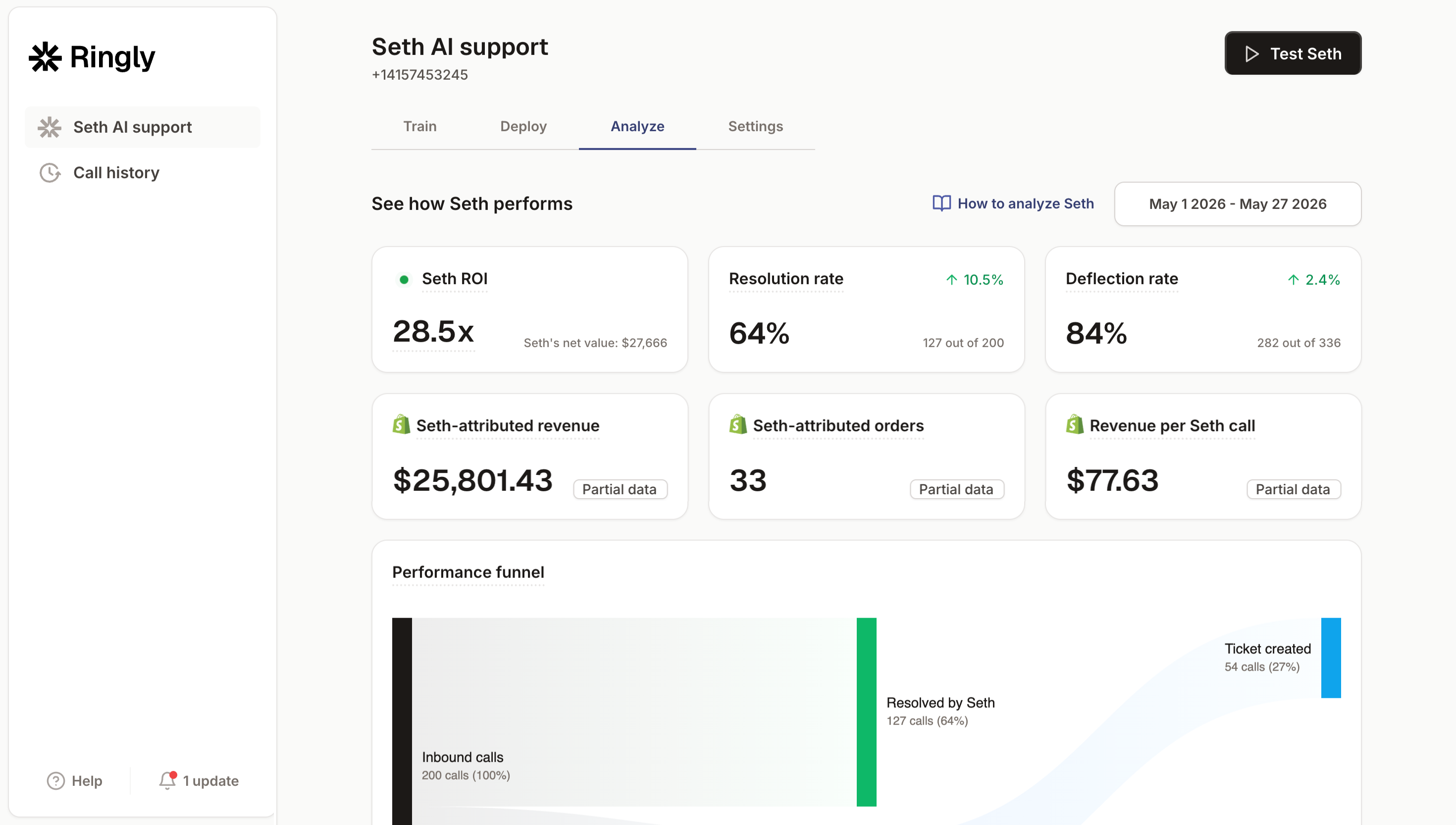
The AI answers inbound calls 24/7. It finds orders in your Shopify store, processes returns and exchanges, answers product questions from your knowledge base, and rescues abandoned carts with outbound follow-up. Across 50+ brands, it resolves 73% of calls on its own at roughly $0.42 per resolved call, versus $7 to $16 per call for human BPO. Calls that need a person escalate cleanly into Gorgias, Richpanel, Reamaze, or whatever helpdesk you already run, so the MCP work you just set up still applies to everything the AI hands off.
WashCo generated $22,664 in attributed revenue in the first 7 days post-launch, across 271 calls, with an 85% handled rate and 66% resolution at $0.91 per call against $2.70 for a human. The MCP server cleans up the queue. Ringly stops the phone from filling it.
If your phone line goes quiet after 6 p.m. and you are not sure what that costs, book a 30-min call and we will review your missed calls live.
Plans: Grow $349/mo (1,000 minutes), Pro $799/mo (2,500 minutes), Enterprise by call. 14-day free trial on Pro. Live in under an hour. If the AI resolves under 65% of your calls in 90 days, we refund the last 3 months. You can read more on our AI phone support for Shopify page, our broader take on Shopify voice agents, or how brands run AI phone agents for Shopify.
Which path should you pick?
Quick decision, then move on.
- Choose the official Gorgias MCP server if you want the safe, free default and you do not want to maintain anything. This is most teams.
- Choose a community server if you are a developer who wants to read the code, self-host, or extend it before the official write features finish.
- Choose a managed platform if you want Gorgias in one agent alongside many other apps, and a platform subscription is fine.
- Choose a custom build if you have a specific action none of the others expose and you have the engineering time.
Whichever you pick, remember the boundary. It governs your helpdesk, not your phone line. If the phone is where your routine volume lives, book a 30-min call and we will do the math on your call volume live. For the helpdesk itself, our roundups on Gorgias features and Gorgias alternatives cover the rest.
Frequently asked questions
Is there an official Gorgias MCP server? Yes. Gorgias shipped a first-party MCP server in open beta in May 2026. It lives at https://mcp.gorgias.com/mcp, works on every Helpdesk plan, and costs nothing extra.
How do I connect Gorgias MCP to Claude? In Claude Desktop, add a custom connector under Customize and paste the server URL. In Claude Code, run claude mcp add --transport http gorgias https://mcp.gorgias.com/mcp. Both then open a browser to sign in to Gorgias.
Does the Gorgias MCP server use an API key? The official server uses OAuth in the browser, so no API key. Community and custom servers built on the Gorgias REST API use HTTP Basic authentication with an API key you create in Settings.
What can the Gorgias MCP server actually do? Today it reads tickets, customer history, CSAT, volume, macros, rules, tags, and AI Agent guidances well. Write actions like replying, tagging, and updating status are partial during the beta, and natural-language analytics queries are not supported yet.
Is it safe to connect an AI tool to my Gorgias account? The official server only pulls data when you ask, and it is limited to what your own Gorgias user role already allows. It does not share data in the background.
Can the Gorgias MCP server answer phone calls? No. Every Gorgias MCP server operates the helpdesk side, meaning tickets, email, and chat. It does not handle voice. For phone, you need AI phone support like Ringly, which resolves routine calls and escalates the rest into Gorgias.
Should I use a community server or the official one? Use the official one unless you are a developer who needs to self-host or extend the server. Community servers were built before the first-party option existed and still help when you want full control of the code.
Talk to us

A Gorgias MCP server makes your helpdesk smarter. It still leaves your phone line uncovered. If you run a $10M to $100M Shopify brand and routine calls are eating your team's day, a 30-min call is the fastest way to see what that costs and what you can hand off.
The 3-layer guarantee.
- Live in 14 days or it's free until launched.
- 65% resolution in 90 days or we refund the last 3 months of subscription fees.
- We keep working free until we hit it.
Ruben (Ringly co-founder) takes these calls personally.