
The Gorgias Klaviyo integration is a two-way bridge between your helpdesk and your marketing.
- Gorgias support events (opened ticket, resolved ticket, satisfaction score) flow into Klaviyo so your flows can react to them. Klaviyo SMS, WhatsApp, and review events flow back into Gorgias as tickets.
- One thing it can't see: the phone. A customer who calls instead of texting never becomes a Klaviyo event unless that call gets logged as a ticket first.
- Written for the founder, COO, or Head of CX at a $10M-$100M Shopify brand already running Gorgias and Klaviyo.
You run Gorgias for support. You run Klaviyo for email and SMS. Out of the box, the two never talk, so your CS team works one customer record and your marketing team works another. The Gorgias Klaviyo integration connects them.
I connected the two on a test Shopify store and watched what flowed in each direction. Every email-list change, every SMS reply, every review event showed up where it should. The phone calls never did, unless I logged the call as a ticket first. That gap is the whole reason this guide is worth reading past the setup steps.
This is for operators running a real stack, not a tutorial for someone setting up their first store. If your CS team is drowning in WISMO and your marketing flows fire promos at customers who are mid-complaint, that disconnect is the thing this integration fixes, and the phone channel is the thing it leaves open. Book a 30-min call and we'll map where your call volume is leaking before it ever reaches Gorgias.
What the Gorgias Klaviyo integration actually does
Think of it as a two-way pipe. Support events flow from Gorgias into Klaviyo, and message events flow from Klaviyo into Gorgias, so both teams finally see the same customer.
On the Gorgias side, your agents get a Klaviyo widget in the customer sidebar. When a ticket comes in, the rep can see which lists the customer is on, their campaign history, and analytics like average order value, churn probability, and predicted lifetime value, without leaving the ticket. That context changes how a rep talks to a first-time buyer versus a customer on their ninth reorder. If you're still weighing helpdesks, our Gorgias alternatives breakdown covers where it wins and where it doesn't.
On the Klaviyo side, your marketing team gets support signals they never had. When a ticket opens or resolves in Gorgias, Klaviyo records it as an event. You can then build segments and flows off those events, which is where the real retention work happens (more on that below).
And the integration runs both message channels into one inbox. Replies to your Klaviyo SMS and WhatsApp campaigns land in Gorgias as tickets, so a high-intent "is this back in stock?" text doesn't die in a marketing tool your support team never checks. According to Gorgias, you can also pause campaigns and flows to anyone with an open ticket, which stops the tone-deaf "20% off!" blast from hitting someone who's mid-complaint.
The practical win is that one customer record stops living in two tools. Your marketing team sees that a customer just opened a frustrated ticket, and your CS team sees that the same customer is a top-decile spender before they decide how hard to fight for the save. That shared view is the whole reason brands bother connecting the two, and it's worth doing even if you only build one flow on top of it.
Exactly what data syncs (and what doesn't)
Most guides hand-wave this. Here's the actual sync map, pulled from the Klaviyo integration docs. The integration moves three support events one way and three data types the other way, and nothing else.
| Direction | What syncs | Notes |
|---|---|---|
| Gorgias to Klaviyo | Opened Ticket event | Real-time. Use it to suppress promos or trigger a "we're on it" flow. |
| Gorgias to Klaviyo | Resolved Ticket event | Trigger post-resolution follow-up or a review request. |
| Gorgias to Klaviyo | Satisfaction survey response | Branch flows on the CSAT score. |
| Gorgias to Klaviyo | Contact details | Email, phone, location, consent, custom properties. |
| Klaviyo to Gorgias | Customer profile in the sidebar | Lists, campaign history, AOV, churn probability, predicted CLV. |
| Klaviyo to Gorgias | SMS and WhatsApp replies | Become tickets for consented subscribers. |
| Klaviyo to Gorgias | Klaviyo Reviews | Only ratings that meet your star threshold create a ticket. |
The thing to notice is what's NOT on this list. Email replies sent from Klaviyo do not create Gorgias tickets, only SMS, WhatsApp, and review events do. So if a chunk of your customers reply to marketing emails expecting a human, those replies sit in Klaviyo, not in your support queue. Plan for that.
How to set up the integration
Setup runs from the Klaviyo side and takes about ten minutes if your accounts are already live. You connect once, then choose exactly which ticket and message types sync, so you're not flooding Gorgias with noise.
Here's the sequence, per the Klaviyo help docs:
- Open the app marketplace. In Klaviyo, go to Integrations, then Explore apps, and search for Gorgias.
- Install and authorize. Click install, enter your Gorgias helpdesk URL, then click Connect to Gorgias and authorize access.
- Choose sync preferences. Decide whether all new tickets sync or only specific tagged tickets, then toggle SMS, WhatsApp, and Reviews on or off. For Reviews, set the star-rating threshold that creates a ticket.
- Optionally enable profile syncing. Turn this on so the Klaviyo widget shows full profile data inside the Gorgias sidebar.
- Complete setup. Save, then send yourself a test SMS reply to confirm a ticket appears in Gorgias.
One setup note that trips up multi-brand operators: if you run more than one brand on the same Gorgias instance, create a tag rule for each brand before you sync, and optionally a view based on those brand tags. Skip that and your brands' tickets blur together in Klaviyo.
What you can actually do with it
The setup is easy. The value is in the flows you build on top. Support events are the most underused trigger in most Klaviyo accounts, and this integration is what unlocks them.
- Suppress promos during a live issue. Build a segment of customers with an open ticket and exclude them from promotional sends. A customer waiting on a missing order shouldn't get a cheerful upsell that afternoon.
- Follow up after resolution. Fire a short flow on the Resolved Ticket event: a thank-you, a how-did-we-do, or a soft product recommendation once the problem is actually fixed. This is the same retention thinking behind good ecommerce customer service, just automated.
- Rescue bad reviews fast. Route low-star Klaviyo reviews into Gorgias as tickets so a rep can reach out before that review hardens into churn. Swanky, a Shopify agency, calls this a direct line to what went wrong and a chance to fix it.
- Branch on satisfaction. Send high-CSAT customers into a loyalty or referral flow, and low-CSAT customers into a personal recovery sequence instead of the next newsletter.
- Catch high-intent SMS. Replies to your Klaviyo SMS become tickets, so "do you have this in medium?" gets a human answer instead of vanishing. The same logic applies to WISMO tickets, which are the highest-volume question in most Shopify queues.
Done well, these flows turn your support data into retention revenue. The catch is that they only fire on the channels the integration can see.
The limitations nobody warns you about
Before you wire half your retention strategy to this, know where it stops. The integration is solid at what it does and silent about what it doesn't, which is how operators get surprised three weeks in.
- No historic sync. Past SMS conversations and old reviews never backfill into Gorgias. Only messages sent after you connect will appear.
- Email replies don't create tickets. Only SMS, WhatsApp, and reviews do. Marketing-email replies stay in Klaviyo.
- Images and GIFs don't render. If a customer texts a photo of a damaged item, your rep sees the text but not the image.
- Branded sender IDs can't receive texts. If you send from a branded ID, replies won't route in.
- Notification email collision. Your SMS and Inbox email notifications have to use different addresses, or routing breaks.
None of these kill the integration. They just mean it covers your email, SMS, and review channels, and you should map the rest of your support surface yourself before you assume the loop is closed.
The channel this integration can't see: the phone
Here's the gap the setup guides skip. The integration links Klaviyo's email, SMS, and review events to Gorgias and pushes ticket events back. It has no idea your phone is ringing.
A customer who calls instead of texting is invisible to Klaviyo unless that call becomes a Gorgias ticket. And for a lot of brands, the phone is exactly where the highest-intent, most-frustrated contacts go. WISMO ("where's my order") makes up 30-40% of support tickets, and over 50% at peak, per Salesforce. A meaningful slice of that arrives by voice, especially for brands with an older customer base who'd rather call than chase a tracking link.
The cost of that blind spot is bigger than a missing data point. When a caller can't reach anyone, 78% abandon the brand after a single unanswered call, per PCN. So the phone gap isn't just a reporting hole, it's the exact moment a frustrated customer decides whether to stay or churn, and your Klaviyo flows have no way to react because the event never landed.
So your "suppress promos on open tickets" rule has a hole. The customer who called you twice this week about a missing order, never opened a ticket, and is now furious? Klaviyo doesn't know. They get the promo. The flows are only as complete as the channels feeding them, and the phone is usually the one nobody fed in. A brand that wires up WISMO automation on email but not on phone is plugging half the leak.
This is where Ringly.io fits, and it's NOT as a replacement for the Klaviyo connector. Ringly is AI phone support for Shopify brands. The AI answers your inbound calls 24/7, finds orders in your Shopify store, handles returns and product questions, and logs every call as a tracked Gorgias ticket. Once the call is a ticket, the same Klaviyo Opened and Resolved events fire on it, so your phone contacts finally enter the flows you already built. Every call is also analyzed and transcribed, so you finally get a real resolution rate on the phone channel.
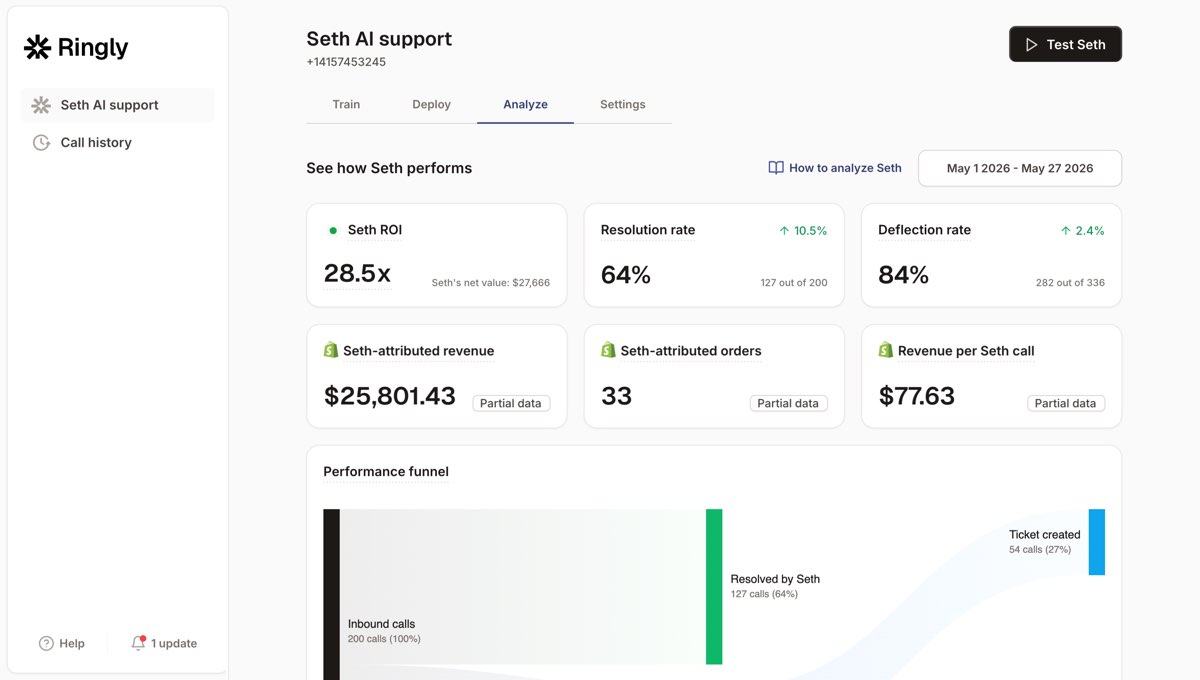
Across 50+ brands, the AI resolves 73% of inbound calls on its own at roughly $0.42 per resolved call, and the calls that need a person escalate cleanly to your CS team inside Gorgias. It also gives you 24/7 phone coverage without staffing a night shift. WashCo, a Shopify brand we launched, recovered $22,664 in its first 7 days on the phone. That's revenue that used to roll to voicemail and never come back.
Run the math on the human alternative. A typical $50M Shopify brand with a 6-rep CS team spends about $24,000 a month on support, and most of that goes to the same repeatable calls (order status, returns, the same five questions). Route 70% of that to the AI and the team handles the 30% that actually needs them.
| Line item | Today | With Ringly |
|---|---|---|
| 6 reps at $4K loaded each | $24,000/mo | n/a |
| Ringly (illustrative) | n/a | ~$5,000/mo |
| Net monthly CS spend | $24,000/mo | $5,000/mo |
| Monthly savings | n/a | ~$19,000/mo |
If your phone goes to voicemail after 6 p.m. and those calls never make it into Gorgias or Klaviyo, book a 30-min call and we'll review your missed calls live.
"My customers also feel like it's a normal person. They feel like they can communicate if they have questions."
Claudia Droge, TechCraft Studio
The point isn't that Klaviyo and Gorgias are doing it wrong. They're doing email, SMS, and reviews right. The phone is just a different problem, and most stacks leave it dark. Close that leg and every channel becomes a Klaviyo event you can act on.
Frequently asked questions
Does the Gorgias Klaviyo integration cost extra? The connector itself is free. You install it from the Klaviyo app marketplace and you're already paying for your Gorgias and Klaviyo plans. There's no separate fee for the sync.
Does it sync email replies into Gorgias? No. Only SMS, WhatsApp, and Klaviyo Reviews create Gorgias tickets. Replies to marketing emails stay inside Klaviyo, so route those separately if your customers expect a human on email.
Will my past data come over when I connect? No. There's no historic sync. Only SMS conversations and reviews that happen after you connect will appear in Gorgias, so don't expect a full back-catalog of past interactions.
Can I segment customers in Klaviyo by their support tickets? Yes, that's the strongest reason to connect it. Opened Ticket, Resolved Ticket, and Satisfaction survey events all sync into Klaviyo, so you can build dynamic segments and flows off real support behavior.
Does the integration track phone calls? No. Inbound phone calls don't become Klaviyo events unless the call is logged as a Gorgias ticket first. An AI phone agent like Ringly closes that gap by turning every call into a tracked ticket so your flows fire on phone contacts too.
Do I need Shopify for this to work? Gorgias and Klaviyo both work best on Shopify, and the customer profile, order, and AOV data that makes the integration useful comes from your Shopify and Gorgias setup. It can run on other platforms, but the DTC playbook above assumes Shopify.
Talk to us

If you run a $10M-$100M Shopify brand and your phone goes to voicemail after 6 p.m., a 30-minute call is the fastest way to see what you're leaving on the table. We'll look at where your call volume is leaking before it ever reaches Gorgias or Klaviyo.
The 3-layer guarantee.
- Live in 14 days or it's free until launched.
- 65% resolution in 90 days or we refund the last 3 months of subscription fees.
- We keep working free until we hit 65%.
Ruben (Ringly co-founder) takes these calls personally.