
Short answer: no. Gorgias is a customer-support helpdesk built for ecommerce, not IT helpdesk software. If you searched "gorgias it helpdesk software" hoping to handle password resets and internal tickets, you're in the wrong aisle, and this post will point you to the right one.
This post in 30 seconds.
- Gorgias is a customer-support helpdesk for ecommerce stores, not an IT or ITSM tool. Different category entirely.
- If you want internal IT support (password resets, asset management, employee tickets), you want Freshservice or Jira Service Management instead.
- Built for $10M-$100M Shopify brands running a CS team. The one place even a well-run Gorgias setup still leaks: the phone, after-hours.
The word "helpdesk" trips people up. Outside ecommerce, "helpdesk" usually means the IT desk you email when your laptop dies. Inside ecommerce, it means the tool your support team uses to answer customers asking where their order is. Gorgias is firmly the second kind, and if you run a Shopify brand with a CS team drowning in the same questions over and over, it's a tool worth understanding. If you run internal IT at a 500-person company, keep reading for 60 seconds and then go look at a real ITSM tool. We sell AI phone support for Shopify brands, and we'll be honest the whole way through, including book a 30-min call if you're the founder or Head of CX trying to figure out the phone side of this.
In this post:
What Gorgias actually is
Gorgias is a helpdesk for ecommerce customer support. It pulls every customer message (email, live chat, social, SMS, and now voice) into one ticketing dashboard, then gives your CS team the order context to answer fast. Its whole reason for existing is the Shopify store.
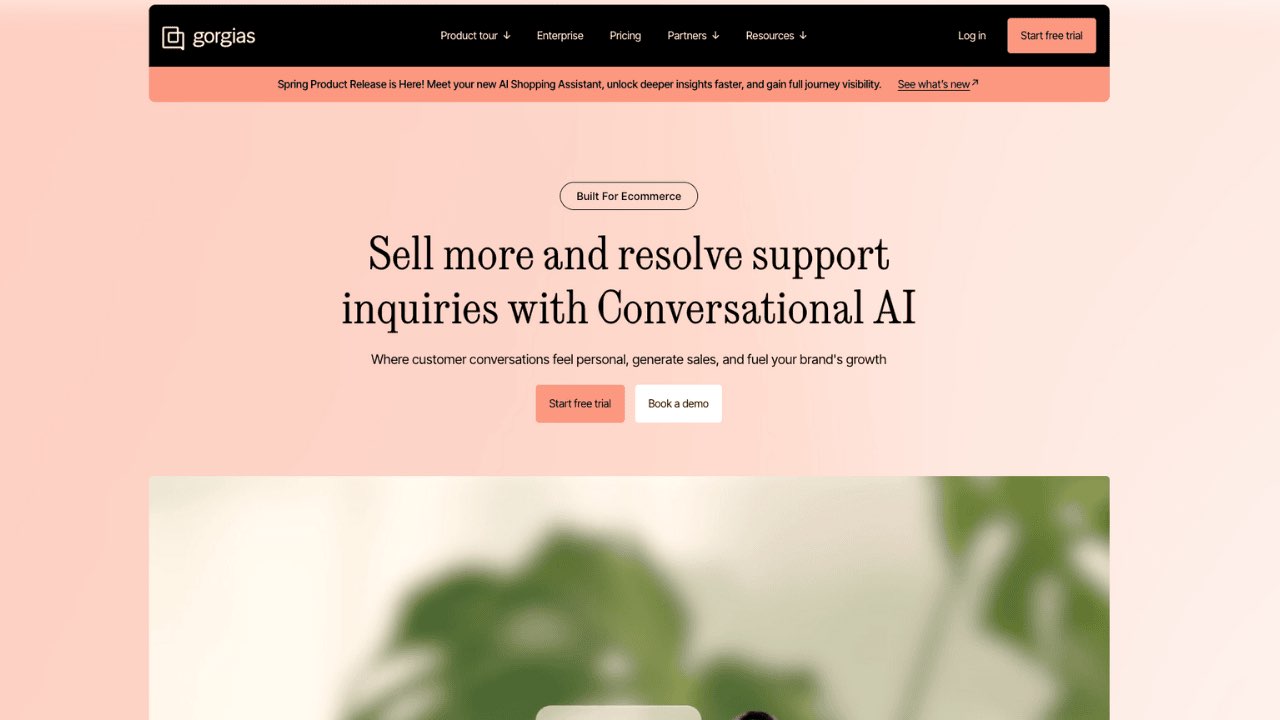
The thing that makes Gorgias different from a generic support tool is how deep it sits inside Shopify: an agent can see the order, issue the refund, and modify the subscription without leaving the ticket. That tight integration is why so many DTC brands run it. Reviewers rate it 4.6 out of 5 across roughly 547 reviews on G2, with 74% at five stars, and it carries a 4.3 on the Shopify App Store.
So when people ask whether Gorgias is "IT helpdesk software," the honest answer is that it shares one word with that category and almost nothing else. It was never built to reset an employee's password or track a laptop fleet. It was built to clear a Monday morning queue of "where's my order" tickets.
If you want the broader explainer on what Gorgias does as a support platform, we wrote a full Gorgias helpdesk breakdown separately.
IT helpdesk vs customer-support helpdesk
Here's the distinction that the keyword is really asking about. There are two completely different software categories that both got stuck with the word "helpdesk," and mixing them up costs people a lot of wasted trial time.
An IT helpdesk (more precisely, an ITSM tool) serves your own employees. It handles internal tickets: password resets, software access, broken hardware, incident and change management. A customer-support helpdesk serves the people who buy from you. It handles order status, returns, exchanges, and product questions.
Gorgias lives entirely on the customer-facing side, which means it has zero of the IT service management features an internal IT team needs. No asset management, no incident workflows, no employee self-service portal for IT requests.
| IT helpdesk (ITSM) | Customer-support helpdesk (Gorgias) | |
|---|---|---|
| Who it serves | Your employees / IT team | Your customers / shoppers |
| Typical tickets | Password resets, assets, incidents | Order status, returns, product questions |
| Examples | Freshservice, Jira Service Management | Gorgias, Re:amaze, Zendesk (CX side) |
| Shopify order data | No | Yes, deep |
| Built for | Internal IT service delivery | Ecommerce support |
If you genuinely need IT helpdesk software, Gorgias is the wrong tool and no amount of configuration will fix that. Look at Freshservice or Jira Service Management, which are purpose-built for IT service management. Both are standalone ITSM platforms, and Atlassian and the major migration vendors document the difference clearly: ITSM is internal IT service delivery, which is a separate discipline from customer support. We don't have a strong opinion on which IT tool wins, because that's outside what we work on.
For everyone still here, you're the right reader: a Shopify brand thinking about customer support. Let's keep going.
Who Gorgias is for (and who it isn't)
Gorgias makes sense for a specific kind of company, and it's worth being blunt about who that is.
Choose Gorgias if you run a Shopify, BigCommerce, or Magento store with real ticket volume and a CS team that needs order data inside every conversation. That's the sweet spot. The deeper your Shopify integration needs go, the more sense it makes.
It's a poor fit if any of these describe you:
- You need internal IT support. Wrong category, as covered above. Go look at an ITSM tool.
- You're a sub-$10M store with a handful of tickets a week. The ticket-based pricing and the setup overhead are hard to justify at low volume. A simpler helpdesk option may fit better.
- You're B2B or wholesale-only. Your support is account-managed, not high-volume ticket-driven, so the ecommerce helpdesk model doesn't match how you actually work.
If you're a $10M-$100M Shopify brand with a visible phone number and a support team handling order status and returns all day, Gorgias is a reasonable backbone. The question then becomes what it covers well and where it leaves gaps.
Gorgias features and pricing in 2026
The core feature set is solid: unified inbox across channels, Shopify-native order actions, macros and automation for repeatable replies, and an AI Agent that can resolve some tickets on its own. That last piece is where the cost gets interesting.
Gorgias prices on tickets, not seats. Here are the 2026 plans, per Gorgias pricing breakdowns:
| Plan | Monthly price | Included tickets | AI Agent | Overage |
|---|---|---|---|---|
| Starter | $10-$60 | 50 | $1.00 / resolution | $0.40/ticket |
| Basic | $50-$210 | 300 | $0.90-$1.00 / resolution | $0.40/ticket |
| Pro | $300-$1,360 | 2,000 | $0.90-$1.00 / resolution | $0.36/ticket |
| Advanced | $750-$3,400 | 5,000 | $0.90-$1.00 / resolution | $0.36/ticket |
| Enterprise | Custom | 5,000+ | $0.90-$1.00 / resolution | $0.32/ticket |
What works:
- Shopify depth: order data, refunds, and order edits live inside the ticket, so your reps stop tab-hopping.
- Multi-channel inbox: email, chat, social, and SMS land in one place with a clean ticketing UI.
- Automation: macros and rules clear a real chunk of the repeatable stuff before a human touches it.
- Track record: strong G2 and Shopify App Store scores, and it's been the default ecommerce helpdesk for years.
What doesn't:
- Cost predictability: ticket-based billing rises with volume, and the AI Agent is billed per resolution while also counting as a ticket. Several review sites flag the double-billing.
- Peak-season overages: a launch or a holiday spike can push you past your ticket allowance fast.
- Phone is an afterthought: the voice channel exists, but it's built around a human at a desk, which is the gap worth its own section.
If the pricing model is your main worry, our Gorgias alternatives post walks through the other ecommerce helpdesks worth a look.
The one channel Gorgias still leaks: the phone
Here's where even a great Gorgias setup falls short. Gorgias added a Voice product, but it's a phone channel, not an autonomous phone agent. A human has to be at a desk to pick up. There's no answering from the mobile app. After-hours calls and overflow roll straight to voicemail.
For most DTC brands, that's the exact window where the money leaks. We run AI phone support that sits in front of Gorgias for 50+ Shopify brands, so we hear the calls its voice channel sends to voicemail at 9 p.m. They aren't complicated. They're the same WISMO and "where's my order" questions your reps answer all day, just arriving when nobody's at the desk.
The numbers on missed calls are ugly. Businesses answer only 37.8% of inbound calls, and another 37.8% go to voicemail, according to AmbsCallCenter. And 80% of voicemail-routed callers hang up without leaving a message. Worse, 85% of callers who can't reach a person never call back, and 62% switch to a competitor. WISMO alone is 30-40% of support tickets, and over 50% at peak, and a big share of those arrive by phone.
The fix isn't to rip out Gorgias. It's to put an AI phone agent in front of it so the routine calls get answered the moment they ring, day or night, and only the genuinely hard ones escalate to your team. That's the whole idea behind Ringly.
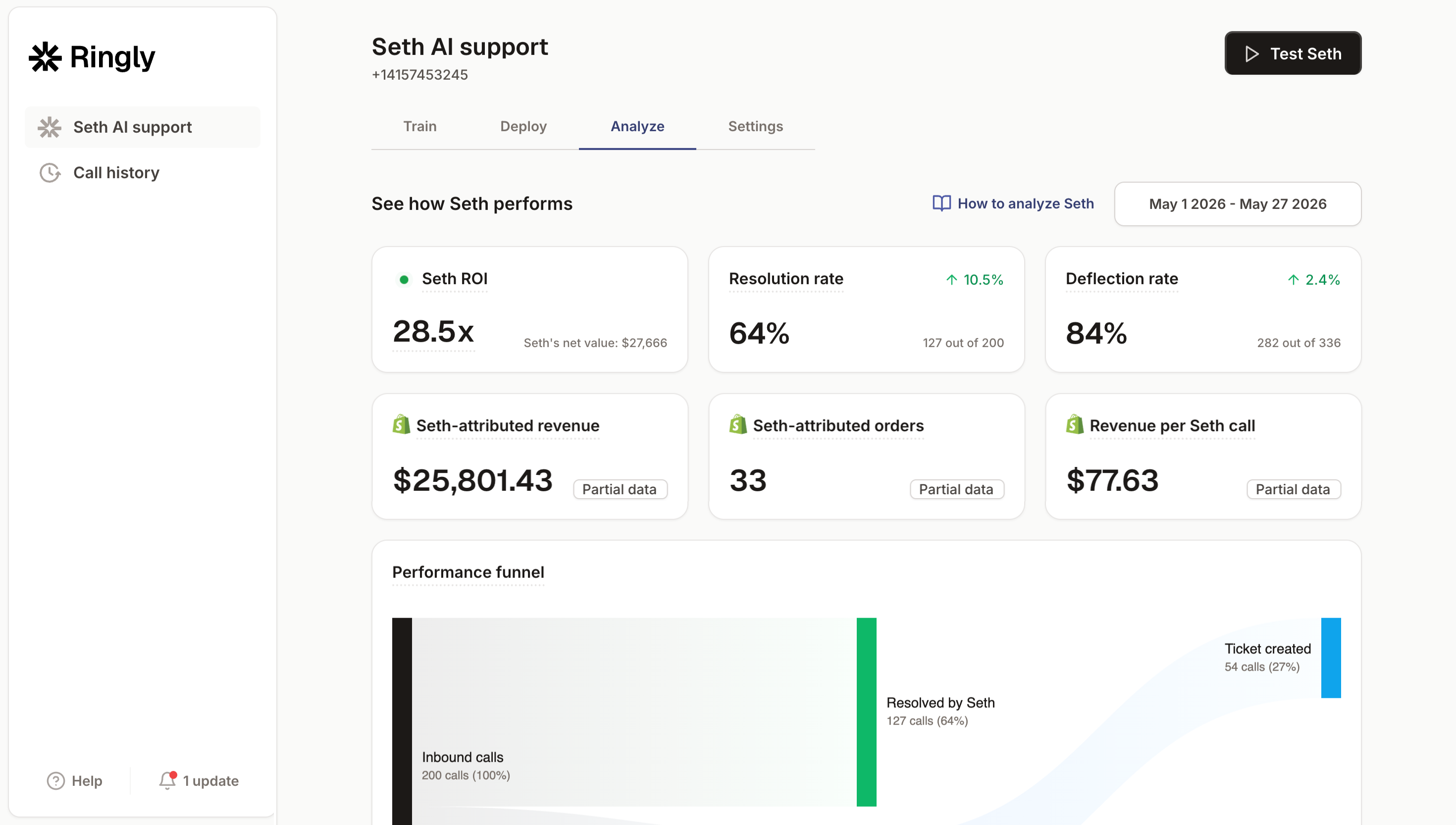
Ringly is AI phone support for Shopify brands. Your team wasn't hired to answer the same call 50 times a day. The AI answers inbound calls 24/7: it finds orders in your Shopify store, processes returns and exchanges, answers product questions from your knowledge base, and rescues abandoned carts via outbound follow-up. Across 50+ brands, the AI resolves 73% of calls autonomously at roughly $0.42 per resolved call. Calls that need a human escalate cleanly to Gorgias, Re:amaze, or whatever helpdesk you already run. You keep your number, your stack, and your workflows.
WashCo, a Shopify brand we launched, recovered $22,664 in its first 7 days on the phone. And the most common thing customers say after a call is that it didn't feel like AI at all.
"My customers also feel like it's a normal person. They feel like they can communicate if they have questions."
Claudia Droge, TechCraft Studio
If you want the deeper version of this, we cover 24/7 ecommerce phone support and Shopify voice agents in their own posts.
What this costs you today vs adding an AI phone agent
Most of the phone volume that rolls to voicemail is repeatable. So the real question is what you're paying to cover it with humans, and what changes when the routine calls get answered automatically.
Take a typical $50M Shopify brand running a 6-rep CS team:
| Line item | Today | With an AI phone agent |
|---|---|---|
| 6 reps × $4,000 loaded per rep | $24,000/mo | (unchanged on tickets) |
| Phone coverage after-hours | voicemail | answered 24/7 |
| Routine calls handled by AI | none | ~73% |
| Cost per resolved call | $7-$16 (human BPO range) | ~$0.42 |
That's roughly 70% of repeatable calls (order status, returns, the same five things over and over) answered without a human. The other 30%, the genuinely complex calls, still go to your CS team through Gorgias, where they have the context to actually solve them.
If you want to see what your own missed-call window looks like, book a 30-min call and we'll review your last week of after-hours calls live.
How to choose
Three different needs, three different answers. Don't make one tool do a job it wasn't built for.
- Choose IT helpdesk software (Freshservice, Jira Service Management) if you need to support your own employees: password resets, asset tracking, internal IT tickets. Gorgias can't do this.
- Choose Gorgias if you run a Shopify, BigCommerce, or Magento store with real ticket volume and want order data inside every customer conversation.
- Add an AI phone agent in front of your helpdesk if customers call about order issues and your phone line rolls to voicemail after-hours. This is where you stop the revenue leak Gorgias' voice channel can't.
For a wider view of the support stack, our customer service for Shopify guide and the ecommerce call center page both go deeper.
Frequently asked questions
Is Gorgias an IT helpdesk? No. Gorgias is a customer-support helpdesk for ecommerce, not an IT or ITSM tool. It handles customer-facing tickets like order status and returns, not internal IT requests like password resets or asset management.
What kind of helpdesk is Gorgias? It's an ecommerce customer-support helpdesk, built mainly for Shopify (also BigCommerce and Magento). It unifies email, chat, social, SMS, and voice into one ticketing dashboard with deep Shopify order data.
Does Gorgias do phone support? It has a voice channel, but it needs a human at a desk to answer, and after-hours or overflow calls roll to voicemail. It's a phone channel, not an autonomous phone agent, which is why brands often add an AI phone agent in front of it.
How much does Gorgias cost? Plans range from $10/mo (Starter, 50 tickets) to $750-$3,400/mo (Advanced, 5,000 tickets), with Enterprise custom. Billing is ticket-based, and the AI Agent costs $0.90-$1.00 per resolved conversation while also counting as a ticket.
Is Gorgias only for Shopify? It works best with Shopify but also supports BigCommerce and Magento. The Shopify integration is the deepest, which is why most of its users are Shopify brands.
What's the difference between an IT helpdesk and a customer-support helpdesk? An IT helpdesk (ITSM) serves your own employees with internal IT tickets. A customer-support helpdesk like Gorgias serves your customers with order and product questions. Different users, different ticket types, different tools.
What should I use for internal IT support instead of Gorgias? For internal IT, look at purpose-built ITSM tools like Freshservice or Jira Service Management. They handle the asset management, incident workflows, and employee self-service that Gorgias doesn't.
Talk to us

If you run a $10M-$100M Shopify brand on Gorgias and your phone line goes quiet after 6 p.m., a 30-min call is the fastest way to see what you're leaving on the table. We'll keep your helpdesk exactly where it is and show you what the AI catches on the calls you're missing now.
The 3-layer guarantee.
- Live in 14 days or it's free until launched.
- 65% resolution in 90 days or we refund the last 3 months of subscription fees.
- We keep working free until we hit it.
Ruben (Ringly co-founder) takes these calls personally.