
Gorgias is one of the strongest Shopify-native helpdesks you can buy. The reviews back that up.
- Pick: strong fit when 40% or more of your tickets need real Shopify actions (refunds, order edits, cancels). G2 4.6, Capterra 4.6.
- Watch: ticket-based pricing plus the AI Agent per-resolution fee can roughly double your bill at scale.
- Gap: it's built for chat and email tickets, not live phone. Best read by founders, COOs, and Heads of CX at $10M-$100M Shopify brands running a paid helpdesk and a visible phone line.
Most people searching for a Gorgias review have already decided it's good. The real question is narrower: is it good for your ticket mix, and what does the bill actually look like once the AI fees and overages show up? That's the part most reviews skip.
We run AI phone support for 50+ Shopify brands, which means we sit in front of helpdesks like Gorgias every single day. So for this review we read through more than a thousand verified reviews, modeled the real monthly cost, and pulled the actual ticket and call data from the brands we work with. If you run customer experience at a $10M-$100M Shopify brand and you're weighing Gorgias against the same questions over and over, book a 30-min call and we'll walk your numbers with you. The short version of this review: Gorgias is a genuinely good ticketing system, the pricing needs eyes, and there's one channel it was never built to own.
Gorgias vs the helpdesk field at a glance
Before the deep dive, here's how Gorgias sits next to the other helpdesks DTC operators shortlist. This is a starting point. The rest of the review is the detail behind the verdicts.
| Helpdesk | Best for | Starting price | Pricing model | Verdict |
|---|---|---|---|---|
| Gorgias | Shopify brands with action-heavy tickets | $10/mo | Per ticket volume | Strong ecommerce fit, watch the AI fees |
| Zendesk | Large multi-channel CX beyond ecommerce | ~$19/agent/mo | Per agent seat | Powerful, heavier, less Shopify-native |
| Richpanel | Ecommerce with a self-service portal | Free tier / ~$29 | Per agent + interactions | Close ecommerce rival, strong self-service |
| Intercom Fin | SaaS and product support with AI | Seat + $0.99/resolution | Seat + per resolution | Great AI, leans SaaS, fees stack like Gorgias |
| Re:amaze | Budget multi-channel helpdesk | ~$29/agent/mo | Per agent | Cheaper, lighter, fewer Shopify actions |
Want to compare Gorgias to whatever you run today? Book a 30-min call and we'll do the math live.
How we evaluated Gorgias
I'm Ruben, co-founder of Ringly. We build AI phone support for Shopify brands, so I evaluate helpdesks constantly, not as a critic, as a buyer who has to escalate into one. Over a couple of weeks I went deeper on Gorgias than a marketing skim.
Here's what I actually did:
- Read the reviews at scale. I went through more than 1,000 verified reviews across G2 (4.6/5), Capterra (4.6/5), and the Shopify App Store (4.3 to 4.4/5), then grouped the praise and the complaints into patterns instead of cherry-picking.
- Modeled the real bill. I took the published tiers and added the parts that don't show on the pricing page: AI Agent resolution fees, ticket overages, and a seasonal spike. The base price is the floor, not the number you pay.
- Pulled real ticket mix. Across the 50+ Shopify brands we work with, I looked at how many inbound contacts are genuinely action-heavy (refunds, order edits) versus simple repeat questions. That ratio decides whether Gorgias is worth it.
- Tested the Shopify actions. I checked where the in-ticket actions fire cleanly (order lookup, refund, edit) and where they get fiddly.
- Stress-tested the channel reviewers ignore. I looked hard at live phone, the after-hours queue specifically, because that's the one part of the support stack a ticketing system doesn't cover, and almost no Gorgias review tests it.
On review volume alone, Gorgias is one of the most validated helpdesks in ecommerce, with a 4.6 on G2 across hundreds of reviews. I don't take affiliate money on anything here. We sell Ringly, which sits in front of a helpdesk rather than replacing it, so I have no reason to talk Gorgias down. Where it's good, I'll say so.
What Gorgias actually is
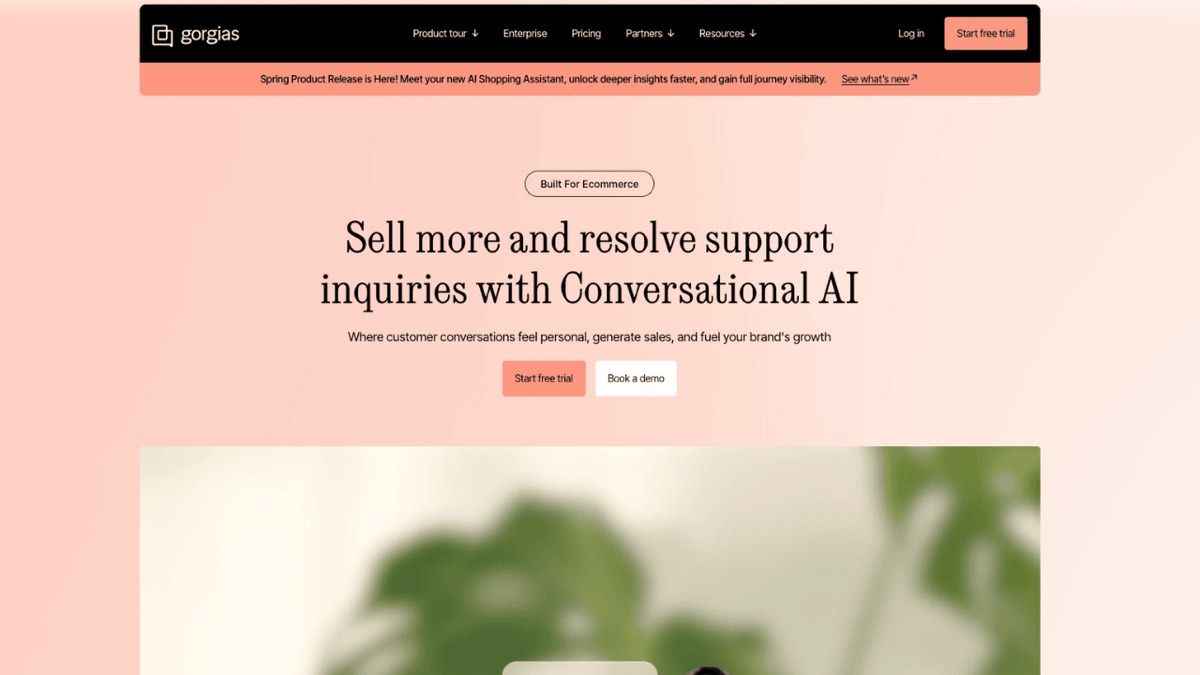
Gorgias is a Shopify-native customer service ticketing system. Every inbound message, whether it's email, live chat, SMS, social, or a voice call, lands in one shared inbox as a ticket. From inside that ticket, an agent can pull up the customer's Shopify profile, issue a refund, edit or cancel an order, and check shipping without ever leaving the screen.
That tight Shopify wiring is the whole pitch. Gorgias is Shopify's Premier Partner for CX and says it serves more than 17,000 brands. On top of the inbox it layers automation: macros for canned responses, rules for routing, intent detection, and an AI Agent that resolves repetitive tickets on its own.
The thing that separates Gorgias from a generic ticketing system is that the order data lives where the conversation lives. For a high-volume Shopify brand drowning in WISMO and return requests, that matters. Your reps stop tab-hopping between the helpdesk and the Shopify admin, which is exactly where the "saves hours each week" praise in the reviews comes from.
If you want the full feature picture, our Gorgias customer service platform guide goes wider than this review does, and the Gorgias ticketing system breakdown covers the inbox mechanics.
What reviewers love
The positive reviews are consistent, and they're not vague. Here's what keeps coming up.
- Shopify actions inside the ticket. Refund, edit, cancel, track, all without leaving the conversation. This is the single most-praised feature and the reason Shopify brands pick it over general helpdesks. You can wire the same kind of order-status lookup into a phone agent too, which is what our check order status feature does.
- Automation that saves real time. Macros, rules, and intent detection let teams auto-close repetitive tickets and route VIPs to a human. Some teams report automating around 50% of interactions.
- One inbox for every channel. Email, chat, SMS, and social in a single view cuts the channel-switching that eats a CS team's day.
- Unlimited agent seats. Because Gorgias bills by ticket volume rather than per user, you can put your whole team on it. One Capterra reviewer noted that charging per ticket "allowed nearly everyone in our company to use it."
- Easy to learn. Most teams are up and running on the core features fast, and ease of use scores 4.6 on Capterra.
For an action-heavy Shopify brand, that bundle is hard to beat. The strengths are real, and the high ratings are earned. The catch is the part of the review most pages gloss over.
What reviewers flag
The critical reviews are just as consistent as the praise, and they cluster around three things: cost, reporting, and AI accuracy.
- Ticket-based pricing gets unpredictable. You're billed on conversation volume, so a busy month costs more than a slow one. Reviewers describe it as fine at steady state and stressful during a spike. One noted that "new updates are always an add-on."
- The AI Agent is double-billed. When the AI resolves a ticket, you pay the helpdesk ticket cost AND a separate automation fee of roughly $0.90 to $1.00 per resolved conversation. So the feature that's supposed to save money can quietly accelerate your overages.
- Reporting runs shallow. This is the most repeated complaint. Reviewers want deeper team-performance tracking and say reporting "could be deeper, especially for tracking team performance over time." One flagged that stats include hours outside business hours, which distorts response-time numbers.
- The AI hallucinates sometimes. Reviewers like the automation but note it's "not always fully accurate yet." On simple FAQ it's solid. On anything nuanced, you'll want guardrails. We went deeper on this in our Gorgias AI customer service reviews breakdown.
- Edge-case support can lag. Day-to-day support gets good marks, but one reviewer's email-suppression issue took "almost three weeks to resolve."
The reporting gap and the AI billing surprise are the two things that turn a happy Gorgias customer into a frustrated one. None of this means Gorgias is bad. It means you need to go in with your eyes open on the bill, which is worth its own section.
Pricing reality: the number you see is the floor
Gorgias publishes five tiers, billed by ticket volume rather than per seat.
| Plan | Monthly | Included tickets | Overage |
|---|---|---|---|
| Starter | $10 | 50 | $0.40/ticket |
| Basic | $60 | 300 | $0.40/ticket |
| Pro | $360 | 2,000 | $0.36/ticket |
| Advanced | $900 | 5,000 | $0.36/ticket |
| Enterprise | Custom | 5,000+ | ~$0.32/ticket |
On paper, clean. In practice, three things move the real number up. The AI Agent costs about $1.00 per resolved conversation ($0.90 on annual billing) on top of the ticket. Voice and SMS channels carry their own per-ticket charges of roughly $0.40 to $1.20. And ticket overages stack once you pass your monthly allowance.
Here's the math reviewers run into. Take a Pro plan at $360 and automate 30% of your 2,000 tickets. That AI usage adds roughly $360 in resolution fees, so your real bill is closer to $720, about double the sticker price (per Featurebase's 2026 pricing breakdown). Add a Voice or SMS channel plus a seasonal spike and brands have seen it climb toward $960 (as Zipchat's review documents).
For a fast-growing or seasonal Shopify brand, the per-ticket model means your worst month is also your most expensive one. That's not a reason to avoid Gorgias. It's a reason to model your own ticket volume before you sign, and to read our Gorgias pricing breakdown so the AI fee doesn't catch you off guard.
The one thing Gorgias was never built for: live phone
Here's the part no aggregator review tests, because it lives outside the ticket. Gorgias is excellent at chat and email. On live phone, it's thin. Voice is an add-on channel, not the core of the product, and there's a real difference between logging a call as a ticket and actually answering the phone well at 11 p.m.
That gap costs more than it looks. When a customer calls after hours and hits voicemail, no Gorgias ticket ever gets created, because the call never became a ticket. The contact just evaporates. And the data on what that's worth is brutal: businesses answer only 37.8% of inbound calls, according to AmbsCallCenter, and 62% of callers who can't reach a person switch to a competitor, per PCN's missed-call study. Your helpdesk dashboard will never show you those calls, because they were never tickets.
This is where Ringly fits, and it's not as a Gorgias replacement. Ringly.io is AI phone support for Shopify brands. It answers your inbound calls 24/7, finds orders, handles returns, and answers product questions, then escalates cleanly to Gorgias, Richpanel, or whatever helpdesk you already run. Across 50+ brands the AI resolves 73% of calls on its own at roughly $0.42 per resolved call. It sits in front of your helpdesk and feeds the calls that need a human straight into it, with a smart call transfer that actually works.
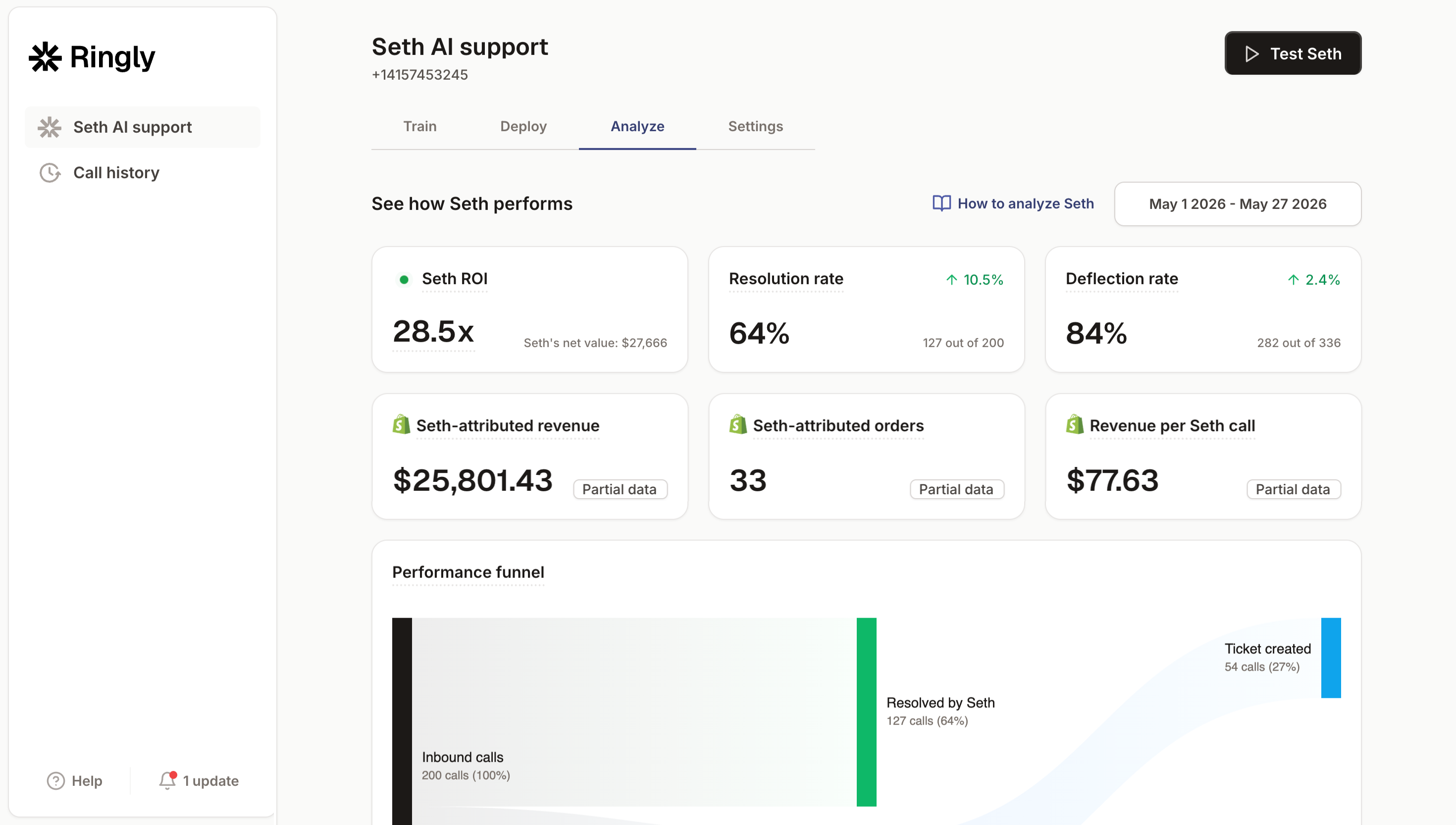
The revenue side is real, not theoretical. WashCo, a Shopify brand we launched, recovered $22,664 in its first 7 days on the phone. And the most common thing customers say after a call is the thing every brand worries about most:
"My customers also feel like it's a normal person. They feel like they can communicate if they have questions."
Claudia Droge, TechCraft Studio
If your support stack has a strong ticketing system but a phone line that goes to voicemail after 6 p.m., the WISMO calls hitting that voicemail are pure leak.
What the phone layer costs vs what you keep
This isn't about replacing your Gorgias spend. It's about the revenue Gorgias can't see because it never became a ticket. Take a typical $50M Shopify brand running a 6-rep CS team.
| Line item | Today | With Ringly |
|---|---|---|
| 6 reps × $4K loaded per rep | $24,000/mo | n/a |
| Ringly (~$5K/mo) | n/a | $5,000/mo |
| Net monthly CS spend | $24,000/mo | $5,000/mo |
| Monthly savings | n/a | $19,000/mo |
| Annual savings | n/a | $228,000/yr |
That's roughly 70% of repeatable calls (order status, returns, the same five questions over and over) handled by the AI, with the genuinely complex calls still going to your team, who now have time to solve them. Keep Gorgias for tickets. Add a phone layer so the after-hours queue stops bleeding. For the full picture, our ecommerce phone support guide breaks down the call economics.
If you want to see what your own after-hours queue is leaving on the table, book a 30-min call and we'll review your missed calls live.
Who Gorgias is for, and who it isn't
Gorgias is a yes for a specific shape of brand and a maybe for others. The clearest signal is your ticket mix.
Choose Gorgias if:
- 40% or more of your tickets need real Shopify actions. Refunds, order edits, cancels. This is the Reddit consensus and it holds up: when your tickets are action-heavy, Gorgias earns its price.
- You're Shopify-native and want everything in one inbox. The integration depth is the whole point.
- You want your whole team on the tool. Unlimited seats on per-ticket pricing is genuinely good value for larger teams.
Look elsewhere, or add a layer, if:
- Your tickets are mostly conversational Q&A. If you're not using the Shopify actions much, a cheaper helpdesk does the same job. Browse our Gorgias alternatives for the field.
- Phone is a big part of your support. A ticketing system isn't a phone agent. Pair it with a dedicated AI customer support phone agent for Shopify.
- You need predictable billing or deep reporting. Both are real weak spots at scale.
Frequently asked questions
Is Gorgias worth it in 2026? For Shopify brands whose tickets are action-heavy, yes. It earns its price when 40% or more of your contacts need refunds, order edits, or cancels. If your support is mostly answering simple questions, a cheaper tool will do the same job.
How much does Gorgias really cost? Plans run from $10/mo (Starter, 50 tickets) to $900/mo (Advanced, 5,000 tickets), plus custom Enterprise. The real cost is higher once you add the AI Agent fee (about $0.90 to $1.00 per resolved conversation), ticket overages ($0.36 to $0.40 each), and Voice or SMS channels. A $360 Pro plan commonly lands closer to $720 with AI usage.
Is the Gorgias AI Agent accurate? On simple, repetitive FAQ it's solid and can automate a meaningful share of tickets. Reviewers note it's "not always fully accurate yet" and hallucinates on nuanced questions, so most teams keep guardrails and human review on anything complex.
Does Gorgias handle phone calls? It can log calls through a Voice add-on, but it's a ticketing system at heart, not a phone agent. Live phone, especially after-hours, is its weakest channel. Many brands pair Gorgias with a dedicated AI phone agent that escalates into it.
Gorgias vs Zendesk or Richpanel, which is better? Gorgias is more Shopify-native than Zendesk, which is broader and pricier per seat. Richpanel is a close ecommerce rival with stronger self-service. Pick on ticket mix and how much Shopify-native action you actually use.
What are the best Gorgias alternatives? For ecommerce, Richpanel and Re:amaze are the common swaps, with Intercom for product-led teams. The right call depends on whether you value Shopify-native actions or cheaper conversational support.
Does Ringly replace Gorgias? No. Ringly is the phone layer that sits in front of your helpdesk. It answers and resolves inbound calls, then escalates the ones that need a human into Gorgias. You keep your ticketing system and stop leaking the calls it was never built to catch.
Talk to us

If your phone goes to voicemail after 6 p.m., a Gorgias ticket never gets created, because the call never became a ticket. A 30-min call is the fastest way to see what that's costing you, and how a phone layer in front of your helpdesk recovers it.
The 3-layer guarantee.
- Live in 14 days or it's free until launched.
- 65% resolution in 90 days or we refund the last 3 months of subscription fees.
- We keep working free until we hit 65%.
Ruben (Ringly co-founder) takes these calls personally.