
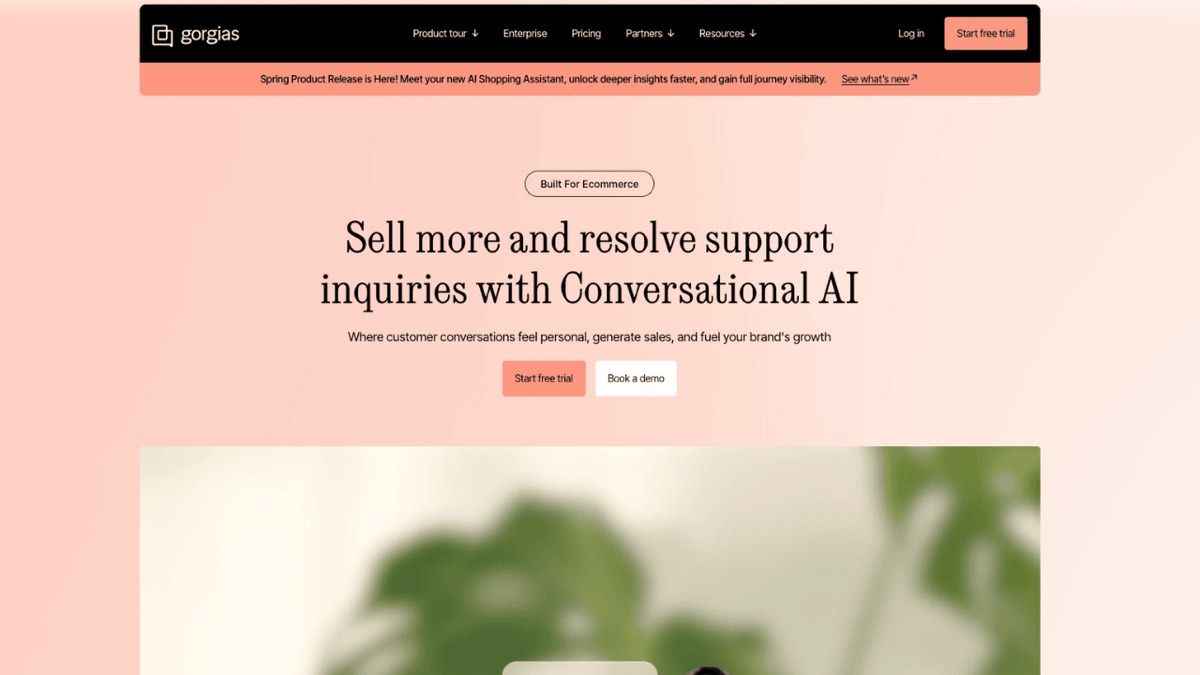
Gorgias is a strong ecommerce helpdesk. Whether its feature set fits your team depends less on the list and more on which features clear your backlog.
- You'll get every core Gorgias feature, what it does, which teams it matters most for, and where each one falls short.
- The platform rates 4.6/5 on G2 (800+ reviews), but it bills per ticket, and AI resolutions get counted twice, which changes the math at volume.
- Written for founders, COOs, and Heads of CX at $10M-$100M Shopify brands running 3-12 reps with a backlog that eats into payroll.
Most feature roundups read like a spec sheet. If you run a 3-12-rep support team, a spec sheet doesn't help much. You don't need to know that Gorgias has macros. You need to know whether macros clear the queue faster than the next hire would, and whether anything in the platform quietly runs up your bill while you're not looking. That's the lens behind every ecommerce customer service decision a high-volume team makes.
So I went through the Gorgias customer service platform feature by feature in a live instance and ranked each one by what it actually does for a high-volume team. One finding up front: the phone channel is the thin part, and for a brand with a visible phone number, that's exactly where the backlog leaks.
If you run customer experience at a Shopify brand doing $10M to $100M and your team is drowning in tickets, this is the honest version of what the platform does and doesn't do. Book a 30-min call and we'll compare it to your current setup, phone channel included.
Gorgias features at a glance
Here's the whole feature set in one view, with the part nobody puts in the marketing copy: who each feature actually helps, and the catch.
| Feature | What it does | Matters most for | The catch |
|---|---|---|---|
| Unified inbox | Email, chat, social, SMS, phone in one ticket feed | Every team | Junk email can become billable tickets |
| Shopify actions | Refund, edit, cancel, see order history from the inbox | High-volume Shopify teams | Tied to Shopify depth, weaker off-Shopify |
| Macros | Saved reply templates with dynamic variables | Teams answering the same questions all day | Only as good as the templates you build |
| Rules engine | If/then auto-tag, assign, route, reply | 3-12 rep teams scaling workflow | Setup is real work |
| AI Agent | Resolves common inquiries autonomously | Teams with clean knowledge sources | Billed per resolution, on top of the ticket |
| Help center | Self-service FAQ and order tracking | Stores with repeatable questions | Needs maintenance to stay accurate |
| Voice and SMS | Phone and inbound text from the helpdesk | Teams adding light phone coverage | Voice is thin, phone is the weak spot |
| Analytics | Ticket volume, response times, revenue stats | Leads reporting up to a founder or CFO | Revenue attribution is generous |
The features split into three groups once you've used them. A few do the heavy lifting. A few help but cost more than the sticker suggests. And a couple are thin enough that you'll end up solving that job somewhere else.
How I went through the feature set
I'm Ruben, co-founder of Ringly. We run AI phone support for 50+ Shopify brands, which means I evaluate helpdesk tools constantly, as a buyer, not a critic. For this roundup I set up a working Gorgias instance and pushed real ecommerce workflows through every core feature.
Here's what I scored each feature against:
- Does it clear the backlog, or just hold it? I ran a batch of WISMO, returns, and product questions through the inbox and counted how many a feature actually closed without a rep.
- What does it cost at volume? I traced the per-ticket and per-AI-resolution billing on a Pro-plan scenario, not the list price.
- Does it need a human to babysit it? Macros, rules, and the AI Agent all need building and tuning. I noted how much.
- Where does it leak? For each channel, I asked where a high-volume team still loses tickets. The phone is where that showed up.
The five things I lean on below come from running those workflows, not from reading the marketing page. Where Gorgias is genuinely strong, I say so. Where the phone channel falls down, I say that too.
The features that actually clear a backlog
These are the four that earn their place on a high-volume team. If you only use Gorgias for these, you're getting most of the value.
Unified inbox
The inbox is the foundation, and it's the heart of what makes a Shopify helpdesk app worth running. It pulls email, live chat, Facebook and Instagram comments and DMs, SMS, and phone into one ticket feed, so a rep isn't tab-switching between five tools to answer one customer. For a 3-12-rep team, the single feed is the difference between a queue you can manage and a queue that manages you.
It's genuinely good. The catch is on the billing side, and it's specific: Gorgias counts billable tickets, and if you connect a Gmail inbox with an auto-responder on, junk and personal email can get labeled as tickets and counted. One merchant on Reddit reported the integration imported 4,000+ ordinary emails and ran up a $200+ overage. Worth knowing before you flip on every channel.
Shopify and ecommerce actions
This is the real moat. Inside a ticket, a rep can see full order history and refund, edit, cancel, or duplicate an order, and create a discount code, without leaving the inbox. It connects to Shopify, BigCommerce, Magento, and WooCommerce, plus Klaviyo and Recharge. The Reddit consensus is blunt and fair: Gorgias wins on Shopify depth.
When 30-40% of your tickets are order-related, the ability to resolve them from inside the inbox is what makes the platform worth its price. WISMO calls alone run 30-40% of tickets in normal periods and over 50% at peak, according to Salesforce. Handling those without a rep clicking into Shopify saves real minutes per ticket. A clean check order status flow is the single biggest lever on that 30-40%. If your brand lives on Shopify, this feature is the reason to be on Gorgias at all. Off-Shopify, the depth thins out fast.
Macros
Macros are saved reply templates with dynamic variables, so a rep types a shortcut and the customer's name, order number, and tracking link drop in automatically. For the same questions over and over, this is the speed lever. A good macro library can cut a two-minute reply to fifteen seconds.
The catch is honest: a macro is only as good as the template you wrote. Teams that invest an afternoon building a tight macro set see the gain. Teams that don't end up with reps free-typing the same answer all day anyway. It's worth the setup, but it is setup.
Rules engine
The rules engine is if/then automation. Auto-tag a ticket, auto-assign it to the right rep, auto-reply to a known question, prioritize by VIP status, route by topic. This is the feature that lets a 3-12-rep team run like a bigger one without the headcount. It's the closest thing in the platform to scaling customer service without hiring.
It's powerful and it's work. Building a rule set that actually routes cleanly takes time, and most teams underuse it because nobody owns the configuration. If you're going to lean on Gorgias, this is where the effort pays back. Want to map this against what you're paying in rep hours today? Book a 30-min call and we'll do the math live.
The AI and self-service layer, and what it costs
This is the layer Gorgias markets hardest. It helps, but the pricing mechanics matter more than the demo does.
AI Agent
The Gorgias AI Agent resolves common inquiries autonomously across channels using your knowledge sources. Gorgias markets it as resolving 60% of inquiries instantly. On clean, repeatable questions it does real work, and for a team buried in WISMO that's meaningful.
Here's the part the marketing skips. Each AI resolution is billed as an interaction, roughly $0.90 each on annual plans, on top of the ticket it's already counting. So one interaction can be billed twice: once as a ticket, once as an AI resolution. At a few hundred tickets a month that's noise. At several thousand, it's a line item you feel. The feature is fine. The billing model is the thing to model out before you turn it up.
Help center and self-service
The help center is a hosted FAQ, knowledge base, and order-tracking flow that customers can search before they open a ticket. Gorgias says self-service can cut ticket volume by up to half, and for stores with a tight set of repeatable questions, deflecting work before it becomes a ticket is the cheapest win in the platform.
The catch is maintenance: a help center only deflects tickets if the answers stay accurate. Stale articles send customers right back into the queue, annoyed. It's a strong feature for teams that assign someone to keep it current, and dead weight for teams that set it and forget it.
What Gorgias pricing does to a high-volume team
The feature set is only half the story. The pricing model is the other half, because Gorgias bills by usage, not by seat, and at volume that cuts both ways.
Here's the current 2026 Gorgias pricing, straight from their plans:
| Plan | Monthly | Tickets included | Notes |
|---|---|---|---|
| Starter | $10/mo | 50 | 3 seats, email and chat, no automation or AI |
| Basic | $60/mo | 300 | adds social channels |
| Pro | $360/mo | 2,000 | recommended, includes 600 AI Agent interactions |
| Advanced | $900/mo | 5,000 | dedicated email server, 2,500 AI interactions |
| Enterprise | Custom | Custom | volume pricing |
Annual billing knocks off roughly two months. Overage tickets run $0.32 to $0.40 each depending on plan, and AI interactions add $0.90 to $1.00 each on top.
The model rewards a clean, well-tagged queue and punishes a messy one. If spam and junk email are slipping in as billable tickets, you're paying for noise. If your AI Agent is firing on volume you could have deflected with a help-center article, you're double-paying. The takeaway for a high-volume team isn't that Gorgias is expensive. It's that the bill tracks your queue hygiene, so the platform pays back hardest for teams that actually build the rules and the help center.
For context on the human side, replacing a single CS rep runs about $14,113 with industry turnover near 31%, per Gartner data via Insignia. A typical $50M Shopify brand running a 6-rep team is carrying roughly $24,000/mo in loaded CS cost. The point of a platform like Gorgias is to bend that curve so call and ticket volume stops translating directly into headcount. It does that well on email and chat. The phone is the part it doesn't reach.
The thin edge: Gorgias on the phone
Gorgias offers Voice and SMS, billed as phone support and inbound text from the helpdesk. SMS is fine. Voice is the thinnest feature in the platform, and the phone is the channel where reviews consistently flag the gap. One common comparison on Reddit notes that rival helpdesks ship a phone channel Gorgias effectively doesn't, and that's roughly right.
For a brand with a visible phone number, that gap is expensive in a way the dashboard doesn't show. The tickets you can see in Gorgias aren't the problem. The calls that roll to voicemail after 6 p.m. are. When a caller can't reach a person, 85% never call back and 62% switch to a competitor, according to a 2026 PCN study. Businesses answer only about 38% of inbound calls per AmbsCallCenter. This is why an after-hours answering service keeps coming up for brands that already run a solid helpdesk. None of that shows up as a Gorgias ticket, because the call never became one.
This is the one place Ringly fits, and it's narrow. Ringly is AI phone support for Shopify brands. It sits in front of your helpdesk on the phone channel only: it answers inbound calls 24/7, handles order status, returns, and product questions, and escalates the calls that need a human cleanly into Gorgias or whatever helpdesk you already run. You keep Gorgias for email, chat, and social. You add ecommerce phone support that doesn't go to voicemail.
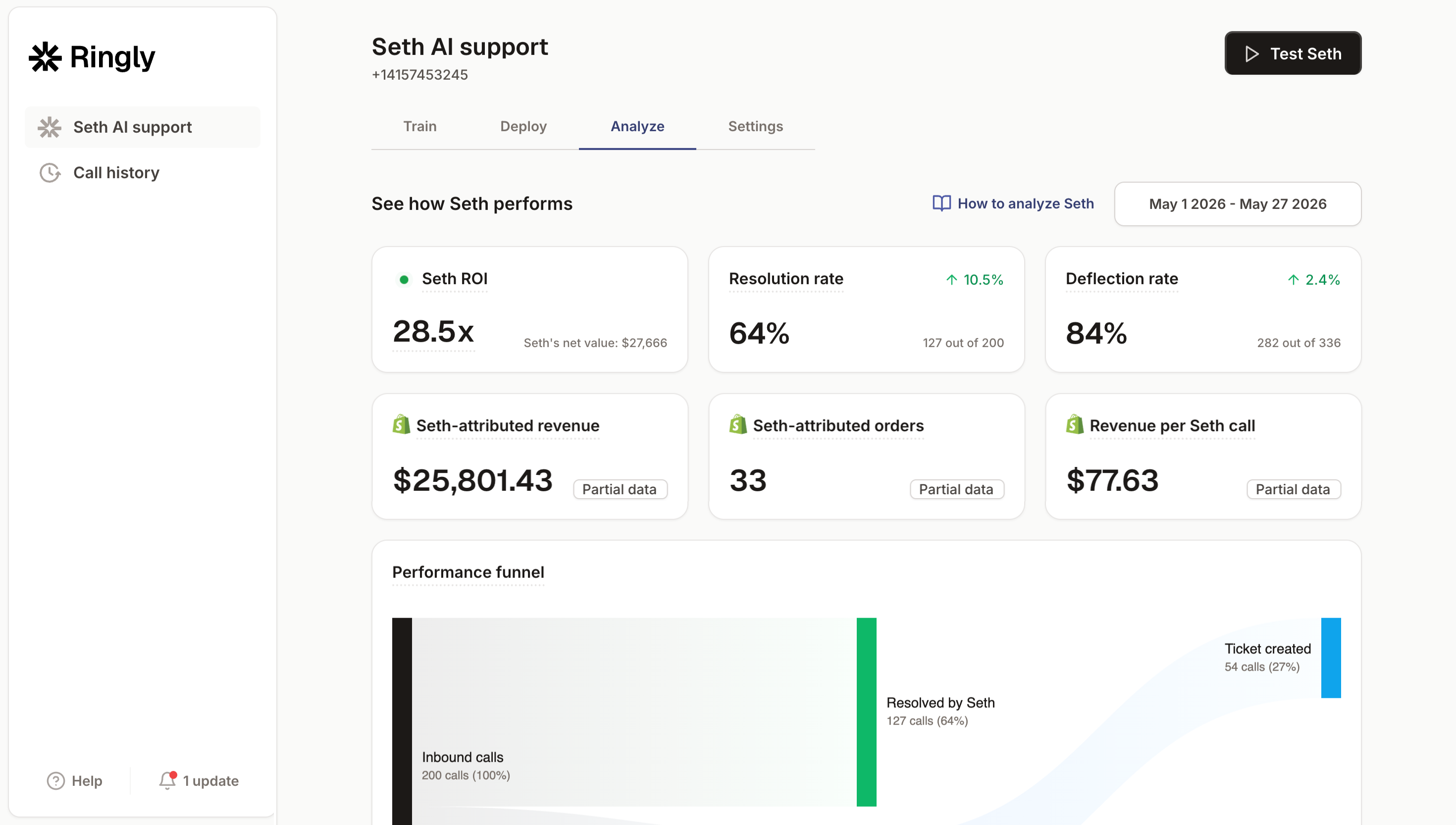
Across 50+ brands, the AI resolves 73% of calls autonomously at roughly $0.42 per resolved call. WashCo, a Shopify brand we launched, recovered $22,664 in its first 7 days on the phone. The math is simple: the calls Gorgias can't pick up are calls that were never going to become tickets, and some of them were orders.
Which features matter most for a high-volume team
If you're sizing up Gorgias for a 3-12-rep team, here's how the feature set actually shakes out once the demo is over.
Tier 1, the heavy lifters. Lean on these:
- Shopify and ecommerce actions if most of your tickets are order-related. This is the reason to be on the platform.
- Rules engine if you want a small team to run like a bigger one. The feature with the most payback, and the most underused.
- Macros if your reps answer the same questions all day. Cheap speed, worth the setup afternoon.
- Unified inbox for everyone. The foundation, just watch the billable-junk setting.
Tier 2, helpful but watch the bill. Use these with one eye on the invoice:
- AI Agent if your knowledge sources are clean. Model the double-billing first.
- Help center if someone owns keeping it current. Strong deflection, dead weight if neglected.
- Analytics if you report up to a founder or CFO. Solid, but discount the revenue-attribution numbers.
Tier 3, the thin edge. Solve this one somewhere else:
- Voice and SMS. SMS is fine. For phone, a high-volume brand with a real call line will want a dedicated layer in front of the helpdesk, because the calls that leak don't show up as tickets.
Frequently asked questions
What is the Gorgias customer service platform? Gorgias is a helpdesk and conversational-AI platform built for ecommerce, with its deepest integration on Shopify. It unifies email, chat, social, SMS, and phone into one ticket feed and layers automation and AI on top.
What are the main features of Gorgias? The core set is the unified inbox, Shopify and ecommerce actions, macros, the rules engine, the AI Agent, a help center for self-service, voice and SMS, and analytics. The Shopify actions and rules engine do the most work for a high-volume team.
Does Gorgias do phone support? Yes, through its Voice feature, but it's the thinnest part of the platform and reviews consistently flag the phone channel as the weak spot. Brands with a real call line usually add a dedicated phone layer rather than rely on Gorgias Voice.
How does Gorgias pricing work? Is it per ticket? Yes. Gorgias bills by usage, not by seat. Plans run from $10/mo (Starter, 50 tickets) to $900/mo (Advanced, 5,000 tickets), with overage tickets at $0.32 to $0.40 each. AI Agent resolutions cost an extra $0.90 to $1.00 each on top of the ticket.
Does Gorgias have AI, and does it cost extra? Yes. The AI Agent resolves common inquiries autonomously and Gorgias markets it as handling 60% of inquiries instantly. Each AI resolution is billed as an interaction on top of the ticket it already counts, so the same interaction can be billed twice.
Is Gorgias only for Shopify? No, it also integrates with BigCommerce, Magento, and WooCommerce. But its deepest order-action support is on Shopify, which is where most of its value lives.
What's the difference between macros and rules in Gorgias? Macros are saved reply templates a rep triggers manually. Rules are if/then automation that runs without a rep, auto-tagging, assigning, routing, or replying. Together they're the core of the Gorgias ticketing system: macros speed up humans, rules reduce how often a human is needed.
Talk to us

Gorgias is a good helpdesk, and for email, chat, and social it does the job. If your Gorgias queue holds email and chat fine but the phone still rolls to voicemail after 6 p.m., that's the gap a 30-min call can map for you. We'll look at your real missed-call volume and show you what it's costing.
The 3-layer guarantee.
- Live in 14 days or it's free until launched.
- 65% resolution in 90 days or we refund the last 3 months of subscription fees.
- We keep working free until we hit 65%.
Ruben (Ringly co-founder) takes these calls personally.