
This guide in 30 seconds.
- What Gorgias actually does as a customer service platform: one ticket feed for email, chat, social, SMS, and voice, sitting right on top of your Shopify data.
- Where the ticket-based pricing and the AI Agent fee quietly add up, with the real numbers from their pricing page.
- The one channel Gorgias still leaves to your CS team, and why a $10M-$100M Shopify brand with a visible phone line should care.
If you run support at a Shopify brand doing $10M to $100M, you have probably already shortlisted Gorgias, or you are running it right now. It is the helpdesk most DTC operators end up on, and for good reason. The question that actually matters is not "is Gorgias good." It is "which parts of my support does Gorgias solve, and which parts is it still leaving on my CS team's plate."
This guide answers that. It is written for the founder, COO, or Head of CX who is past the marketing pages and wants to know what they are buying. We build AI phone support for 50+ Shopify brands, so we sit next to Gorgias every day and watch where it ends. If your phone backlog and after-hours calls are the part that never gets solved, book a 30-min call and we will map exactly what is leaking.
What Gorgias actually is
Gorgias is a customer service platform built specifically for ecommerce, with the deepest roots in Shopify. Its core job is to pull every customer conversation into a single feed of tickets so your team stops living in seven tabs.
That feed covers email, live chat, Facebook, Instagram, TikTok, WhatsApp, SMS, and phone (the last few are paid add-ons). Instead of a rep checking the Instagram inbox, then the support email, then the SMS tool, every message lands in one place with the customer attached. For a brand fielding the same five questions all day across five channels, that consolidation alone is worth the line item. It is the spine of a modern ecommerce customer service operation.
It is genuinely well-liked. Gorgias holds a 4.6 out of 5 on G2 across roughly 550 reviews (G2) and a 4.3 on the Shopify App Store. That is not a tool people tolerate. It is one most DTC support leads recommend to each other.
Where it fits in your stack: Gorgias is the ticketing and routing layer, the Shopify helpdesk app your team logs into all day. It is not a phone system, not a marketing tool, and not an order management system. It is the place your team works the queue. Hold that thought, because it matters when we get to the channel it does not fully cover.
The Shopify-native part is the real draw
Plenty of helpdesks claim a Shopify integration. The difference with Gorgias is depth. An agent can see a customer's full order history, then refund, edit the order, or cut a discount code without ever leaving the ticket.
That is the feature that earns its keep. When a customer writes in about a delayed order, the rep is not alt-tabbing into Shopify admin to look up the order, copy the tracking, and paste it back. The order is right there in the conversation. For WISMO tickets, which run 30-40% of support volume in a normal week and over 50% at peak (Salesforce), that saved minute per ticket adds up across a 6-rep team.
Gorgias also ships a Help Center, a self-service FAQ and knowledge base that customers can search before they ever open a ticket. Gorgias says self-service like this can cut ticket volume by up to half. Treat that as a best case, not a promise, but the direction is right: the cheapest ticket is the one your team never sees.
This is the part of Gorgias that is hard to argue with. If your support pain is "email and chat are a mess and my reps waste time hunting for order data," Gorgias is a strong answer. The honest caveat comes next, on cost.
Automation, rules, and the AI Agent
Gorgias has two layers of automation, and they are worth separating because they bill differently.
The first layer is the classic helpdesk automation: macros, response templates, and rules. You build a rule once ("tag every message containing 'return' and route it to the returns queue"), and it runs on every ticket forever. This is included in your plan and it is where most teams get their first real time savings. Set up clean rules and your reps stop triaging by hand.
The second layer is the AI Agent, Gorgias's autonomous resolver. It can answer questions, edit orders, manage subscriptions, and push product recommendations across chat and email without a human. When it works, it is genuinely useful. The thing to understand is the bill.
The AI Agent is priced per resolved conversation, $1.00 each on monthly billing or $0.90 on annual, charged on top of your helpdesk ticket cost (Gorgias pricing). So an AI-resolved conversation can count twice: once as a ticket against your plan allowance, and once as an automation fee. Operators flag this constantly. As one independent review puts it, the ticket-based model "can get complicated fast, especially for fast-growing teams or seasonal stores" (eesel AI). It is not a gotcha if you model it. It is a surprise if you do not.
What it costs, honestly
Gorgias prices on tickets, not seats, which is a real advantage: you can add as many agents as you want without the bill moving. Here are the current monthly plans straight from their pricing page.
| Plan | Tickets / month | Price | Overage |
|---|---|---|---|
| Starter | 50 | $10/mo | $0.40 per ticket |
| Basic | 300 | $60/mo | $40 per 100 |
| Pro | 2,000 | $360/mo | $36 per 100 |
| Advanced | 5,000 | $900/mo | $36 per 100 |
| Enterprise | Custom | Custom | $32 per 100 |
Annual billing knocks off about 16% (Pro drops to $300/mo, Advanced to $750/mo). A 7-day free trial runs without a card.
Then come the parts that sit outside the base plan:
- AI Agent: $0.90 to $1.00 per resolved conversation, on top of the ticket.
- Voice add-on: $0.40 to $1.20 per ticket.
- SMS add-on: $0.41 to $0.80 per ticket.
For a brand on Pro doing real volume, the headline $360 is rarely the all-in number. Add ticket overages in a busy month, the AI Agent fee on automated conversations, and Voice plus SMS on top, and the true monthly cost climbs. None of that makes Gorgias a bad buy. It makes it a buy you should model on your actual ticket volume before you sign, not after the first overage invoice.
Who Gorgias fits, and the one gap it leaves
So who is it for. Gorgias fits a Shopify or Shopify Plus brand that lives in email, chat, and social, wants order context inside every ticket, and is fine staffing the humans to work the queue. That is most DTC brands, which is exactly why it is the category default. If you are comparing it head to head with other helpdesks, our Gorgias alternatives breakdown goes deeper.
Here is the gap. Gorgias is excellent at the channels a rep can work asynchronously. The phone is the one channel it still hands back to a human every single time.
Gorgias does offer Voice. A rep can make and receive calls inside the helpdesk with the full customer timeline next to them, which is a nice upgrade over a separate phone tool. But Voice is a tool for human agents, not an autonomous one. There is no AI that picks up the phone, pulls the order, and resolves a "where's my order" call on its own (Gorgias Voice). When the line rings, a person has to answer it. After 6 p.m., on the weekend, during a launch spike, that means the call rolls to voicemail or it gets missed.
That gap has a price. 85% of callers who can't reach a person never call back, and 62% switch to a competitor (PCN). The average business answers only about 38% of inbound calls (AmbsCallCenter). For a brand with a visible phone number, the missed-call channel is usually the quietest leak on the P&L, because nobody sees the calls that never connect. An after-hours answering service used to be the only patch, and it never paid for itself.
This is the slot an AI phone layer fills, and it is what we build.
Where Ringly fits
Ringly.io is AI phone support for Shopify brands. It is not a Gorgias replacement. It sits in front of your phone line and handles the routine inbound calls Gorgias Voice would otherwise put on a rep.
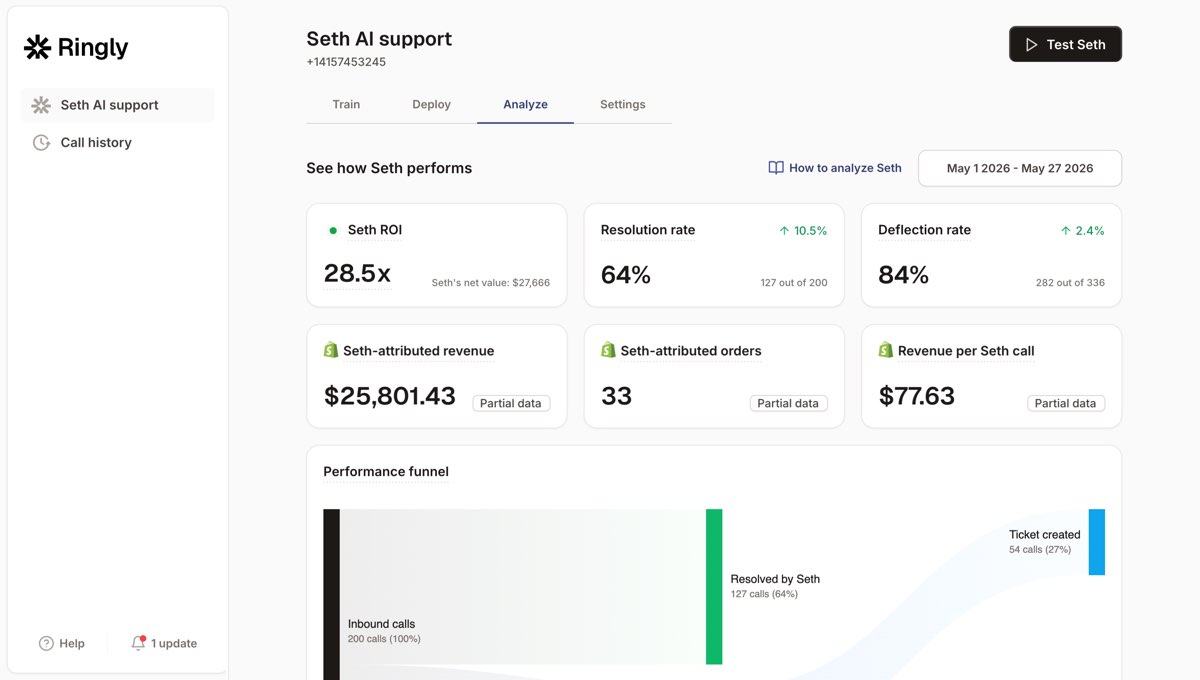
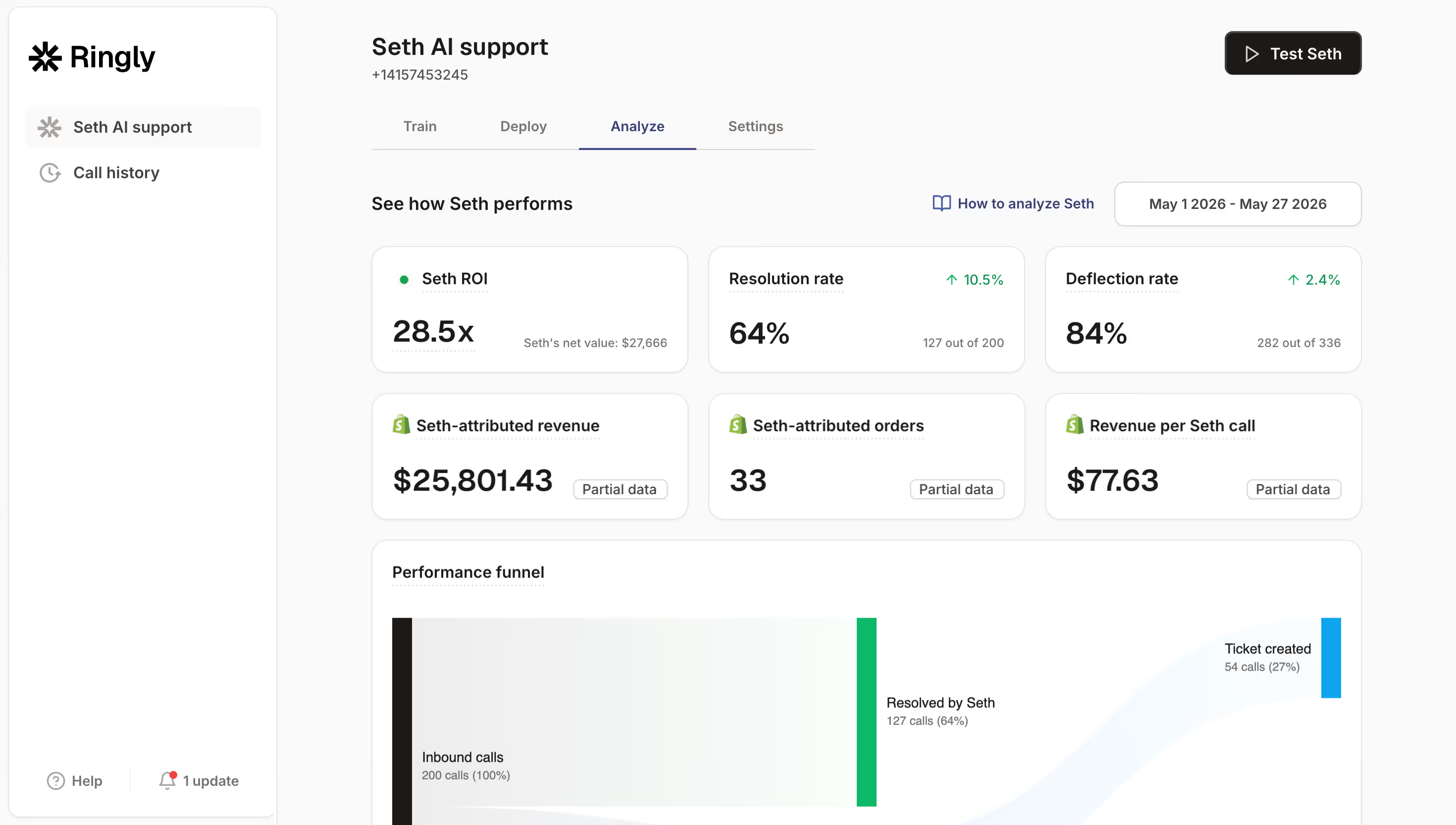
The AI answers inbound calls 24/7. It finds the order in your Shopify store, answers product and return questions from your knowledge base, and rescues abandoned carts on outbound follow-up. Across 50+ brands, it resolves 73% of calls on its own at roughly $0.42 per resolved call, against the $7 to $16 a human BPO call runs. The calls that need a person escalate cleanly into Gorgias, Richpanel, or whatever helpdesk you already run. Your reps keep their stack. They just stop being the after-hours phone queue. If you have weighed building this in-house, our take on customer service for Shopify covers the trade-offs.
Here is the cost picture most operators recognize.
| Line item | Today | With Ringly |
|---|---|---|
| 6 reps x $4K loaded per rep | $24,000/mo | n/a |
| Ringly Enterprise (~$5K/mo) | n/a | $5,000/mo |
| Net monthly CS spend | $24,000/mo | $5,000/mo |
| Monthly savings | n/a | $19,000/mo |
That is roughly 70% of repeatable calls (order status, returns, the same questions over and over) routed to the AI. The other 30%, the genuinely hard calls, still go to your team. WashCo, a Shopify brand we launched, recovered $22,664 in its first 7 days on the phone.
"My customers also feel like it's a normal person. They feel like they can communicate if they have questions."
Claudia Droge, TechCraft Studio
If your Gorgias setup is solid on tickets but your phone still goes to voicemail after hours, book a 30-min call and we will do the math on your actual call volume live. Want the deeper version, see our guide to Gorgias phone support.
Frequently asked questions
Is Gorgias a CRM or a helpdesk? It is a helpdesk, a customer service platform for ecommerce. It manages support conversations and tickets, not a sales pipeline. It connects to Shopify for order and customer data, but it is not a full CRM in the Salesforce sense.
Does Gorgias work with Shopify? Yes, deeply. It is built for Shopify first, so agents see full order history inside the ticket and can refund, edit orders, or create discount codes without leaving Gorgias. It also supports BigCommerce and Magento. See our notes on Shopify customer service apps.
How much does Gorgias really cost? Base plans run $10 (Starter) to $900 (Advanced) per month, priced on ticket volume, not seats. The all-in number is usually higher once you add ticket overages, the AI Agent fee ($0.90 to $1.00 per resolved conversation), and Voice or SMS add-ons. Model it against your real monthly ticket count.
Does Gorgias handle phone calls? It offers a Voice add-on so human agents can make and receive calls inside the helpdesk, with full customer context. It does not autonomously answer or resolve inbound calls with AI, so a person still has to pick up every call. That phone gap is where an AI phone agent for Shopify comes in.
Can I use Ringly and Gorgias together? Yes, that is the point. Ringly handles the inbound phone channel and escalates the calls that need a human straight into Gorgias. You keep your helpdesk, your number, and your workflows. Nothing gets ripped out.
What's the best way to cut WISMO load on Gorgias? Deflect it before it becomes a ticket. A self-service order-tracking page and a clear Help Center cut the email and chat side, and an AI phone agent handles the WISMO calls so they never hit a rep at all. More in our guide to 24/7 ecommerce phone support.
Talk to us

If you run a $10M-$100M Shopify brand, Gorgias is probably the right ticket layer for you. The phone is the piece it leaves open. A 30-min call is the fastest way to see what your after-hours and missed calls are actually costing, and how an AI phone layer plugs the gap without touching your helpdesk.
The 3-layer guarantee.
- Live in 14 days or it's free until launched.
- 65% resolution in 90 days or we refund the last 3 months of subscription fees.
- We keep working free until we hit 65%.
Ruben (Ringly co-founder) takes these calls personally.