

This post in 30 seconds.
- The eight Gorgias practices that actually move the number, plus the one channel every other guide skips: the phone line.
- WISMO runs 30-40% of your tickets, and about 70% of your inbound calls are the same repeatable questions your macros already answer in writing.
- Written for founders, COOs, and Heads of CX at $10M-$100M Shopify brands running a paid Gorgias instance with a visible phone number.
You already pay for Gorgias. You already pay a team. And the queue still stacks up 200 deep every Monday morning, most of it the same five questions.
Most "best practices" posts are feature tours. They tell you Gorgias has macros and rules, then move on. That doesn't help when you're the Head of CX at a $30M Shopify brand staring at a backlog and a CFO asking why support headcount keeps climbing. The practices that actually change your CSAT and your cost per contact are operational, not a list of features you already know exist.
So here are eight you can run this week. We run AI phone support for 50+ Shopify brands, almost all of them on a helpdesk like Gorgias, so the call-pattern data in the phone section is ours, not a guess.
If your phone still rolls to voicemail after 6 p.m. and nobody returns it, that's the part this post spends the most time on, because nobody else does. Book a 30-min call and we'll show you what those missed calls are actually worth.
How I built this list
I'm Ruben, co-founder of Ringly.io. We run AI phone support for 50+ Shopify brands, and almost every one of them runs Gorgias or something like it alongside us. So I see a lot of real setups, not demo accounts.
For this list I pulled four things from those brands over the last few months:
- Tag taxonomies. I read the actual tag lists CS teams use day to day, and counted how many were dead weight.
- Rule order. I audited which rules fired first and where they collided.
- CSAT by response time. I matched each brand's CSAT scores against how fast their first reply went out.
- Call patterns. I counted what people actually call about across every brand we answer the phone for.
That last one is the number nobody outside this seat has: about 70% of inbound calls are the exact same repeatable questions your Gorgias macros already answer in writing. Hold onto that, it matters for practice number seven.
Build macros that pull live data, not canned paragraphs
A macro is not a saved paragraph. The macros that earn their place pull live customer data, the name, the last order number, the tracking link, so an agent sends a personal, specific reply in two clicks instead of copy-pasting a generic block. That's the difference between a reply that sounds like a person and one that sounds like a form letter.
Three rules keep your Gorgias macros from rotting:
- Version them when policy changes. Your return window changed from 30 to 14 days? Every macro mentioning it is now wrong. Keep a short list of which macros reference policy, and update them as a set.
- Insert dynamic variables, don't hardcode. Pull the order number from Shopify. Hardcoded examples get sent to the wrong customer eventually.
- Don't let agents over-rely. A macro is a starting point. If your team fires the same WISMO macro at a customer who's clearly furious about a third failed delivery, your CSAT pays for it.
A quick test for whether a macro is pulling its weight: if an agent has to edit it more than half the time before sending, it's too generic or too specific. Rebuild it. The best macro libraries cover your top 15 to 20 ticket reasons and nothing else, so agents can find the right one in seconds instead of scrolling past 80 near-duplicates. Good macros are the foundation everything else sits on, because your rules are going to send them automatically. Speaking of which.
Sequence your rules and build them from real tickets
Rules are the IF/THEN engine: if a ticket contains X, tag it, assign it, or auto-reply with a macro. The mistake almost everyone makes is that rules match keywords, not intent, so a ticket that says "haven't gotten my package" sails right past a WISMO rule that only listens for "where is my order."
Two things fix this:
- Build keyword lists from your real ticket history, not your imagination. Export a month of tickets, read how customers actually phrase things, and feed those exact phrasings into the rule. WISMO alone is 30-40% of your tickets in a normal period and over 50% at peak, per Salesforce, so this one rule earns more than any other.
- Mind the order. Rules fire top to bottom and the first match often wins. If a broad "auto-close spam" rule sits above your VIP-routing rule, you'll quietly close tickets from your best customers. Audit the sequence whenever you add a rule.
Test new rules on a slice of traffic before you turn them loose on the whole queue. A bad Gorgias rule doesn't just fail, it fails silently while you think it's working. Pair this with WISMO automation on Shopify so the tracking link goes out before the customer ever opens a ticket.
Keep a tight tag taxonomy
This is the most boring practice and the one that breaks the most setups. Ten clean tags beat forty overlapping ones, because tags are what feed your rules and your reporting, and a messy tag list quietly corrupts both.
Tag along three axes and stop there:
- Issue type: order-status, return, exchange, product-question, shipping-issue, billing. Six to eight is plenty.
- Priority: urgent, high, normal. Drive these off rules, not agent judgment.
- Segment: vip, first-time, wholesale. Keep it small.
When two tags mean the same thing (order-status and where-is-my-order), pick one and delete the other. Run a tag cleanup once a quarter. Clean tags are what make your Gorgias reporting and Gorgias insights actually trustworthy, instead of a chart built on noise.
Set SLA tiers and a breach-recovery rule
Most teams set one SLA target for everything and miss it constantly. A tiered SLA, faster for VIPs, faster for the channels customers expect speed on, plus an auto-escalation when a ticket is about to breach, is what keeps your worst response times from torching your CSAT.
Ecommerce buyers expect a first reply under one hour on email, and the cost of being slow is measurable: each additional hour of delay costs roughly 1.7 CSAT points, per 2026 benchmark research. So set tiers that match the channel, then build a rule that flags any ticket nearing its SLA and bumps it to the top of the queue or pings a lead. Don't wait for the weekly report to find out you blew it.
Map your targets to a real ecommerce customer service SLA framework, and pressure-test them against current response time benchmarks so you're not promising something the team can't hit.
One thing teams forget: an SLA only counts business hours unless you tell it otherwise. If your phone line goes dark at 6 p.m. but your SLA clock keeps ticking, you'll breach every overnight ticket and never know why your worst response times all cluster after dark. Set business-hours windows per channel, and be honest about which channels you actually cover after hours. That gap, the hours nobody is staffed, is where most of the damage to your numbers happens.
Put self-service in front of the queue
The cheapest ticket is the one that never opens. 88% of customers say they expect a self-service option, per Statista, and a good order-status flow plus a returns portal will quietly take the most repetitive 30% of your volume off the team entirely.
Three flows do most of the work:
- Order tracking: let customers pull their own WISMO tracking status without a ticket.
- Self-serve returns: a Shopify self-serve returns portal handles the start-a-return request that otherwise becomes a back-and-forth thread.
- A real help center: the answers to your top 20 product questions, indexed and searchable.
Self-service isn't a wall to hide behind. Done right, it follows the same ecommerce returns best practices your team already knows, just without a human in the loop for the easy stuff.
Close the CSAT loop, don't just measure it
Plenty of teams send a CSAT survey and file the score in a dashboard nobody opens. Measuring CSAT does nothing on its own. The win is closing the loop: trigger the survey with a rule, tag the detractors automatically, and route every low score back to a human who fixes the specific thing that went wrong.
The stakes are real. A reply inside five minutes lands around 92% CSAT, while a 24-hour reply drops to 51%, and the median ecommerce store sits near 82% with top-quartile teams at 92%+. So a one-point move is worth fighting for. Tie your CSAT tags back to your other tags and you'll see exactly which issue types and which channels are dragging the average down, which is half the battle. The other half is acting on it, fast, and feeding what you learn into your first-call resolution work so the same complaint doesn't come back next week.
There's one channel where this loop is hardest to close, because the customer never even reaches a human to score. We hear it constantly from the brands we work with.
"My customers also feel like it's a normal person. They feel like they can communicate if they have questions."
Claudia Droge, TechCraft Studio
If you want to compare your current CSAT and response numbers against what's actually achievable on your stack, book a 30-min call and we'll do the math live.
Staff the phone line Gorgias doesn't staff for you
Here's the practice every other Gorgias guide skips. Gorgias can log a phone call and put it next to your VoIP tool, but it does not answer the phone for you, so the single most expensive channel in support is the one your helpdesk leaves entirely to humans.
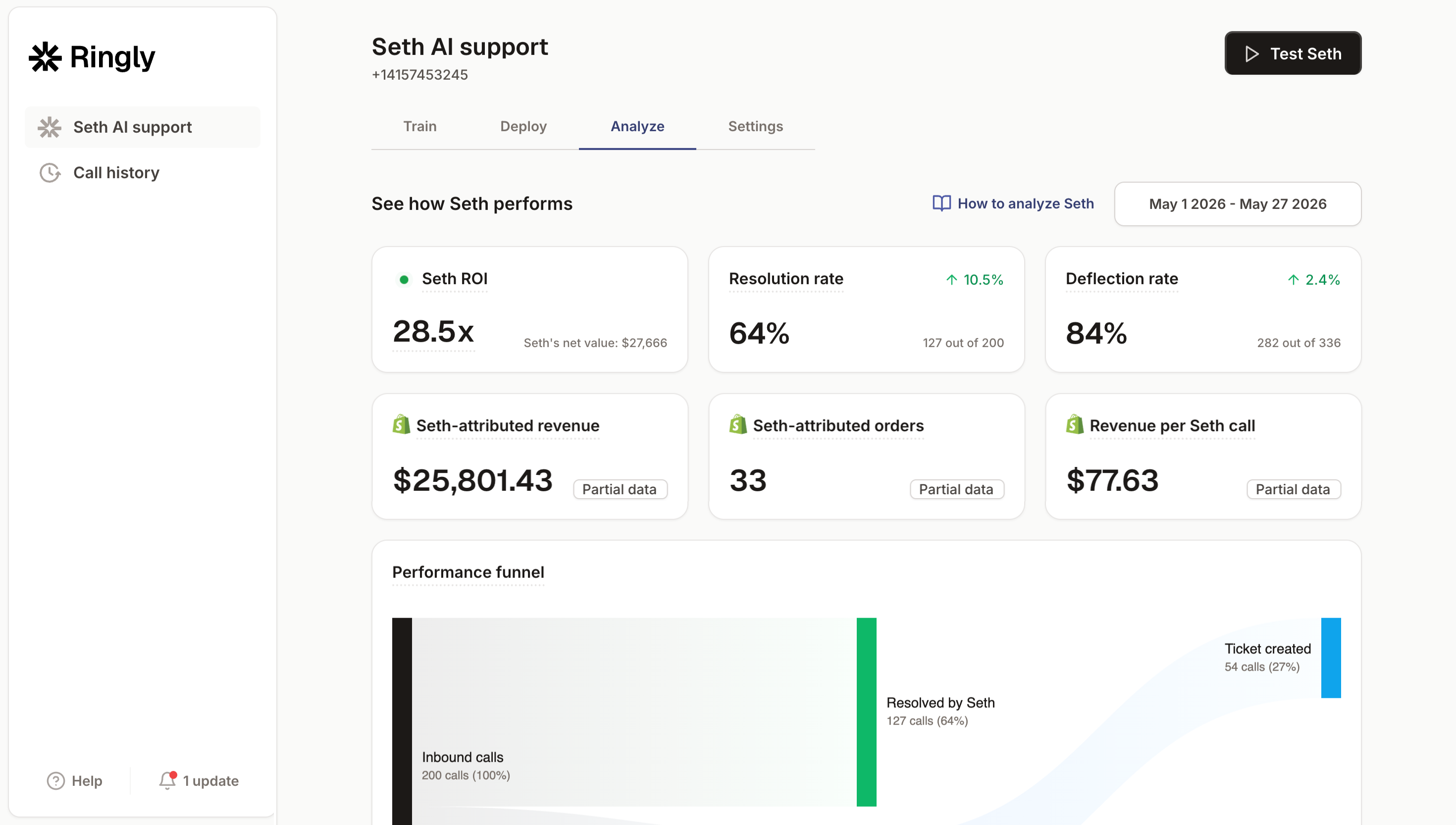
Look at what that costs. A six-rep team at the standard $4,000-per-rep loaded cost runs you $24,000 a month, and a chunk of it is spent reading the exact same tracking links your macros already write.
| Line item | Today | With an AI phone agent in front of Gorgias |
|---|---|---|
| 6 reps × $4K loaded | $24,000/mo | n/a |
| AI phone layer (~$5K/mo) | n/a | $5,000/mo |
| Net monthly phone spend | $24,000/mo | $5,000/mo |
| Monthly savings | n/a | $19,000/mo |
That's the same 70% repeatable, 30% complex split you already manage in Gorgias, just applied to voice. Routine calls get answered 24/7, the genuinely hard ones escalate cleanly into your Gorgias queue with the full context attached, and your reps get the calls that actually need them.
This is also where the keyword-versus-intent problem from practice number two comes back. A brittle phone tree that only understands "press 1 for order status" is the voice version of a rule that only listens for "where is my order." It fails the customer who phrases it any other way. An AI phone agent listens for intent the way a good rule should.
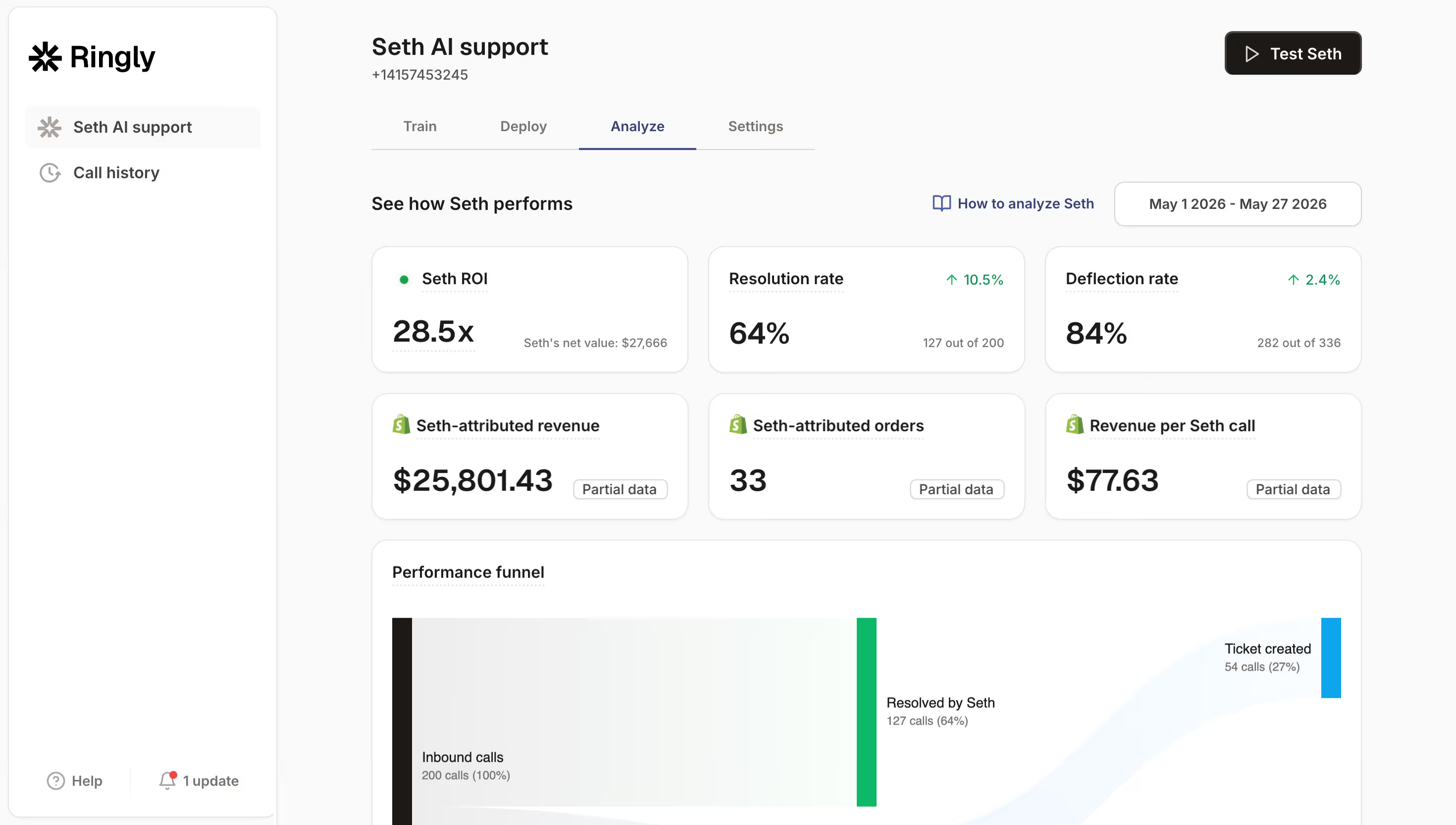
Ringly.io is AI phone support for Shopify brands. The AI answers inbound calls 24/7, finds orders in your Shopify store, processes returns and exchanges, answers product questions from your knowledge base, and escalates cleanly to Gorgias when a call needs a human. Across 50+ brands, it resolves 73% of calls autonomously at roughly $0.42 per resolved call. WashCo, a Shopify brand we launched, recovered $22,664 in its first 7 days on the phone. It keeps your current number, your helpdesk, and your workflows, and it's live in under an hour.
If you're staffing the phone with people for work the AI customer support phone agent for Shopify can do, that's the ecommerce phone support line on your P&L worth a hard look. It matters even more after hours: 78% of buyers abandon a brand after one unanswered call, and an after-hours answering service that's just voicemail is the same as no coverage. Book a 30-min call and we'll scope it for your store.
Measure the right four numbers
You can drown in support metrics. Four numbers tell you almost everything: first response time, resolution rate, CSAT, and cost per contact, and the last one only makes sense if you count the phone, not just the tickets.
Track them together:
- First response time, split by channel, against your SLA tiers.
- Resolution rate, including how much self-service and automation handled without a human.
- CSAT, segmented by your tags so you know which issue type is hurting.
- Cost per contact across every channel, phone included, because that's where the customer service KPIs for ecommerce usually hide the real spend.
Gorgias reporting handles the ticket side well. The blind spot is the phone, so if you're serious about reducing call center costs, make sure your phone channel reports the same four numbers your tickets do. You can't fix the line item you don't measure.
Frequently asked questions
What are the most important Gorgias customer service best practices? Start with dynamic macros, well-sequenced rules built from real ticket history, and a tight tag taxonomy, because those three feed everything else. Then add tiered SLAs, self-service flows, and a closed CSAT loop. The one most teams miss is staffing the phone line, which Gorgias logs but doesn't answer.
How do macros and rules differ in Gorgias? A macro is a reusable reply that pulls in live customer data like name, order number, and tracking link. A rule is the IF/THEN automation that decides when to tag, assign, or auto-send one of those macros. Macros are the message, rules are the trigger.
How many tags should we use in Gorgias? Fewer than you think. Aim for six to eight issue-type tags, three priority tags, and a handful of segment tags. Ten clean tags beat forty overlapping ones, because tags feed your rules and your reporting, and a messy list corrupts both.
Does Gorgias handle phone calls? Gorgias integrates with VoIP tools and logs calls in the ticket timeline, but it does not autonomously answer the phone for you. The actual answering is left to your team or a separate tool. That gap is why most Shopify brands either let calls roll to voicemail after hours or add an AI phone agent that sits in front of Gorgias and escalates into it.
What's a good CSAT and first response time benchmark for ecommerce? The median ecommerce store lands around 82% CSAT, with top-quartile teams at 92%+. For first response, buyers expect under an hour on email and a couple of minutes on live chat. Every hour of delay costs you roughly 1.7 CSAT points.
How do we stop WISMO tickets from eating the queue? WISMO is 30-40% of tickets normally and over 50% at peak, so attack it directly: a self-service order-tracking flow, a rule that auto-sends the live tracking link on any WISMO phrasing, and proactive shipping updates. Build the rule's keyword list from how customers actually phrase it, not just "where is my order."
Is Gorgias per-ticket pricing worth it? For most $10M-$100M Shopify brands, yes, because the native Shopify actions and automation save real agent time. Watch the billable-ticket count as you scale, since AI and auto-replies can quietly add to it. The bigger cost usually isn't Gorgias, it's the human hours on the phone channel it doesn't staff.
Talk to us

If you run a $10M-$100M Shopify brand on Gorgias and the phone line still rolls to voicemail after 6 p.m., a 30-min call is the fastest way to see what that's costing you. We'll look at your missed calls and do the math live.
The 3-layer guarantee.
- Live in 14 days or it's free until launched.
- 65% resolution in 90 days or we refund the last 3 months of subscription fees.
- We keep working free until we hit 65%.
Ruben (Ringly co-founder) takes these calls personally.