
Gorgias CSAT in 30 seconds.
- What it is: a one-question, 1-to-5 star survey that fires after a ticket closes, scored and tracked inside Gorgias.
- The trap: reading the average and missing the distribution, the response rate, and the one channel it can't survey.
- Who this is for: Heads of CX and founders at $10M-$100M Shopify brands running Gorgias with a visible phone line.
CSAT is the number a lot of CX leads stake their quarter on, and Gorgias CSAT makes it easy to collect: flip on the satisfaction survey, and every closed ticket can ask "how would you rate your experience?" The number that comes back feels like the truth about your support.
It mostly is. But the average hides two things, and one of them is a whole channel.
Most $10M-$100M Shopify brands we work with run Gorgias, watch their CSAT sit somewhere in the low 80s, and feel fine. Then a Trustpilot review lands saying "I called four times and nobody picked up," and they realize the report never saw it. If your CSAT looks healthy but your phone goes to voicemail after 6 p.m., book a 30-min call and we'll show you the satisfaction you're not measuring.
What Gorgias CSAT actually measures
Gorgias CSAT is a satisfaction survey built into the helpdesk. When a ticket closes, Gorgias can send the customer a one-question survey asking them to rate the interaction on a star scale. The score gets logged, averaged, and reported back to you over time.
The feature only surveys four channels: chat, email, contact form, and help center. That detail matters more than it looks, and we'll come back to it.
For context on what "good" looks like: the median CSAT for ecommerce stores sits around 82%, with top-quartile merchants clearing 92%, according to 2026 CSAT benchmarks. Anything above 75% is generally considered solid, 80% and up is strong. So if your Gorgias dashboard shows 82%, you're average for the category. Not a problem to celebrate, not one to panic about. If you want the full picture, our roundup of CSAT statistics for 2026 breaks it down by industry.
Gorgias itself calls CSAT a "North Star metric," and there's a real reason: high CSAT correlates with repeat purchases, which is the whole game for a DTC brand. It's one of the customer service KPIs worth tracking closely.
Worth being clear on what CSAT is and isn't, because brands mix it up. CSAT measures one interaction, right after it happens. It's not loyalty, it's not lifetime sentiment, and it's not the same as a Net Promoter Score that asks whether someone would recommend you. CSAT is the closest, freshest read on "did that specific support moment land," which is exactly why the channel coverage underneath it matters so much. The question is whether the number you're looking at is actually telling you the truth.
The exact rules: when a survey sends, and when it doesn't
Gorgias doesn't survey every closed ticket. It has hard conditions, and knowing them stops you from misreading your own data. Per Gorgias's own documentation, a survey only goes out when all of these are true:
- There's a real back-and-forth. At least one message from the customer and one reply from an agent. Messages sent by rules and internal notes don't count.
- The conversation is substantial. The whole thread has to be longer than 250 characters. A two-word "thanks" exchange won't trigger a survey.
- The reply is recent. The agent's last reply, at the moment the ticket closes, has to be less than a week old.
- The channel qualifies. Chat, email, contact form, or help center. Nothing else.
By default, the survey sends two hours after the ticket closes, unless you set your own delay. Links expire after three months, and snoozed tickets, deleted tickets, and social-media conversations are skipped entirely. You can also fire an "exclude from CSAT" action to keep a specific ticket out of the survey pool. If you're new to the platform, our Gorgias reporting overview shows where these settings live.
Every one of those rules quietly shapes the score you read, because each one decides which customers get a vote. Long, messy tickets get surveyed. Quick wins under 250 characters don't. That's a sampling choice you didn't make on purpose, baked into the feature.
How to read the CSAT report without fooling yourself
The report lives under Statistics, then Support Performance, then Satisfaction. You'll see surveys sent, response rate, average rating, the rating distribution, and individual comments. You can filter by score to pull up the exact conversation behind a one-star, which is the most useful thing in there. Gorgias surfaces more of this in its insights views too.
Here's the part operators skip: the average is the least informative number on the page.
Three reads matter more. First, the distribution: a 4.2 average made of fours is a stable team; a 4.2 made of fives and ones is a team with a consistency problem hiding behind a decent mean. Second, the response rate: email surveys under-respond, and the people who do respond skew to the extremes, the delighted and the furious. Your "average" is really an average of strong opinions. Third, the comments, because the why is worth more than the score.
"My customers also feel like it's a normal person. They feel like they can communicate if they have questions."
Claudia Droge, TechCraft Studio
One more thing the report won't tell you on its own: timing. A score collected two hours after a smooth chat means something different from one collected the same way after a customer waited three days for a reply. The survey records the rating, not the wait that produced it, so pair the CSAT view with your response-time data before you draw conclusions about a dip.
If you only ever report the headline average up to your founder, you're handing them a number that looks precise and isn't. Read the shape, not just the center.
CSAT on AI tickets vs human tickets
If you've turned on Gorgias's AI Agent, you can see its CSAT separately, broken down by the reason customers contact you. That breakdown is where you decide which ticket topics the AI should keep and which to route to a human.
The fear most CX leads carry into this is simple: won't AI tank our CSAT? The data says no, as long as the AI resolves instead of deflecting. AI-agent CSAT averages 78% across the industry, with the best deployments clearing 85%, per 2026 support data. On a 5-point scale, pure AI lands around 4.1 against 4.3 for humans, and once you add clean escalation, the gap shrinks to about 0.05 points.
There's a perception gap underneath all this. 84% of consumers assume a human is more accurate than AI, yet AI CSAT beats human baselines on the routine, repeatable tickets, the order status, the return, the same five questions over and over. The trick isn't AI vs human. It's letting the AI own what it's good at and handing your reps the calls that actually need them, which is the heart of any modern voice AI customer support setup.
So when you read AI CSAT in Gorgias, judge it by topic, not in aggregate. The AI's score on "where is my order" should be near the top of your whole operation, because that ticket is repeatable and fast. If it isn't, that's a knowledge-base gap, not a reason to pull the AI off. The score on a nuanced complaint or a damaged-on-arrival claim will be lower, and that's the signal to route that topic to a human. The report gives you that split if you actually read it that way.
The blind spot: your phone calls never enter CSAT
Go back to that channel list: chat, email, contact form, help center. Phone is not on it.
That means none of your phone support shows up in your Gorgias CSAT, ever. And phone isn't a minor channel. It posts the highest CSAT of any support channel, around 76%, ahead of chat and email, according to channel benchmarks. The channel customers are most satisfied with is the one your satisfaction report can't see.
It gets worse for the calls you miss. When a customer calls after hours and hits voicemail, no ticket is created, so nothing ever lowers your CSAT. The number stays healthy while the customer walks. And they do walk: 62% of people who can't reach you switch to a competitor, per PCN's missed-call research. Your report shows 82% and feels safe. Meanwhile the most frustrated customers you have, the ones who couldn't get through at all, were never counted. A big share of those are simple WISMO calls that nobody picked up.
There's a second-order effect too. Because the calls that never become tickets never get surveyed, the loudest, most loyal phone customers, the ones who call because they trust a voice, are also underrepresented in your CSAT even when they get through. The report leans toward the chatters and the emailers, which on a phone-heavy brand can quietly misrepresent how your best customers actually feel.
When we pulled call data across the 50+ Shopify brands we run phone support for, the after-hours and weekend volume was the part nobody had a number on. It wasn't in Gorgias, because it never became a ticket. WashCo, a Shopify brand we launched, recovered $22,664 in its first 7 days on the phone, almost entirely from calls that previously rolled to voicemail and quietly hurt nobody's CSAT. That's the gap: a healthy score sitting on top of a leaking channel. An after-hours answering setup is what turns those uncounted calls back into measured, satisfied customers.
How to actually improve your Gorgias CSAT
So you've read the report honestly. Now move the number.
- Chase first contact resolution. It's the biggest single lever. Every 1% improvement in first contact resolution tends to produce about 1% higher CSAT. Solve it the first time and the rating takes care of itself.
- Survey your AI tickets too. Don't exclude them. You want the AI's CSAT visible so you can tune which topics it keeps.
- Read the distribution, fix the ones. Filter to your lowest scores, read the comments, and find the repeatable failure. Usually it's a slow reply or a WISMO loop, not a bad rep.
- Tighten the send timing. A survey that lands a week after a chat is worthless. The two-hour default is reasonable; don't stretch it.
- Cover the channel you can't measure. Your phone CSAT is invisible and your missed calls are uncounted. Fixing the leak there is the move with no downside.
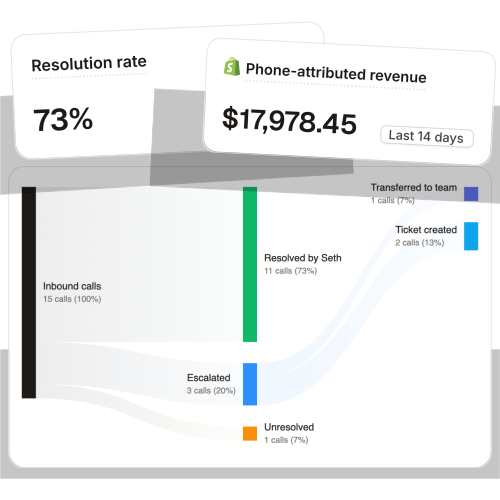
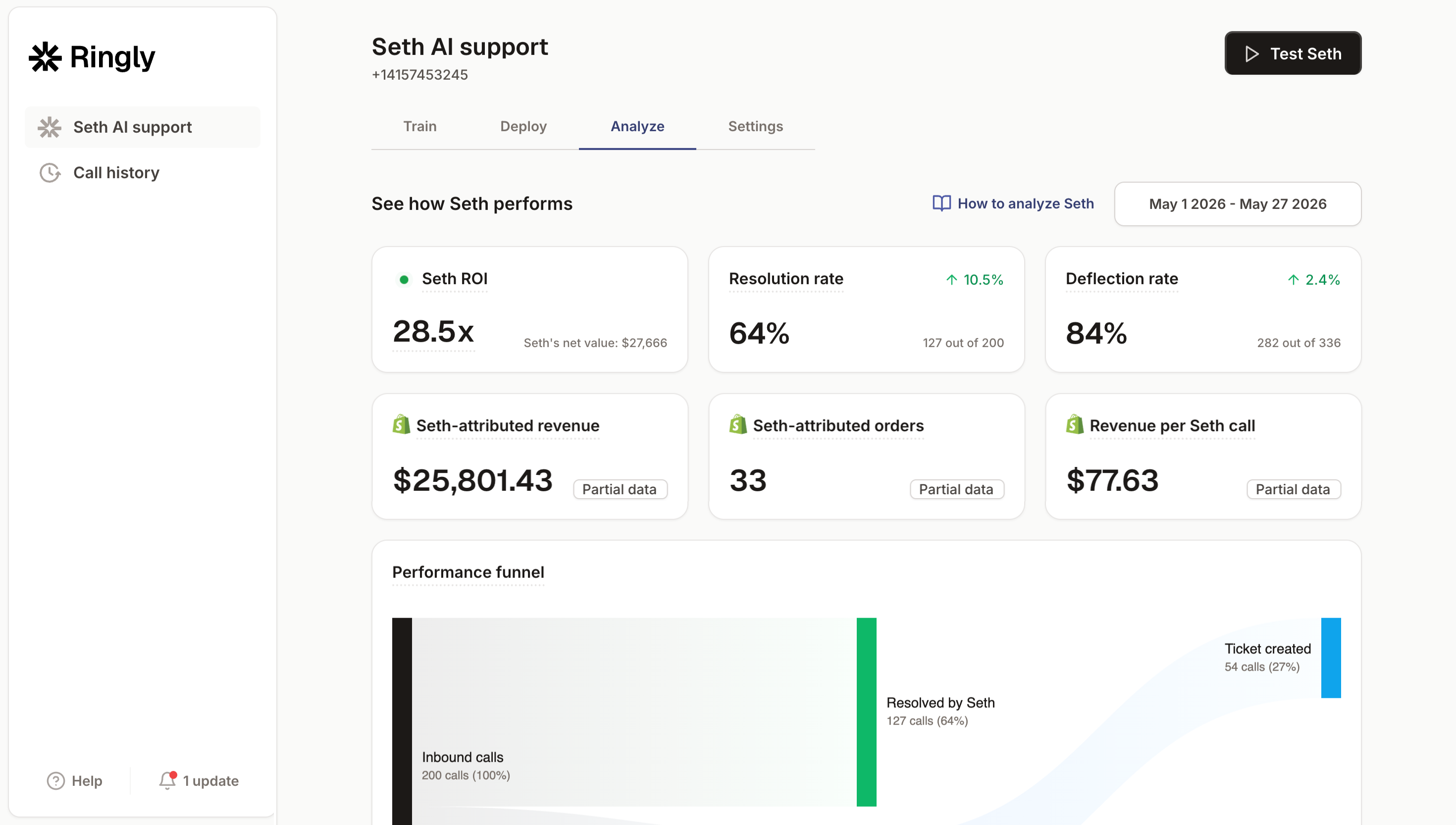
That last one is where most Gorgias brands have the most upside, because it's the part they've never had data on. Ringly.io is AI phone support for Shopify brands. Instead of hiring a phone team or letting calls roll to voicemail, the AI answers inbound calls 24/7: order status, returns, product questions, abandoned-cart rescue. Across 50+ brands it resolves about 73% of calls on its own at roughly $0.42 per resolved call, and the calls that need a human escalate cleanly into Gorgias, so you keep your stack and your workflows. It's the kind of 24/7 ecommerce phone support that the survey-only crowd never measures.
The math is straightforward. Take a $50M Shopify brand running a 6-rep CS team:
| Line item | Today | With Ringly |
|---|---|---|
| 6 reps x $4K loaded per rep | $24,000/mo | n/a |
| Ringly Enterprise (~$5K/mo) | n/a | $5,000/mo |
| Net monthly CS spend | $24,000/mo | $5,000/mo |
| Monthly savings | n/a | $19,000/mo |
| Annual savings | n/a | $228,000/yr |
That's roughly 70% of repeatable calls, the order status and returns and the same questions over and over, routed to the AI. The other 30%, the genuinely hard calls, still go to your CS team, who now have time to actually solve them and earn the five-star.
If you're running a $10M-$100M Shopify brand on Gorgias and your CSAT looks fine but your phone doesn't, book a 30-min call and we'll do the math live on your call volume.
Frequently asked questions
What is a good CSAT score in Gorgias? For ecommerce, the median sits around 82%, with top-quartile brands above 92%. Anything over 75% is solid and 80% and up is strong, so if your Gorgias dashboard reads low 80s you're average for the category.
How does Gorgias send CSAT surveys? After a ticket closes, Gorgias sends a one-question star survey, by default two hours later. It only fires when the thread is over 250 characters, has a real customer-and-agent exchange, the last agent reply is under a week old, and the channel is chat, email, contact form, or help center.
Does Gorgias measure CSAT on AI tickets? Yes. If you run Gorgias AI Agent, its CSAT is reported separately and broken down by contact reason, so you can see which ticket topics the AI should keep handling and which to route to a human.
Why is my Gorgias CSAT response rate low? Email surveys under-respond by nature, and the people who do answer skew to the extremes. A low response rate means your average reflects strong opinions more than your typical customer, so read the distribution and comments alongside it.
Does Gorgias CSAT cover phone calls? No. The survey only covers chat, email, contact form, and help center. Phone support, including missed and after-hours calls, never enters your CSAT report, even though phone is the highest-satisfaction channel at around 76%.
Can I customize when Gorgias sends a CSAT survey? Yes. You can set the delay after a ticket closes, edit the survey message with variables, control which ticket interactions get surveyed, and fire an "exclude from CSAT" action to keep specific tickets out.
How do I improve my CSAT score? Push first contact resolution, since roughly every 1% gain in FCR lifts CSAT by about 1%. Then read your distribution to find repeatable failures, survey your AI tickets, and cover the phone channel so after-hours satisfaction stops leaking out of view.
Talk to us

If you run a $10M-$100M Shopify brand on Gorgias and your phone goes quiet after 6 p.m., a 30-min call is the fastest way to see the CSAT you're not measuring. We'll look at your real ecommerce customer service call volume and what's rolling to voicemail.
The 3-layer guarantee.
- Live in 14 days or it's free until launched.
- 65% resolution in 90 days or we refund the last 3 months of subscription fees.
- We keep working free until we hit 65%.
Ruben (Ringly co-founder) takes these calls personally.