
This post in 30 seconds.
- Open the Gorgias invoice and the number rarely matches the plan page. Double-billing and overage push real monthly cost 40 to 60 percent above list.
- The number a finance lead should actually model is blended cost per resolved ticket, not the headline plan price.
- Written for founders, COOs, and finance-minded operators at $10M to $100M Shopify DTC brands watching the support line item climb.
Search "gorgias cfo" and you mostly get one name: Kunal Agarwal, the Chief Financial Officer at Gorgias, talking about outcome-based AI pricing on a podcast circuit. Interesting if you run a SaaS company. Less useful if you're the one paying the bill. The more useful question is the one your own CFO asks when the Gorgias invoice lands and it's a few thousand dollars over what the pricing page promised: what does this actually cost us, and is it worth it?
That's the version of "gorgias cfo" this post answers. Not a profile of their finance chief. The finance lens on your support line item, with the real numbers a $30M Shopify brand sees once tickets, overages, and AI fees all hit the same invoice.
We run AI phone support for 50+ Shopify brands, which means I read these invoices constantly, from the buyer's side, not the vendor's. If your support cost is creeping past where your board is comfortable and you want a second set of eyes on the math, book a 30-min call and we'll do it live on your real numbers.
What a CFO actually sees on the Gorgias invoice
Gorgias is the most-installed helpdesk on Shopify, and for good reason. It's a solid product. But the pricing model is where finance people start asking questions, because the model is variable by design and variable costs are the ones a CFO can't forecast.
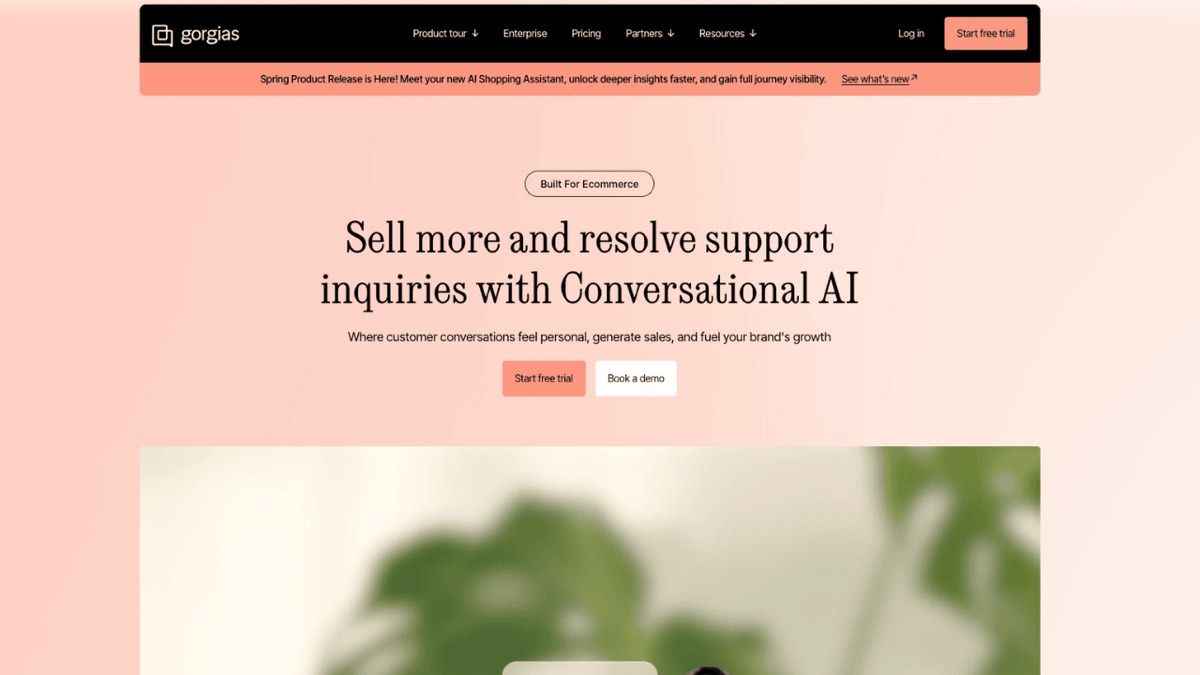
Here's the published plan table:
| Plan | Price/mo | Tickets included | Overage |
|---|---|---|---|
| Starter | $10 | 50 | $0.40/ticket |
| Basic | $50 | 300 | ~$0.40/ticket |
| Pro | $300 (annual) | 2,000 | ~$0.36/ticket |
| Advanced | $750 (annual) | 5,000 | ~$0.36/ticket |
| Enterprise | Custom | Custom | n/a |
Looks affordable. The problem is what the table doesn't show. An AI-resolved conversation gets billed twice: once as the automation fee, and once as a billable helpdesk ticket against your monthly allotment. According to a 2026 Gorgias pricing teardown by Stormy AI, the outcome-based model "essentially double-bills for automated resolutions," at roughly $0.90 to $1.00 per AI resolution on top of the ticket cost. Go past your included AI resolutions and that rate climbs toward $1.50 per interaction.
Stack those and the list price stops meaning much. A brand on the $10 Starter plan that automates 30 tickets sees the bill jump to $52: $10 base, $12 in ticket overages, $30 in AI resolution fees. That's five times the plan price for a quiet month.
It gets sharper at scale. On the Pro plan ($300/mo for 2,000 tickets), a Black Friday spike to 2,800 tickets adds 800 overage tickets, and if 1,500 of those conversations get AI-resolved, the bill lands near $1,038. That's a 246 percent jump over list in the exact month you can least afford a surprise. One Shopify App Store reviewer, cited across multiple 2026 pricing analyses, reported $14,000 in unexpected AI Agent charges on top of a $13,500 annual Advanced subscription.
There's a second-order issue a finance lead catches that an ops lead often doesn't: what counts as a billable ticket. Auto-replies, reopened tickets, and multi-channel conversations can each tick the meter. So the number on the invoice isn't just "how many customers contacted us," it's "how many billable events the system generated," and those two numbers drift apart as volume grows. That drift is precisely the kind of thing that makes a year-over-year support budget impossible to forecast from last year's actuals.
None of this makes Gorgias a bad tool. It makes it an unpredictable line item. And unpredictable is the word that gets a support budget flagged in a board deck.
The number that matters: blended cost per resolved ticket
When a CFO benchmarks support, they don't care about the plan price. They care about cost per resolved ticket, blended across every channel and every rep, because that's the number that scales with the business.
So model that instead. Here's where the channels land in 2026, with sources:
| Channel | Cost per ticket / contact | Source |
|---|---|---|
| Human, retail and ecommerce | $2.70 to $8.00 | Stealth Agents 2026 |
| Human, blended all channels | $13.50 median | Gartner |
| Phone (most expensive channel) | $9.00 to $16.00 | Stealth Agents 2026 |
| Gorgias AI resolution | $0.90 to $1.00 | Stormy AI |
| Ringly AI phone resolution | ~$0.42 to $0.91 | Ringly billing data |
A couple of things jump out. Phone is the single most expensive support channel to staff, at $9 to $16 per contact, which is exactly why it's the channel a finance team should model on its own. And human support overall runs about $3.10 per ticket against roughly $1.00 for an AI resolution, per the same Stormy AI analysis. Stealth Agents' 2026 cost-per-ticket benchmarks put the blended human figure at $13.50, citing Gartner.
The costs I'm quoting on the Ringly side aren't list-price math. We pulled the real monthly billing across 50+ Shopify brands running AI phone support, then set it next to the standard loaded-cost baselines (a US in-house rep runs about $4,000 a month fully loaded, an offshore rep about $2,000). The point of the exercise is simple. Once you're looking at blended cost per resolved ticket, the conversation stops being "which helpdesk is cheapest" and becomes "which volume can I take off the human line entirely." For more of this math by channel, our DTC customer service cost calculator breaks it down per brand size.
The reason blended cost is the right unit is that it survives a volume spike. A per-plan price tells you nothing about what happens at 2x volume; a blended cost per resolved ticket tells you exactly what your next 10,000 tickets cost. That's the difference between a number a CFO can put in a model and a number they have to caveat. And when most of your routine volume sits on the most expensive channel, the model points in one obvious direction.
The phone line item nobody models
Here's the gap in almost every Gorgias cost analysis: they model tickets, but they don't separate out the phone.
That's a mistake, because phone is where the money quietly leaks. It's the most expensive channel to staff. It generates a big share of the "where's my order" volume that turns into Gorgias tickets. And after 6 p.m. it rolls to voicemail, where most callers hang up without leaving a message and a chunk of them go buy from someone else. You're paying for the channel on the way in, and losing revenue on the way out.
These are the same questions over and over: WISMO, returns, "is this in stock," the seasonal spike around a launch. They don't need a human, but they still hit your CS team and your invoice. Our breakdown of WISMO calls shows just how much of inbound is this routine stuff, and our guide to ecommerce phone support covers why the after-hours queue is where the leak lives.
For a finance lead, the phone channel has a second cost that never shows up on the Gorgias invoice at all: the revenue you don't capture when a ready-to-buy caller hits voicemail and goes elsewhere. Most callers routed to voicemail hang up without leaving a message. That's not a support cost, it's a top-line cost, and it's invisible until you measure what happened on the calls you missed. A CFO who only models the ticket bill is modeling half the line item.
WashCo, a Shopify brand we launched, recovered $22,664 in its first 7 days on the phone by answering the routine calls it used to miss. That's the line item nobody models showing up as recovered revenue, not just saved cost. If you're trying to cut the missed-call leak without adding headcount, book a 30-min call and we'll map your phone volume.
What this costs you today vs what it costs with Ringly
Let's put real numbers on it. Take a typical $50M Shopify brand running a 6-rep CS team:
| Line item | Today | With Ringly |
|---|---|---|
| 6 reps × $4K loaded per rep | $24,000/mo | n/a |
| Ringly Enterprise (~$5K/mo) | n/a | $5,000/mo |
| Net monthly CS spend | $24,000/mo | $5,000/mo |
| Monthly savings | n/a | $19,000/mo |
| Annual savings | n/a | $228,000/yr |
That's roughly 70 percent of repeatable calls, the order-status, returns, and product questions, routed to the AI. The other 30 percent, the genuinely complex calls, still go to your CS team, who now have time to actually solve them.
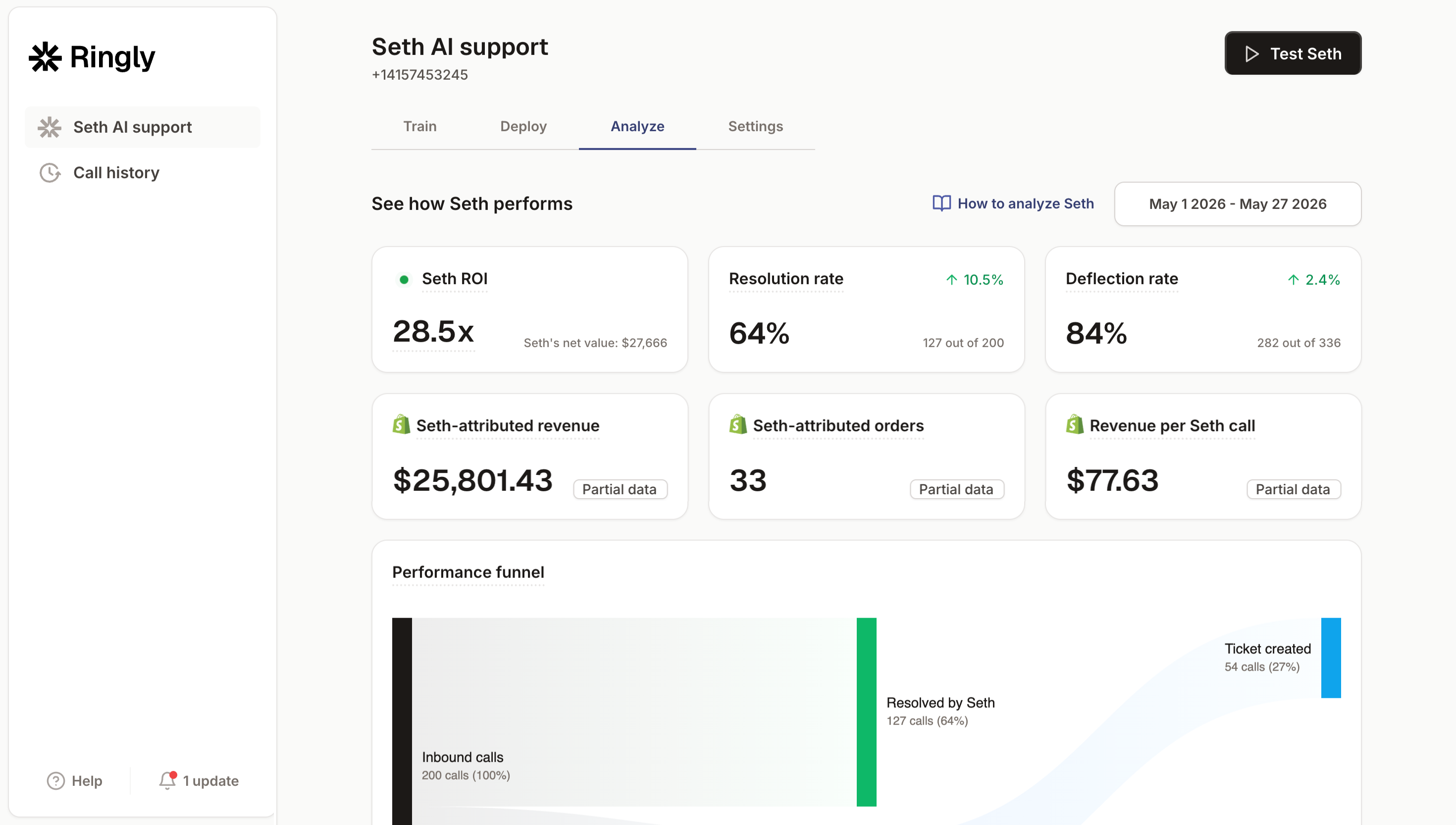
One thing to be clear about: this isn't a Gorgias replacement. Ringly sits in front of Gorgias on the phone channel, takes the routine inbound calls, and escalates the rest cleanly into whatever helpdesk you already run. You keep Gorgias. You just stop paying a human, and a per-ticket fee, for the calls that never needed either. Want the math on your actual numbers? Book a 30-min call and we'll compare it to your current setup live. For the self-serve version of this math, our AI phone agent ROI calculator does it for you.
Where the support line item should actually sit
So what does a finance lead do with all this?
The CFO move isn't to rip out Gorgias and shop for a cheaper helpdesk. It's to shrink the variable, unpredictable part of the bill and put a flat, forecastable number on the most expensive channel. You can't budget a line item that swings 246 percent on a Black Friday spike, but you can budget a flat monthly cost with a resolution guarantee behind it.
Concretely, that looks like this. Keep Gorgias as the helpdesk and the escalation home for email, chat, and the hard calls. Route the routine phone volume to an AI that resolves about 73 percent of inbound calls autonomously across 50+ brands at roughly $0.42 per resolved call. Then de-risk the whole thing with a guarantee your CFO can underwrite: if the AI resolves under 65 percent of your calls in 90 days, you get the last three months of fees back.
That last part matters more than it sounds. A finance person doesn't want a promise, they want a number they can hold someone to. If you've been burned by a vendor that overpromised on automation, that's the whole point of the guarantee. It moves the risk of the AI underperforming off your P&L and onto ours.
Run the comparison on your own numbers and it usually nets out the same way. The Gorgias line stays roughly flat, because it's now doing what helpdesks do well: email, chat, escalations, and a record of every conversation. The expensive, variable, after-hours phone volume comes off the human line and lands on a flat AI line that's cheaper per resolution and guaranteed. The support budget stops being a thing you defend every quarter and becomes a thing you can actually forecast.
"My customers also feel like it's a normal person. They feel like they can communicate if they have questions."
Claudia Droge, TechCraft Studio
If you're comparing your current setup, our Gorgias pricing breakdown covers what each plan actually costs, our Gorgias alternatives guide covers the field, and our piece on reducing Shopify support cost goes deeper on the in-house-vs-automate decision. For the staffing side, see in-house vs outsourced support for Shopify and how to scale customer service without hiring.
Frequently asked questions
Does Ringly replace Gorgias? No. Ringly sits in front of Gorgias on the phone channel and handles routine inbound calls, then escalates the rest into Gorgias or whatever helpdesk you already run. You keep your stack, your number, and your workflows.
Why is my Gorgias bill higher than the plan price? Two reasons: ticket overages once you pass your monthly limit ($0.36 to $0.40 each), and AI resolutions billed separately at $0.90 to $1.00 on top of the ticket. Teardowns put real monthly cost 40 to 60 percent above the list price for many brands.
How much does Gorgias AI cost per resolution? Roughly $0.90 to $1.00 per AI-resolved conversation, and that conversation also counts as a billable helpdesk ticket. Go past your included AI resolutions and the rate can climb toward $1.50 per interaction.
What's a realistic cost per resolved ticket for a DTC brand? Human retail and ecommerce support runs $2.70 to $8.00 per ticket, with phone the priciest channel at $9 to $16 per contact. AI resolutions land near $0.90 to $1.00, and Ringly's phone resolutions run about $0.42 to $0.91 across our customer base.
Who is the CFO of Gorgias? Kunal Agarwal is the Chief Financial Officer at Gorgias, and he's spoken publicly about outcome-based AI pricing. The more useful exercise for a buyer is applying your own CFO's lens to the invoice: blended cost per resolved ticket, not the headline plan price.
How much does Ringly cost? Grow is $349/mo and Pro is $799/mo, with Enterprise set on a call for $10M to $100M brands. Every plan carries the 65 percent resolution guarantee. See the full pricing page for details.
Will the AI sound like a bot to my customers? The most repeated thing customers say after a call is "you don't sound like AI." It answers in a natural voice, finds orders in your Shopify store, and escalates cleanly when a call needs a human.
Talk to us

If you run a $10M to $100M Shopify brand and the support line item is climbing faster than revenue, a 30-min call is the fastest way to see the real cost per resolved ticket and where the phone channel is leaking.
The 3-layer guarantee.
- Live in 14 days or it's free until launched.
- 65% resolution in 90 days or we refund the last 3 months of subscription fees.
- We keep working free until we hit 65%.
Ruben (Ringly co-founder) takes these calls personally.