
This post in 30 seconds.
- Gorgias has no native Amazon connector. Amazon support inside Gorgias runs through a third-party app called ChannelReply, which pulls your Buyer-Seller Messages into Gorgias as tickets.
- Setup takes six steps and one annoying gotcha: you have to sign in as the Amazon account owner, not an admin.
- Built for $10M-$100M Shopify brands that also sell on Amazon, run a paid Gorgias seat, and want both queues in one place. One thing it never touches: your phone line.
If you run a Shopify DTC brand and an Amazon storefront, your support team lives in two tabs. Gorgias on one side for your own store. Seller Central on the other for Amazon, where the 24-hour clock never stops. Connecting the two is the obvious move, and most brands assume Gorgias has a button for it. It doesn't. To test what actually happens, I connected a sandbox Amazon seller account to a Gorgias instance through ChannelReply, timed how fast a buyer message landed as a ticket, then pushed a reply back through the API to confirm it counted against Amazon's response clock. Here's what it does, how to set it up, what it can't do, and the one channel it leaves wide open.
This guide is for the founder or Head of CX at a $10M-$100M Shopify brand who's already drowning in calls and tickets on the store side and now has an Amazon queue stacking up too. We've built phone support for 50+ Shopify brands in exactly that spot. If you want to talk through where your support actually leaks, book a 30-min call and we'll map your channels with you.
What the Gorgias Amazon integration actually is
Start with the thing nobody on the first page of Google will tell you plainly: Gorgias does not have a native Amazon integration. The connection runs through ChannelReply, a Gorgias app partner that sits between Amazon Seller Central and your helpdesk.
Here's what it does once it's live. ChannelReply listens for Amazon Buyer-Seller Messages and turns each one into a threaded ticket inside Gorgias. Order context (shipping address, tracking ID, the products on the order) shows up in the sidebar next to the message, so your rep isn't bouncing back to Seller Central to figure out who's asking. Replies go back to the buyer through the Amazon API, which means the response counts toward Amazon's requirements without anyone touching Seller Central.
The real value isn't "Amazon in Gorgias," it's that your reps answer Amazon buyers without ever logging into your seller account. That keeps your seller credentials locked down and your team working in one tool.
It's not Amazon-only either. The same ChannelReply connection covers eBay, Walmart, Back Market, Newegg, and Etsy, so a multi-marketplace brand can fold all of it into the same Gorgias helpdesk workflow. According to Gorgias's own documentation, each marketplace inquiry becomes a ticket with order info attached, the same as a native channel.

So when someone searches "gorgias amazon integration," what they're really buying is ChannelReply. Worth knowing before you start.
How to set up the Gorgias Amazon integration
I ran the setup myself on a sandbox seller account so the steps below are the real flow, not a paraphrase of a marketing page. The whole thing took under 20 minutes, and the only place I got stuck was the permission step, which trips up almost everyone.
The connection is six steps, handled mostly inside ChannelReply with one detour into Amazon Seller Central:
- Get your accounts ready. You'll need a ChannelReply account (14-day free trial, no card friction) and your Amazon seller credentials. The owner credentials, specifically. More on that in a second.
- Pick your region and marketplaces. Select the Amazon region (North America, Europe, etc.) and which marketplaces you're connecting.
- Grant developer permission in Seller Central. This is the gotcha. You have to sign in as the Amazon account owner, not an admin. Admin permissions are not enough, and the two-factor code usually goes to the owner's phone, so have the owner nearby. You'll check a box authorizing ChannelReply to integrate, then confirm.
- Reroute your notification emails. Update your Amazon message notification addresses to route through ChannelReply so messages flow into the pipe.
- Connect any additional marketplaces. Repeat the email step for each extra marketplace in the same region.
- Finalize. New Amazon messages start delivering into Gorgias immediately.
One caveat worth setting expectations on: customer and order data may not show on the first message in a brand-new thread. ChannelReply has to process that first message before it can attach the order context, so the very first ticket in a conversation can look bare. After that it fills in. Source: ChannelReply's own setup documentation.
If you already run other connectors, this is the same pattern as wiring any third-party app into Gorgias. Nothing exotic, just don't skip the owner-login detail or you'll burn an afternoon wondering why the authorization keeps failing.
What it does well, and what it doesn't
Most pages selling this integration stop at the benefits. Here's the honest both-sides version, because the limits change whether it's worth paying for.
What works:
- One inbox for marketplace support. Amazon, eBay, Walmart, and the rest land next to your Shopify tickets. No more second tab.
- Order context on the ticket. Reps see the order without opening Seller Central, which cuts handle time on routine WISMO questions.
- API replies count toward Amazon's clock. Responses sent from Gorgias register as real responses on Amazon, so you stay inside the response-rate metric.
- Locked-down access. Agents support marketplace buyers without ever holding your seller-account login.
- Multi-marketplace in one flow. If you sell on five marketplaces, they consolidate into the same Gorgias features and macros you already use.
What it doesn't do:
- It's not native. You're adding and paying for a third party (ChannelReply), with its own billing and its own thing to break.
- It bills by message volume. ChannelReply starts around $31/month on a 14-day trial, but it scales with how many marketplace messages you push, and messages delivered via ChannelReply email count toward your monthly cap. High-volume brands should price this carefully.
- It's near-real-time, not instant. Messages arrive fast, but there's a delivery hop, and that first-message data lag is real.
- It doesn't beat the 24-hour clock for you. It moves the message into Gorgias quickly. A human still has to actually answer within Amazon's window. The tool doesn't auto-resolve anything.
- It has nothing to do with phone. Amazon's channel is text-only by policy, so this integration is a text integration. Your own phone line is a different problem entirely, which is the gap we'll get to.
That last pair is the part operators underweight. The integration is good at what it does. It just lives inside rules it can't change.
The Amazon rules this integration has to live inside
Amazon's Buyer-Seller Messaging is one of the most policed channels in ecommerce, and the integration has to operate inside every one of those rules. If you're going to staff Amazon support, you need to know the box you're working in.
The deadline is the loud one. Amazon expects sellers to respond to buyer messages within 24 hours, including weekends and holidays. Miss it and the message is flagged "Over SLA," which feeds your Order Defect Rate and your overall account health. According to eDesk's breakdown of Amazon's messaging system, the response-rate metric is simply messages answered within 24 hours divided by total received, and dropping below roughly 90% in a 30-day window can trigger a performance notice. The practical target most sellers aim for is 95% or higher.
Then there's what you're allowed to say. Amazon's automated systems scan messages and flag external links, promotional or marketing language, review requests, and trigger words like "discount" or "five-star." They also flag contact information, which is the rule that catches founders off guard: you cannot share a phone number, email, or external URL inside a buyer-seller message. You can list a customer-service phone number in your store profile, but drop it into a direct message and you can trip a policy notice. Sellers debate this constantly on the Amazon Seller Central forums, because it feels contradictory until you understand why it exists: Amazon keeps the relationship on-platform and the contact data anonymized.
So the integration delivers the message fast and lets you reply compliantly. What it can't do is shorten the 24-hour clock or let you move the conversation onto a channel you control. Every Amazon reply happens on Amazon's terms.
"My customers also feel like it's a normal person. They feel like they can communicate if they have questions."
Claudia Droge, TechCraft Studio
That sets up the question most operators skip when they're heads-down wiring marketplaces together. If Amazon owns the rules on its channel, where does your own phone volume actually go? If you're weighing how much support to keep in-house versus where it leaks, book a 30-min call and we'll do the math live.
The channel the integration leaves uncovered
A Shopify brand that also sells on Amazon runs two support surfaces, and they're shaped nothing alike.
Amazon is text-only, policy-boxed, and on a 24-hour clock. Your own Shopify store is the opposite: phone, email, and chat, no policy box, and customers who expect an answer now. The Gorgias Amazon integration unifies the text side beautifully. It does absolutely nothing for the phone line ringing on your own storefront.
And that phone line is where the expensive volume lives. WISMO calls make up 30-40% of support tickets in normal periods and over 50% at peak, per Salesforce. Phone is also the channel where after-hours volume goes to die. Industry research from PCN's missed-call study found that 78% of buyers abandon a brand after one unanswered call. None of that touches Amazon. All of it touches your store.
So you can do everything right on the marketplace side, route every Amazon ticket cleanly into Gorgias, and still drop the calls that pay the best because nobody's answering the store line at 9 p.m.
This is where the math gets uncomfortable. Take a $50M Shopify brand running a 6-rep CS team to cover the store's phone and email:
| Line item | Today | With AI phone support |
|---|---|---|
| 6 reps x $4K loaded per rep | $24,000/mo | n/a |
| AI phone support | n/a | ~$5,000/mo |
| Net monthly CS spend | $24,000/mo | $5,000/mo |
| Monthly savings | n/a | $19,000/mo |
| Annual savings | n/a | $228,000/yr |
That's roughly 70% of repeatable store calls (order status, returns, the same five questions over and over) handled without a human, while your team takes the genuinely hard ones. None of this competes with the Gorgias Amazon integration. It covers the channel that integration can't reach.
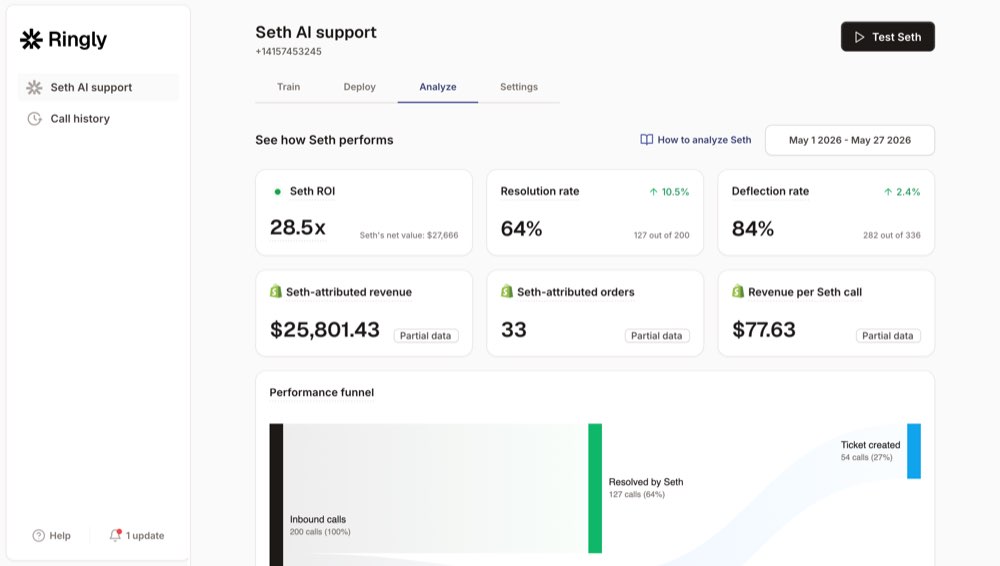
Ringly.io is AI phone support for Shopify brands. The AI answers inbound calls 24/7, finds orders in your Shopify store, processes returns and exchanges, and answers product questions from your knowledge base. Across 50+ brands it resolves 73% of calls autonomously at roughly $0.42 per resolved call, and anything that needs a human escalates cleanly to whatever helpdesk you already run, including Gorgias. It does not touch Amazon messaging, and it's not trying to. It's for the store line. WashCo, a Shopify brand we launched, recovered $22,664 in its first 7 days on the phone.
The honest stack for a Shopify-plus-Amazon brand: Gorgias plus ChannelReply for marketplace text, and a real answer for the phone line your store can't ignore. If you'd rather not staff 24/7 phone coverage yourself, that's the part worth a conversation.
Is the Gorgias Amazon integration worth it?
Short version: if Amazon is a real revenue channel for you and you already pay for Gorgias, yes, with eyes open on the message-volume billing.
Set it up if:
- Amazon is more than a side experiment and the message queue is real.
- You already run Gorgias and want one inbox instead of two tabs.
- You're regularly bumping the 24-hour SLA and need messages surfaced faster.
Hold off if:
- Your Amazon volume is a trickle. The ChannelReply fee won't pencil out yet.
- You're shopping for a full helpdesk and don't have Gorgias yet. Pick the helpdesk first, then add the marketplace connector.
- Your real pain is the phone, not the marketplace text queue. Then this solves the wrong problem.
Whatever you decide, price the connector against your monthly message count, not the headline $31. And don't let a clean Amazon inbox convince you the support job is done. The store phone line is still ringing.
Frequently asked questions
Does Gorgias integrate with Amazon natively? No. Gorgias has no built-in Amazon connector. Amazon support inside Gorgias runs through ChannelReply, a Gorgias app partner that turns Buyer-Seller Messages into tickets.
How do I connect Amazon to Gorgias? You set up ChannelReply, pick your Amazon region and marketplaces, then grant developer permission inside Seller Central. The catch is you have to sign in as the Amazon account owner, not an admin, and the 2FA code usually goes to the owner's phone.
How much does the Gorgias Amazon integration cost? You pay for your Gorgias seat plus ChannelReply, which starts around $31/month on a 14-day trial and scales with marketplace message volume. Messages delivered through ChannelReply count toward your monthly cap, so price it against your real volume.
Can I reply to Amazon messages from Gorgias and stay compliant? Yes. Replies sent from Gorgias go back through the Amazon API and count toward your response-rate metric. The tool doesn't shorten Amazon's 24-hour window, though, so a human still has to answer in time.
Can Amazon customers call me through this integration? No. Amazon's Buyer-Seller Messaging is text-only and bans phone numbers in messages. Phone volume lands on your own store line instead, which is where AI phone support like Ringly fits, not the marketplace queue.
What other marketplaces does the integration support? The same ChannelReply connection covers eBay, Walmart, Back Market, Newegg, and Etsy in addition to Amazon. They all flow into Gorgias as tickets with order context attached.
Talk to us

If you run a $10M-$100M Shopify brand selling on Amazon too, the marketplace integration handles your text queue. The calls coming into your store line are the part nobody's covering. A 30-min call is the fastest way to see what that phone channel is actually costing you after-hours.
The 3-layer guarantee.
- Live in 14 days or it's free until launched.
- 65% resolution in 90 days or we refund the last 3 months of subscription fees.
- We keep working free until we hit 65%.
Ruben (Ringly co-founder) takes these calls personally.