

The short version.
- Gorgias AI customer insights surface your automation rate, the intent topics your AI handles, revenue influenced by conversations, and CSAT on AI-handled tickets.
- They tell you what happened on your digital tickets, not always why, and they barely instrument the phone.
- Written for the founder, COO, or Head of CX at a $10M-$100M Shopify brand running Gorgias plus a visible phone line.
You open the Statistics tab on a Monday because the founder asked, again, what your resolution rate is trending toward. Gorgias hands you a wall of numbers: automation rate, intent breakdowns, CSAT on the tickets the AI closed. It is genuinely useful. It also quietly leaves out a chunk of your customers, the ones who picked up the phone instead of opening a ticket.
If you run customer experience at a $10M-$100M Shopify brand, the gap between what your dashboard shows and what your customers actually did is where decisions go wrong. Most $30M+ brands we work with are drowning in calls their helpdesk never sees, and the insight layer they trust has a hole in it. We have launched AI phone support for 50+ Shopify brands trying to close that hole, and the first thing we do is read their existing Gorgias data. Book a 30-min call and we will map what your insights are missing.
What Gorgias AI customer insights actually surface
Gorgias renamed its reporting "Statistics," and the AI-specific views sit alongside the standard support KPIs. The four insights that matter most are automation rate, AI intent, revenue influence, and CSAT on AI-handled tickets. Here is what each one is telling you.
Automation rate by feature. This is the headline AI number: the share of questions resolved without a human touching them, broken out by Flows, Order Management, and the AI Agent. Gorgias pairs it with estimated savings and time recovered, so you can put a dollar figure next to the deflection.
AI intent categorization. Every interaction gets tagged by intent: order status, refunds, product questions, and the rest. Read across a month, this is the closest thing to a topic map of why customers contact you. It is also the input you use to decide what to document next.
Revenue influence. Gorgias now ties conversations to purchases. In its 2026 trends report, the company found that nearly 10 million of 350 million analyzed conversations led to a sale, and 79% of brands said conversational commerce lifted revenue (Gorgias State of Conversational Commerce 2026). The same report puts AI at 31% of all interactions today, on the way to 47% within two years.
Support KPIs, segmented by AI vs human. First response time, resolution time, ticket volume, one-touch rate, and CSAT all split by whether the AI or a rep handled the ticket. The agent performance report drills into per-rep numbers when you need to coach, with tickets closed per rep, individual CSAT, and personal response times all in one view.
There is also a softer signal buried in the automation overview: time recovered. Gorgias estimates the rep-hours the AI gave back, which is the number your CFO actually wants when the headcount question comes up. It is a rough estimate, not a stopwatch, but read month over month it tells you whether the AI is scaling with your volume or stalling.
You also get live statistics for real-time volume and custom dashboards built from 70-plus metrics. The custom report builder is still limited, with deeper building flagged for 2026, so for now you work inside predefined templates. Some reports also run on a delay of up to 72 hours, which matters if you are trying to react to a launch-day spike in real time. None of that is the real problem, though. The problem is what the insights do once you are staring at them.
How to read each insight (the do-this playbook)
Numbers without a next move are wallpaper. The complaint we hear most about Gorgias analytics is that they feel too technical, that you can see the metric but not action it. Every AI insight points at a specific operational fix if you know how to read it. Here is the translation.
| The insight | What it's telling you | The move |
|---|---|---|
| Automation rate flat or low | The AI is hitting questions it can't answer | Find the failing intents and add macros, articles, or a knowledge base entry for each |
| Top AI intent is "order status" | WISMO is eating your queue | Fix your post-purchase tracking comms and tighten the order-status flow (see our take on WISMO calls) |
| Revenue influence low | The AI isn't surfacing product answers pre-purchase | Enrich the product KB so the AI can recommend, not just deflect |
| CSAT dips on AI tickets | The AI is over-reaching on calls it should hand off | Tighten escalation rules so the hard ones route to a human faster |
The reason this matters: Gorgias is strong at telling you what happened and weaker at telling you why. It does not connect data across your tools, it cannot simulate what the AI would have done on last quarter's tickets, and it will not hand you a ranked list of knowledge gaps. That diagnostic work is on you, which is fine once you have the playbook above. For a deeper read on which reporting numbers to trust, our Gorgias reporting guide goes line by line, and the Gorgias insights breakdown covers the customer-data side.
Where Gorgias 2026 data says your customers are heading
The reason the insight layer is worth obsessing over is that conversations are turning into the checkout. Gorgias analyzed 350 million conversations across 16,000-plus brands for its 2026 report, and the behavioral shifts are sharp.
93% of AI-driven purchases happen within 48 hours of first contact, and 80% of AI-recommended purchases close the same day. That compresses the window in which your support data is also sales data. Returning customers convert at 46% versus 25% for first-timers, which means the intent tags on your repeat callers are some of the highest-value signals you own.
So when you read your own AI customer insights, you are not just auditing support. You are watching demand form in real time. The catch is that this only works for the conversations your tools can see. A growing share of buying behavior happens on channels that get analyzed least, and for most brands that channel is voice. Industry research found that companies examine fewer than 2% of their calls (CustomerThink). Your phone line is generating insights nobody is reading.
Three ways operators misread these insights
Before you act on anything in the Statistics tab, it helps to know where the data lies by omission. The most common mistake is treating automation rate as a quality score when it is really a coverage score. A 70% automation rate looks great until you notice CSAT on those tickets is sliding, which means the AI is closing conversations the customer did not consider resolved. Read the two numbers together, never apart.
The second mistake is reading intent tags as a complete topic map. They only map the topics that reached a digital ticket. If your older, higher-AOV customers prefer the phone, the entire shape of your demand is skewed by which channel your insights can see. We have watched brands chase a "refunds problem" in their Gorgias data while the real volume driver was a pre-purchase sizing question that only ever came in by phone.
The third is trusting revenue influence as a full picture of conversational commerce. It captures the purchases that happened inside a tracked conversation, not the sale you lost when a caller hit voicemail at 7 p.m. and bought from a competitor instead. The revenue your insights show is real. The revenue they cannot show is the expensive part.
The blind spot: your phone calls aren't in the insight layer
Here is the uncomfortable part. Gorgias AI customer insights are scoped to digital tickets. Even with the Voice add-on, the reporting still does not surface call abandonment rate, so you cannot see how many callers hung up before anyone answered. The most expensive support moment in ecommerce, the missed call, is the one your dashboard is silent on.
The numbers around that silence are brutal. Businesses answer only about 37.8% of inbound calls (AmbsCallCenter), and 85% of callers who can't reach a person never call back, with 62% switching to a competitor (PCN). None of those people open a ticket. They never enter your insight layer at all. As far as your reporting is concerned, they were never customers.
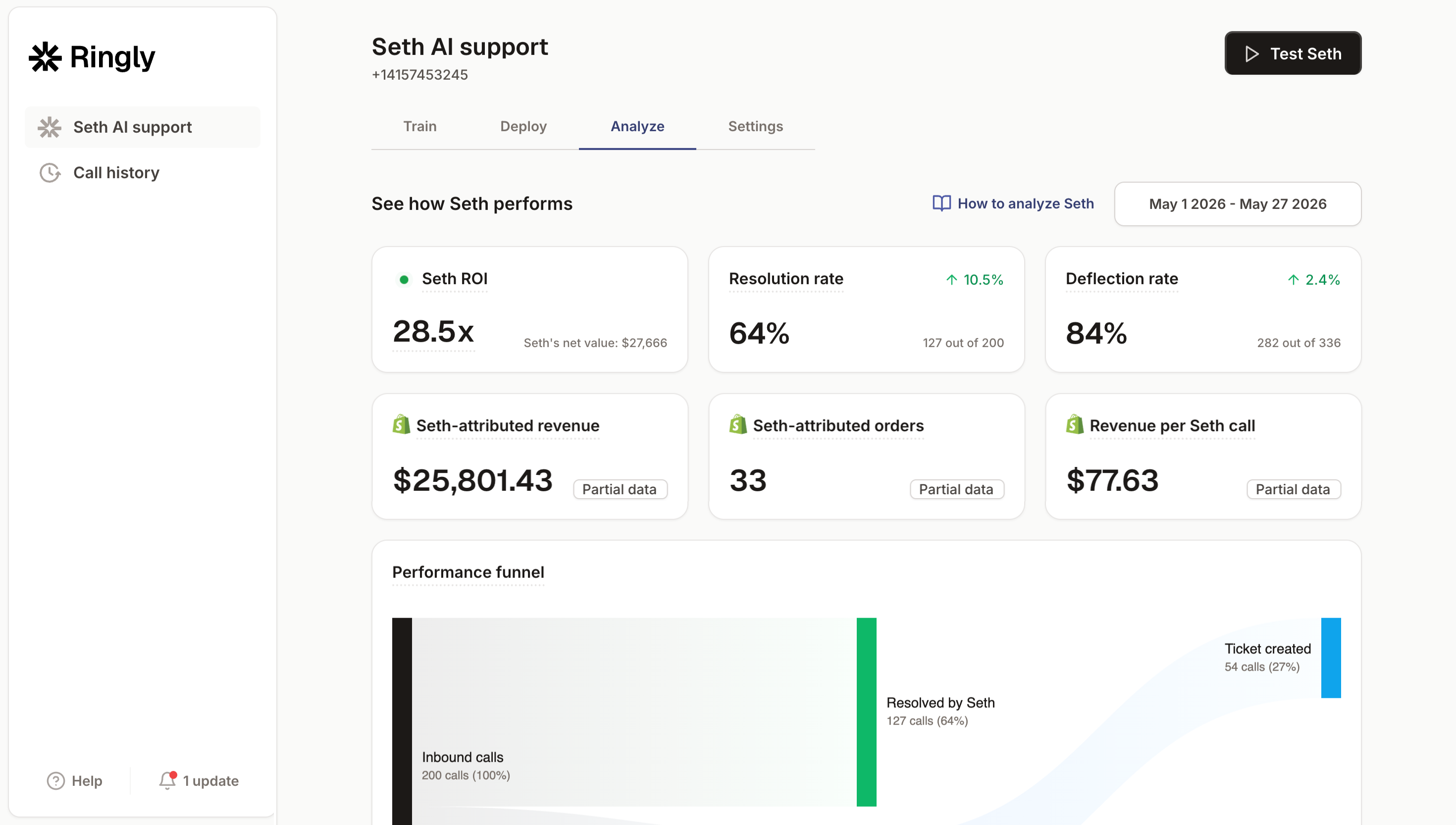
We see this from the other side. When we read the AI intent tags on phone calls across the 50+ Shopify brands on Ringly, the most common topics by voice often barely register in those same brands' Gorgias dashboards, because the questions came in by phone and stopped there. After-hours order checks, sizing questions before a purchase, the same five things over and over, all invisible to a helpdesk that only counts tickets. The insight you are missing isn't a metric, it's an entire channel of customer intent. WashCo, a Shopify brand we launched, recovered $22,664 in its first 7 days once those calls finally got answered and logged.
How to get phone calls into your customer insights
You do not fix a blind spot by squinting harder at the same dashboard. You instrument the channel that is dark. That is the whole job of an AI phone agent: answer the calls, then turn each one into structured data the rest of your stack can read.
Ringly.io: AI phone support for Shopify brands
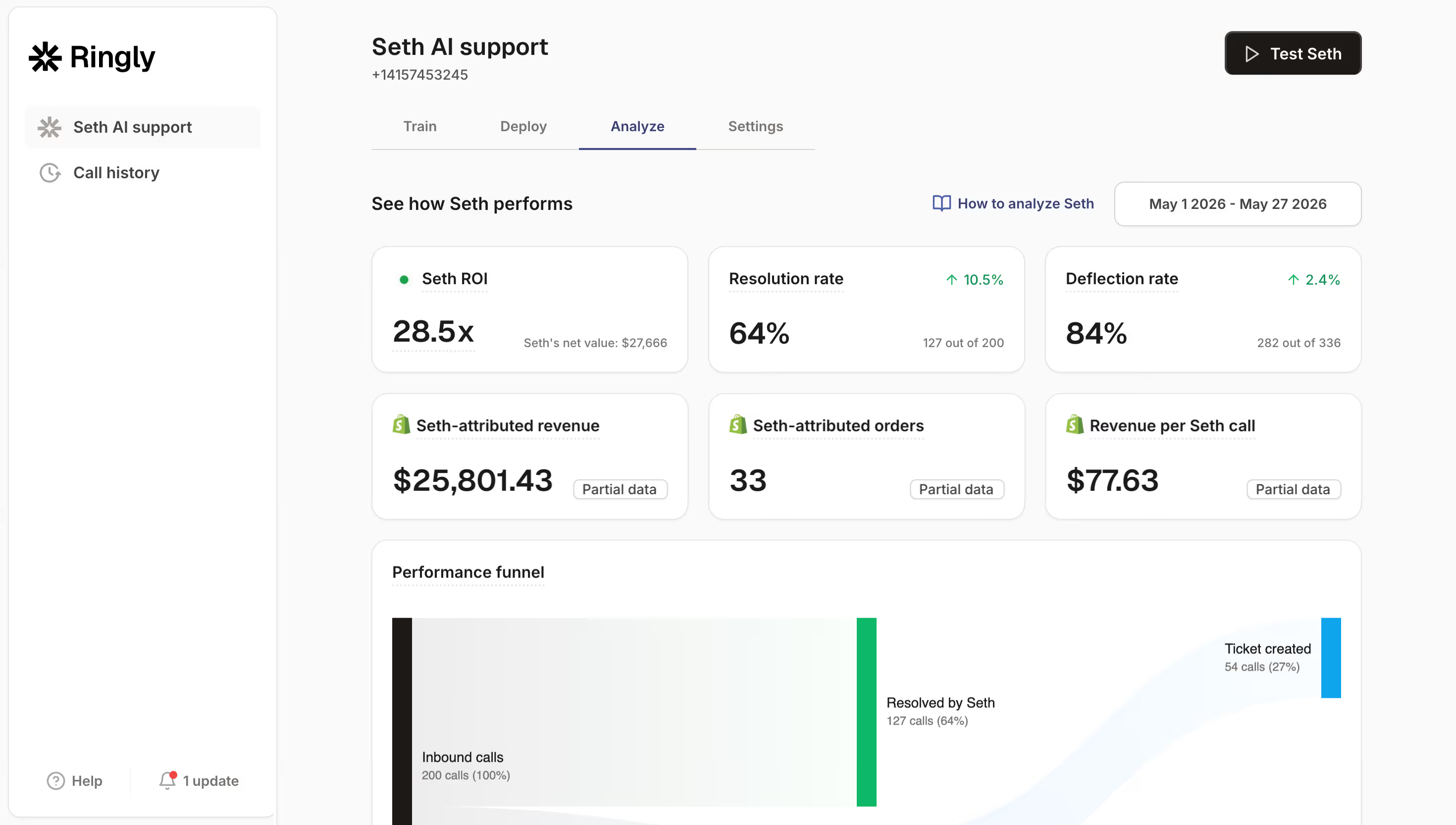
Ringly.io is AI phone support for Shopify brands. Your team wasn't hired to answer the same call 50 times a day, and your insight layer wasn't built to ignore the phone. The AI answers inbound calls 24/7, finds orders in your Shopify store, processes returns, and answers product questions from your knowledge base. Then it tags every call with intent, resolution, escalation reason, and attributed revenue, so the phone channel finally shows up next to your Gorgias numbers instead of vanishing.
It is not a Gorgias replacement. Calls that need a human escalate cleanly into Gorgias, Richpanel, Reamaze, or whatever helpdesk you already run, so the ticket trail stays unified. Across 50+ brands, the AI resolves 73% of calls autonomously at roughly $0.42 per resolved call, with full call analysis and a smart transfer rule set you control.
Pricing: Grow is $349/mo (1,000 minutes), Pro is $799/mo (2,500 minutes), and Enterprise is custom for $10M-$100M brands. There is a 65% resolution guarantee: if the AI resolves under 65% of your calls in 90 days, we refund the last 3 months.
What this costs you today vs what it costs with Ringly
Take a typical $50M Shopify brand running a 6-rep CS team:
| Line item | Today | With Ringly |
|---|---|---|
| 6 reps × $4K loaded per rep | $24,000/mo | n/a |
| Ringly Enterprise (~$5K/mo) | n/a | $5,000/mo |
| Net monthly CS spend | $24,000/mo | $5,000/mo |
| Monthly savings | n/a | $19,000/mo |
| Annual savings | n/a | $228,000/yr |
That is roughly 70% of repeatable calls (order status, returns, product questions, the same things over and over) routed to the AI and logged. The other 30%, the genuinely complex calls, still go to your team, who now have the time to actually solve them. If you want to see the math on your own call volume, book a 30-min call and we will run it live.
"My customers also feel like it's a normal person. They feel like they can communicate if they have questions."
Claudia Droge, TechCraft Studio
The point is not more dashboards. It is one complete picture. When phone intent sits next to your Gorgias AI agent data, the read-this-do-this playbook above finally covers every channel your customers use, not just the ones that happen to file tickets. For the broader context, our guide to ecommerce customer service and the 2026 support statistics lay out where the volume is going. If you are still weighing the platform itself, our roundup of Gorgias alternatives covers the field.
Frequently asked questions
Does Gorgias show AI customer insights on the base plan? The standard Statistics reports come with every plan, including FRT, resolution time, CSAT, and ticket volume. The richer AI agent reports populate once you are using Gorgias's AI features, which carry a per-resolution cost on top of your base plan.
What's the difference between Gorgias analytics and AI agent insights? Analytics is the whole Statistics suite covering human and AI work. AI agent insights are the slice that measures automation specifically: automation rate by feature, AI intent tags, and the estimated savings the AI generated.
Why doesn't Gorgias tell me why a metric changed? Native reporting is built to show what happened, not diagnose root cause. It does not connect data across your other tools or rank your knowledge gaps, so the "why" is analysis you run yourself using the intent tags as your starting point.
Does Gorgias track phone call insights? Only partially. The Voice add-on handles calls, but the reporting still omits key voice metrics like call abandonment rate, so the phone channel is largely missing from your AI customer insights.
Can I combine Gorgias insights with phone call data? Yes. An AI phone agent like Ringly tags every call with intent, resolution, and attributed revenue, then escalates into Gorgias, so phone insight lives alongside your ticket data instead of in a separate silo.
How accurate is the AI intent categorization? It is reliable for high-volume, well-defined intents like order status and refunds, and looser on ambiguous or multi-topic conversations. Treat it as a strong directional signal for what to document next, not a precise audit.
Talk to us

If you run a $10M-$100M Shopify brand on Gorgias and your phone line is a data black hole, a 30-min call is the fastest way to see what you're missing. We will read your existing insights with you and show you the channel they leave out.
The 3-layer guarantee.
- Live in 14 days or it's free until launched.
- 65% resolution in 90 days or we refund the last 3 months of subscription fees.
- We keep working free until we hit 65%.
Ruben (Ringly co-founder) takes these calls personally.