

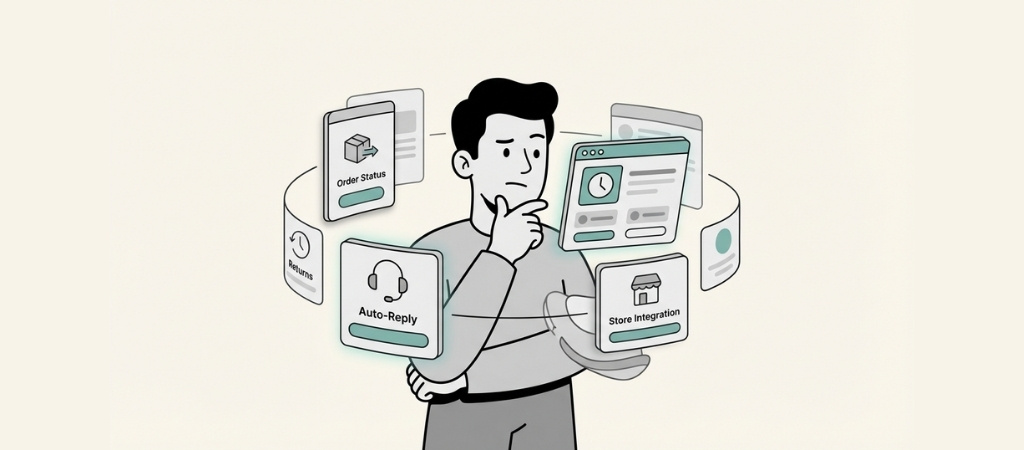
70% of eCommerce founders are burning cash on support teams that spend all day answering the same three questions.
You are likely paying a high-tier team to act as human calculators for "Where is my order?" requests.
It feels like you’re stuck choosing between expensive headcount or generic phone systems that don't actually talk to your Shopify store.
It gets worse.
This guide will go over the best GetVoIP alternatives for eCommerce.
First, we will look at why standard VoIP tools fail online brands. Then, we will compare the top automated alternatives for 2026.
Editor’s note: Want to hear some sample support calls made for your Shopify store?
- Just paste your store URL
- Get sample calls in under 20 seconds (no email required)
- Listen to demo calls for my store
What is GetVoIP and why look for a getvoip ecommerce alternative?
First, let's clarify what GetVoIP is. It isn't a phone service provider itself; it's a comparison website.
Founded in 2012, the site is a research hub that reviews and compares different VoIP (Voice over Internet Protocol) and contact center services.
It’s helpful to understand their business model. GetVoIP is an advertising-supported publisher, which means they get paid by the vendors they feature.
This model encourages them to list a wide variety of general-purpose options, which can be suitable for a large corporation but may lead e-commerce entrepreneurs to solutions that don't precisely fit their needs.
Challenges of general VoIP solutions for e-commerce
Directories like GetVoIP mostly feature what’s known as Unified Communications as a Service (UCaaS) platforms.
Think of them as all-in-one communication hubs that bundle voice, video, and team messaging for office environments.
An online store’s phone support needs are often different.
The focus is typically on questions about orders, returns, and products. This is where general-purpose VoIP systems may not be an ideal fit.
Here are some reasons why they may present challenges for an online store:
- Lack of deep e-commerce integration: Many of these platforms cannot directly look up an order in Shopify. This is a significant limitation, as it means a human agent still has to be available to answer the most basic, repetitive questions. To make them communicate with your store, you often need additional integrations with tools like Relay.app or Albato, which can add cost and complexity.
- Built for human agents: These systems are designed to make call routing more efficient so that your team can answer calls faster. They don’t always address the goal of reducing the number of calls your team has to take in the first place.
- Complex or unnecessary features: Many of these platforms come loaded with features you may not use, like webinar software or advanced team collaboration tools. You may end up paying for a system with features that are not relevant to your primary need of handling customer queries efficiently.
Key features for an e-commerce phone solution
If a generic VoIP system isn't the right fit, what are the alternatives?
When you're looking for a phone solution for your store, here's a checklist of what can be important. This infographic breaks down the essential features:

Deep Shopify integration
Your phone system needs to connect directly to your Shopify backend.
Without it, automating tasks becomes more difficult. It should be able to access real-time order status, shipping details, and customer information to give accurate answers instantly.
AI-powered autonomous resolution
The goal is automation. Your system could use AI to understand and resolve common customer questions without human help.
This means handling "Where Is My Order?" (WISMO) queries, starting a return process, or pulling answers from your FAQ page, all on its own.
24/7 availability
Your customers shop at all hours, so their questions don't stick to a 9-to-5 schedule.
A modern phone solution has to be on, 24/7, ready to help customers and potentially save a sale, no matter the time.
Effortless, no-code setup
As a store owner, you may not have time for complicated software. A phone support system should be easy to get up and running in minutes, not days.
A tool designed for e-commerce shouldn't require a developer to get started.
Multilingual support
If you sell to customers around the world, you may need a solution that can speak their language.
Being able to communicate fluently in multiple languages is an advantage for providing a great customer experience.
A look at top GetVoIP e-commerce alternatives
While countless tools are out there, let's look at a few popular VoIP providers from the perspective of a Shopify store owner and see how they stack up against our checklist.
1. Quo (formerly OpenPhone)

Quo, which was formerly OpenPhone, is a sleek, modern VoIP system that’s popular with small businesses.
Its clean interface and features like shared numbers for teams make it an attractive option.
E-commerce strengths
Its shared inbox is useful for a small support team. Everyone can see and respond to calls and texts, which helps keep things organized.
They also have an AI agent named "Sona" that can answer calls 24/7, which is helpful when your team is offline.
E-commerce limitations
Sona functions more as an AI receptionist than a support agent. It can take messages and answer basic questions, but it can't natively look up a Shopify order or start a return.
To get OpenPhone to perform an action like updating an order, you'd need to use a third-party automation tool. This adds another layer of complexity and potential cost.
Pricing
(Billed annually)
- Starter: $15 per user/month. Comes with one local or toll-free number per user, shared numbers, and voicemail transcripts.
- Business: $23 per user/month. Adds phone menus (IVR), call transfers, and integrations with CRMs like HubSpot and Salesforce.
- Scale: $35 per user/month. Includes AI-powered call tags and priority support.
- Sona AI: The AI agent includes 10 free calls per month. After that, paid plans start at $25/month for 40 calls.
2. Dialpad
Dialpad is a well-known player in communications. It’s an enterprise-level, AI-powered platform that offers everything from voice and video meetings to team messaging. They’ve also recently rolled out autonomous AI Agents.
E-commerce strengths
Dialpad's AI can perform real-time transcriptions, create call summaries, and its AI-powered autonomous resolution can handle tasks like checking order status or processing refunds.
E-commerce limitations
A key consideration with Dialpad is that it's a large, all-in-one platform designed for a broad range of companies, not specifically for Shopify stores.
While it has an "Order Status" skill for its AI, getting it set up requires more technical configuration than a purpose-built tool.
Its focus on internal communication features makes it a more complex solution than what some e-commerce brands might need.
Pricing
(Billed annually)
- Standard: $15 per user/month. Offers unlimited calling in the US/Canada, video meetings, and real-time transcription.
- Pro: $25 per user/month. Unlocks CRM integrations and support for multiple office locations.
- Enterprise: Custom pricing is required for features like a 100% uptime SLA and access to their most advanced AI Agents.
3. Aircall

Aircall is a cloud-based phone system known for its extensive library of integrations.
It's a popular choice among sales and support teams who need their phone system to connect to many other tools.
E-commerce strengths
Aircall boasts over 100 integrations, including Shopify.
It can sync with your store data, and they’ve recently launched an AI Voice Agent to help manage inbound calls.
E-commerce limitations
Aircall is designed to help human agents be more efficient. Its AI Voice Agent is a separate add-on that's priced per minute, starting at $0.49/minute.
For a store with significant call volume, that cost could increase quickly. On top of that, all of Aircall's plans have a three-user minimum, making it a more expensive choice for small stores or solo entrepreneurs.
Pricing
(Billed annually)
- Essentials: $30 per user/month, with a 3-user minimum. Includes unlimited domestic calls and basic integrations.
- Professional: $50 per user/month, with a 3-user minimum. Adds Salesforce integration, call whispering, and a dedicated account manager.
- AI Voice Agent: This is an add-on. After 50 free minutes per month, it’s priced per minute, starting at $0.49/min.
Ringly.io

This brings us to Ringly.io, a platform built with the goal of automating phone support for Shopify stores.
Its AI phone agent, the AI, is designed to resolve customer issues from start to finish.
E-commerce strengths
Ringly.io was designed to address the items on our e-commerce checklist:
- Deep Shopify Integration: the AI connects directly to your store's data. It can provide real-time order updates, start the return process, and answer product questions without needing third-party tools.
- High Autonomous Resolution Rate: In real-world use across thousands of stores, the AI resolves around 73% of calls entirely on its own. This leads to a reduction in the number of calls a team has to handle.
- Instant, No-Code Setup: You can get Ringly.io up and running in about 3 minutes. You just link your Shopify store, and you're ready to go. No developers are needed.
- 24/7 & Multilingual: the AI works around the clock and can converse in 40 different languages, ensuring all your customers get the help they need.
- Predictable, Value-Based Pricing: Ringly.io's plans come with a large bucket of included minutes, so your costs are predictable and easy to manage.
Ringly.io is a system designed to resolve calls for you, making it a considerable option for any store that wants support automation.
Pricing:
- Start: $349/month for 250 call minutes.
- Grow: $349/month for 1,000 call minutes, which also includes a self-learning AI and more detailed analytics.
- Enterprise: custom pricing for stores handling 5,000+ minutes/month, with private Slack channel and custom integrations.
Best of all, Ringly.io offers a guarantee. You pay nothing until The AI resolves 65% of your calls, making it risk-free to try.
How to choose the right getvoip ecommerce alternative for your store
Feeling a little clearer on what to look for? Here’s a simple process to help you find the perfect fit.

Step 1: Analyze your call drivers
Before you do anything else, figure out why people are calling you. Are most of your calls simple WISMO questions or return requests?
If so, you may need a solution with deep e-commerce automation.
Step 2: Evaluate your team's capacity
Be honest about what your team can handle. Can you cover all incoming calls, especially on weekends or after hours?
If not, an always-on AI agent can be a better investment than a system that just sends frustrated customers to voicemail.
Step 3: Consider your total cost of ownership
Look beyond the monthly price tag. A system that relies on human agents or charges per-minute AI fees can get more expensive as your store grows.
An automation-first platform like Ringly.io is built to scale with you cost-effectively.
The role of automation in e-commerce phone support
While directories like GetVoIP can be a starting point for research, e-commerce stores have unique needs that often demand a specialized solution. General-purpose tools like Quo, Dialpad, and Aircall are powerful platforms, but they were designed for a broad range of workflows.
They may require additional setup or have pricing models less suited for a growing online store.
For scalability, efficiency, and an improved customer experience, a purpose-built AI phone agent is a strong option.
It's about moving from managing calls to resolving them automatically.
Ready to see how much time and money an AI phone agent can save your store? Start your free 14-day trial and let the AI start resolving customer calls today.