
The short version.
- Getting a business number takes about 20 minutes: pick a provider, pick a number type, buy it, route it. We cover Google Voice, Grasshopper, OpenPhone (Quo), and Twilio with real 2026 prices below.
- The harder part starts after the number is live. Small businesses answer only 37.8% of the calls they get, and on a high-traffic DTC site that gap is real revenue walking to a competitor.
- Built for founders, COOs, and Heads of CX at $10M to $100M Shopify brands who already have a number on the site and want it picked up.
Getting a business number is the easy part. You can have one ringing on your site before lunch. Most guides walk you through providers and number types, then stop at "publicize it," which is exactly where the actual problem starts.
If you run a $10M to $100M Shopify brand with a phone number sitting in your footer, the number itself was never the hard part. Picking it up every time is. We have launched AI phone agents for 50+ Shopify brands trying to fix that, and the pattern is always the same: the line goes live, the calls come in, and the support team is drowning in calls inside a month. Book a 30-min call and we will show you what your store is leaving on the table after-hours.
So this guide does both halves. First the real, practical walk-through of getting a number. Then the part nobody writes: now someone has to answer it.
Do you actually need a separate business number?
Short answer: yes, and not for the reason most guides give.
The usual pitch is professionalism. A real number keeps your work and personal life separate, makes you look established, and routes calls properly. All true. But for a Shopify brand, the real reason is simpler. Your customers are going to call you whether you want them to or not.
About 88% of consumers still use phone support, and 76% reach for the phone the moment a problem gets complicated, according to ecommerce customer-service research compiled by eDesk. The bigger the order, the truer this gets. At a $40 average-order-value store, roughly 3% of orders trigger a phone call. At a $250 AOV store, that jumps to 12 to 18% of orders, which is the kind of phone volume Shopify Plus brands feel every single day.
A business number is not a vanity item for a DTC brand. It is an open promise that someone will pick up when a customer with a $250 order in limbo decides to call. Get the number first. We will get to the promise in a minute.
The four types of business number (and which one you want)
Before you pick a provider, pick a number type. There are four that matter.
- Local number: a standard area-code number tied to a region. Builds trust with nearby customers and feels personal. Good if your brand has a strong local or regional identity.
- Toll-free number: an 800, 888, 877, 866, 855, 844, or 833 number. The caller pays nothing, it works nationwide, and it reads as "established business." This is the default for most DTC brands selling across the country. Here is the full breakdown on 800 numbers if you want the detail.
- Vanity number: a custom number that spells something, like 1-800-FLOWERS. Memorable, great for radio and packaging, but a bonus, not a necessity. More on vanity numbers here.
- VoIP / virtual number: a software-based number that rings on any device, app, or browser. This is the modern default. Almost every provider below is some flavor of this. See how virtual phone numbers work for the specifics.
Which one? If you sell nationally, get a toll-free virtual number. If you are intensely local, get a local virtual number. Skip vanity unless marketing is paying for it. The "virtual" part is non-negotiable in 2026, because a software number is the only kind you can route, record, transcribe, and eventually hand to something that answers it for you.
Where to get a business number: 4 real options compared
Here is the honest comparison. These are the four routes people actually take, with real 2026 pricing.
| Provider | Starting price | Number types | Best for | Verdict |
|---|---|---|---|---|
| Google Voice | Free (Workspace ~$10/user/mo) | Local only | Solo founders, earliest stage | Cheapest, but consumer-grade |
| Grasshopper | ~$18/mo | Local, toll-free, vanity | Small teams wanting toll-free fast | Turnkey, no integrations |
| OpenPhone (Quo) | $15/user/mo | Local, toll-free | 1 to 5 user collaborative teams | Modern, integrates, per-user cost adds up |
| Twilio | ~$1/number/mo + usage | Local, toll-free | Engineering teams building custom | Cheapest infra, you build the phone |
Now the detail on each.
Google Voice
Best for: solo founders and the earliest stage, where free matters more than features.
Google Voice gives you a free US number tied to your Google account, with voicemail transcription and call forwarding. It is the cheapest way to look slightly more professional than handing out your cell. The catch in 2026 is texting: because of the FCC's 10DLC business-messaging rules, sending texts to customers from Google now requires a paid Workspace plan, and there are no toll-free or vanity options at all.
What works
- Free entry point: a real second number at zero cost for calls and personal-grade texting.
- Voicemail transcription: read your voicemails instead of listening.
- Google account sync: works smoothly if you already live in Gmail and Workspace.
What doesn't
- Consumer-grade: it was built for individuals, not a CS team with shared access.
- No toll-free or vanity: local numbers only.
- Texting now gated: business SMS needs a paid plan post-10DLC.
If you want a fuller picture of where it falls short for a growing brand, here are some Google Voice alternatives.
Grasshopper
Best for: small teams that want toll-free and vanity numbers with extensions, set up in an afternoon.

Grasshopper is a turnkey virtual phone system. No hardware, no developers. Plans start around $18/mo and scale up by users, numbers, and extensions, and you can grab toll-free or vanity numbers right inside it, as GetVoIP's review of Grasshopper lays out. It is the "I just want a business line and an extension menu, today" option. We dug into the numbers in our Grasshopper pricing breakdown too.
What works
- Toll-free and vanity supported: the number types Google Voice skips.
- Simple and predictable: flat plans, fast setup, no learning curve.
- Extensions out of the box: route to "sales," "support," and so on.
What doesn't
- No integrations: it does not connect to your helpdesk or CRM.
- Pricier than Google Voice: you pay for the convenience.
- Still just a phone: it makes the phone ring. It does not help anyone answer it.
OpenPhone (Quo)
Best for: collaborative teams of one to five people who want a modern shared line with AI summaries and CRM hooks.
.jpeg)
OpenPhone, rebranded to Quo in 2026, is the modern shared business phone. Numbers live in an app the whole team logs into, calls and texts are shared, and the higher tiers add AI call summaries plus HubSpot and Salesforce integrations. Pricing runs $15/user/mo on Starter, $23 on Business, and $35 on Scale billed annually, with toll-free numbers free to register, as CloudTalk's 2026 OpenPhone pricing breakdown documents. Watch the extras: a one-time carrier registration fee per user and a small monthly messaging-campaign fee stack on top.
What works
- Built for teams: shared numbers, shared inbox, no logging in and out of one device.
- Integrations and AI summaries: connects to your CRM and recaps calls automatically.
- Free toll-free registration: get a national-looking number without an extra charge.
What doesn't
- Per-user pricing adds up: a 5-person team on Business is well over $100/mo.
- Carrier and campaign fees: the sticker price is not the full price.
- It is a phone system, not an answerer: it organizes the calls. Humans still have to take them.
If pricing is the deciding factor, here is the full OpenPhone pricing breakdown.
Twilio
Best for: engineering teams building a custom voice or messaging product, not operators who want a working phone.

Twilio is not a business phone. It is a developer platform that sells you raw, programmable numbers and the building blocks to make them do things. Local numbers run about $1/mo and toll-free about $2/mo, plus per-minute voice (around 1.4 cents) and per-message fees, as Shopify's own business-number guide notes. The number is almost free. The phone you have to build yourself, with developers, which is the part the price tag hides.
What works
- Cheapest per number: a dollar a month is hard to beat.
- Total control: program any call flow, any routing, any integration you can code.
- Scales infinitely: the same platform that powers enterprise voice products.
What doesn't
- Not turnkey: there is no out-of-the-box phone to hand a non-technical team.
- Usage fees stack: per-minute and per-message costs add up at volume.
- You are the builder: budget engineering time, not just $1. If you want the managed route instead, here are some Twilio alternatives.
One more route worth a line: the traditional carriers. AT&T, Verizon, and T-Mobile sell business lines from roughly $23 to $35 per line, and a physical landline can run around $85/mo. For a DTC brand, this is almost always the wrong move. You get a number and a bill, and none of the routing or recording that a virtual line gives you.
How to get your number live in four steps
The mechanics are genuinely simple. Here is the whole sequence.
- Pick a provider by need and budget. Solo and cheap? Google Voice. Want toll-free fast? Grasshopper. A small team that shares the line? OpenPhone (Quo). Building something custom? Twilio.
- Choose your number type. Toll-free virtual for national DTC, local virtual if you are regional. Buy the number inside the provider's dashboard. It takes minutes.
- Verify and register. In 2026 you complete 10DLC registration before you can text customers reliably. Most providers walk you through it. Do not skip it, or your texts get filtered.
- Route it and publish it. Point the number where calls should land, set up after-hours handling, then put it in your site footer, your order confirmations, and your Google Business profile.
That is it. You now have a live business number. Which is exactly where every other guide ends, and where the real work begins.
The part nobody writes: now someone has to answer it
A business number is a promise. The moment it goes in your footer, you have told every customer "call us and we will pick up." Most brands quietly break that promise.
Here is the number that should bother you. Small businesses answer only 37.8% of their inbound calls, with the other 62.2% rolling to voicemail or nothing, based on a 411 Locals study of 85 businesses across 58 industries reported by Amba. And the customer does not wait around. Across the data, 85% of callers who hit voicemail never call back, and 62% go to a competitor instead. Tally it up and missed calls cost the average small business roughly $126,000 a year in lost revenue.
I felt this one personally. Before we built our AI to answer them, I called five of our own customers' published business numbers at 9 p.m. on a Tuesday, just to hear what their customers heard. Two rang out completely. One hit a voicemail box that was full. These were real, growing Shopify brands with the number right there on the site. The number was live. The promise was not.
This is the after-hours gap, and it is most of the leak. The calls you miss are not spread evenly through a staffed 9-to-5. They cluster at night, on weekends, and during the seasonal spike after a launch, exactly when your CS team is gone and the voicemails we never return pile up. Hiring a night shift to cover it almost never pencils out, because the volume is bursty, not steady.
So what actually answers the number? For a growing brand the realistic options are a bigger team, an outsourced call center, or an AI phone agent that picks up every call on the first ring. WashCo, a Shopify brand we launched, recovered $22,664 in attributed revenue in its first 7 days once the number was actually answered instead of going to voicemail. That is the difference between a number that exists and a number that works.
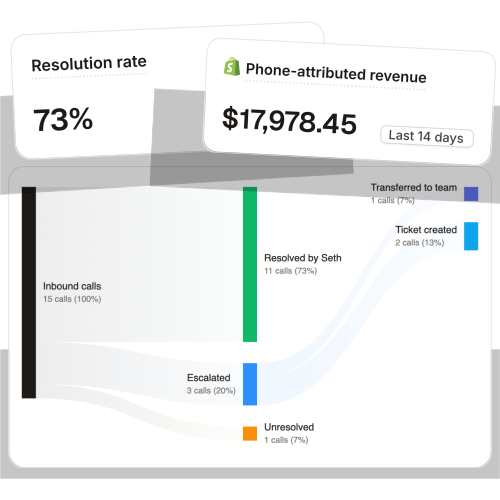
The reassuring part, for anyone nervous about putting AI on the line, is that customers rarely clock it.
"My customers also feel like it's a normal person. They feel like they can communicate if they have questions."
Claudia Droge, TechCraft Studio
If your number rolls to voicemail after 6 p.m., that is the gap worth closing first. Book a 30-min call and we will pull your missed-call pattern and show you what it is costing.
What it costs to answer vs not answer
Once you decide to actually answer the number, the math is about who picks up. Here is the shape of it for a typical brand.
Take a $50M Shopify brand running a 6-rep support team:
| Line item | Today | With Ringly |
|---|---|---|
| 6 reps x $4K loaded per rep | $24,000/mo | n/a |
| Ringly (~$5K/mo) | n/a | $5,000/mo |
| Net monthly CS spend | $24,000/mo | $5,000/mo |
| Monthly savings | n/a | $19,000/mo |
| Annual savings | n/a | $228,000/yr |
That assumes roughly 70% of calls are repeatable: order status, returns, the same questions over and over. Those route to the AI. The other 30%, the genuinely complex calls, still go to your team, who now have time to solve them instead of reading tracking numbers off a screen all day.
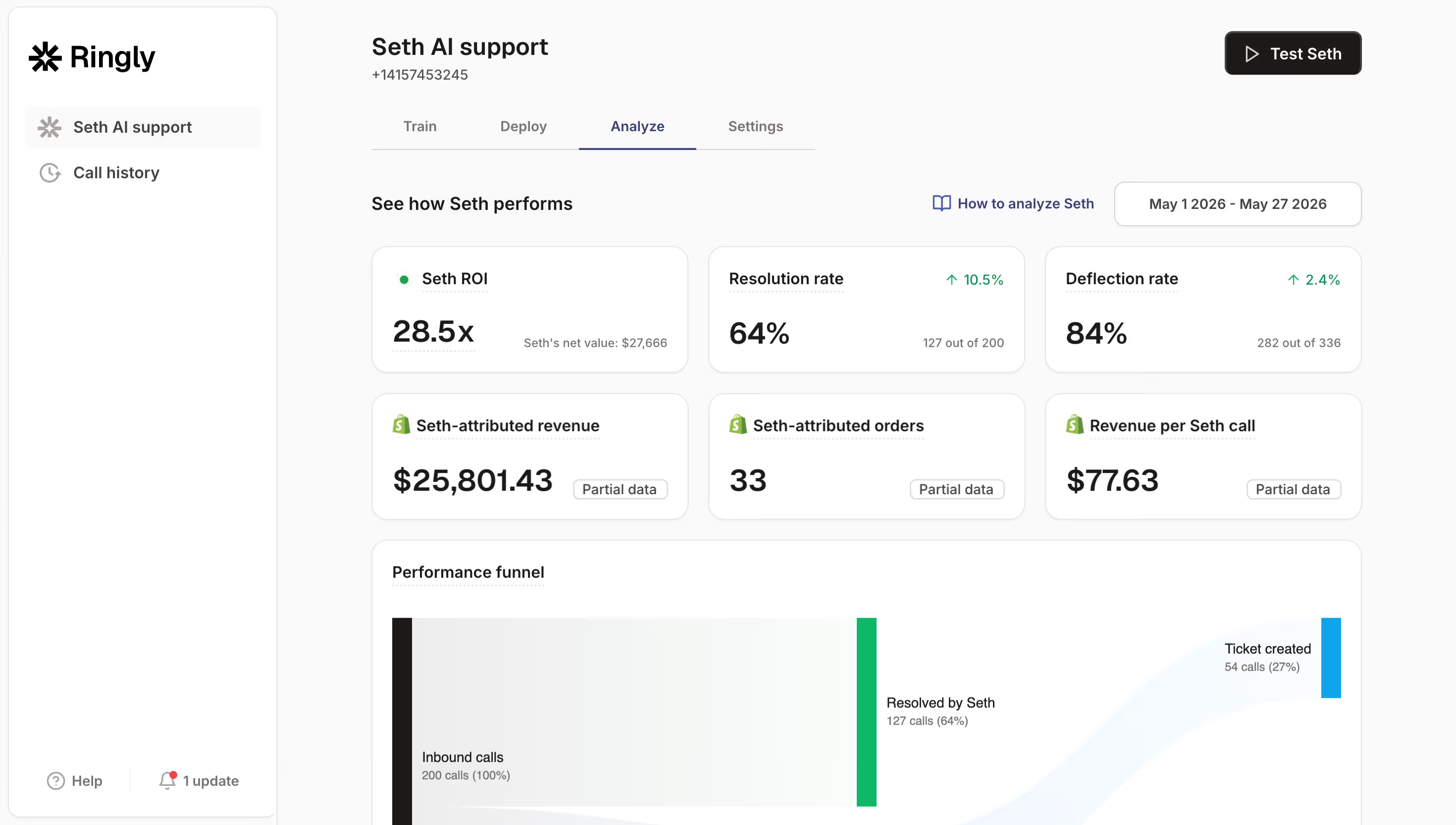
Ringly.io is AI phone support for Shopify brands. Instead of growing your support headcount every time call volume goes up, the AI takes the routine inbound calls so your team can focus on the work that moves revenue. It answers 24/7, finds orders in your Shopify store, processes returns, answers product questions from your knowledge base, and escalates cleanly to whatever helpdesk you already run. Across 50+ brands it resolves 73% of calls autonomously at roughly $0.42 per resolved call, versus $7 to $16 per call for human BPO. Plans start at $349/mo, with a 65% resolution guarantee. You can see how the order-status lookup works or read about scaling support without hiring.
The point is not that AI beats humans on every call. It is that a number which rolls to voicemail at 9 p.m. is losing you money the cheap providers above will never get back. Getting the number is step one. Answering it is the whole game. If you want the deeper version, here is the playbook on 24/7 ecommerce phone support and on handling WISMO calls at volume.
Frequently asked questions
What's the cheapest way to get a business number? Google Voice is free for a basic local number and personal-grade texting. If you need toll-free or business texting to customers, expect to pay: Grasshopper from about $18/mo or OpenPhone (Quo) from $15/user/mo. Twilio numbers cost about $1/mo but you build the phone around them yourself.
Is Google Voice good for a business? For a solo founder at the earliest stage, it is fine as a free second line. For a growing Shopify brand with a CS team it falls short: no toll-free or vanity numbers, no helpdesk integrations, and business texting now requires a paid plan under the FCC's 10DLC rules. Most brands outgrow it fast.
Should an ecommerce brand get a local or toll-free number? Toll-free is the safer default for a brand selling nationally, because it reads as established and the caller pays nothing. Get a local number only if your brand leans hard on a regional identity. Either way, make it a virtual number so you can route and record it.
Can I get a business number without buying a second phone? Yes. Every provider here except a traditional carrier is virtual, so the number rings in an app or browser on the device you already own. That is the main reason VoIP replaced landlines for small business.
Do I need a separate number to text customers? You need a registered one. As of 2026, sending business texts to customers in the US requires 10DLC registration, which most providers handle during setup. Texting from an unregistered number gets filtered or blocked, so complete that step before you publish the line.
Once the number is live, who actually answers it? That is the real question. Your options are a bigger in-house team, an outsourced call center, or an AI phone agent that picks up every call instantly. Ringly is the third option, built for Shopify brands: it answers 24/7, resolves 73% of calls autonomously, and escalates the rest to your team.
Talk to us

If you run a $10M to $100M Shopify brand and your number is already in the footer, the fastest way to find out what after-hours is costing you is a 30-minute call. We will pull your recent missed-call pattern and do the math live.
The 3-layer guarantee.
- Live in 14 days or it's free until launched.
- 65% resolution in 90 days or we refund the last 3 months of subscription fees.
- We keep working free until we hit 65%.
Ruben (Ringly co-founder) takes these calls personally.