
Most "generative AI call center use cases" articles are written for a 500-seat enterprise floor. They list 50 things, half of which you will never touch, and none of them tell you which ones actually matter when your "call center" is three to twelve reps and a phone number nobody picks up after 6 p.m.
So here's a shorter, more honest version. The conversational-AI contact-center market is worth about $17.97 billion in 2026 and growing roughly 23% a year (CXToday), and 88% of contact centers say they're deploying AI. The catch: only about a quarter have actually put it into day-to-day work (CMSWire). The gap between "we bought AI" and "AI is doing real work" is exactly the gap I want to close here. I pulled the call logs from the Shopify brands running Ringly and counted which use cases actually fired, and which ones the roundups list but no direct-to-consumer team ever uses. If your phone goes to voicemail after-hours and you want to see what that's costing, book a 30-min call and we'll run your numbers.
If you run customer experience at a $10M-$100M Shopify brand, you already know which calls eat your week: WISMO, returns, the same five product questions over and over. This is the list of generative-AI use cases that take those off your CS team's plate, sorted by whether they remove the call or just make a rep faster. We've launched AI phone agents for Shopify brands doing exactly this. Book a 30-min call and we'll map your call volume to these use cases live.
This post in 30 seconds.
- 12 generative-AI call-center use cases, split into the 6 that remove the call entirely and the 6 that make your CS team faster.
- Each one comes with the outcome it produces, not just a definition. AI now resolves about 30% of service cases and that's headed toward 50% by 2027.
- Built for founders, COOs, and Heads of CX at $10M-$100M Shopify brands running 3-12 reps and a paid helpdesk.
The two buckets that actually matter
There are dozens of ways to slice "generative AI in a call center." For a Shopify brand, only one split is useful: does the use case remove the call, or does it make the human handling the call faster?
Removing the call is where the money is. Making the rep faster is where the quality is. Both matter, but they solve different problems and you should know which one you're buying.
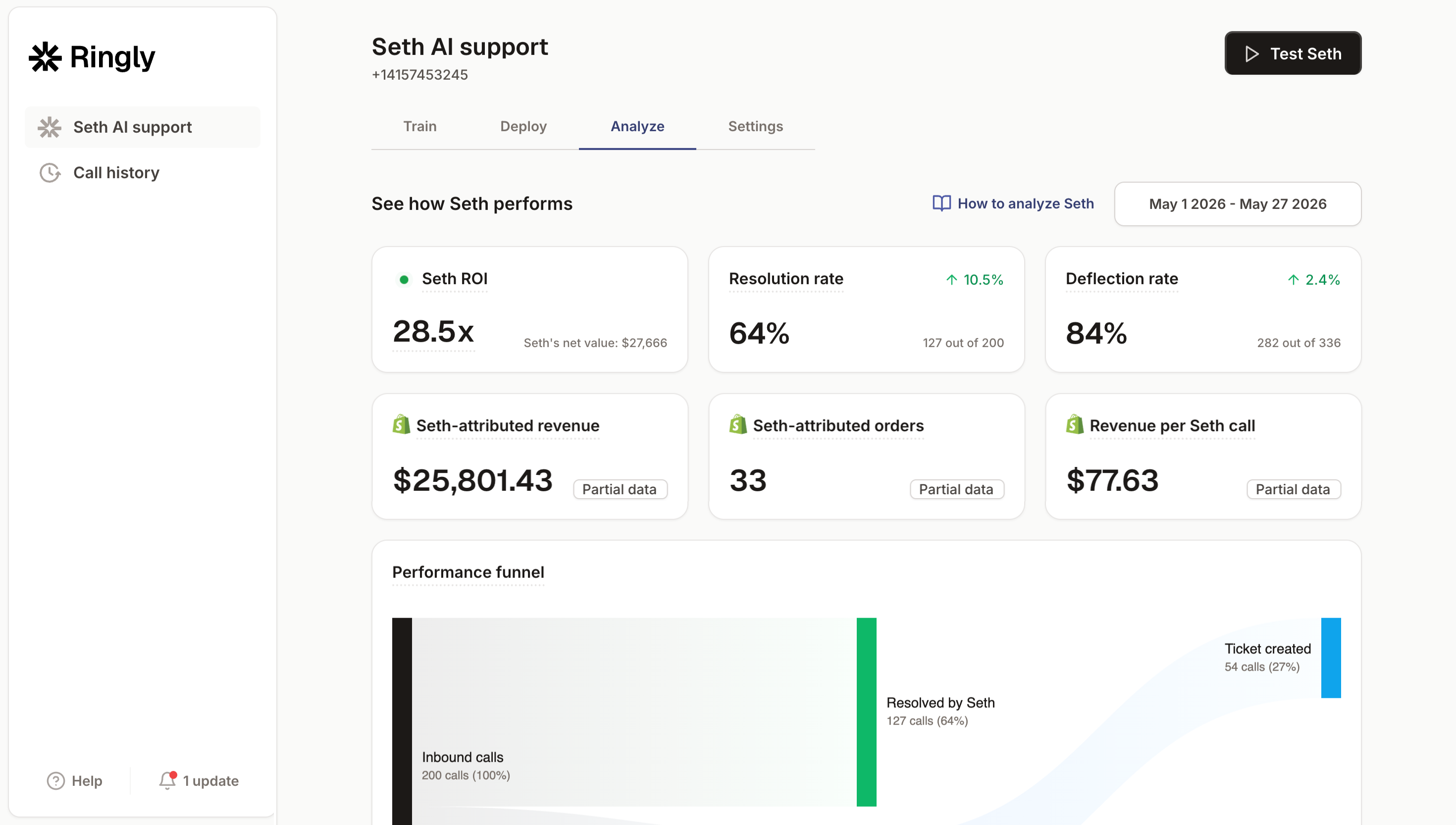
Bucket A is the autonomous voice agent: it picks up, understands the caller, finds the order, processes the return, and ends the call without a human ever joining. That bucket resolves up to 90% of inbound calls on its own, for $1.99 a call after the first 50, versus the $7-$16 a human BPO charges. Industry-wide, AI already handles about 30% of service cases and that's projected to hit 50% by 2027 (CMSWire).
Bucket B keeps your reps in the seat but hands them a co-pilot: live answer suggestions, instant call summaries, scoring on every call instead of a 2% sample. A Stanford and MIT study found a generative-AI assistant lifted support productivity by about 15% in issues resolved per hour (AmplifAI). Useful. But it doesn't shrink your headcount, it just makes the headcount you have less miserable.
For a 3-12 rep team, the order of operations is almost always Bucket A first. Get the routine calls off the queue, then optimize what's left. Here are the 12, six per bucket.
6 use cases that remove the call entirely
These are the calls a generative-AI voice agent can take end to end. If 70% of your calls are repeatable, this is the 70%. The single highest-value use case for a Shopify brand is the one you already dread: "where's my order." So that's where the list starts.
1. WISMO and order-status calls
WISMO ("where's my order") is 30-40% of support tickets and up to 50% at peak, according to Salesforce. On the phone it's the same script every time: caller gives a name or order number, the agent looks up the order in Shopify, reads the tracking status, and texts the link. A generative-AI agent does that whole loop without a human, pulling live order data through your Check Order Status integration. WashCo, a Shopify brand we launched, recovered $22,664 in its first 7 days on the phone, most of it on calls exactly like these. If you want the deeper version of this one, our WISMO calls breakdown goes call by call.
2. Returns and exchanges
A return call is three steps: confirm the order, decide return or exchange, issue the label or swap the size. The AI runs all three on the call, writes the result back to your helpdesk, and only escalates the edge cases (damaged in transit, outside the window, "I want to speak to someone"). What used to be a five-minute rep call becomes a 90-second self-resolving one. This is the use case that quietly drains the post-holiday queue.
3. Subscription pause, skip, and swap
If you sell supplements, skincare, coffee, or anything on a subscription, you know this call. "Pause my next shipment." "Skip this month." "Switch me to the larger size." It's high-volume, it's emotional only about 10% of the time, and it's the call your save-desk reps burn out on. The AI handles the routine 90% and routes the genuine cancel-saves to a human. BioLongevity Labs, a supplement brand on Ringly, hits 79% end-to-end resolution doing exactly this.
4. Product and knowledge-base questions
"Is this gluten-free?" "Will the medium fit a 38-inch chest?" "Does this work with my model?" These are the same questions over and over, and they all live in your docs already. A generative-AI agent answers them straight from your knowledge base, in your brand's voice, with the same answer every time. No more "let me check and call you back."
5. After-hours and overflow calls
This is the use case nobody on the roundups treats seriously, and it's where DTC brands bleed the most. A caller hits voicemail at 8 p.m. and 85% of them never call back. 62% switch to a competitor (PCN, 2026). An AI line is on at 2 a.m., on weekends, and during the call you can't staff for. Gear Rider, a Ringly customer, handled 1,595 sales calls in 90 days without a phone rep, a lot of them outside business hours. For the full picture of how a 24/7 AI line handles the inbound flood, see our AI inbound call center guide.
6. Abandoned-cart callbacks (opt-in)
This one's outbound, so I'll keep it short. When a high-value cart stalls, an opt-in AI callback can re-engage the shopper and recover the cart before it's gone. The compliance and consent side matters a lot here, so we wrote it up separately: the AI outbound call center playbook covers opt-in and the rest.
Those six are the bucket that changes your CS payroll math. If you're drowning in WISMO and after-hours voicemails, book a 30-min call and we'll show you what's recoverable.
6 use cases that make your CS team faster
These don't remove the call. They sit behind your reps and make the calls that do reach a human shorter, more consistent, and less exhausting. The calls a human still has to take are the hard ones, and that's exactly where an AI co-pilot earns its keep.
7. Live agent assist
While a rep is on a call, the AI listens and surfaces the right knowledge-base answer, the customer's order history, and the next best action in real time. The rep stops alt-tabbing through five tabs. That Stanford and MIT study put the lift at about 15% more issues resolved per hour (AmplifAI), and it lands hardest on your newest reps, who get pulled up to your best rep's level fast.
8. Post-call summaries and CRM write-back
After a call, the AI writes the summary, extracts the key details, updates the helpdesk fields, and logs the next step. Wrap-up tools like this save agents roughly 60% of their post-call time (CX Foundation). For a small team, that's the difference between a rep taking the next call now versus typing notes for two minutes first.
9. Auto-QA on 100% of calls
Most teams manually review 2-5% of calls. A generative-AI QA layer scores every single call against your rubric (CX Foundation), so you actually know how your phone support is performing instead of guessing from a tiny sample. Our AI call analysis does this on both the AI's calls and your humans'.
10. Call analytics and theme mining
Beyond scoring individual calls, the AI mines the whole call volume for themes: what people are actually calling about, in their words, week over week. A spike in "my order says delivered but it isn't here" calls tells you a carrier is failing before your reviews do. It turns the phone from a cost center into a listening post.
11. Knowledge-base drafting
Every resolved call is training data. The AI can turn a cleanly handled call into a draft knowledge-base article, which closes the loop: the more calls it handles, the smarter your KB gets, the more it can resolve next month. This is the use case that compounds.
12. Sentiment and smart escalation routing
Not every call should stay with the AI. A grief call to a pet brand, an angry customer, a high-value VIP, those need a human, fast. Sentiment detection plus a hard-coded escalation rule means the routine stays automated and the sensitive calls transfer cleanly to the right person. You decide what escalates.
"My customers also feel like it's a normal person. They feel like they can communicate if they have questions."
Claudia Droge, TechCraft Studio
TechCraft Studio handles 88% of its calls without a human, and the quote above is the part that surprises people: customers don't feel handed off to a machine.
Which of the 12 actually matter at your call volume
Here's the part the 50-item enterprise lists skip. At a 3-12 rep DTC brand, you do not implement all twelve at once, and you don't need to. You start with the calls that are eating the most hours.
| Use case | Bucket | Outcome it produces | Start here if... |
|---|---|---|---|
| WISMO / order status | Remove the call | 30-40% of volume gone | you sell physical product (everyone) |
| Returns + exchanges | Remove the call | post-peak queue drains | returns season hurts |
| Subscription pause/skip | Remove the call | save-desk burnout drops | you run subscriptions |
| Product / KB questions | Remove the call | "same five questions" automated | you get repeat product calls |
| After-hours + overflow | Remove the call | the 85% who never call back, caught | your line dies after 6 p.m. |
| Abandoned-cart callback | Remove the call | stalled carts re-engaged | high AOV, opt-in list |
| Live agent assist | Make reps faster | ~15% more issues/hour | new reps, long ramp |
| Post-call summaries | Make reps faster | ~60% of wrap-up time back | reps drowning in notes |
| Auto-QA 100% of calls | Make reps faster | full coverage vs 2% sample | you're guessing at quality |
| Call analytics / themes | Make reps faster | early warning on issues | recurring mystery spikes |
| KB drafting | Make reps faster | resolution compounds | thin knowledge base |
| Sentiment + escalation | Make reps faster | sensitive calls reach a human | emotional or VIP calls |
If you only do one thing, do WISMO. It's the biggest single slice of volume and the easiest to hand off. Everything else stacks on top of it. For a wider look at the software that powers these, our automated call center tools guide sorts the categories, and best-rated AI call center technologies rates them.
What removing the routine calls is worth
Use cases are abstract until you put them against your CS payroll. So here's the math for a typical $50M Shopify brand running a 6-rep team.
| Line item | Today | With Ringly |
|---|---|---|
| 6 reps × $4K loaded per rep | $24,000/mo | n/a |
| Ringly Enterprise (~$5K/mo) | n/a | $5,000/mo |
| Net monthly CS spend | $24,000/mo | $5,000/mo |
| Monthly savings | n/a | $19,000/mo |
| Annual savings | n/a | $228,000/yr |
That's roughly 70% of repeatable calls (order status, returns, product questions, the same things over and over) routed to the AI. The other 30%, the genuinely complex calls, still go to your CS team, who now have time to actually solve them instead of reading tracking numbers all day. Industry-wide, conversational AI is projected to save contact centers about $80 billion in agent labor costs in 2026 (Gitnux). Your slice of that is the difference between hiring your next two reps and not needing to.
Want this run against your real call volume instead of a sample brand? Book a 30-min call and we'll do the math live.
How we map a brand's calls to these use cases before going live
The reason most AI deployments stall (95% of pilots never operationalize, per CMSWire) is that brands buy a generic "AI agent" and never map it to their actual calls. We do the opposite.
I pulled the call logs from the Shopify brands on Ringly to build this list, and counted which of the twelve use cases actually fired versus which the roundups list but no DTC team ever touches. Before any brand goes live, we run the same exercise on their numbers:
- We listen to a sample of your real calls. Not a survey. Actual recordings, so we know your real call mix, not the one you assume you have.
- We bucket every call type by volume. WISMO, returns, subscription, product, after-hours. The 70% repeatable shows up fast.
- We map each high-volume bucket to a use case. What the AI resolves alone, what it assists on, what always escalates.
- We hard-code the escalation rules with you. You decide which calls a human always takes (grief, VIP, anything you name).
- We test against your edge cases before launch. We try to break it on your weirdest calls so your customers don't have to.
Most brands are live in under an hour of setup once the mapping is done. The mapping is the part that makes it actually work.
Frequently asked questions
What's the difference between generative AI and the old IVR phone trees? An IVR makes the caller press 1 for orders, 2 for returns. Generative AI lets the caller just talk, understands what they mean, and resolves it. There's no menu, no "I didn't catch that," and it pulls live data from Shopify mid-call. It's the difference between a phone tree and an actual conversation.
Which use case should a Shopify brand start with? WISMO and order-status calls, every time. It's the biggest single slice of volume (30-40% of tickets per Salesforce), it's the most repeatable, and it's the easiest to hand off cleanly. Once that's stable, returns and product questions stack on top.
Will customers be able to tell it's AI? Some will, some won't, and the brands we work with find that customers care less than expected as long as the call gets resolved. The common feedback is that it feels like a normal person they can actually ask questions to. You keep a hard escalation path to a human for anyone who wants one.
Does this replace my CS team? No, and the framing of "remove the call" is about routine calls, not people. The AI takes the repeatable 70% so your reps handle the 30% that actually needs judgment. Most brands redeploy reps to retention and complex cases rather than cut headcount.
How does generative AI handle a call it can't resolve? It escalates. You set the rules: sentiment triggers, specific call types, VIP customers, or a simple "speak to a human" request all route to your team, and the AI passes along a summary so the customer doesn't repeat themselves. Clean handoff is its own use case (number 12 above).
Does it work with my existing helpdesk and phone number? Yes. You keep your current number, and calls that need a human escalate into Gorgias, Richpanel, Re:amaze, or whatever you already run. Nothing about your stack has to change for the AI to start taking calls.
How much does it cost versus hiring? A US CS rep runs about $4,000/month loaded. AI phone support on Ringly runs $1.99 a call after the first 50. See pricing for the published plans.
Talk to us

If you run a $10M-$100M Shopify brand and you're trying to figure out which of these use cases is worth turning on first, a 30-min call is the fastest way to find out. We'll map your real call volume to the twelve and tell you what's recoverable.
Our 3 promises.
- Live in under 1 hour. Setup and test calls are free.
- 30-day money back on the $99 plan fee.
- 65% resolution guarantee: if Seth resolves under 65% of your support calls in a month, that month comes back as credit (after 90 days on Pay per call).
Ruben (Ringly co-founder) takes these calls personally.