
The short version.
- Returns are not one tool you buy. They are a five-layer system, and most Shopify brands wire up four of the layers and forget the fifth: the calls returns create.
- Online return rates sit near 20%, US shoppers sent back $890 billion in 2024 (NRF), and every return is also a support touchpoint, not just a logistics one.
- Built for founders, COOs, and Heads of CX at $10M-$100M Shopify brands running a paid helpdesk and a visible phone line.
One in five online orders comes back. In 2024 US shoppers returned $890 billion in merchandise, about 16.9% of all retail sales, according to the NRF and Happy Returns. For a $40M Shopify brand, a return rate in the high teens isn't an edge case. It's one of the biggest lines on the P&L that nobody owns end to end.
Search "ecommerce returns solutions" and you get two kinds of articles: a list of returns software, or a list of return-reduction tactics. Both are half the picture. A real returns solution is a stack of layers that work together, and the layer almost everyone skips is the one your CS team feels every January: the calls and tickets that returns generate.
If you run a Shopify brand at $10M-$100M, you already know the seasonal spike. Post-holiday return weeks turn a calm phone line into a stream of "where's my refund" and "how do I send this back," the same questions over and over, while your reps fall behind. This post lays out the full stack, layer by layer, so you can see which parts you've already solved and which one is quietly costing you. If you want to map your own returns calls against it, book a 30-min call and we'll do the math live.
Why returns are a margin problem and a support problem
Returns hit you twice. Once on the unit economics, and again on the support load. Most teams only count the first one.
On the economics: processing a single return costs between $15 and $30 in reverse logistics once you add the label, the inspection, the restock, and the refund, per the 2026 returns playbook from DigitalApplied. At a 20% return rate, a brand doing 2,000 returns a month is spending tens of thousands just to take product back. Online returns run more than double the in-store rate (roughly 19-20% vs about 8.7%), and the rate is not the same across categories.
| Category | Typical return rate | Main driver |
|---|---|---|
| Apparel | 25-40% | Fit and sizing |
| Footwear | 17-30% | Sizing and width |
| Furniture / home | 8-15% | Color and dimensions |
| Electronics | 8-10% | Specs and defects |
| Beauty | 4-5% | Shade and preference |
The second cost is the one that doesn't show up in a reverse-logistics report. Every return is also a conversation: a "how do I return this" before it ships back, and a "where's my refund" after. Refund-status questions alone make up 15-25% of all support tickets at many companies, according to Lorikeet. Refund-status is the WISMO of returns: high volume, repetitive, time-sensitive, and almost always answerable from data you already have.
It peaks exactly when you can least afford it. Post-holiday return rates jump to 15-30%, and National Returns Day in early January sees roughly 1.5 million packages come back in the US in a single day. That's the same week your reps are buried, and a slow or rude return experience does real damage: 96% of shoppers will buy again after an easy return, while 76% won't return after a bad one. The way you handle a return is a retention event, not a cost center.
The 5-layer returns solution stack
Here's the reframe. A returns solution isn't a single app. It's five layers, each solving a different part of the problem. Most brands buy one or two and call it done, which is why returns still feel broken even after you've paid for a returns app.
| Layer | What it solves | Example approaches |
|---|---|---|
| 1. Policy | The rules customers and reps follow | Clear window, condition, who-pays, exchange-first default |
| 2. Prevention | Stops the return before it happens | PDP content, size charts, 3D/AR |
| 3. Self-service portal | The customer-facing returns flow | Branded portal, labels, exchanges, store credit |
| 4. Reverse logistics + fraud | Getting product back, screening abuse | Carrier routing, restock, drop-off networks, fraud scoring |
| 5. Support layer | The calls and tickets returns create | AI phone support, refund-status answers, clean escalation |
Solve all five and returns stop being a fire drill. Solve four and the fifth one quietly eats your CS payroll every returns season. Let's go layer by layer.
1. Policy: the rules
Everything starts with the policy, and the most common mistake is hiding it. Nearly 44% of sites leave the return policy off the product page even though about 60% of shoppers look for it there, per the Baymard Institute. That's a conversion leak and a returns leak at once: 81% of consumers review the return policy before they buy, and 82% now treat free returns as a key purchase factor (NRF, 2025).
A good policy answers four things in plain language: the window, the acceptable condition, who pays return shipping, and whether you default to exchange, store credit, or refund. If you don't have one written cleanly, our return policy generator is a fast start, and our guide to a solid ecommerce return policy covers the trade-offs. Put it on the PDP, not buried in a footer.
2. Prevention: stop the return before it happens
The cheapest return is the one that never happens, and most returns are preventable expectation gaps. Fit and sizing alone drive about 44% of all returns. The fix is content, not logistics: real garment measurements per size, model-fit data, honest photography, and richer product detail. Shopify has reported up to 40% fewer returns and a 94% conversion lift on products with 3D content.
This is the same optimization discipline you already apply to conversion, pointed at the post-purchase moment. Our breakdown of how to reduce product returns goes deep on the prevention layer. Run a quarterly audit of your 20 most-returned SKUs and most brands shave a few points off the rate within two quarters.
3. Self-service portal: the returns flow
This is the layer most people mean when they say "returns software." A branded self-service portal that issues labels, offers an exchange or store credit before a refund, and handles instant refunds for trusted customers. Done well, it shifts up to 60% of returns into exchanges or store credit instead of cash back, according to Narvar, and customers who pick instant refunds are roughly 4x more likely to repurchase.
Tools like Loop, Redo, AfterShip Returns, Swap, and Happy Returns all play here, and they're good at it. The exchange-first flow is the single biggest revenue-retention move in the whole stack. Our guides to Shopify self-serve returns and Shopify exchanges cover how to set the defaults, and the broader ecommerce returns management overview ties the portal back to the rest of the stack.
4. Reverse logistics and fraud: the back end
Behind the portal sits the physical work: carrier and label routing, inspection, restocking, and drop-off or return-bar networks. This is also where you defend the policy. Roughly 9% of returns are outright fraud, but 52% of consumers admit to some past return abuse, so the answer is targeted scoring of repeat offenders, not a blanket crackdown that punishes good customers. Our piece on reducing the costs of ecommerce returns and the Shopify returns process walkthrough cover the operational side.
5. The support layer: the calls and tickets returns create
Here's where almost every "returns solution" article stops. The top results in this very search don't mention it at all. But returns are conversations, and the conversations don't disappear when you install a portal. They move.
A customer who can't find the portal calls. A customer whose refund hasn't posted calls. A customer who wants an exchange but isn't sure of the size calls. Across the 50+ Shopify brands we run phone support for, return and refund questions are one of the most repeated call types after WISMO, and the AI resolves a measured share of them before a rep ever picks up. That's the gap layers 1 through 4 leave open.
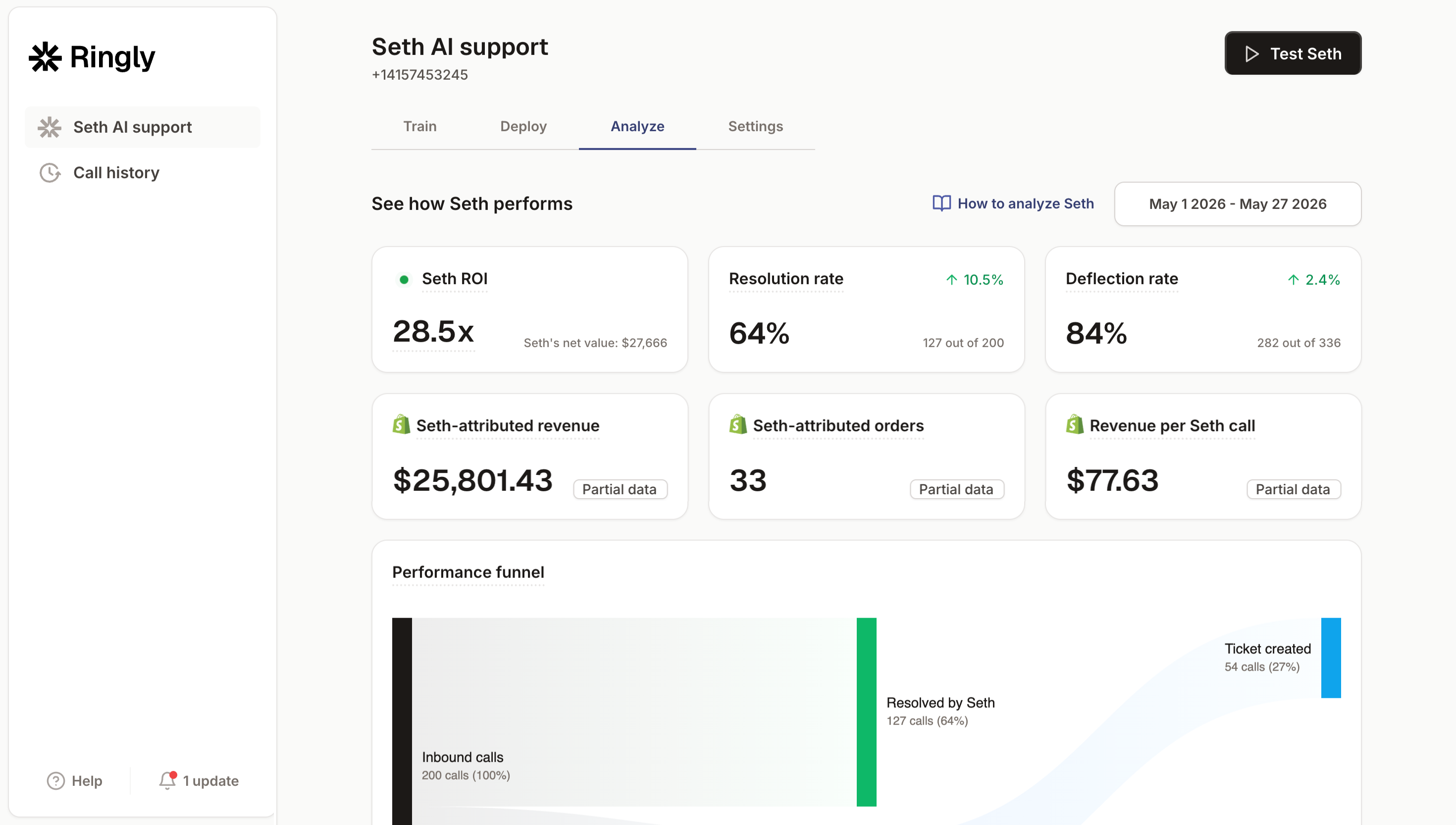
This is where Ringly.io fits. Ringly is AI phone support for Shopify brands. Instead of growing your support headcount every returns season, the AI answers inbound calls 24/7, finds the order in your Shopify store, processes returns and exchanges, and answers refund-status questions from real data. Across 50+ brands, it resolves 73% of calls autonomously at roughly $0.42 per resolved call, and the calls that genuinely need a human escalate cleanly to Gorgias, Richpanel, Re:amaze, or whatever helpdesk you already run. WashCo, a Shopify brand we launched, recovered $22,664 in its first 7 days on the phone.
The fear here is always the same: won't a customer mid-return be annoyed to hit AI? The most repeated thing customers say after a call is the opposite.
"My customers also feel like it's a normal person. They feel like they can communicate if they have questions."
Claudia Droge, TechCraft Studio
TechCraft handles 88% of its calls without a human. The genuinely upset customer still reaches your team, faster, because the routine refund-status calls aren't clogging the queue. If you want the full picture of how this layer connects to the rest, our ecommerce customer service guide is the place to start.
What the returns calls actually cost you
Put a number on layer 5 and the case makes itself. The math is most obvious during the seasonal spike, when a return-heavy week can double your call volume and you either staff up or fall behind.
Take a $50M Shopify brand running a 6-rep CS team:
| Line item | Today | With Ringly |
|---|---|---|
| 6 reps x $4K loaded per rep | $24,000/mo | n/a |
| Ringly (~$5K/mo) | n/a | $5,000/mo |
| Net monthly CS spend | $24,000/mo | $5,000/mo |
| Monthly savings | n/a | $19,000/mo |
| Annual savings | n/a | $228,000/yr |
That's roughly 70% of repeatable calls (order status, return requests, refund status, the same five things over and over) routed to the AI. The other 30%, the genuinely complex calls, still go to your team, who now have time to actually solve them. Per call, an in-house rep runs about $2.70 loaded; the AI runs closer to $0.42. The point isn't to cut the team. It's to stop paying rep time for the calls a system answers better. Our guide to scaling customer service without hiring goes deeper on the staffing trade-off.
Want to see this against your real call volume? Book a 30-min call and we'll compare it to your current setup.
How to choose your returns solution stack
You don't need all five layers from one vendor. No single tool does all five well. Pick the best option for each layer, and start with the layer that's bleeding the most.
- If your return rate is too high: start with layers 1 and 2. Tighten the policy, fix the PDP content, and audit your worst SKUs. See ecommerce returns best practices.
- If you're refunding revenue you could keep: start with layer 3, an exchange-first portal with store credit and instant refunds.
- If returns cost or fraud is the issue: start with layer 4, reverse-logistics routing and targeted fraud scoring.
- If your CS team is buried in return and refund calls: start with layer 5. A portal won't answer the phone, and the refunds questions keep coming.
Most $10M-$100M Shopify brands have layers 1 through 4 partly handled and layer 5 wide open. That's the cheapest win on the board, because the calls are already happening and someone is already paying for them. You can see plan options on the pricing page.
Frequently asked questions
What is an ecommerce returns solution? It's the full system a brand uses to handle returns, not a single app. It spans five layers: the return policy, prevention on the product page, a self-service portal, reverse logistics and fraud screening, and the support layer that handles the calls and tickets returns generate.
What's a good ecommerce return rate? Online return rates average around 19-20%, more than double the roughly 8.7% rate in physical stores. It varies sharply by category: apparel runs 25-40% while beauty sits near 4-5%, so benchmark against your own vertical, not a blended average.
How much does it cost to process a return? Reverse logistics runs roughly $15 to $30 per return once you count the label, inspection, restock, and refund. That's before the support cost of the calls and tickets each return tends to generate.
How do I reduce returns without hurting sales? Work the prevention layer: accurate sizing, richer product content, and 3D or AR where it fits. Fit and sizing drive about 44% of returns, and an exchange-first portal keeps the revenue you'd otherwise refund.
Do returns software tools handle the phone calls returns generate? No. Portals and reverse-logistics tools handle the logistics and the flow, but they don't answer the phone. The "where's my refund" and "how do I return this" calls still land on your CS team, which is the support layer most stacks leave open.
How does Ringly help with returns? Ringly is AI phone support for Shopify brands. It answers inbound calls 24/7, finds the order, processes returns and exchanges, and answers refund-status questions from real data, escalating anything complex to your helpdesk. Plans start at $349/mo with a 65% resolution guarantee, and you're live in under an hour.
Will customers mind talking to AI about a return? The most repeated compliment from customers is that it doesn't sound like AI. The routine refund-status calls get resolved fast, and the genuinely upset customer reaches a human sooner because the queue isn't clogged.
Talk to us

If returns season turns your phone line into a refund-status hotline, a 30-minute call is the fastest way to see which of those calls you never need to take again. We'll look at your real call volume and map it against the five-layer stack so you know exactly where the leak is.
The 3-layer guarantee.
- Live in 14 days or it's free until launched.
- 65% resolution in 90 days or we refund the last 3 months of subscription fees.
- We keep working free until we hit it.
Ruben (Ringly co-founder) takes these calls personally.