
The short version.
- Returns are a service with four jobs inside them, and most vendors only sell you one. You can run returns in-house, hand the physical side to a 3PL, or buy returns software and run it yourself. Each one leaves a different gap.
- The gap nobody prices in: every return generates inbound calls (where's my refund, did you get my package, how do I send this back), and none of the three models answer the phone.
- Built for founders, COOs, and Heads of CX at $10M-$100M Shopify brands with a real phone line and a paid helpdesk.
The average ecommerce return rate hit roughly 20% in 2026, up from about 11% in 2020 (Eightx). For apparel it runs closer to 25%. If you sell physical product on Shopify, returns are no longer a back-office chore. They are a line item, a margin drain, and a steady source of phone calls.
The trouble is that "ecommerce returns service" means two completely different things depending on who you ask. A 3PL means the boxes coming back to a warehouse. A software vendor means a self-service portal. Neither one picks up the phone when a customer wants to know why their refund is four days late. That call still lands on your team.
If you run support or ops at a Shopify brand doing $10M to $100M, you already know the returns season pattern: the portal works fine, the warehouse processes the boxes, and your CS team still spends half the day reading refund status off a screen for people who called in. We've launched AI phone agents for Shopify brands trying to close exactly that gap. Book a 30-min call and we'll show you how much of your return call volume an AI phone layer would absorb.
What an ecommerce returns service actually covers
When operators say "returns service," they're usually compressing four separate jobs into one word. Pulling them apart is the whole game, because each vendor in the market sells you one or two of these and stays quiet about the rest.
A returns service is really four jobs stacked together, and the one that gets dropped is almost always the phone.
- Physical processing. Receiving the boxes, inspecting condition, restocking what's resellable, disposing or refurbishing the rest. This is reverse logistics. It costs $10 to $65 per return depending on category and complexity (Redo).
- The customer-facing portal. The self-service flow where a customer starts a return, picks a reason, prints a label, or swaps for a different size. This is what most returns software sells.
- Policy and decisioning. What's eligible, what's final sale, who eats the shipping, when an exchange beats a refund. The rules that protect your margin without torching the customer relationship.
- The inbound communication. Every status question a return generates: "where's my refund," "did you get my package," "can I still return this," "how do I send it back." This is the job nobody bundles into "returns service," and it's the one that lands on your phone line.
Returns are not free even when they go smoothly. Studies peg the total drag at around $362 billion, roughly a quarter of online sales revenue, lost to returns each year (eMarketer). Less than half of returned items get resold at full price, so every return carries a double cost: the processing overhead and the margin haircut on the item's second life.
For a deeper look at the operational side, our guide to ecommerce returns management breaks down the workflow end to end, and the returns best-practices playbook covers policy design. This post is about the layer above those: which service-delivery model you actually buy, and who absorbs the calls.
The 3 ways to run returns, compared
There are three real ways to deliver a returns service, and the right one depends on your volume, your margin, and how much of the customer relationship you want to keep. None of them is wrong. They just solve different jobs.
Pick the model that fits your volume and margin, then notice that all three leave the phone uncovered.
Model 1: an in-house returns desk
You staff it yourself. Your own people receive boxes, inspect, restock, and answer the return questions that come in. This is where most brands start.
It works while return volume is low. The problem shows up as you scale: more returns means more warehouse hands, more CS hours, and a restocking backlog that bleeds into inventory accuracy. In-house returns "start to overwhelm" once volume climbs, which is the moment most brands look outward (ShipMonk). The loaded cost of a US support or warehouse rep runs about $4,000 a month once you count benefits, training, and attrition.
Model 2: a 3PL returns service
You hand the physical side to a third-party logistics provider. The 3PL receives returns at their warehouse, inspects, restocks, and reports back. ShipNetwork, Radial, Ryder, and ReverseLogix all sell this.
About 40% of retailers now route returns through a 3PL, drawn by quoted savings of 9-15% on logistics and 30-50% on labor through automation and scale (Claimlane). The trade-off: a 3PL handles the boxes, not the conversation. When a customer calls asking where their refund is, the 3PL is not the one answering. You are. Pricing is custom and usually per-return plus warehouse fees.
Model 3: returns software
You buy a portal and run it yourself. Loop Returns, Happy Returns, ReturnGO, Swap, and AfterShip live here. The software gives the customer a self-service flow, pushes exchanges over refunds to protect revenue, and reports on the data.
Loop Returns starts around $155/mo and runs to $272/mo on the Advanced plan (StackScored). ReturnGO starts near $147/mo. Happy Returns (now a UPS company) prices custom and leans on its box-free drop-off network. The returns software market is growing fast, from $13.26 billion in 2025 to a projected $26.38 billion by 2035, which tells you how many brands are buying the portal. If you're weighing specific platforms, we compared the field in our Loop Returns alternatives breakdown and our roundup of the best returns management software.
Here's the same three models side by side, with the column most comparisons leave out.
| Model | What it does | Rough cost | Who answers the calls |
|---|---|---|---|
| In-house desk | You process, restock, and field questions yourself | ~$4K/mo loaded per rep | Your team |
| 3PL returns service | Provider receives, inspects, restocks, reports | Custom, per-return + fees | Your team |
| Returns software | Self-service portal, exchanges, analytics | ~$147-$272/mo and up | Your team |
| AI phone layer (Ringly) | Answers the return calls, looks up status, escalates | From $99 a month (50 conversations included) | The AI, 24/7 |
Read the last column. Whichever of the first three you pick, the phone is still yours. That's the gap.
The layer every returns service skips: the phone
Returns don't just generate boxes. They generate questions, and most of those questions arrive by phone, chat, and email after the return is already in motion.
Returns software handles the portal. It does not handle the human who calls in because the portal didn't answer their question.
There's a specific name for this. WISMO is "where is my order." WISMR is "where is my refund" or "where is my return," and it's a distinct support-volume driver that kicks in after a customer ships their item back (WISMOlabs). WISMO alone accounts for 20-40% of support tickets, climbing past 50% at peak (Salesforce). Stack WISMR on top during return season and the phone line gets loud.
Reading through the call logs of the Shopify brands on Ringly, return questions are a recurring slice of live phone volume, and they're remarkably consistent: where's my refund, did you get my package, how do I send this back, can I still return this. None of it gets absorbed by the returns platform, because every returns platform is software, not a phone-answering service. The portal sits there. The customer calls anyway.
That's the layer Ringly fills.
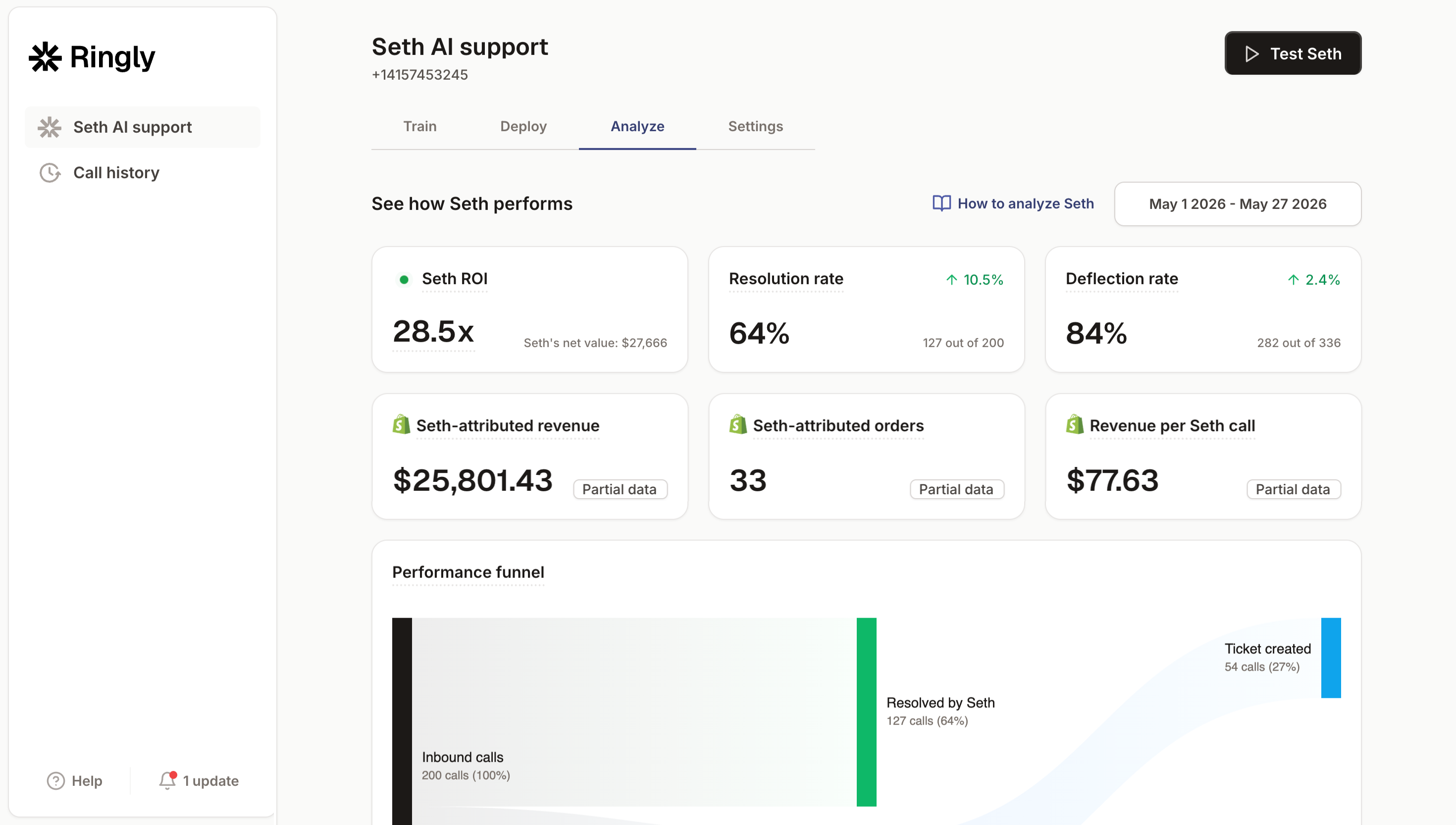
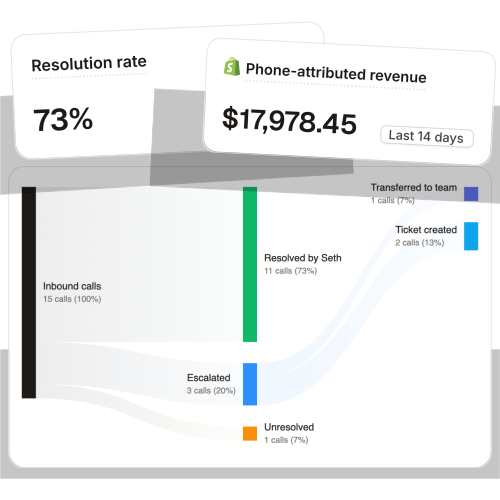
Ringly.io is AI phone support for Shopify brands. Instead of growing your support headcount every time return season spikes the queue, the AI takes the routine inbound calls so your team can focus on the ones that actually need a human. It answers calls 24/7, finds the order in your Shopify store, checks return and refund status, answers policy questions from your knowledge base, and escalates cleanly to Gorgias, Richpanel, Reamaze, or whatever helpdesk you already run. Seth resolves up to 90% of calls autonomously.
It doesn't replace your returns software. It sits in front of it and your helpdesk, answering the calls that the portal generated but can't take. WashCo, a Shopify brand we launched, recovered $22,664 in its first 7 days on the phone. The order-status and refund-status lookups it runs are the same machinery that absorbs return calls, which you can see in our check order status feature and the AI phone agent for Shopify support.
"My customers also feel like it's a normal person. They feel like they can communicate if they have questions."
Claudia Droge, TechCraft Studio
If you want the tactical version of cutting this volume, our strategies to reduce WISMO calls and the broader WISMO calls guide go deeper.
What this costs you today vs with an AI phone layer
The returns software and the 3PL both have a clear line on your P&L. The return-call workload usually doesn't. It's buried inside CS payroll, which is exactly why it's the easiest cost to leave bleeding.
The return calls aren't a separate budget line, so most brands pay for them twice: once in payroll, once in the customer they lose to a four-day refund delay.
Take a typical $50M Shopify brand running a 6-rep CS team during return season:
| Line item | Today | With an AI phone layer |
|---|---|---|
| 6 reps x $4K loaded per rep | $24,000/mo | n/a |
| Ringly (Enterprise, illustrative) | n/a | $5,000/mo |
| Net monthly CS spend | $24,000/mo | $5,000/mo |
| Monthly savings | n/a | $19,000/mo |
| Annual savings | n/a | $228,000/yr |
That's roughly 70% of repeatable calls (order status, refund status, return instructions, the same handful of questions over and over) routed to the AI. The other 30%, the genuinely complex calls, still go to your team, who now have time to actually solve them. Exact pricing gets set on a call, but these are the savings shapes we see across Shopify brands. Pricing is public too: $99 a month for the first 50 conversations, then $1.99 each, listed on the pricing page.
If you're running a $10M+ Shopify brand and returns are spiking your phone line, book a 30-min call and we'll do the math on your actual call volume live.
How to choose your returns service
The three models aren't mutually exclusive. Most brands at scale end up running two or three of them together. Here's the quick decision framework.
- Choose an in-house desk if your return volume is low, your margins are thin, and you'd rather keep tight control of the customer than pay for scale you don't need yet.
- Choose a 3PL returns service if the physical processing is your bottleneck, you're drowning in restocking, and warehouse labor is the cost you most want off your books.
- Choose returns software if your customers want self-service, exchanges-over-refunds is your retention lever, and you want clean returns data without building it. Compare options in our returns management service and Shopify returns process guides.
- Add an AI phone layer if returns generate a real call spike, your team is reading refund status off a screen all day, and you're tired of hiring seasonal reps just to answer "where's my refund." This is the piece the other three don't cover. It pairs with whatever returns software and helpdesk you already run, more in ecommerce customer service.
Most $10M-$100M Shopify brands land on software plus an in-house or 3PL physical layer, then discover the phone is still uncovered. That's the order it usually happens in.
Frequently asked questions
What is an ecommerce returns service?
It's any setup that handles returns for an online store, but the term covers four different jobs: physical processing, the customer-facing portal, policy decisioning, and the inbound communication. Most vendors sell one or two of these. A 3PL handles the boxes, returns software handles the portal, and the phone calls usually stay with your own team.
Should I outsource returns or keep them in-house?
Keep them in-house while volume is low and you want tight control of the customer relationship. Outsource the physical side to a 3PL once restocking and warehouse labor become the bottleneck, which is roughly where 40% of retailers have landed. Either way, decide separately who answers the return-related calls, because neither model covers that.
How much does a returns service cost?
It depends on the model. Returns software runs roughly $147 to $272 a month and up for mid-market plans. A 3PL prices custom, usually per-return plus warehouse fees. In-house costs you about $4,000 a month in loaded labor per rep. The processing cost alone is $10 to $65 per return.
Does returns software answer customer calls?
No. Returns software gives the customer a self-service portal to start a return, print a label, or pick an exchange. It does not pick up the phone. When a customer calls because the portal didn't answer their question or their refund is late, that call still goes to your team unless you've added a phone layer.
What's the difference between WISMO and WISMR?
WISMO is "where is my order," the status questions that come before delivery. WISMR is "where is my refund" or "where is my return," the status questions that come after a customer ships an item back. WISMO is the bigger share of support volume, but WISMR spikes hard during return season and lands on the same phone line.
Does Ringly handle returns?
Ringly is not a returns platform. It's the AI phone layer that answers the calls returns generate: refund status, return instructions, policy questions, order lookups. It sits in front of your returns software and helpdesk, resolves up to 90% of calls autonomously, and escalates the rest to your team.
Talk to us

You can buy the best returns software and the best 3PL on the market and still leave the phone uncovered. If returns are spiking your phone line and your team is reading refund status off the warehouse all day, a 30-min call is the fastest way to see what an AI phone layer would absorb.
Our 3 promises.
- Live in under 1 hour. Setup and test calls are free.
- 30-day money back on the $99 plan fee.
- 65% resolution guarantee: if Seth resolves under 65% of your support calls in a month, that month comes back as credit (after 90 days on Pay per call).
Ruben (Ringly co-founder) takes these calls personally.