

This post in 30 seconds.
- The 8 practices that turn your returns process from a margin leak into a reason customers come back, covering policy, portal, refund speed, exchanges, status comms, return-reason data, fraud, and retention.
- Online return rates sit near 20.8% in 2026, but 96% of shoppers will buy again from a brand that made the return easy. The process is the lever.
- Built for founders, COOs, and Heads of CX at $10M-$100M Shopify brands running a paid helpdesk and a visible phone line.
Returns are the one part of the buying journey where a happy customer and an angry one go through the exact same door. Get it smooth and 76% of first-time buyers come back. Get it slow and 71% never order again. Most brands treat the returns flow as a cost to minimize, then wonder why their phone lights up with people asking where their refund went.
If you run customer experience at a Shopify brand doing $10M to $100M, you already know the second half of that sentence. A slow refund doesn't just annoy one person. It becomes a "where's my refund" call, then a ticket, then a Trustpilot line about how nobody picked up. We build AI phone support for Shopify brands, and the routine return-status call is one of the most repeatable things we see. Book a 30-min call and we'll show you what your returns volume sounds like on the phone.
This is a checklist for the end-to-end returns experience. If you want help writing the policy document itself, that's a separate job covered in our guide to ecommerce return policies. If your goal is fewer returns in the first place, start with how to reduce product returns. This post is about the process every returned order actually moves through.
Why your returns process is a retention moment, not a cost center
Here's the number that should reframe the whole thing: 65% of revenue at most DTC brands comes from repeat customers, and a 5% lift in retention can swing profit anywhere from 25% to 95% (Saras Analytics). The return is one of the highest-stakes touchpoints for that retention number, and it's the one most teams under-invest in.
The volume is real. Online return rates run around 20.8% in 2026, more than double the 8.7% you see in physical retail, and it climbs by category: apparel hits 20-40%, footwear 17-30%, electronics 8-15%, beauty 4-12% (WiserReview). At a $30M brand, that's a returns operation processing thousands of items a month, each one a small test of whether the customer stays.
A smooth return is the cheapest loyalty program you'll ever run: 96% of shoppers say they'll buy again from a brand that made the return easy (Signifyd). The brands winning here stopped asking "how do we process this return for less" and started asking "how do we keep this customer through the return." Those are different questions with different answers.
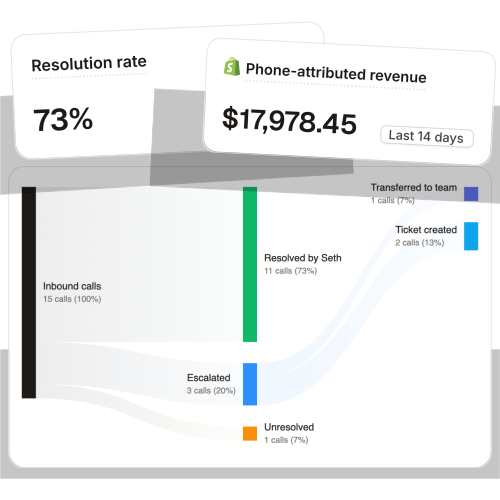
You can see the same pattern in the call data. When we look at the inbound calls across the brands we run, the return-status and order-status calls cluster together as the highest-volume, lowest-complexity bucket. They're the routine the same questions over and over that eat your reps' day. More on what to do with that in practice 5. First, the foundation.
The 8 ecommerce returns best practices
These are ordered the way a returned order actually flows: the policy the customer reads, the portal they use, the refund they wait for, the exchange you offer instead, the updates you send, the data you collect, the fraud you screen, and the next sale you earn. Work them in order and the process tightens end to end.
1. Write a return policy customers can actually find and understand
The policy is the contract, and most are written to protect the brand instead of guide the customer. That backfires. A confusing or buried policy is the single biggest driver of pre-return support contacts, because the customer can't self-serve an answer they can't find.
Three things make a policy work in practice:
- Put it where the decision happens. Link it in the footer, the cart, and on the product page itself. A shopper deciding on a $120 jacket wants the return terms before they buy, not after.
- Write the window and the outcomes in plain language. "30 days, free returns, refund to original payment or instant store credit" beats a wall of legal text every time.
- Match the policy to the category. Beauty and final-sale items need different rules than apparel. Spell out the exceptions so nobody calls to ask.
A policy the customer can read in 15 seconds prevents the call they'd otherwise make to ask what your policy is. For the full structure of the document, including the clauses and the template, see our ecommerce return policy guide. The clearer the policy, the less your team gets pulled into interpreting it on the phone.
2. Put a self-service returns portal at the center
Forcing a customer to email or call to start a return is the friction that defines a bad returns experience. A branded self-service portal lets them initiate, pick an outcome, and print a label without ever touching your team.
The portal should do the work your reps shouldn't:
- Enforce the policy automatically. Auto-approve returns inside the window, flag the rest for review, so nobody is manually checking dates.
- Generate the return label and the rules in one step. Tie label creation to the return reason and the item, not a generic catch-all.
- Show return tracking from the customer's side. They should see "received, processing, refunded" without asking.
There are good options in the Shopify ecosystem for this, which we cover in our roundup of the best Shopify returns apps. For the broader operational picture, our ecommerce returns management guide walks through the reverse-logistics side. The point of the portal is simple: every return that completes itself in the portal is a return your CS team never has to handle.
3. Make refunds fast, because the 9-10 day refund is a phone call waiting to happen
This is where most returns processes quietly leak both money and trust. 85% of shoppers expect a refund within a week, and 45% expect it within three days. Most brands take 9-10 days from return to completed refund (Opensend). That gap, between when the customer expects their money and when they get it, is the exact window the "where's my refund" call lives in.
Think about the mechanics. The customer ships the item back, hears nothing for a week, and starts to worry. They check their bank, see nothing, and pick up the phone. Now you're paying a rep to handle a call that exists only because your refund timeline is slower than the expectation you set.
The fix is partly operational and partly communication. Compress the warehouse step (scan-on-receipt, not scan-at-end-of-week) and trigger the refund the moment the item is verified. Cutting your refund time from 10 days to 3 doesn't just satisfy the customer, it deletes the call they would have made on day 8. When the refund genuinely can't move faster, the answer is the next two practices: offer an instant outcome, and tell the customer where things stand before they have to ask.
4. Default to exchange or store credit before a refund
A refund is the only outcome that loses the sale entirely. An exchange keeps it. Store credit keeps it and often grows it. So the best returns processes present those options first, without hiding the refund.
The data backs the framing. Exchange-focused returns flows retain around 30% of the revenue that would otherwise walk out as a refund (Redo). And only 48% of returned items get resold at full price, so every refund you convert to an exchange protects margin twice (WiserReview).
How to do it without feeling like a trick:
- Lead with "exchange or store credit" in the portal, refund as the third option. Make the better outcome the easy one, not the hidden one.
- Sweeten the credit. A small bonus on store credit (5-10%) often beats a refund in the customer's head.
- Offer instant credit before the item ships back. Letting them reorder immediately, while the return is in transit, is the move that surprises people and earns loyalty.
The brands that win returns make the refund available but make the exchange irresistible. This is also where your returns process feeds directly into retention, which is the whole point of practice 8.
5. Send proactive return-status updates and kill the "where's my refund" call
This is the practice the rest of the SERP skips, and it's the one that touches your phone bill directly. WISMO ("where is my order") accounts for up to 50% of inbound calls to ecommerce support teams, at roughly $5 each to resolve (Salesforce). Its returns-side twin, sometimes called WISMR, "where is my return," is the same call wearing a different hat: the customer chasing a refund or an exchange that's mid-process.
I called the return and refund lines of a handful of Shopify brands one evening after 9 p.m. to see where a "where's my refund" call actually lands after hours. Mostly voicemail. The customer who's already anxious about money they're owed hits a recording, leaves a message nobody returns until Tuesday, and stews. That's the experience quietly costing brands the repeat purchase.
The fix is to tell the customer before they ask:
- Trigger an update at every step. Return received, return inspected, refund issued or exchange shipped. Each notification removes a reason to call.
- Make the status checkable on demand. A tracking link in the portal and a phone line that can answer "your refund posted yesterday" both work.
- Cover after-hours. The anxious refund call doesn't respect business hours, and voicemail is not an answer.
"My customers also feel like it's a normal person. They feel like they can communicate if they have questions."
— Claudia Droge, TechCraft Studio
This is the bucket we built AI phone support for. Seth resolves up to 90% of inbound calls autonomously, including return and refund status, by pulling the live order from Shopify and reading the customer the real answer. The status call is the most automatable call you have, which means it's the cheapest one to stop paying a human to take. For the order side of the same problem, see how to reduce WISMO calls and our ecommerce order tracking breakdown.
6. Track return reasons and act on the data
Every return is a piece of feedback you paid for. If your portal makes the customer pick a reason and you never look at the aggregate, you're throwing away the most honest product research you'll ever get.
Capture the reason at the source and make it specific:
- Use granular reasons, not "other." "Too small," "color not as pictured," "arrived damaged," and "changed my mind" point at completely different fixes.
- Watch the SKU-level pattern. One product returning at 35% while the catalog averages 20% is a sizing, photography, or quality problem you can fix.
- Feed it back to the right team. Damaged-in-transit goes to packaging, "not as described" goes to merchandising, "changed my mind" is often a returns-policy framing issue.
The return-reason data tells you exactly which products to fix, which is the only way to bring your return rate down without making returns harder. That reduction work is its own discipline, covered in how to reduce product returns, and the broader financial picture of how all this hits your P&L is in how your returns policy impacts orders.
7. Build fraud controls that don't punish good customers
Return fraud costs retailers over $100B a year through wardrobing, bracketing, item-swapping, and empty-box returns (Signifyd). The instinct is to tighten the policy for everyone. That's the wrong move, because you punish the 96% of honest customers to stop the few who abuse it.
Screen at the account level instead of the policy level:
- Flag serial returners by behavior, not by blanket rule. A customer who returns 80% of orders is a different risk than one returning their first item in a year.
- Verify high-risk returns before refunding. Require the item back, or photo evidence, on flagged accounts only.
- Keep the default experience generous. Auto-approve the clean returns instantly so fraud screening is invisible to good customers.
Good fraud control is invisible to honest buyers and quietly firm with abusers, never a tax on everyone. The brands that get this right protect margin without ever showing up in a "their returns policy is hostile" review.
8. Treat the return as the start of the next sale
The return is not the end of the relationship. It's the moment you decide whether there's a next one. Every practice above feeds this: a clear policy, an easy portal, a fast refund, a generous exchange, proactive comms, and an honest fraud stance all add up to a customer who trusts you enough to order again.
The math is hard to argue with. 76% of first-time customers who have an easy return say they'll shop again, while 71% who have a bad one say they won't (Loop Returns). The return is a coin flip on a repeat customer, and the process is how you weight the coin.
Close the loop deliberately:
- Follow up after the return resolves. A short "we made it right, here's 10% on your next order" turns a refund into a re-engagement.
- Route the exchange into the next purchase. Surface complementary products in the exchange flow.
- Measure return-cohort retention. Track whether customers who returned and were treated well buy again. They usually do.
A returned order handled well is a higher-intent retention opportunity than most marketing emails will ever be. For the full retention playbook this connects to, see our ecommerce customer retention guide.
What a slow returns process costs you vs fixing it
Most of the cost of a bad returns process hides in two places: the refunds you didn't need to give in full, and the support payroll spent answering status calls. The second one is the one you can attack this quarter.
Take a typical $50M Shopify brand running a 6-rep CS team, with a big share of the queue being return-status and order-status calls:
| Line item | Today | With Ringly |
|---|---|---|
| 6 reps × $4K loaded per rep | $24,000/mo | — |
| Ringly Enterprise (~$5K/mo) | — | $5,000/mo |
| Net monthly CS spend | $24,000/mo | $5,000/mo |
| Monthly savings | — | $19,000/mo |
| Annual savings | — | $228,000/yr |
That's roughly 70% of repeatable calls, return status, order status, the same five questions over and over, routed to the AI. The genuinely hard calls, the angry exchange dispute, the edge-case warranty claim, still go to your CS team, who now have time to actually solve them.
If you want to compare that against your current setup, book a 30-min call and we'll do the math live on your real call volume.
Frequently asked questions
What is a good return rate for ecommerce? It depends heavily on category. The 2026 online average is around 20.8%, but apparel runs 20-40%, electronics 8-15%, and beauty 4-12%. Benchmark against your own category, then watch the SKU-level outliers rather than chasing a single store-wide number.
How fast should refunds be processed? Aim for three days or less. 85% of shoppers expect a refund within a week and 45% expect it within three days, while most brands take 9-10 days. That gap is where the "where's my refund" calls come from, so closing it pays off twice.
Should I offer free returns? For most $10M+ DTC brands, yes, because 96% of shoppers will buy again after an easy return and the retention upside outweighs the shipping cost. The exception is low-margin or high-abuse categories, where you can offset cost by steering toward exchanges and store credit instead of refunds.
How do I encourage exchanges instead of refunds? Lead with exchange and store credit in the portal, make the refund the third option, and sweeten the credit with a small bonus. Exchange-focused flows retain around 30% of revenue that would otherwise leave as a refund, and instant credit before the item ships back works best.
What causes "where's my refund" calls and how do I reduce them? They're driven by the gap between when a customer expects their refund and when it actually posts, made worse by silence during the return process. Send proactive status updates at every step and make the status answerable on demand, including after hours, and most of these calls disappear.
How do returns affect customer retention? Returns are one of the highest-stakes retention moments you have: 76% of customers with an easy return say they'll shop again, while 71% with a bad one won't. Since most DTC revenue comes from repeat customers, the returns experience is effectively a loyalty program in disguise.
Does Ringly handle return and refund status calls? Yes. Ringly is AI phone support for Shopify brands that pulls the live order from your store and answers return, refund, and order-status questions on the call, resolving up to 90% of calls autonomously. Calls that need a human escalate cleanly to Gorgias, Richpanel, Re:amaze, or whatever helpdesk you already run.
Talk to us

If you run a $10M-$100M Shopify brand and your returns process is generating more phone calls than it should, a 30-min call is the fastest way to see what the status queue is actually costing you. We'll pull your real numbers and show you what's automatable.
Our 3 promises.
- Live in under 1 hour. Setup and test calls are free.
- 30-day money back on the $99 plan fee.
- 65% resolution guarantee: if Seth resolves under 65% of your support calls in a month, that month comes back as credit (after 90 days on Pay per call).
Ruben (Ringly co-founder) takes these calls personally.