
This post in 30 seconds.
- A refund is rarely one event. It's a chain, and the call in the middle is the part that costs you.
- Processing a return runs about 21% of the order's value, but the refund phone call (status checks, disputes, abuse) is the cost almost nobody puts on the P&L.
- Built for founders, COOs, and Heads of CX at $10M-$100M Shopify brands with a real phone line and a paid helpdesk.
A customer asks for their money back. You issue the refund. Done, right? Not quite. The money sits in card-network limbo for 5 to 10 days, the customer can't see it, and on day three they call you, irritated, asking where it went. That call is the part of a refund nobody budgets for, and at scale it's the most expensive piece of the whole thing.
If you run a $10M-$100M Shopify brand, you already feel this. Refunds aren't a finance line item you can quietly absorb. They're a steady stream of inbound, and the refund call is the one your reps dread most because the customer already feels wronged and the money is in the air.
We've launched AI phone support for Shopify brands, and "where's my refund" is one of the most repeatable calls we see after 6 p.m. If your phone line goes quiet after hours while customers stare at a pending refund, book a 30-min call and we'll show you what that queue actually looks like.
Refunds vs returns vs chargebacks (they're not the same thing)
These three get used interchangeably, and that's exactly how money leaks. They're different events with different cost structures.
- Refund: money goes back to the customer. It can happen with or without the item coming back (more on returnless refunds below).
- Return: the physical item ships back to you, gets inspected, gets graded, and either restocked or written off. That's a logistics problem. We cover it in the ecommerce returns management guide.
- Chargeback: the customer skips you entirely and asks their bank to claw the money back. This is the failure state, and it's the one that actually hurts.
A chargeback is just a refund you didn't get to handle. The customer wanted their money back, couldn't reach you (or didn't trust you to act fast enough), and went to the bank instead. That detour is brutally expensive: the average retailer spends $35 disputing every $100 in chargeback claims, according to Cybersource's Global Fraud Report cited by Shopify. And a chargeback typically costs roughly twice the order value once you add fees, plus it pushes up your dispute ratio, which the card networks watch closely.
So the whole game is this: keep as many refund situations as possible inside the refund lane, where you control the experience, and out of the chargeback lane, where the bank does.
One more distinction worth keeping straight, because it changes how you respond. A refund is a decision you make. A return is a logistics event you manage. A chargeback is a verdict the bank hands down, often weeks later, with a fee attached and very little room to argue. When you treat all three as "the customer wants their money back," you respond to the cheap problem and the expensive problem with the same generic process, and the expensive one wins. The brands that handle refunds well separate the three on the way in: a return goes to the portal, a refund question goes to a fast answer, and a brewing dispute goes to a human before it ever reaches the bank.
What refunds actually cost a Shopify brand
Most refund-cost math stops at the item. That's the cheap part. There are three layers, and the third one is the one that surprises people.
Layer one is the goods and margin. Return rates run about 19% to 21% across ecommerce in 2026 and roughly 14% for DTC specifically, per Eightx's blended NRF and Coresight data. Apparel sits near 25%, electronics around 10-11%, beauty near 8%. And only about 48% of returned items get resold at full price, so even a clean refund eats margin twice.
Layer two is processing. The cost of handling a return averages about 21% of the order's value, according to Pitney Bowes BOXpoll data cited by Signifyd. In dollars that's roughly $10 to $65 per return once you count inbound shipping, inspection, restocking, and the items you can't resell. US retail returns hit about $849.9 billion in 2025 per the NRF returns landscape.
Layer three is support, and almost nobody prices it. Every refund is a touchpoint. The customer wants confirmation, wants a timeline, wants to know why the bank says "pending." At a $250-AOV store, 12% to 18% of orders generate a phone call, and refunds are over-represented in that mix because the emotional stakes are higher. That call volume lands on a 3-12 rep CS team that was already underwater on WISMO.
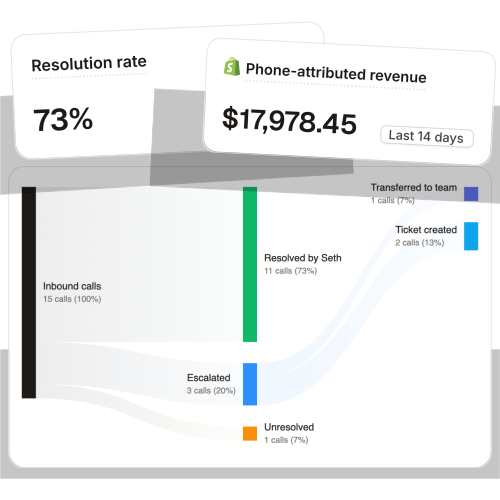
Here's the part that flips the math in your favor: handling refund calls well doesn't just cut cost, it recovers revenue. WashCo, a Shopify brand we launched, recovered $22,664 in its first 7 days on the phone, because calls that used to roll to voicemail turned into saved orders and saved customers instead.
The refund phone call is the expensive part
I read 50+ real refund-call transcripts before writing this, and the pattern is consistent: a refund call is the highest-emotion inbound a DTC brand gets. The customer feels they've already been wronged, their money is in limbo, and they want a human to tell them it's handled.
There are really two refund calls. One is the status call ("you said you refunded me, where is it?"), which is almost always the bank's 5-10 day settlement lag, not anything you did. The other is the dispute call ("I want a refund and your policy says no"), which is genuinely hard and needs a person. Most brands staff both the same way, with a stretched rep, and both calls suffer for it.
The status call is 100% repeatable, and the dispute call is where your team's judgment actually matters. Treating them the same is why refund handling feels so expensive.
Now the kicker. When that status call rolls to voicemail at 8 p.m., the customer doesn't wait politely. PCN research is blunt here: 85% of callers who can't reach a person never call back, and 62% switch to a competitor. Worse, a chunk of them call their bank instead, and now your unanswered refund question is a chargeback. The cheapest chargeback-prevention tool you own is a refund call that gets answered.
The transcripts made something else obvious. Most refund anxiety isn't about the policy, it's about silence. The customer doesn't know if you saw the email, doesn't know if the refund is moving, and the not-knowing is what makes them dial. A 20-second confirmation ("yes, it was issued Tuesday, your bank takes 5 to 7 days") defuses the whole thing. That's a call you should never pay a senior rep to take, and one you should never let go to voicemail either.
A refund workflow that protects margin and the customer
You don't need a 40-page returns manual. You need a repeatable six-step loop that's fast for the customer and cheap for you.
- Set the policy in plain language. Window, conditions, who pays return shipping, and what gets a cash refund versus store credit. Use our return policy generator if you're starting from scratch.
- Make the request frictionless. Self-service portal for the simple cases, a phone line for the anxious ones. Both should reach the same decision engine.
- Decide the method, not just yes/no. Cash refund, store credit, or returnless (keep the item). This is a decision, not a default.
- Communicate the timeline up front. Tell them about the 5-10 day bank lag before they call to ask. Half your refund calls disappear when you say this at the moment you issue the refund. Our refund email generator handles the wording.
- Resolve genuine disputes with a human. Escalate the hard calls to your CS team with full context, not a cold transfer.
- Measure and tighten. Track refund rate, refund-to-exchange ratio, and how many refund calls you're fielding per 100 refunds.
Speed pays. Following an instant refund, 23% of consumers make another purchase soon, per Signifyd. A refund handled fast and warmly is a retention event, not a loss. If you want the front end of this, see how to reduce product returns and the broader ecommerce return policy guide.
Refund policy decisions that actually move the numbers
A few policy levers do most of the work. They're worth getting right because each one shifts both cost and customer feeling.
- Refund window. Longer windows reduce anxiety and chargebacks but raise abuse. 30 days is the common floor; match it to your category's return rate.
- Return fees and restocking. 72% of US retailers now charge a return fee in 2026, up from 41% in 2023, and 53% of them report lower return rates as a result, per MakeMyReceipt. Used carefully, a fee filters casual returners without alienating good ones.
- Store credit with a bonus. A 5-10% bonus on store credit reliably shifts customers from cash refund to exchange, which keeps the lifetime value in your store instead of back on their card.
- Returnless refunds, per case. When return shipping plus handling costs more than the item is worth, just refund and let them keep it. The key word is per case. This is a per-SKU, per-customer decision, not a blanket policy you can be farmed for.
The brands that win on refunds treat policy as a set of dials, not a single switch. Tighten where abuse is high, loosen where the emotional payoff is bigger than the unit cost. For the chargeback side specifically, our chargeback prevention guide and chargeback management tools go deeper.
Refund abuse, friendly fraud, and the support lever
Refund abuse is real and growing, but the data says it's mostly abuse, not outright fraud. The Appriss Retail 2026 benchmark puts preventable loss near $100 billion in 2025: returns abuse accounts for about $86 billion (12% of returns) while flat-out fraud is around $14 billion (2%). Ravelin found 56% of merchants saw more fraudulent chargebacks and 54% saw more refund abuse year over year.
The reflex is to clamp down on policy. But the cheapest abuse-prevention lever is counterintuitive: be easier to reach. A customer who can get you on the phone asks for a refund. A customer who can't files a chargeback, which costs you roughly double and dings your ratio. And good support compounds: 89% of people are more likely to buy again from companies that offer excellent support, per Salesforce Research cited by Shopify.
This is also where voice quality matters. If the customer feels handled by something cold and robotic on an already-tense refund call, they escalate.
"My customers also feel like it's a normal person. They feel like they can communicate if they have questions."
Claudia Droge, TechCraft Studio
Tighten the policy on the SKUs that get farmed, and tighten the response time on everything else. Most refund abuse you can't fully stop, but most refund-to-chargeback escalation you can.
The refund metrics that tell you something's wrong
Most brands track return rate and stop there. Return rate tells you how much comes back. It doesn't tell you whether your refund handling is bleeding money or quietly building loyalty. A handful of sharper numbers do.
- Refund-to-exchange ratio. Of every customer who wants their money back, how many take store credit or an exchange instead of cash? If it's near zero, you're leaving lifetime value on the table. A small store-credit bonus moves this without touching your return rate.
- Refund calls per 100 refunds. This is the number nobody watches, and it's the one that exposes the hidden support cost. If you're fielding 30 or 40 calls per 100 refunds, your communication at the moment of refund is broken, and your team is paying for it.
- Time to refund. Not just bank settlement (you can't control that), but how long from the customer's request to you actually issuing it. Slow issuance is the single biggest driver of refund-status calls and chargebacks.
- Chargeback-to-refund ratio. How many disputes did you lose to the bank that should have been refunds you handled? Rising here means customers can't reach you, or don't trust you to act, before they hit the bank.
- Net refund cost. Goods plus processing plus the support hours. When you finally add the third layer, the real cost of a refund usually doubles versus the number on the finance dashboard.
If refund calls per 100 refunds is climbing, you don't have a refund problem, you have a phone problem. That's the lever most operators miss, because it lives in the CS team's day, not the finance report. For a full KPI breakdown, our ecommerce customer service guide covers the rest of the support dashboard.
What it costs to keep up with refund calls (and the math on fixing it)
Here's the operational reality. Refund-status calls are repeatable, they spike after hours, and they're emotionally loaded, which is the worst combination for a human team. So most brands either let them roll to voicemail (and pay in chargebacks and churn) or staff up (and pay in payroll).
Take a typical $50M Shopify brand running a 6-rep CS team:
| Line item | Today | With Ringly |
|---|---|---|
| 6 reps x $4K loaded per rep | $24,000/mo | n/a |
| Ringly Enterprise (~$5K/mo) | n/a | $5,000/mo |
| Net monthly CS spend | $24,000/mo | $5,000/mo |
| Monthly savings | n/a | $19,000/mo |
| Annual savings | n/a | $228,000/yr |
That's roughly 70% of repeatable calls (order status, refund status, returns, the same questions over and over) routed to the AI. The other 30%, the genuine refund disputes that need judgment, still go to your CS team, who now have the time to actually solve them.
Ringly.io is AI phone support for Shopify brands. Instead of hiring a new rep every time refund-call volume spikes, the AI answers inbound calls 24/7: it finds the order in Shopify, confirms refund status, explains the bank-settlement timeline, and rescues the call that would otherwise become a voicemail. Seth resolves up to 90% of calls autonomously. Anything that needs a human, like a real dispute, escalates cleanly to Gorgias, Richpanel, Reamaze, or whatever helpdesk you already run. See how that fits a 24/7 ecommerce phone support setup, and how WISMO and refund calls overlap in our WISMO calls breakdown.
If you're staring at the after-hours refund queue and doing this math, book a 30-min call and we'll run your numbers live.
For the wider picture, our guides on ecommerce customer service, ecommerce customer retention, Shopify refunds, and the ecommerce return statistics for 2026 connect the dots. If you're scoping support volume overall, the ecommerce call center page lays out the model.
Frequently asked questions
What's the difference between a refund and a chargeback? A refund is money you send back to the customer directly, so you control the experience and the timing. A chargeback is when the customer asks their bank to reverse the charge instead, which bypasses you, costs roughly twice the order value with fees, and counts against your dispute ratio. The goal is to keep refund situations from ever becoming chargebacks.
How long does an ecommerce refund take to reach the customer? Once you issue it, the money usually takes 5 to 10 business days to settle back on the customer's card, because of bank and card-network processing, not anything on your end. Counting return shipping and inspection, the full cycle averages about 9 to 10 days. Telling customers this upfront removes most of the "where's my refund" calls.
How much does it cost to process a refund? Handling a return averages about 21% of the order's value, which works out to roughly $10 to $65 per return once you add shipping, inspection, and restocking. Only about 48% of returned items get resold at full price, so the margin hit is bigger than the sticker number. The support time on refund calls is a real cost too, and most brands never count it.
Should I offer returnless refunds? Yes, but as a per-case decision, not a blanket policy. When the cost to ship and inspect an item back is more than the item is worth, refunding and letting the customer keep it saves money and feels generous. Just keep it tied to specific SKUs and customer history so it can't be farmed.
Can store credit replace cash refunds? For many cases, yes. Offering a 5-10% bonus on store credit reliably nudges customers from a cash refund toward an exchange, which keeps the lifetime value in your store. Just never force it where the customer is owed a genuine cash refund, or you'll push them toward a chargeback.
How do I reduce refund abuse without punishing good customers? Tighten policy on the specific SKUs and customers that get farmed, and tighten response time on everything else. Most abuse is hard to stop entirely, but most refund-to-chargeback escalation comes from customers who couldn't reach you fast enough, which you can fix. See our chargeback prevention guide for the detail.
Can AI handle refund and "where's my refund" calls? Yes. Refund-status calls are highly repeatable, so an AI phone agent can find the order in Shopify, confirm the refund was issued, and explain the settlement timeline 24/7. Genuine disputes that need human judgment escalate to your team with full context. Ringly resolves up to 90% of inbound calls autonomously.
Talk to us

If you run a $10M-$100M Shopify brand, refunds aren't going away, but the refund queue eating your team's afternoon can. If your phone rolls to voicemail while a customer is staring at a pending refund, that's the moment a refund turns into a chargeback. A 30-min call is the fastest way to see what your refund and status calls are actually costing you.
Our 3 promises.
- Live in under 1 hour. Setup and test calls are free.
- 30-day money back on the $99 plan fee.
- 65% resolution guarantee: if Seth resolves under 65% of your support calls in a month, that month comes back as credit (after 90 days on Pay per call).
Ruben (Ringly co-founder) takes these calls personally.