

This post in 30 seconds.
- Most $10M+ Shopify brands answer fewer than half their calls and never see the revenue walking out the door after 6 p.m. Here's how to fix the answer rate, the hold time, and the after-hours gap.
- You'll get the five numbers to run your phone line on, plus seven practices that actually move them, with real 2026 benchmark targets you can measure against this week.
- Written for founders, COOs, and Heads of CX at $10M-$100M Shopify brands running a paid helpdesk and a visible phone number, with 3-12 reps.
Your Gorgias queue has 217 unread tickets stacked since Friday 6 p.m. A third of them are some version of "where's my order." There are five voicemails on the weekend line, one from a customer who called five times on Saturday. Nobody returned them, and nobody can tell you what those calls were worth.
That's the real state of ecommerce phone support at most brands your size. Not bad reps. Not a bad helpdesk. Just a phone line that quietly drops calls and a team that can't keep up with the routine stuff, so the calls that actually matter wait in line behind "did my package ship."
I'm Ruben, co-founder of Ringly.io. I called five DTC brands' published phone lines at 11 p.m. on a Tuesday to write this. Four went to voicemail, one rang out. Then I pulled the call data from the 50+ Shopify brands we run phone support for and lined it up against the 2026 industry benchmarks. The gap between what brands think their phone line does and what it actually does is the whole story.
If you run a $10M-$100M Shopify brand and your phone backlog only ever grows, the practices below are the ones that move the numbers. If you'd rather just see what your own line is leaking, book a 30-min call and we'll review your missed calls live.
How I built this list
The practices here come from one place: what's actually working on the phone lines of the 50+ Shopify brands on Ringly right now, cross-checked against where the 2026 benchmark data says the bar sits.
I pulled call volume, resolution rates, and after-hours patterns from our dashboard. I made the 11 p.m. test calls myself. And I checked every benchmark number below against published industry data (Nextiva's 2026 call-center benchmarks, the PCN missed-call study, Salesforce on WISMO) so you're not taking my word for the targets.
Where a number is a Ringly customer result, I say so. Where it's an industry figure, it's linked. The point isn't theory. It's the handful of moves that separate a phone line that recovers revenue from one that burns payroll.
First, the number nobody on your team can answer
Ask your Head of CX what your phone answer rate was last week. Most can't tell you, because the data sits split across Gorgias, Shopify, and whatever your carrier reports.
Here's why that blind spot is expensive. Across all businesses, only about 37.8% of inbound calls get answered. And the callers you miss don't wait around: 85% of people who can't reach a person never call back, and 62% switch to a competitor, according to the 2026 PCN missed-call study. Roughly 30-40% of those missed calls happen outside business hours.
That last part is where the real money leaks. One ecommerce brand tracked it and found it was dropping 38% of its after-6 p.m. calls, about $200,000 a year to voicemail. And the voicemail isn't a safety net: 80% of callers routed to voicemail hang up without leaving a message.
The calls you never see are worth more than the calls you answer, because the ones you miss are the ones already trying to give you money. Some are checking on an order they're nervous about. Some are about to place a phone order because they don't trust the website. After 6 p.m., all of them hit a wall.
Then there's WISMO. "Where's my order" calls are 30-40% of support volume in a normal month and over 50% at peak, and each one costs $5 to $12 to handle by hand. That's not customer service. That's your team reading a tracking number out loud, all day, for the price of a real conversation.
Put those two leaks together and the picture is clear. You're paying a trained team to read tracking numbers during the day, and you're sending revenue to voicemail at night. Neither problem is a people problem. Both are routing problems, and routing problems have cheap fixes once you can see them.
WashCo, a Shopify brand we launched, recovered $22,664 in its first 7 days on the phone, most of it from calls that used to roll to voicemail. The leak is real and it's measurable. The first best practice is just to start measuring it.
The five numbers to run your phone support on
You can't fix what you don't track. Before any tactics, agree on the five numbers and the targets. These are the 2026 benchmarks, pulled from Nextiva's call-center standards and adjusted for retail.
| Metric | 2026 target | Why it matters |
|---|---|---|
| Answer rate | 80-90%+ | The single number that predicts lost revenue |
| Average speed of answer | Under 40 seconds | Past this, callers start dropping |
| Hold time | Under 1 minute | 60% hang up by 2 minutes |
| Abandonment rate | 2-5% | Above 5% means you're understaffed or misrouted |
| First call resolution | 80%+ | Repeat calls double your real cost per issue |
A few of these deserve a note.
The classic service-level target is the 80/20 rule: answer 80% of calls within 20 seconds. It's still the right north star, even if you only hit it during staffed hours.
Hold time is where you bleed goodwill fastest. The industry average hold is over five minutes, but 60% of callers hang up after about two minutes, and 90% are gone by five. Anything over a minute is a problem you can see.
First call resolution is the metric that quietly fixes your cost-per-call, because every "I'll have to call you back" is a second touch you pay for twice. Push first call resolution toward 80% and your average handle time stops being the number that matters.
Seven phone support practices that actually move those numbers
The targets are the easy part. Here's what actually moves them, ranked roughly by impact for a brand your size.
1. Make the number easy to find, and easy to dial
Put a real phone number on the homepage, the contact page, and the order-confirmation email. On mobile, make it a click-to-call link, not an image. A customer who has to copy a number into their dialer is a customer you've already half-lost.
This sounds obvious, and plenty of brands still do the opposite: they bury the number, or drop it entirely, to suppress volume. That doesn't reduce the demand. It just moves the angry version of it to Trustpilot and to your founder's DMs. If you're confident your phone line can handle the calls, advertise it. The brands with the best support put the number where you can't miss it, because the call is a sales channel, not a cost to hide.
2. Answer fast, or route fast
The 80/20 rule only works if calls land somewhere in 20 seconds. If you can't staff that, the next-best move is an instant route by reason: order status here, returns there, everything else to a person. The goal is that no caller sits wondering whether anyone's coming.
The old way to do this was a phone tree with seven options and a "press 9 to repeat." Don't. Long menus are where callers give up. Keep the routing to two or three branches at most, and make the most common reason (almost always order status) the first thing the caller can resolve without waiting for a human at all.
3. Kill hold time before it kills the call
Two moves cut hold time more than any staffing change. Offer a callback instead of a queue, so the customer keeps their place in line without keeping the phone to their ear. And route by call reason up front, so simple calls never sit behind a complex one.
The math here is brutal and worth repeating: the industry average hold is over five minutes, but most callers are gone long before that. If your busy-hour hold creeps past a minute, you're not managing a queue, you're losing customers in real time. The brands that run after-hours coverage well treat hold time as a design problem, not a staffing problem. The fix is almost never "hire faster typists." It's "stop sending simple calls to the same line as hard ones."
4. Give the rep order context before they pick up
Nothing wastes a call like a rep asking for an order number the system already has. Connect your phone layer to Shopify and your helpdesk so the rep sees the customer, the last order, and the open ticket the moment the call connects. If you run Gorgias, Zendesk, or Gladly, the integration usually exists. Most teams just never turned it on.
5. Route WISMO out of the human queue
This is the single biggest win on the list. If 30-40% of your calls are the same "where's my order" question, those should never reach a rep. A phone agent that pulls the live order status from Shopify and reads it back resolves the call in under a minute, any hour. Your reps get the 30% of calls that actually need a human. That one change is what takes most brands from "drowning in calls" to a queue that empties.
6. Write your escalation hard-rules down
Automating the routine only works if the exceptions are crisp. Decide, in writing, which calls always go straight to a human. A good starting list: grief or pet-loss calls, anything legal or safety-related, a customer who's already escalated twice, a chargeback threat, and any account above a revenue threshold you set. Those are the calls where getting it wrong costs you a customer or a lawsuit, so they never touch automation.
Hard-code each one as a smart transfer rule with a named owner on the other end. The brands that get AI phone support wrong are the ones that skipped this step and let the system try to handle a call it had no business handling. The brands that get it right spend an afternoon writing the escalation list before they automate a single call.
7. Cover after-hours without a night shift
The after-hours gap is where the revenue is, and a night shift is the worst way to close it. Volume after 6 p.m. is bursty and unpredictable, so a human sits idle most of the shift and still misses the spike. The practical answer is an AI phone agent that takes the routine after-hours calls and escalates the rest by your rules. The customer who calls at 11 p.m. gets an answer instead of voicemail, and you don't pay anyone to wait for them.
This is also the practice that pays for itself fastest. Remember the brand that was losing 38% of its after-6 p.m. calls to voicemail, about $200,000 a year. Closing that gap isn't a cost. It's recovered revenue that was already trying to reach you. Start measuring your after-hours answer rate for one week and you'll see your own version of that number.
If your phone goes quiet after 6 and you want to see what that's costing in real numbers, book a 30-min call and we'll do the math on your actual volume.
Why hiring your way out of this doesn't pencil
The instinct is to staff up. The math says don't.
A US-based CS rep runs about $4,000 a month loaded, once you count benefits, payroll tax, training, and the churn you'll eat. And on an after-hours shift, that rep is idle most of the time, because the volume isn't steady enough to keep one person busy. You're paying full freight for coverage that's empty 60% of the night.
Then there's the replacement treadmill. It costs around $14,113 to replace a single CS rep, the ramp to productivity is six to eight months, and most new reps quit inside the first year. The next hire is rarely the answer to a phone backlog. It's just the answer that feels normal because everyone's CFO has been trained to approve it. That's exactly why brands are rethinking outsourced and in-house support headcount before they add seat number five.
"My customers also feel like it's a normal person. They feel like they can communicate if they have questions."
Claudia Droge, TechCraft Studio
What this costs you today vs with an AI phone agent
Here's the comparison most teams never run. Take a $50M Shopify brand with a 6-rep CS team.
| Line item | Today | With Ringly |
|---|---|---|
| 6 reps × $4K loaded per rep | $24,000/mo | n/a |
| Ringly (illustrative) | n/a | $5,000/mo |
| Net monthly CS spend | $24,000/mo | $5,000/mo |
| Monthly savings | n/a | $19,000/mo |
| Annual savings | n/a | $228,000/yr |
That's the roughly 70% of calls that are repeatable (order status, returns, product questions, the same five things over and over) routed to the AI. The other 30%, the genuinely complex calls, still go to your team, who finally have the time to solve them properly.
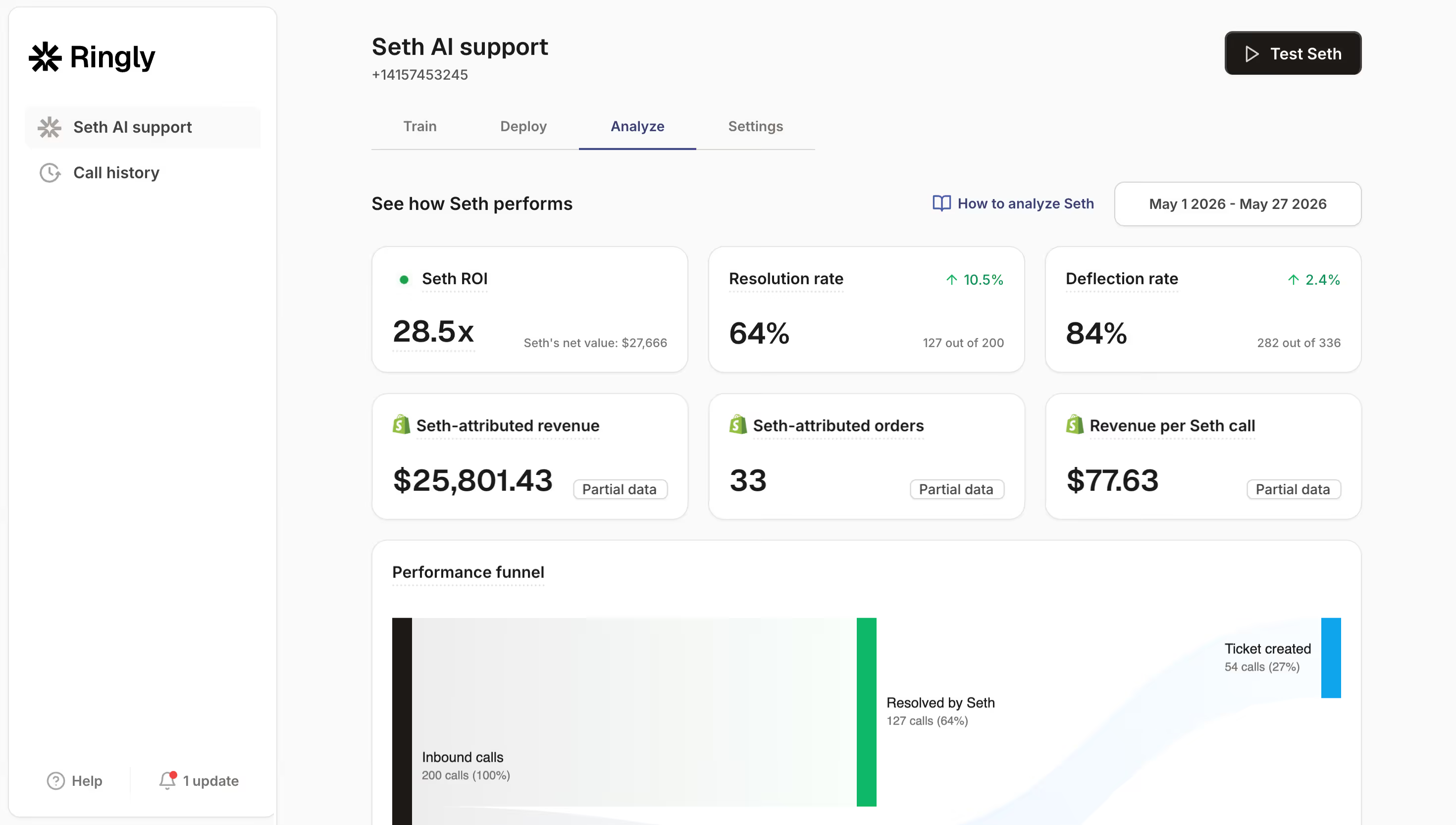
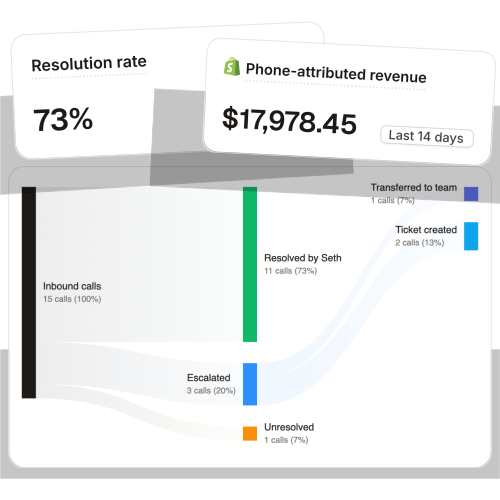
Ringly.io is AI phone support for Shopify brands. It answers inbound calls 24/7, finds orders in your store, handles returns, answers product questions from your knowledge base, and escalates cleanly to the helpdesk you already run. Across 50+ brands, it resolves 73% of calls autonomously at roughly $0.42 per resolved call. TechCraft Studio handles 88% of its calls without a human ever picking up.
And the most common thing customers say after a call is that they didn't realize they were talking to AI. You keep your number, your helpdesk, and your escalation rules. You just stop dropping calls. If you want to compare it to your current setup, the pricing is here, and the full picture is on the AI phone support page for Shopify.
Frequently asked questions
What's a good answer rate for an ecommerce phone line? Aim for 80-90% or higher during staffed hours, with 80% of calls answered inside 20 seconds. If you're below 60%, you're almost certainly losing revenue to voicemail and don't have the data to see it yet.
How do I handle after-hours calls without hiring a night shift? A night shift is the expensive answer because after-6 p.m. volume is bursty, so the rep sits idle most of the shift. The practical fix is an AI phone agent that handles routine after-hours calls and escalates the rest by your rules, so callers get an answer instead of voicemail nobody returns.
How much of phone support can actually be automated? For most Shopify brands, about 70% of calls are repeatable: order status, returns, simple product questions. Those resolve without a human. Ringly customers run at 73% resolution on average, with the complex 30% escalating to the team.
Won't customers be annoyed talking to AI? The risk is real if it sounds like a chatbot reading a script. The thing customers say most often after a Ringly call is that they didn't realize it wasn't a person. Voice quality is what makes or breaks this, so test it with your own ears before you judge the category by a bad past experience.
Does an AI phone agent work with Gorgias or my existing helpdesk? Yes. It sits in front of your helpdesk, not in place of it. Calls that need a human escalate cleanly to Gorgias, Zendesk, Re:amaze, or whatever you already run, and you control exactly what escalates.
How fast can I get phone support set up? On the self-serve plans you can be live in under an hour by pointing it at your site and docs. For a done-for-you build on a larger brand, we run a 14-day Launch Sprint and handle the setup ourselves.
What's the one metric I should start tracking this week? After-hours answer rate. Almost no brand your size tracks it, and it's where the recovery is biggest. Pull last week's calls, split them by hour, and look at how many after 6 p.m. went to voicemail. That single number usually makes the case on its own.
Talk to us

If you run a $10M-$100M Shopify brand and your phone goes quiet after 6 p.m., a 30-min call is the fastest way to see what that's costing you. We'll pull your missed-call pattern and do the math on your actual volume.
The 3-layer guarantee.
- Live in 14 days or it's free until launched.
- 65% resolution in 90 days or we refund the last 3 months of subscription fees.
- We keep working free until we hit it.
Ruben (Ringly co-founder) takes these calls personally.