
Returns software moves the box. It does not pick up the phone.
- Selling across Shopify plus Amazon, eBay, or Walmart splits one return into three systems with three different policies, and the customer still calls your one number to ask where their refund is.
- The marketplace returns tools below (Loop, ReturnGO, AfterShip, Narvar, ReadyReturns, ClickPost) route the package well. None of them answer a phone.
- Written for founders, COOs, and Heads of CX at $10M-$100M Shopify brands that also sell on marketplaces and keep a visible phone line.
You sell on Shopify. You also sell on Amazon, maybe eBay, maybe Walmart. A customer buys a jacket on one of them, decides it runs small, and starts a return. Now three things happen in three systems, on three different timelines, under three sets of rules you don't fully control. And the customer, who thinks of you as one brand, calls your one published phone number to ask the same question every time: did you get my return, and where's my refund.
That's the part marketplace returns software doesn't solve. It moves the box across channels. The call still lands on your team.
If you run support at a Shopify brand doing $10M-$100M that also sells across marketplaces, you already know the phone backlog that builds the week after a big sale. This is what 50+ Shopify brands we work with do with it. Book a 30-min call and we'll show you what those refund-status calls are costing you across every channel.
What makes marketplace returns different from a single-store return
A return on your own Shopify store is simple. One policy, one refund clock, one system. Sell the same SKU across three marketplaces and that simplicity disappears.
Each marketplace enforces its own return policy, and that policy can override the settings you use on your own store. Amazon can push automatic refunds in cases where you'd rather inspect the item first. Walmart's Multichannel Solutions only accepts returns by mail, never in store, and requires you to refund within 48 hours of receiving the item, with a processing fee charged by weight the moment the package is scanned (Walmart Marketplace). eBay lets you manage returns more independently. Three channels, three rulebooks.
Then there's routing. Depending on where the order came from, the package goes back to a different hub, gets refunded on a different timeline, and shows up in a different dashboard. You lose the single source of truth you had when everything ran through Shopify.
The money behind this is real. Reverse logistics can eat 20-30% of a product's original value, and only about 48% of returned items get resold at full price (SmartRoutes). With the average ecommerce return rate now sitting around 19-20% and apparel closer to 25% (Eightx), a sloppy multi-channel returns process isn't a minor annoyance. It's a margin problem. US returns losses hit an estimated $685 billion in 2024 (ReadyCloud).
Good returns management software exists to tame that mess. Let's look at what it actually does.
What marketplace returns software actually does (and what it costs)
Returns software gives the customer a self-service portal, applies your rules (refund, exchange, store credit), generates the label, and tracks the package back to your warehouse. The good ones add fraud checks, exchange incentives, and analytics so you can see which products come back and why.
The catch is that most of the popular tools are built tight to Shopify, and only a few genuinely span Amazon, eBay, and Walmart alongside your store. Here's how the main options compare.
| Tool | Best for | Channels | Pricing (2026) | Verdict |
|---|---|---|---|---|
| Ringly | The post-return phone call, across every channel | Shopify + your phone line | $349-$799/mo, Enterprise custom | Not a returns portal. The voice layer that answers the calls the portal creates. |
| Loop Returns | Exchange-first Shopify DTC | Shopify / Shopify Plus | ~$29-$340/mo + volume | Strong exchanges, Shopify-only |
| ReturnGO | AI exchanges on a budget | Shopify, Magento 2 | ~$23-$447/mo | Good value, not multi-marketplace |
| AfterShip Returns | Fast multi-platform setup | Shopify, BigCommerce, Magento, SFCC | ~$9-$340/mo | Multi-platform, light on marketplace policy |
| Narvar | Enterprise omnichannel | Shopify Plus, SFCC, Magento | ~$30k-$45k/yr | Powerful, enterprise pricing |
| ReadyReturns | True multi-marketplace | Amazon, eBay, Walmart, Shopify + more | Quote-based | Closest to real marketplace coverage |
| ClickPost | Multi-carrier reverse logistics | Shopify, Magento, WooCommerce + OMS | Custom quote | Carrier breadth, less DTC-native |
A few quick reads on the list:
- Loop Returns is the exchange-first favorite for Shopify Plus brands and rates 4.7 on G2, but it lives in the Shopify ecosystem. It won't reconcile an Amazon or Walmart return for you.
- ReturnGO leans hard into AI-driven exchanges and store credit and rates 4.8 on G2. Great value for a growing Shopify brand, still not a true marketplace tool.
- AfterShip Returns spans more platforms (Shopify, BigCommerce, Magento, SFCC) with fast setup, which makes it a reasonable pick if you're spread across storefronts rather than marketplaces.
- Narvar is the enterprise choice with drop-off networks and omnichannel routing, but pricing typically lands in the $30,000-$45,000 per year range.
- ReadyReturns is one of the few that actually connects Amazon, eBay, Walmart, and your own store into one returns flow, which is the real "marketplace" promise in this category.
- ClickPost brings 500+ carrier integrations and a strong reverse-logistics engine, better suited to brands optimizing the physical return than the DTC experience.
If you want a wider field of options, our roundup of the best returns management software for ecommerce goes deeper, and the Shopify returns app guide covers the Shopify-native side. Pick whichever one fits how you sell. Then notice what every single one of them has in common.
The gap every returns tool shares: none of them answer the phone
Across the 50+ Shopify brands we run phone support for, the single highest-volume call after a return isn't "how do I send this back." The portal already handles that. It's "did you get my return," and "where's my refund," and "I sent it back two weeks ago and nothing's happened."
Returns software routes the package. It has no idea your customer is on hold right now asking about it. That call is a WISMO call wearing a different hat, and on a multi-channel brand it's worse, because the answer depends on which channel the order came from and the customer has no clue. They bought on Amazon, the refund clock is Amazon's, but they're calling your number because yours is the one on the box.
The stakes are higher than they look. 25% of customers say a delay in return processing creates a negative experience, and 92% say they'll buy again from a brand that handles returns well (ChannelReply). The return itself might be smooth in the portal. The refund-status call is where the relationship gets won or lost, and a voicemail you never return is a customer you taught to check Trustpilot instead.
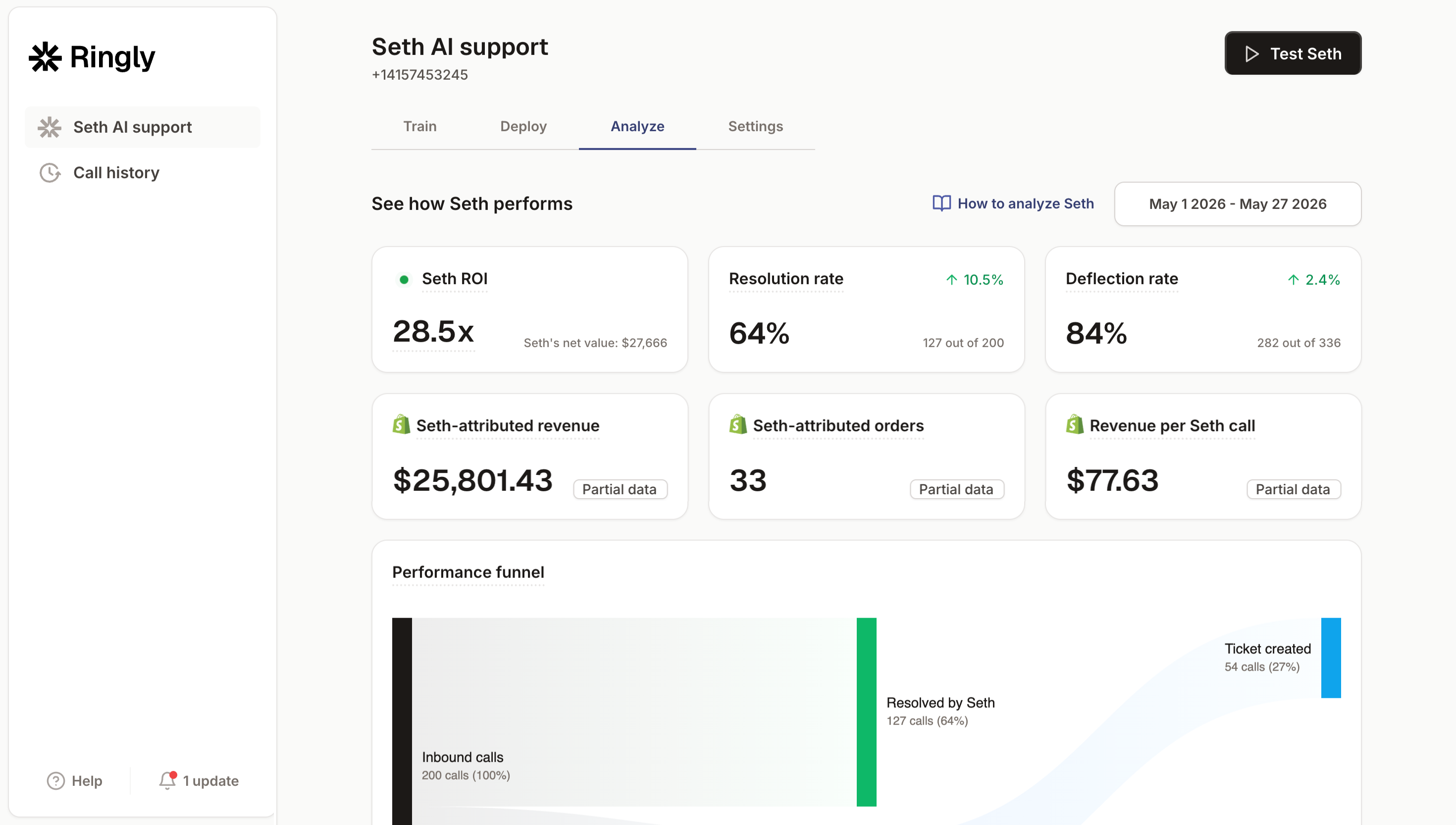
This is where an AI phone agent fits next to your returns stack. It picks up every call, pulls the order from Shopify (or the order tracking source you connect), tells the caller exactly where their return and refund stand, and only routes to a human when the call genuinely needs one. WashCo, a Shopify brand we launched, recovered $22,664 in its first 7 days on the phone, because answered calls turn into kept customers and saved orders instead of abandoned ones.
If your phone rings every time a refund runs slow across channels, book a 30-min call and we'll do the math on that call volume with you.
What this costs your team today vs an AI phone layer
Put a number on it. Take a typical $50M Shopify brand selling across a few marketplaces, running a 6-rep customer service team.
| Line item | Today | With Ringly |
|---|---|---|
| 6 reps × $4K loaded per rep | $24,000/mo | n/a |
| Ringly (~$5K/mo) | n/a | $5,000/mo |
| Net monthly CS spend | $24,000/mo | $5,000/mo |
| Monthly savings | n/a | $19,000/mo |
| Annual savings | n/a | $228,000/yr |
Roughly 70% of those calls are the same questions over and over: return status, refund timing, where's my order. Across 50+ brands the AI resolves 73% of inbound calls on its own at about $0.42 per resolved call, versus the $7-$16 a human-handled call runs at a typical BPO. The 30% that are genuinely complex still go to your support team, who now have time to actually solve them instead of reading tracking numbers off a screen all day.
"My customers also feel like it's a normal person. They feel like they can communicate if they have questions."
Claudia Droge, TechCraft Studio
You don't have to grow a call center headcount every time you add a sales channel. That's the trade most multi-channel brands miss.
How to choose, and where Ringly fits
Two decisions, not one. First, pick the returns software that matches how you sell. Second, decide who answers the phone after the return.
For the returns portal:
- Choose ReadyReturns or ClickPost if you genuinely need Amazon, eBay, and Walmart returns reconciled with your Shopify store in one flow.
- Choose Loop or ReturnGO if you're mostly Shopify and care most about turning refunds into exchanges.
- Choose AfterShip if you're spread across storefronts and want fast multi-platform setup.
- Choose Narvar if you're enterprise and need drop-off networks plus omnichannel routing, and the budget is there.
For the phone, the field is empty, because none of those tools answer one. Ringly.io is AI phone support for Shopify brands. It isn't a returns portal and won't pretend to be one. It sits in front of your helpdesk and handles the inbound calls your returns stack generates: order status, return status, refund timing, product questions, abandoned-cart rescue. Across 50+ brands it resolves 73% of calls autonomously, escalates the rest cleanly to Gorgias, Richpanel, Re:amaze, or whatever you already run, and goes live in under an hour. Plans are Grow $349/mo, Pro $799/mo, and Enterprise by call, all backed by a 65% resolution guarantee.
The returns software keeps the box moving. Ringly keeps the customer service app and the phone line from drowning while it does. If you want the returns best practices playbook alongside this, we keep one updated too, and an AI receptionist for ecommerce overview if you're newer to the voice side.
Frequently asked questions
What is ecommerce marketplace returns software?
It's software that manages and tracks product returns across multiple sales channels (your Shopify store plus marketplaces like Amazon, eBay, and Walmart) from one place. It applies your return rules, generates labels, and tracks packages back, so you're not juggling each channel's policy by hand.
Can one tool handle Amazon, eBay, Walmart, and my Shopify store?
A few can. ReadyReturns and ClickPost are built to connect multiple marketplaces alongside your own store, while Shopify-native tools like Loop and ReturnGO mostly stay inside the Shopify ecosystem. Check the channel column before you commit.
Why do customers still call me after a marketplace return?
Because customers think of you as one brand even though their order lives in one of several systems. They call your published number to ask where their refund is, regardless of which channel they bought on, and returns software has no way to answer a phone.
Does returns software reduce my support call volume?
It reduces the "how do I return this" questions by giving customers a self-service portal. It doesn't touch the "where's my refund" follow-up calls, which is where most of the post-return phone volume actually lives.
How much does marketplace returns software cost?
It ranges widely. Shopify-native tools start around $9-$29/mo and scale with volume, mid-market tools run $150-$450/mo, and enterprise platforms like Narvar are quote-based at roughly $30,000-$45,000 per year.
Does Ringly replace my returns software?
No. Ringly is the AI phone layer that answers the calls your returns software generates. You keep your returns portal for the logistics and add Ringly so the refund-status calls don't pile up on your team. The two work together.
Talk to us

If you sell across Shopify, Amazon, eBay, and Walmart and your phone rings every time a refund is slow, a 30-min call is the fastest way to see what that volume is costing you.
The 3-layer guarantee.
- Live in 14 days or it's free until launched.
- 65% resolution in 90 days or we refund the last 3 months of subscription fees.
- We keep working free until we hit 65%.
Ruben (Ringly co-founder) takes these calls personally.