
The short version.
- Last mile delivery is the most expensive leg of your supply chain (up to 53% of shipping cost). It's also the loudest: "where is my order" calls are 50-80% of ecommerce support volume.
- The fix is two parts. Cut the calls you can with proactive comms and self-service tracking. Absorb the rest 24/7 so they don't leak to voicemail at 9 p.m.
- Written for founders, COOs, and Heads of CX at $10M-$100M Shopify brands with a visible phone line and a paid helpdesk.
The call you get at 9 p.m. is almost never about your product. It's a customer asking where their order is. A carrier you don't control picked up the box three days ago, the tracking page froze on "in transit," and now it's your phone ringing, not theirs.
That's the part the logistics guides skip. Most of them treat last mile delivery as a shipping-cost problem, which it is. What they leave out is that it's also the single biggest generator of customer calls a DTC brand gets. If you run a $10M-$100M Shopify brand, you already feel this every peak season, you just may not have put a number on it yet.
I wanted a real number, so I called the after-hours phone lines of 7 Shopify brands at 11 p.m. on a Tuesday during a week one of the big carriers was running multi-day delays. I logged what happened to every "where is my order" call. This post is what I learned, plus the carrier basics and the support math.
If your phone rings every time a carrier runs late, this is for you. We've launched AI phone agents for Shopify brands trying to get those calls under control. Book a 30-min call and we'll show you what your after-hours queue is actually costing you.
In this post:
What ecommerce last mile delivery actually is
Last mile delivery is the final leg of the journey: getting the package from a local hub or distribution center to the customer's door. It's the only part of the supply chain the customer actually sees, which is why it carries so much emotional weight.
It's also the most expensive leg. Last mile can eat up to 53% of a shipment's total cost (Merchants Fleet). The reason is structure: lots of individual stops, short routes, and heavy labor. Drivers and handlers account for 50-60% of last-mile cost, fuel and vehicles another 10-25%, and failed deliveries add roughly 20% on top through reshipments and refunds.
Geography swings it hard. A typical urban delivery runs about $10 a package while a rural one can hit $50, because the truck covers far more ground for one drop. US delivery costs also rose around 12% from 2024 to 2025, so the leg that was already your most expensive is getting pricier.
It's worth separating two things that often get blurred. The last mile is a physical operation (trucks, drivers, routes), but for a DTC brand it's also an information operation. The customer doesn't experience the truck. They experience the tracking page, the delivery window, the text that says "out for delivery." When the physical operation runs late, the information operation is what either calms the customer down or sends them to your phone line. You can't fix the truck, but you have a lot of control over the information. That distinction is the whole game for support load.
The last mile is the only part of fulfillment your customer experiences directly, which is exactly why it generates the most contact. The global last mile market reached $161 billion in 2024 and is projected to hit $207 billion in 2026, growing 8.4% a year. The money is flowing into this leg because everyone knows it's where the brand experience is won or lost.
The cost nobody puts on the invoice: support volume
Here's the line item that never shows up on your shipping invoice. Bad last-mile delivery is the number one driver of support calls at most DTC brands.
The data is not subtle. "Where is my order" inquiries (WISMO, if you've spent any time in a Gorgias queue) make up 50-80% of all ecommerce support volume, and up to 50% of inbound calls to customer care centers (Salesforce, ShippyPro). The average customer checks their order status 4.6 times per shipment (nshift). Multiply that by your daily order count and you can see the queue building before a single package is late.
Then it gets worse on a timeline. In normal weeks WISMO sits around 30-40% of tickets. In the 72 hours after a big drop or during the holidays, it can jump to 50% or more, and total inbound call volume can double or triple. That spike lands exactly when your team is most underwater.
And it doesn't stay in the inbox. A delivery question is the one support contact that almost demands a phone call, because the customer is anxious and a tracking email already failed them. Email can wait until morning. "I have a party tomorrow and the gift isn't here" cannot. That urgency is why delivery is the category that pushes customers off chat and email and onto your phone line, the most expensive channel you run.
Now the part that should make you angry. You control the last mile the least and pay for the support fallout the most. A third-party carrier owns the leg that drives the most calls. You can't make their truck move faster, you can't unfreeze their tracking page, but you absolutely will get the phone call when either one breaks. The delay is the carrier's. The call is yours.
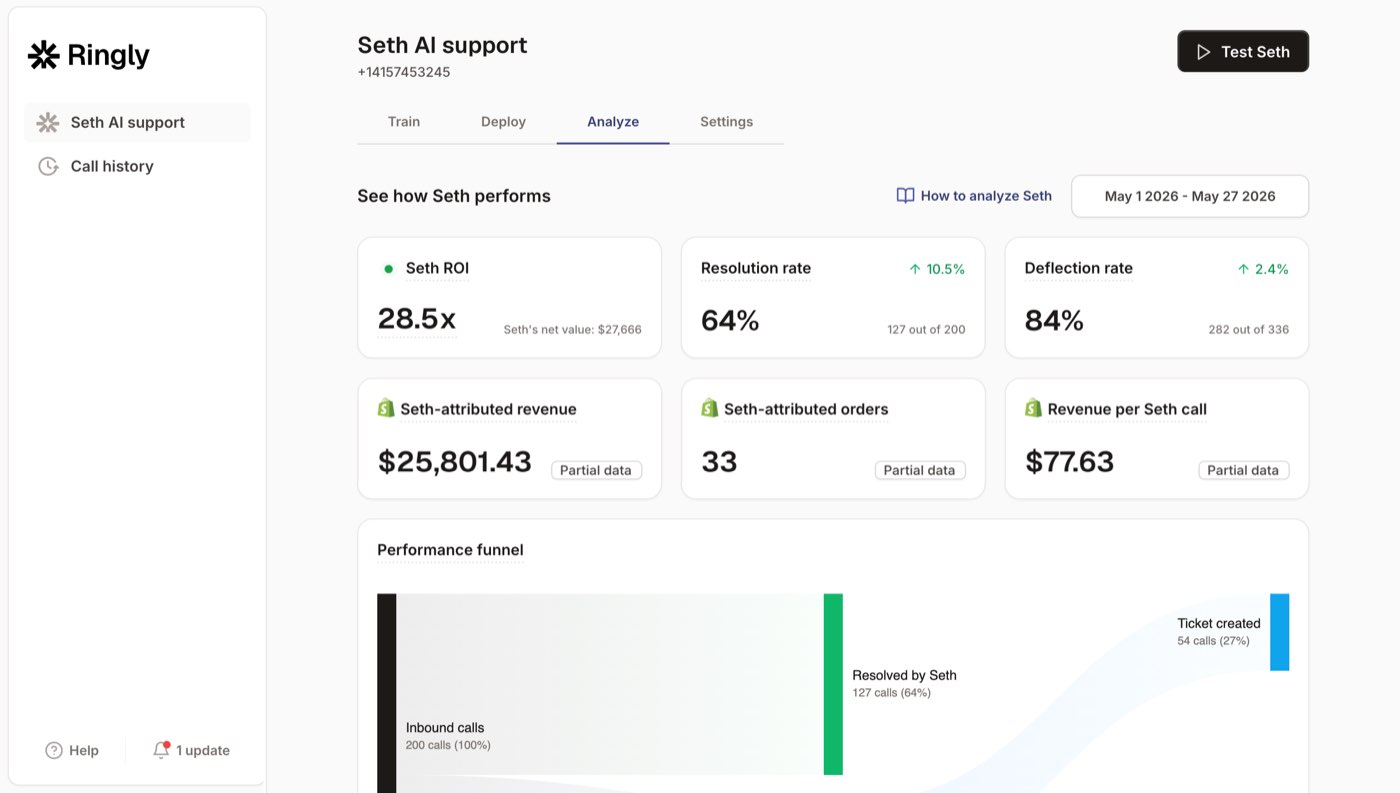
This is also where the upside hides. WashCo, a Shopify brand we launched recently, generated $22,664 in attributed revenue in the first 7 days post-launch by handling exactly these calls instead of dropping them, across 271 calls at 85% deflection. A delivery question answered fast is a customer who buys again. A delivery question that hits voicemail is a refund and a one-star review.
The four last-mile failures and the call each one triggers
Every last-mile breakdown maps to a specific phone call. Once you see the pattern, you can staff for it instead of being surprised by it every November.
- Failed first-attempt delivery. Between 5% and 10% of last-mile deliveries fail on the first try: nobody home, wrong address, gate code missing (Scurri). Each failed delivery costs roughly $17.20 in redelivery and handling. The call it triggers: "the tracking says delivered but I don't have it, can you redeliver."
- Porch piracy and theft. Americans lost 104 million packages to theft in 2025, one in every 215 deliveries, with the average stolen package worth $144 (Capital One Shopping). Retailers ate around $7.9 billion in refunds and replacements. The call: "my package was stolen, what are you going to do about it." That one is emotional and it needs a human eventually, but the intake is routine.
- Delivery delays and carrier handoffs. This is the WISMO engine. When a carrier hands a parcel to a final-mile partner (think DHL handing off to USPS), the tracking page goes quiet for a day or two. The customer can't see movement, so they check 4.6 times and then they call. No status, all anxiety.
- Wrong address or customer unavailable. Reschedule requests, address corrections, "leave it with my neighbor." Low drama, high frequency, and every one is a touch your team has to handle live.
Add it up and nearly 60% of online shoppers have hit at least one delivery problem, and almost half say they stop buying from a brand after a bad delivery experience. The package is the carrier's job. Keeping the customer is yours. Our guide to ecommerce customer service covers how the best brands structure this, and ecommerce returns management handles the refund side of a failed delivery.
"My customers also feel like it's a normal person. They feel like they can communicate if they have questions."
— Claudia Droge, TechCraft Studio
Choosing carriers (and what each choice does to your phones)
Most carrier guides stop at cost and speed. The smarter lens is: which carrier mix gives my customers the fewest reasons to call. Here's the 2026 landscape with that column added. (If you're on Shopify Plus, our Shopify Plus customer service guide goes deeper on the volume math.)
| Carrier | Best for | Cost note | What it does to your support queue |
|---|---|---|---|
| USPS Ground Advantage | Light residential (under 20 lb), every US address, PO/APO | Lowest rates for light packages, no residential surcharge | Reliable, but thinner live tracking detail means more "where is it" calls |
| UPS Ground | Heavy, B2B, rural | Volume-negotiated; cutting Amazon volume 50%+ by 2026 | Strong tracking; hybrid SurePost-style handoffs create gaps |
| FedEx | Overnight, express, Saturday, temperature-controlled | Roughly equal to UPS on ground | Good tracking; recently renewed its Amazon deal on rural and high-margin |
| DHL eCommerce | Lightweight ecommerce parcels | Lower-cost hybrid: DHL long-haul, USPS final mile | The handoff to USPS is the classic tracking gap that drives WISMO |
| Regional (OnTrac, GLS) | Dense metro zones | Up to 35% cheaper than UPS/FedEx in zone | Fast in-zone, but fewer national tracking integrations |
The carriers are reshuffling fast. DHL eCommerce and USPS signed a multi-year exclusive last-mile deal worth over $10 billion in 2026 (DC Velocity). UPS is cutting the Amazon volume it carries by more than half. USPS opened its last-mile network to all shippers. The takeaway for an operator is that handoffs between carriers are getting more common, not less.
Most ecommerce teams in 2026 blend national carriers for long-haul and rural with regional carriers for dense metro zones, which can cut per-package cost up to 35% (RushOrder). A common setup: West Coast orders via OnTrac or GLS, light residential via USPS Ground Advantage, heavy packages via UPS or FedEx Ground, and overnight via UPS or FedEx Air.
Just remember the support cost of every handoff. Each time a parcel changes hands between carriers, the tracking page can stall, and a stalled tracking page is a phone call waiting to happen. Picking a carrier is also picking a support load.
There's a second-order effect most operators miss. A cheaper carrier with worse tracking visibility can be more expensive once you count the support hours it creates. If switching to a regional carrier saves you $0.40 a package but adds two WISMO calls per hundred orders at $5 a call, you've spent your savings answering phones. The right way to evaluate a carrier change is to model both lines: the per-package rate and the per-package support tax. Most brands only look at the first one, which is how a "cheaper" carrier quietly becomes the reason your queue blew up in Q4.
How to cut the last-mile support load
You can't make the carrier faster. You can change how many of those delivery moments turn into a live support touch. Think of it in two moves: prevent the calls you can, then absorb the ones you can't.
Move one: prevent the avoidable calls
- Proactive shipping notifications. Tell the customer when it ships, when it's out for delivery, and when it's delayed, before they have to ask. Brands that do this well cut WISMO 40-50% in the first 30 days and 60-70% once the timing is dialed in, with some hitting 78-90% (ShippyPro). That's $50K-$200K a year in avoided support for a mid-market brand.
- Branded self-service tracking. A tracking page on your domain that actually updates kills the "did it ship yet" ticket before it forms.
- Set expectations at checkout. A realistic delivery window at the point of purchase prevents the surprise that drives the inquiry. See our guide on ecommerce order tracking for the full setup.
Proactive comms gets you most of the way. It does not get you to zero. Some customers will always pick up the phone, and the residual volume clusters in the worst possible window.
Move two: absorb what's left, 24/7
Here's the leak. Most people shop in the evenings and on weekends, so the delivery anxiety peaks after your support team has gone home. If your phone rolls to voicemail after 6 p.m., you're missing the exact calls the carrier just created. 80% of voicemail-routed callers hang up without leaving a message, and 85% of callers who can't reach a person never call back, with 62% switching to a competitor (PCN).
That's the case for 24/7 ecommerce phone support, and it's the case against hiring a night shift to read tracking numbers off a screen. This is where an AI phone agent fits cleanly. It picks up every call, looks up the order in Shopify, reads the live carrier tracking back to the customer, and sends a follow-up SMS, all without waking anyone up. The genuinely-broken-delivery calls (a stolen package, a real refund) get escalated to your team with the context already attached.
Ringly.io is AI phone support for Shopify brands. Instead of growing your support headcount every time a carrier has a bad week, the AI takes the routine delivery calls so your team can handle the ones that actually need a person. The AI answers inbound calls 24/7 in 40 languages. It finds orders in your Shopify store, checks order status against your tracking, answers product questions from your knowledge base, and cancels orders when a caller asks. Seth resolves up to 90% of calls autonomously. Calls that need a human transfer cleanly to Gorgias, Richpanel, Reamaze, or whatever helpdesk you already run.
It pairs with the work you're already doing: see how to handle high call volume in ecommerce and our breakdown of WISMO calls for the deeper playbooks. If you'd rather see the dedicated product page, here's the AI customer support phone agent for Shopify and our ecommerce call center overview.
How I pressure-tested this
I'm Ruben, co-founder of Ringly. I didn't want to write another last-mile post off other people's blog posts, so I ran the actual test.
- I called 7 Shopify brands' after-hours phone lines at 11 p.m. on a Tuesday during a week one of the major carriers was posting multi-day delays. I logged what happened to each "where is my order" call.
- I timed how long until a human (or anything) picked up. Five of the seven went straight to voicemail. One had a generic IVR loop. One actually answered.
- I pulled real call data from the Shopify brands running Ringly to see how the delivery-call share moves during a carrier-delay week versus a calm one.
- I checked the escalation path on every call. The question that matters isn't just "can it answer," it's "does the broken-delivery call reach a human with context, or does it die in a queue."
- I compared the cost per resolved delivery call across human reps, voicemail-then-callback, and the AI agent.
The WashCo figures in this post come from that live data, not from estimates. Where a number is illustrative, I've said so.
What this costs you today vs what it costs to fix
Let's put the support tax in dollars. Take a typical $50M Shopify brand running a 6-rep CS team, with a big chunk of that team's day spent on delivery and order-status calls.
| Line item | Today | With Ringly |
|---|---|---|
| 6 reps × $4K loaded per rep | $24,000/mo | — |
| Ringly (illustrative) | — | $5,000/mo |
| Net monthly CS spend | $24,000/mo | $5,000/mo |
| Monthly savings | — | $19,000/mo |
| Annual savings | — | $228,000/yr |
That's roughly 70% of repeatable calls (where is my order, did it ship, can you reschedule) routed to the AI. The other 30%, the genuinely complex calls, still go to your team, who now have time to actually solve them. Per call, a human delivery call runs about $2.70 loaded; the AI on Ringly runs $1.99 after the first 50. Exact pricing gets set on a call, but the savings shape holds across the brands we run.
If you want to see the self-serve plans first, the pricing page has the details, though most brands at this size are better off on a call.
If that's you, the math usually works. Book a 30-min call and we'll run your missed calls live on your store.
Frequently asked questions
What is last-mile delivery in ecommerce? Last-mile delivery is the final leg of shipping, moving a package from a local hub or distribution center to the customer's door. It's the most visible part of the supply chain to the buyer, and the most expensive part to operate.
Why is last-mile delivery so expensive? Because it's all individual stops and heavy labor. Drivers and handlers make up 50-60% of the cost, and failed deliveries add roughly 20% more. Last mile can reach 53% of a shipment's total cost, and rural drops can run five times the cost of urban ones.
What percentage of customer support is about delivery? A lot. "Where is my order" inquiries make up 50-80% of ecommerce support volume and up to 50% of inbound calls. That share climbs past 50% during peak season and the days after a big product drop.
How do I reduce WISMO calls from delivery issues? Two moves. First, proactive shipping notifications and self-service tracking, which cut WISMO 40-70% for most brands. Second, 24/7 phone coverage for the residual calls so they don't leak to voicemail at night. See our WISMO automation guide for Shopify.
Who is responsible for a stolen or failed delivery, me or the carrier? Legally it varies, but practically the customer calls you, not the carrier. Even when the delay or theft is the carrier's fault, the brand owns the conversation and the refund decision, which is why intake and escalation matter so much.
Should I use one carrier or multiple for last mile? Most brands at scale blend national carriers for long-haul and rural with regional carriers for dense metro zones, which can cut per-package cost up to 35%. Just track the support cost of each handoff, since every carrier-to-carrier transfer can stall the tracking page and trigger calls.
Can an AI phone agent handle "where is my order" calls? Yes, that's the routine call it's best at. It looks up the order in Shopify, reads live tracking back to the caller, and sends a follow-up SMS. The genuinely-broken-delivery calls get escalated to a human with the context attached.
Does Ringly work with my current helpdesk and tracking? Yes. Calls that need a human escalate cleanly to Gorgias, Richpanel, Reamaze, or whatever helpdesk you run, and the AI reads your live carrier tracking on the call. You control what escalates.
Talk to us

If your phone rings every time a carrier runs late, a 30-min call is the fastest way to see what that's actually costing you. We'll pull your missed and after-hours calls live and show you how many are delivery questions a 24/7 agent could take off your team's plate.
Our 3 promises.
- Live in under 1 hour. Setup and test calls are free.
- 30-day money back on the $99 plan fee.
- 65% resolution guarantee: if Seth resolves under 65% of your support calls in a month, that month comes back as credit (after 90 days on Pay per call).
Ruben (Ringly co-founder) takes these calls personally.