
This post in 30 seconds.
- Apparel return rates run 20% to 40%, the highest of any ecommerce category, and most of it traces to one thing: fit.
- The cost nobody counts is the phone load. Every return you process is also one to three support contacts: the return request, the size swap, and the "where's my refund" follow-up.
- Built for $10M-$100M Shopify apparel and fashion brands running a visible phone line and a paid helpdesk, watching returns climb every quarter.
If you sell clothing online, you already live with a number the rest of ecommerce doesn't. Apparel returns sit at 20% to 40% of orders, versus roughly 8.7% in a physical store, and the gap has only widened since 2020 (Eightx). A shopper orders three sizes, keeps one, sends two back. Another wears a dress to an event and returns it on Monday. None of that is news to you, and the broader ecommerce return statistics only confirm that fashion and apparel brands carry the heaviest load.
What gets missed is the second bill. I read through more than 50 real return-related call transcripts across the Shopify brands on Ringly, and almost every return showed up on the phone as the same three calls. The return itself is a reverse-logistics cost. The calls around it are a support cost, and most apparel brands never put a number on it.
This guide is for the founder, COO, or head of CX at a clothing brand doing $10M to $100M on Shopify, watching the return rate climb and the queue with it. We work with 50+ Shopify brands on exactly this. If your CS team spends its mornings on return and refund-status calls, book a 30-min call and we'll show you what that queue is actually costing you.
Why fashion has the worst return rate of any category
Clothing and shoes are the two most-returned things people buy online, and it isn't close. Apparel averages around 25% returns, footwear pushes past 31%, and women's fashion lands near 28% (Richpanel, Branvas). Electronics, by contrast, sits around 8% to 15%. Same checkout, very different reverse flow.
Four things drive it, and they stack:
- Fit and sizing. This is the big one. Up to 70% of apparel returns come down to the garment not fitting the way the shopper expected (Boldmetrics). A medium at one brand is a large at the next, and the customer can't try it on before it ships.
- Bracketing. Somewhere between 43% and 63% of online shoppers now order multiple sizes or colors planning to return most of them, and for Gen Z that number runs over half (Claimlane). It's normal behavior now, not abuse. Your conversion rate loves it. Your returns desk does not.
- Wardrobing. The wear-it-once-and-return-it crowd. Return fraud and abuse cost retailers $103.8 billion in 2024, roughly 15% of all returns (NRF). Apparel takes the hardest hit because the item still looks new.
- Color and fabric mismatch. The screen lied. The stretch wasn't what they pictured, the drape sits differently, the white reads cream in daylight.
You can move these numbers, and the back half of this post is about how (the full reduce-product-returns playbook goes deeper). But here's the part the return-reduction playbooks skip: even the returns you can't prevent come with a phone call attached.
The cost nobody counts: returns are a phone problem too
Every return is also a support event, and at a 25% apparel return rate that adds up to a tax nobody put on the P&L. Walk through what actually happens after a shopper decides to send something back.
First, the return request. "What's your return policy?" "Is this final sale?" "How long do I have?" Then, for the ones who liked the product but not the size, the swap. "Can I exchange the medium for a large?" "Do you have it in black?" And then, days later, the one that stings most: "Did you get my return? Where's my refund?"
That last one has a name. It's called WISMR, "where is my return," the refund-status sibling of WISMO. Together, order-and-return status questions make up about 1 in 5 of all customer conversations, and on the phone they can hit up to half of inbound volume at roughly $5 each to resolve (Salesforce, Parcel Perform). For an apparel brand, returns are the engine generating most of that customer service volume.
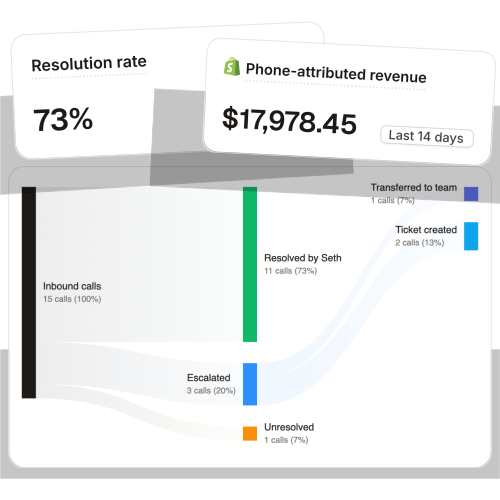
Now layer on timing. Returns and refund anxiety don't keep business hours. A customer who gets a "your refund is on its way" email at 9 p.m. calls at 9:05 to ask why it hasn't hit their card. The drop you launched Friday means a return wave on Tuesday. Your CS team is answering the same questions over and over, your phone backlog grows after every launch, and the after-hours calls roll to voicemail nobody returns by morning. Across the brands we work with, the AI handles 73% of these calls on its own at about $0.42 per resolved call, versus the $7 to $16 a human-handled call runs through a BPO. WashCo, a Shopify brand we launched, recovered $22,664 in attributed revenue in its first 7 days on the phone, much of it on exactly these routine calls.
So there are two levers, not one. Cut the return rate at the source. And cut the cost of every return you can't prevent. Most brands only pull the first.
Lever 1: cut the return rate at the source
The cheapest return is the one that never happens, and on apparel that almost always means closing the gap between what the shopper expected and what showed up. This is where the standard playbook is right, so do it properly.
- Build real size charts, not a generic grid. Chest, waist, hip, inseam, sleeve, total length, and where each was measured. Add the model's height and the size they're wearing, plus fit notes in plain language: "runs narrow at the shoulders," "size up if you're between." Most fit returns are guesswork returns.
- Add a fit or size-recommendation tool. Brands that deploy AI size guidance see returns drop 22% to 26% and conversion lift around 9%, because the shopper stops ordering two sizes to hedge (Fitez). Calibrate it on your own return data, not generic averages, so a dress that runs tight at the bust gets flagged as such.
- Make the product page do the work. Photos in motion and at multiple angles, fabric close-ups, stretch percentage, shrink risk. The fewer surprises on arrival, the fewer reverse shipments.
- Put the return policy on the product page. Around 44% of sites bury it, and roughly 60% of buyers go looking for it before they check out (Baymard). A clear policy sets expectations and pre-empts the first return call.
- Track returns by SKU, size, color, and reason. Separate "didn't fit" from "poor quality" from "not as described," because each needs a different fix. A solid returns management setup makes this visible. If one style returns at triple your average, that's a sourcing or a sizing problem you can solve once.
Do all of this and you might shave your apparel return rate by a quarter. That's real money. It also still leaves you with a return rate that no amount of size-chart work gets to zero, which is the whole reason for lever two.
Lever 2: cut the cost of every return you can't prevent
You will never get apparel returns down to electronics levels, so the second move is to make each one cheaper to handle, and the phone is where that cost hides. This is the part the return-reduction guides leave out entirely.
Go back to those three return calls: the policy question, the size swap, and the where's-my-refund. They're routine. They're repeatable. They're the same questions over and over, and they're exactly what an AI phone agent is good at. Ringly is AI phone support for Shopify brands. It answers inbound calls 24/7, finds the order in your Shopify store and checks order status, checks return and refund status, processes the exchange through custom actions, and answers policy questions straight from your knowledge base. The calls that need a human, a damaged item, a disputed charge, a chargeback threat, escalate cleanly to Gorgias or whatever helpdesk you already run. You keep your number, your team, and your workflows.
The math behind it is straightforward. Your CS team wasn't hired to read tracking numbers off a screen 50 times a day. When the routine return and refund-status calls route to the AI, the reps you're already paying get the genuinely hard conversations back: the unhappy customer, the wholesale issue, the VIP who needs a human. And the after-hours calls stop dying in voicemail, because the line is staffed at 11 p.m. on a Saturday whether your team is or not.
"My customers also feel like it's a normal person. They feel like they can communicate if they have questions."
Claudia Droge, TechCraft Studio
The objection I hear most is "a customer doesn't want to talk to AI about a return." The single most repeated thing shoppers say after a call with our agent is that it doesn't sound like AI. They get their answer, they get their exchange started, and they hang up without ever clocking that nobody human was on the line. If your phone goes to voicemail after 6 p.m. and the after-hours return calls pile up, book a 30-min call and we'll map which of your return calls the AI can take off your team's plate.
Lever 3: turn the refund call into an exchange
The most expensive way to handle a return is to hand the money back, and the cheapest is to turn that same call into an exchange, which only happens if someone picks up. This is lever two's quiet payoff.
The numbers here are stark. A customer who exchanges or takes store credit comes back to buy again about 68% of the time, versus 45% to 50% for a cash refund (Shopify). Hand someone $50 in credit and they typically spend $65 to $75 on the next order. Over two years, the lifetime value of an exchanger versus a refunder can run 7 to 10 times the single transaction (Swap).
A returns app can nudge the exchange in the portal. It can't have the conversation. When a customer calls wanting their money back because the medium was too tight, that's the exact moment to offer the large or a different style in one motion. The AI phone agent can run that play live: check the size, confirm stock, start the exchange instead of the refund, all on the call. It's one of the simplest returns best practices most apparel brands never staff for: the refund the customer phoned in to demand becomes the next order they didn't plan to make.
What this costs you today vs what it costs to fix it
Take a $50M apparel brand running a 6-rep CS team. Most of their phone day is return and refund-status calls.
| Line item | Today | With Ringly |
|---|---|---|
| 6 reps x $4K loaded per rep | $24,000/mo | n/a |
| Ringly Enterprise (illustrative) | n/a | $5,000/mo |
| Net monthly CS spend | $24,000/mo | $5,000/mo |
| Monthly savings | n/a | $19,000/mo |
| Annual savings | n/a | $228,000/yr |
That's roughly 70% of your return, exchange, and refund-status calls routed to the AI. The other 30%, the disputes and the damaged items and the VIP escalations, still go to your team, who now have the time to actually solve them. Self-serve plans start at $349/mo on the public pricing page, and exact Enterprise pricing gets set on a call. These are the savings shapes we see across 50+ Shopify brands. Want the math on your own call volume? Book a 30-min call and we'll run it live against your numbers.
Frequently asked questions
What is the average return rate for fashion ecommerce? Apparel runs 20% to 40% of orders, averaging around 25%, the highest of any online category. Footwear is higher still, past 31%. By comparison, in-store apparel returns sit near 8.7%.
Why are clothing return rates so high? Fit and sizing drive up to 70% of apparel returns, because sizing isn't consistent between brands and shoppers can't try before they buy. Bracketing (ordering several sizes to keep one) and wardrobing (wear once, return) push the number higher.
What is bracketing and how do I reduce it? Bracketing is buying multiple sizes or colors of the same item planning to return most of them. The fix is confidence: real size charts, a fit-recommendation tool, and clear product photos so the shopper orders one size instead of three.
What is wardrobing? Wardrobing is buying an item, using it once, and returning it as if unworn. It's a form of return fraud that hits apparel hardest, since clothing often still looks new. Clear worn-item policies and return tracking by customer help flag the repeat offenders.
How do returns increase customer service volume? Every return tends to generate one to three support contacts: the return request, a size or color exchange question, and the "where's my refund" follow-up (WISMR). Order and return status questions alone make up about 1 in 5 of all customer conversations.
Should I offer exchanges or refunds? Lead with exchanges and store credit. Customers who exchange come back to buy again around 68% of the time versus 45% to 50% for a cash refund, and the lifetime-value gap can be 7 to 10 times the order. Keep refunds available, but make the exchange the easy path.
Can an AI phone agent handle return and exchange calls? Yes, for the routine ones. An AI phone agent can answer policy questions, check return and refund status, and start an exchange on the call, 24/7, then escalate disputes and damaged-item claims to your team. Across the Shopify brands on Ringly, the AI resolves about 73% of calls on its own.
Talk to us

If you run a Shopify apparel brand and your CS team spends its mornings on return and refund-status calls, a 30-minute call is the fastest way to see what that queue is actually costing you. We'll look at your real return calls and show you which ones the AI can take.
The 3-layer guarantee.
- Live in 14 days or it's free until launched.
- 65% resolution in 90 days or we refund the last 3 months of subscription fees.
- We keep working free until we hit 65%.
Ruben (Ringly co-founder) takes these calls personally.