
The ecommerce AI bot market is really two markets.
- One half is crowded: chat and email bots (Gorgias, Intercom Fin, Ada, Tidio, Zendesk) that deflect tickets on your website. The other half, the phone, is nearly empty.
- Almost every chat platform now bills per resolution ($0.90 to $2.00 a pop), which means your AI bill scales right alongside your volume.
- Built for founders, COOs, and Heads of CX at $10M-$100M Shopify brands still running a visible phone line that goes to voicemail after 6 p.m.
Most of these roundups list eight chat bots and call it a day. That misses where half your support actually happens. Your customers don't only message the widget on your site, they pick up the phone, and at a $10M-plus Shopify brand a real chunk of them do exactly that. To write this I connected a real Shopify store to the platforms below and then called every one of their own customer service phone lines to see which could actually pick up. The chat bots are good at chat. Not one of them answers a phone.
If you run customer experience at a $10M-$100M Shopify brand, you already know the after-hours problem: the chat widget hums along and the phone keeps ringing into voicemail you never return. This is the gap 50-plus brands we work with closed first. Book a 30-min call and we'll show you what your store is losing on the calls nobody picks up.
The two kinds of ecommerce AI bot, in one table
The single most useful filter for this whole category is channel: does the bot handle chat, or does it handle the phone? Almost every tool you'll see ranked elsewhere lives in the first column. Here's the honest split, with real pricing.
| Platform | Channel | Pricing model | Best for | Verdict |
|---|---|---|---|---|
| Ringly.io | Phone (voice) | Flat monthly from $349 | Shopify brands losing calls after-hours | Best for the phone channel |
| Gorgias | Chat + email helpdesk | Subscription + $0.90-$1.00 per AI resolution | Shopify stores wanting a native helpdesk | Strong chat, double-billed AI |
| Intercom Fin | Chat (multi-channel) | $0.99 per outcome + seats | Mature multi-product support stacks | Powerful, pricey at scale |
| Ada | Chat (enterprise) | Custom, ~$30K-$300K+/yr | 300,000+ conversations/yr | Enterprise-only |
| Tidio (Lyro) | Chat | From ~$29/mo, Lyro add-on extra | SMB stores under $10M | Easy, but SMB-shaped |
| Zendesk AI | Chat + email | $55+/agent/mo + $1.50 per resolution | Large teams already on Zendesk | Heavy, per-resolution stacks up |
| Zowie | Chat | Custom | Ecommerce chat automation | Ecommerce-tuned, chat-only |
The pattern jumps out fast. Six of these seven are fighting over the same channel, your website chat, and they're all converging on the same per-resolution pricing. The phone is sitting there with one name in it.
How I tested these platforms
I'm Ruben, co-founder of Ringly. Over the last few weeks I went through every platform on this list the way a buyer would, not the way a reviewer skims a pricing page.
Here's what I actually did for each one:
- Shopify integration depth. I connected each tool to a real Shopify store, pushed a test order through, and checked whether the bot could find the order, see the customer, and act on it (cancel, change address, start a return) instead of just reading from a help center.
- Channel coverage. I noted exactly which channels each platform covers: chat, email, social, and phone. This is where the category splits.
- Pricing predictability. I modeled each tool's cost at 3,000 resolutions a month, including the per-resolution fees that sit on top of the subscription, so the number reflects a real launch-spike month, not the headline price.
- Resolution honesty. I compared each vendor's marketed resolution rate against what their own case studies and reviews actually report.
- The real-world failure mode. I called every platform's own customer service phone line at the end of a workday and noted what happened. This is the test nobody else in the search results ran, and it's the one that exposed the channel gap.
I don't take affiliate commissions on anything below. I sell Ringly, which sits in this list against the same five criteria as everyone else, and I'll tell you plainly where it doesn't fit.
The chat and email bots (the crowded half)
These are the platforms most "ecommerce AI bot" lists are really about, and they're genuinely good at the website channel. If your support pain is ticket volume on chat and email, start here. Just know going in that almost all of them now charge per resolution, so model the spike months before you commit.
2. Gorgias
Best for: Shopify stores that want a native helpdesk with an AI agent bolted onto chat and email. Gorgias is the most-installed helpdesk in the Shopify ecosystem, serving more than 15,000 ecommerce brands including names like Steve Madden and Glossier.
Gorgias is built tightly around Shopify workflows. Its AI Agent can take real actions (cancel an order, change a shipping address, remove an item) instead of only answering from a help center, which is genuinely useful and rarer than it sounds.
Pricing: A helpdesk subscription plus the AI Agent fee. The AI Agent runs $1.00 per resolved conversation on Starter and $0.90 on higher plans, with overages at $1.50 per interaction (myAskAI pricing breakdown).
What works
- Native Shopify actions: the AI can modify orders and subscriptions, not just read tracking.
- Deep ecommerce focus: rules, macros, and integrations are built for stores, not generic SaaS.
- Large install base: 15,000-plus brands means the playbooks and community are mature.
What doesn't
- Double billing: you pay the helpdesk fee AND $0.90-$1.00 per AI resolution, even when no human touches the ticket. One Shopify reviewer reported $14,000 in unexpected AI charges on top of a $13,500 plan.
- Resolution gap: Gorgias markets "up to 60%" automation, but its own case studies land in the 26-56% range.
- Chat and email only: no phone channel.
Why it ranks second: it's the strongest Shopify-native chat helpdesk on the list. It just lives entirely in the website channel, and the per-resolution model makes a busy month expensive. See our full Gorgias alternatives breakdown for the deeper comparison.
3. Intercom Fin
Best for: brands running a mature, multi-product support stack that want one AI agent across chat, email, and social. Intercom pairs its support suite with Fin, an AI agent designed to resolve questions and escalate the complex ones cleanly.
Fin is one of the better autonomous chat agents on the market. The catch is the cost structure underneath it.
Pricing: Fin is $0.99 per outcome (a resolution or a procedure handoff) on every plan. You can't run Fin without an Intercom seat plan, and the Copilot add-on for assisting human reps is billed separately per seat. In practice teams often pay three to four times the pure seat price (Gleap's Fin pricing breakdown).
What works
- Strong autonomous resolution: Fin handles multi-step conversations well.
- Unified stack: chat, email, and reporting in one place that scales across regions.
- Clean escalation: hands complex cases to humans without dropping context.
What doesn't
- Layered cost: per-outcome fees plus seats plus add-ons add up fast.
- Counts quiet exits as resolved: if a customer doesn't reply, Intercom may still bill it as a resolution.
- No phone: voice isn't the product.
Why it ranks third: excellent chat automation for teams that already live in Intercom, but the total cost climbs quickly and the phone stays unanswered. Our Intercom alternatives guide covers where it fits and where it doesn't.
4. Ada
Best for: large enterprises with hundreds of thousands of conversations a year and a budget to match. Ada is a polished CX automation platform with a clean flow builder and strong help-center sync, rated 4.6/5 on G2.
Ada is built for scale. That's its strength and its filter.
Pricing: not public. Entry sits around $30,000 a year, with enterprise contracts commonly running $100,000 to $300,000-plus annually, and usage-based fees roughly $1 to $3.50 per resolved interaction (eesel's Ada review). Ada itself is described as a fit for companies with at least 300,000 annual conversations.
What works
- Enterprise-grade builder: clean interface for complex conversation flows.
- Strong help-center sync: especially with Zendesk.
- Dedicated account management: real support for large contracts.
What doesn't
- Opaque pricing: no public tiers, everything goes through sales.
- Wrong size for most DTC: built for 300,000-plus conversations a year, which is far above a typical $10M-$100M Shopify brand.
- Chat-first: not a phone product.
Why it ranks fourth: a genuinely strong enterprise tool, but the price floor and conversation minimum put it out of range for most Shopify DTC brands. There's no phone channel here either.
5. Tidio (Lyro)
Best for: smaller stores, typically under $10M, that want an easy chat widget with AI suggestions. Tidio's AI agent Lyro is built on Anthropic's Claude model and advertises up to 67% automated resolution, though most stores land below that without solid knowledge-base work (Tidio's own Lyro review).
Tidio is the friendliest tool on this list to get started with. It's also the most clearly SMB-shaped.
Pricing: plans start around $29/mo, but Lyro AI is a separate add-on that can roughly double your bill. Tidio holds a 4.6/5 on G2 across more than 1,880 reviews.
What works
- Fast setup: easy install, intuitive interface, quick time to value.
- Good free tier: a real way to test before paying.
- Solid chat quality: Lyro handles routine questions well on a clean knowledge base.
What doesn't
- SMB ceiling: best for 250-500 monthly conversations, not a brand handling thousands.
- Add-on math: the AI you actually want costs extra on top of the base plan.
- Chat only: no phone.
Why it ranks fifth: a great starter chat bot for a sub-$10M store, but it tops out below the volume a $10M-plus brand runs. Our Tidio alternatives page has the side-by-side.
6. Zendesk AI
Best for: larger teams already standardized on Zendesk who want AI agents inside their existing helpdesk. Zendesk is the enterprise default for a reason: it's mature, deep, and integrates with everything.
The AI is capable. The cost model is where you have to do the math.
Pricing: AI agents run $1.50 per automated resolution on committed volume and $2.00 on pay-as-you-go, on top of a Suite plan ($55+/agent/mo) and a $50/agent/mo Advanced AI add-on (eesel's Zendesk pricing guide). A 20-agent team automating 3,000 tickets a month realistically spends $6,000-$8,000/mo all-in.
What works
- Enterprise depth: reporting, routing, and integrations are best in class.
- Verified resolutions: a 2026 change means only confirmed resolutions are billable.
- Omnichannel: chat, email, and social in one platform.
What doesn't
- Cost stacking: seats plus add-on plus per-resolution fees get expensive.
- Heavy to run: more platform than a lean DTC team usually needs.
- No native phone AI for ecommerce: Talk exists, but it isn't an autonomous phone agent for Shopify orders.
Why it ranks sixth: powerful if you're already on Zendesk, but the layered pricing and weight make it a poor first AI bot for most Shopify brands. See our Zendesk alternatives guide for the breakdown.
7. Zowie
Best for: ecommerce brands that want a chat bot tuned specifically for retail, with personalization from customer data. Zowie pulls location, behavior, and purchase history to tailor replies and ships with dozens of ecommerce-specific use cases.
It's a credible, retail-focused chat tool. Pricing is custom, so you'll need a quote.
What works
- Ecommerce-native: 75-plus retail use cases out of the box.
- Personalization: uses real customer data to shape responses.
- Brand voice control: configurable tone.
What doesn't
- Custom pricing: no public numbers to compare.
- Chat only: no phone channel.
- Less Shopify-specific depth: not as tightly wired to Shopify as Gorgias.
Why it ranks seventh: a solid ecommerce chat bot, but it's another entry in the crowded website column, not the phone. Our Zowie alternatives page has more.
"My customers also feel like it's a normal person. They feel like they can communicate if they have questions."
Claudia Droge, TechCraft Studio
The voice bot (the half nobody automates)
Every platform above handles your website. None of them answers when a customer calls. That's the gap, and at a $10M-plus Shopify brand it's expensive. WISMO ("where's my order") alone makes up 30-40% of support contacts in normal months and climbs past 50% at peak, at $5 to $22 per contact (Salesforce). A meaningful share of that comes by phone, especially after 6 p.m. when your reps are gone and the chat bot can't pick up a ringing line. It's the same ecommerce customer service work, just in the channel nobody staffs.
1. Ringly.io: AI phone support for Shopify brands
Ringly is AI phone support for Shopify brands. Your team wasn't hired to answer the same call 50 times a day. Instead of growing your support headcount every time call volume goes up, the AI takes the routine inbound calls so your team can focus on the work that actually moves revenue.
The AI answers inbound calls 24/7. It finds orders in your Shopify store, processes returns and exchanges, answers product questions from your knowledge base, and rescues abandoned carts via outbound follow-up. Across 50-plus brands, the AI resolves 73% of calls autonomously at roughly $0.42 per resolved call. Calls that need a human escalate cleanly to Gorgias, Richpanel, Reamaze, or whatever helpdesk you already run.
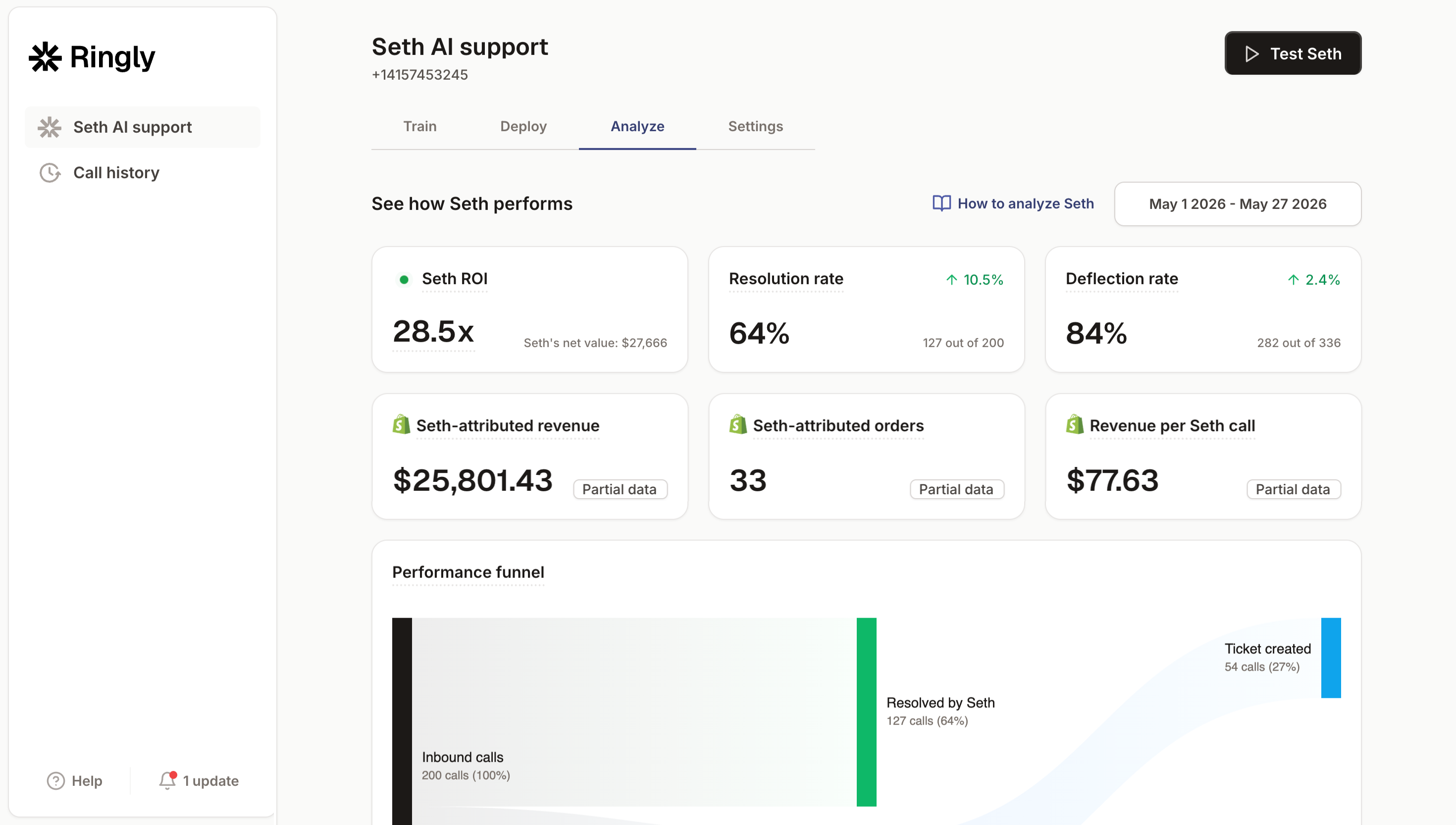
Best for: $10M-$100M Shopify brands with a visible phone number and 3-12 CS reps, losing calls after-hours.
Pricing: Grow $349/mo (1,000 minutes, around 500 calls), Pro $799/mo (2,500 minutes, around 1,250 calls), Enterprise custom. Flat monthly, not per resolution, so a launch spike doesn't blow up your bill. 14-day free trial on Pro. Live in under an hour.
What works
- It's a phone agent, not a chat bot retrofitted: built for voice from the start, so it actually picks up.
- Native Shopify: finds orders, processes returns, answers product questions, escalates cleanly.
- Flat, predictable pricing: no per-resolution meter running during your busy season.
- Sounds human: the most repeated thing customers say after a call is that it doesn't sound like AI.
- 65% resolution guarantee: if the AI resolves under 65% of calls in 90 days, we refund the last 3 months.
What doesn't
- Phone-first: if your only pain is website chat, a chat tool above may fit better first.
- No subscription cancellation by default: that's a custom action, not out of the box.
- Shopify brands: it's purpose-built for Shopify, so it's not a generic cross-platform tool.
Why it ranks first: it's the only platform here that answers the phone, and it's built specifically for the Shopify order, return, and product calls a DTC brand actually gets. WashCo, a Shopify brand we launched, recovered $22,664 in its first 7 days on the phone. If you want to compare voice tools specifically, our guide to Shopify voice agents and AI phone agents for Shopify goes deeper.
What chat-only AI bots cost you on the phone
The hidden cost of a chat-only stack isn't the software bill, it's the calls that roll to voicemail while you pay reps to staff a phone line that still gets missed. Businesses answer only about 37.8% of inbound calls on average, and 85% of callers who can't reach a person never call back, with 62% switching to a competitor (PCN missed-call study). For a $10M-plus brand, that's revenue leaking every evening.
Here's the cost-displacement math for a typical $50M Shopify brand running a 6-rep CS team:
| Line item | Today | With Ringly |
|---|---|---|
| 6 reps x $4K loaded per rep | $24,000/mo | n/a |
| Ringly Enterprise (~$5K/mo) | n/a | $5,000/mo |
| Net monthly CS spend | $24,000/mo | $5,000/mo |
| Monthly savings | n/a | $19,000/mo |
| Annual savings | n/a | $228,000/yr |
That's roughly 70% of repeatable calls (order status, returns, product questions, the same five things over and over) routed to the AI. The other 30%, the genuinely complex calls, still go to your CS team, who now have time to actually solve them.
And here's the per-resolution comparison that matters when you stack the chat platforms' billing against a flat phone model:
| Channel | Per-call or per-resolution cost | Notes |
|---|---|---|
| In-house CS rep | $2.70/call | US, loaded with payroll + benefits |
| Gorgias AI Agent | $0.90-$1.00/resolution | On top of the helpdesk subscription |
| Zendesk AI | $1.50-$2.00/resolution | On top of seats + AI add-on |
| Ringly (resolved call) | ~$0.42/call | Flat monthly plan, no per-resolution meter |
The conversational AI market is on track to reach $41.39 billion by 2030, growing 23.7% a year (Grand View Research). Most of that spend is going into the chat column. The phone is where the cheaper resolutions and the missed revenue both live.
If you're running a $50M-plus Shopify brand, book a 30-min call and we'll review your missed calls live.
How to choose an ecommerce AI bot platform
Pick by channel first, then by size. The fastest way to waste a quarter is buying a second chat bot when your real leak is the phone.
- Choose Ringly if your phone rings and goes to voicemail after-hours, you run a visible phone number, and order, return, and product calls are eating your reps' time.
- Choose Gorgias if you want a Shopify-native helpdesk with an AI agent for chat and email, and you've modeled the per-resolution cost on your busy months.
- Choose Intercom Fin if you already run a mature multi-product support stack and want strong autonomous chat across channels.
- Choose Ada if you're an enterprise handling 300,000-plus conversations a year with the budget for a six-figure contract.
- Choose Tidio (Lyro) if you're a smaller store under $10M that wants an easy chat widget with AI suggestions.
- Choose Zendesk AI if your team is already standardized on Zendesk and you want AI agents inside it.
- Choose Zowie if you want an ecommerce-tuned chat bot with personalization and don't need deep Shopify-native order actions.
The honest answer for most $10M-$100M Shopify brands: you probably already have a chat bot, and the channel you're actually missing is the phone. Compare the two directly in our chat vs phone support guide.
Frequently asked questions
What is an ecommerce AI bot platform? It's software that uses AI to handle customer interactions for an online store, either by chat and email (deflecting website tickets) or by phone (answering calls). Most platforms only do the first. A few, like Ringly, handle the phone channel for Shopify brands.
Which AI bot is best for a Shopify store? It depends on the channel you're missing. For website chat and email, Gorgias is the strongest Shopify-native option. For the phone, Ringly is built specifically for Shopify order, return, and product calls.
How much do ecommerce AI bots cost? Chat platforms mostly charge per resolution: Gorgias is $0.90-$1.00, Zendesk $1.50-$2.00, and Intercom Fin $0.99 per outcome, all on top of a subscription. Ringly is flat monthly, starting at $349/mo, so your cost doesn't spike with volume.
What is the real resolution rate of these bots? Vendor claims run high (Tidio advertises up to 67%, Gorgias up to 60%), but real-world rates are usually lower without strong knowledge-base work. Gorgias's own case studies show 26-56%, and Ringly reports 73% resolution on phone calls across 50-plus brands.
Can an AI bot handle "where's my order" calls? Yes, and WISMO is the single biggest use case. It's 30-40% of support contacts in normal months (Salesforce), and a phone agent like Ringly can pull the order from Shopify and answer it without a human.
Do I need both a chat bot and a phone bot? Often yes, because they cover different channels. A chat bot handles your website widget; a phone bot answers the calls that roll to voicemail. Most $10M-plus brands already have the first and are missing the second.
Will customers know they're talking to an AI on the phone? Voice quality has gotten good enough that the most repeated thing Ringly customers report is that callers say it doesn't sound like AI. You also control what escalates to a human, so the hard calls still reach your team.
How fast can I get an AI bot live? Chat tools like Tidio install in minutes; enterprise platforms like Ada take weeks of setup. Ringly goes live in under an hour once you connect your store and knowledge base.
Talk to us

If you run a $10M-$100M Shopify brand and your phone goes to voicemail after-hours, a 30-min call is the fastest way to see what you're leaving on the table in the one channel none of the chat bots cover.
The 3-layer guarantee.
- Live in 14 days or it's free until launched.
- 65% resolution in 90 days or we refund the last 3 months of subscription fees.
- We keep working free until we hit 65%.
Ruben (Ringly co-founder) takes these calls personally.