
This post in 30 seconds.
- The average e-commerce product return rate sits around 19-20% of online orders in 2026, roughly two to three times the in-store rate, but the number that matters is your category's, not the blended one.
- Apparel runs 20-40%, electronics 8-15%, beauty 4-12. A single return costs $10-$65 to process, and only about 48% of returned items get resold at full price.
- Built for founders, COOs, and Heads of CX at $10M-$100M Shopify brands who want the rate down without torching conversion or goodwill.
A founder asked me last month what a "good" return rate looks like, and I gave him the honest answer: it depends entirely on what he sells. The blended e-commerce product return rate hovers near 19-20% of online orders (NRF 2025 Retail Returns Landscape, cited widely), but a jewelry brand at 4% and an apparel brand at 35% are both completely normal. The number on its own tells you almost nothing until you put it next to your category.
Here's the part that surprised me after running phone support across Shopify brands. A real slice of inbound calls are pre-purchase questions, will this fit, is this the right model, does it work with what I already own. Answered live, the wrong purchase never ships and never becomes a return. That's the lens this post takes: return rate isn't only a logistics number, part of it is a support number.
If you run a $10M-$100M Shopify brand and your reverse-logistics bill keeps climbing, book a 30-min call and we'll look at how many of your return-adjacent calls are actually preventable.
What counts as a normal return rate in 2026
Start with the blended figure, then ignore it. The average online return rate in 2026 is about 19-20.5% of orders, two to three times the 5-8.9% brick-and-mortar rate (Eightx). DTC brands specifically average closer to 14%, up from 11% in 2020.
The rate has been climbing for years, and retailers noticed. By 2026, 72% of US retailers charge some form of return fee, up from 41% in 2023, and 53% of them report a lower return rate as a result (Eightx). Fees work on the number. They also carry a cost most operators underweight: 57% of shoppers say they won't buy from a retailer again after being charged for a return (Richpanel).
The blended 19% average is a vanity benchmark, your category rate is the only one worth tracking against. A home-goods brand comparing itself to the overall figure will feel fine while quietly running 6 points above its real peers. That's the trap.
If you want the deeper data set, our 42 e-commerce return statistics page breaks the whole landscape down by topic. This post stays focused on the rate itself, what drives it, and how to move it.
E-commerce return rates by category
This is the table to bookmark. Find your category, find your honest peer range, and stop benchmarking against the blended average.
| Category | Typical online return rate | Top driver |
|---|---|---|
| Apparel | 20-40% | Fit and sizing |
| Footwear | 17-30% | Fit and sizing |
| Home & furniture | 15-23% | Damage, "looked different" |
| Auto parts | ~19% | Compatibility |
| Accessories | 12-15% | Expectation gap |
| Electronics | 8-15% | Defects, compatibility |
| Beauty & personal care | 4-12% | Reaction, "not as described" |
| Supplements / health | ~7% | Changed mind |
| Jewelry | ~4% | Quality, expectation |
Sources: Richpanel, Shopify, Eightx.
A 25% rate is a disaster for an electronics brand and a quiet win for an apparel brand. Same number, opposite verdict. The spread between categories is wider than most operators assume, which is exactly why the blended figure misleads.
Two patterns sit underneath the table. Categories where the customer is guessing about something physical (fit, size, how it looks in real life) run high. Categories where the spec is objective (electronics, supplements) run low, and when they do get returned it's usually a defect or a compatibility miss, not buyer's remorse. If you sell something people have to imagine before they buy, your rate will live at the top of the range, and a lot of that gap is a question that went unanswered before checkout. Our guide to e-commerce returns management digs into the operational side.
Why customers actually return products
If you want to lower the rate, you have to know what's driving it. The drivers are remarkably consistent across brands.
- Fit and sizing dominate. Sizing is responsible for up to 70% of apparel returns, and 65% of online shoppers say they've returned something that didn't fit (Claimlane).
- The product didn't match the description. 49% of shoppers have returned an item because it didn't match the online description, and another 22% returned something because it "looked different" in person (Lateshipment).
- Wrong or damaged item. 23% returned because they got the wrong item, and 20% returned something that arrived damaged (Lateshipment).
- Bracketing is now normal. Between 58% and 63% of apparel shoppers admit to ordering multiple sizes on purpose, planning to send back what doesn't work (Richpanel).
Most of these are expectation gaps, not product failures, which means a chunk of them are preventable before the order ever ships. A customer unsure whether a jacket runs small either doesn't buy (a lost sale) or buys two sizes to test (a guaranteed return). A live answer collapses both outcomes into one clean purchase.
This is the subset nobody benchmarks. When a shopper picks up the phone before buying and asks "which one fits a wrist like mine" or "will this charger work with my model," that call is a fork in the road. Resolved well, it's a sale that sticks. Sent to voicemail, it's either a lost order or a return waiting to happen. We wrote more about that pre-purchase moment in our piece on e-commerce customer service, and the broader retention angle in e-commerce customer retention.
What a single return really costs you
The return rate is a percentage. The cost is a number, and it's bigger than the refund.
Processing one return runs $10 to $65 depending on category, distance, and complexity, with $15-$30 as a conservative direct-handling estimate (DigitalApplied). Reverse logistics costs two to three times forward fulfillment per unit, and most brands can't tell you where that money goes. Worse, only about 48% of returned items get resold at full price (Eightx). The rest get discounted, liquidated, or written off.
Then there's the cost that never shows up on the reverse-logistics invoice: the support load. Every return spawns "where's my refund" calls, and those land on the same team already handling order status. WashCo, a Shopify brand we launched, recovered $22,664 in its first 7 days on the phone by catching the calls that would otherwise roll to voicemail, a mix of pre-purchase questions and post-return status checks.
Here's the rough math when you put a price on the support side of returns.
| Line item | Today | With Ringly |
|---|---|---|
| 6 reps × $4K loaded per rep | $24,000/mo | n/a |
| Ringly Enterprise (~$5K/mo) | n/a | $5,000/mo |
| Net monthly CS spend | $24,000/mo | $5,000/mo |
| Monthly savings | n/a | $19,000/mo |
| Annual savings | n/a | $228,000/yr |
That's roughly 70% of repeatable calls, order status, return status, the same product questions over and over, handled by the AI. The complex calls still go to your team, who now have time to actually solve them. For the full cost picture, see our breakdown of the cost of e-commerce returns and how the routine work flows through WISMO calls.
If your phone goes to voicemail after 6 p.m. and you've never counted what that costs, book a 30-min call and we'll run the numbers on your actual call volume.
Your return rate is not flat across the year
The annual number hides a January problem. Post-holiday return rates spike 30-50% above baseline, and the first week of January alone sees roughly a 40% jump in return initiations versus the prior peak (Eightx). If you only look at your blended yearly rate, you miss the month that actually breaks your reverse-logistics budget and your support queue.
Who's driving the spike matters too. Gen Z averaged 7.7 online returns in the past 12 months, more than any other generation, and over 51% of them admit to bracketing on purpose (Richpanel). A slice of every return pool is habitual, not situational, which is why prevention beats processing for the returns you can influence and policy beats both for the ones you can't.
Plan your staffing and your refund policy around the January peak, not the annual average, or both will buckle when the gift returns land. The brands that handle the seasonal spike well decide their returnless-refund thresholds and their phone coverage before December, not during the January flood. Our holiday customer-service prep guide covers the seasonal playbook.
Return rate vs refund rate vs cost-per-return
A lot of operators chase the wrong number. Return rate is the one you can least control, because it's driven by category, by bracketing culture, by things outside your store. The metrics you can actually move sit one layer down.
- Refund rate. The share of returns that end in a cash refund instead of an exchange or store credit. Convert a refund into an exchange and you keep the revenue. This is where margin actually lives.
- Cost-per-return. Reverse shipping plus the labor to inspect, restock, and answer the follow-up call. Drive this down and a high return rate hurts a lot less.
You can have a 30% return rate and a healthy business if most of those returns become exchanges and each one costs you $8 instead of $40. Return rate is the headline, refund rate and cost-per-return are the P&L. Track all three, but optimize the two you can change.
The exchange-first move is the cleanest example. When a customer is sending something back because of fit, an exchange keeps the order and the relationship, while a refund hands the money back and often the customer to a competitor. Leading with exchange options before showing the refund button, plus a small store-credit bonus, shifts the mix without changing your return rate at all. Our e-commerce returns best practices guide covers the exchange-first playbook, and the Shopify returns process walkthrough shows where the workflow usually leaks.
How to lower your e-commerce product return rate
There's no single lever. The brands that get their rate down stack a few of these, and the order matters: prevent first, then process cheaper.
- Fix the product information. Better images, detailed measurements, real-world video, and a clear sizing chart close the expectation gaps that drive nearly half of all returns. This is the cheapest lever and most brands under-invest in it.
- Add predictive sizing. Fit-profile quizzes and AI body-modeling cut fit-related returns by roughly 35% (DigitalApplied). For apparel and footwear, this is the single highest-impact move.
- Answer the pre-purchase question live. The fit and compatibility questions that turn into returns often start as a call or a chat. Catch them before checkout and the wrong purchase never happens. This is the lever the benchmarks ignore.
- Use returnless refunds for low-value items. Auto-approving a refund without the item back, for anything under about $20, saves the full $15-$30 processing cost on each one (NetSuite).
- Move standard returns to self-service. Automated return portals cut per-return handling cost by 40-60% and process returns 3-5x faster than email-based workflows (DigitalApplied).
The cheapest return is the one that never happens, and a surprising number of those are just an unanswered question. Once you've squeezed prevention, automate the processing so the returns you can't avoid cost you less.
"My customers also feel like it's a normal person. They feel like they can communicate if they have questions."
Claudia Droge, TechCraft Studio
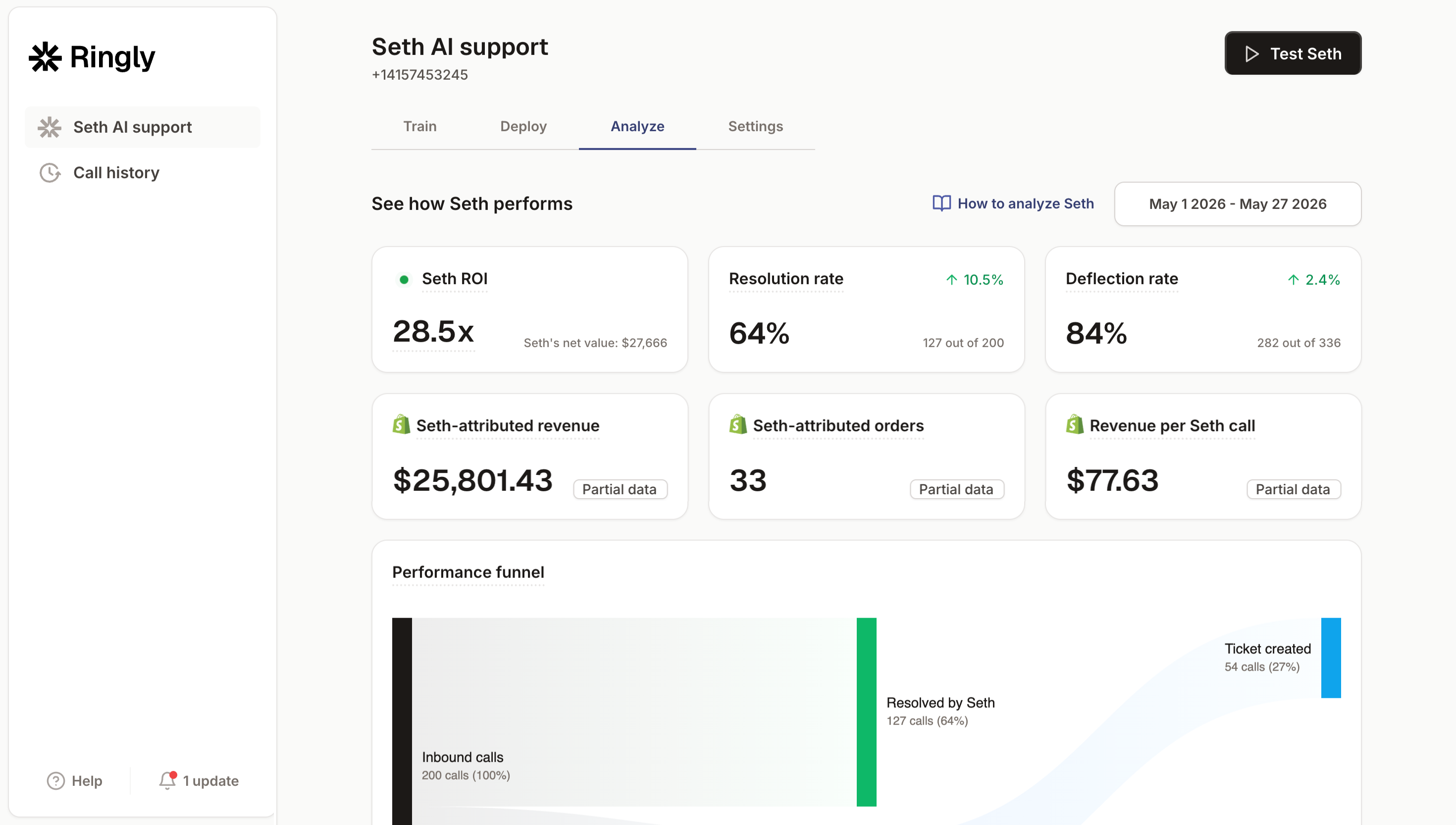
On the support side, Ringly.io is AI phone support for Shopify brands. Instead of hiring and training a phone team to field fit questions, compatibility questions, and where's-my-refund calls, the AI handles inbound calls 24/7: order status, return status, product questions, order cancellations. It resolves up to 90% of calls autonomously for $1.99 a call after the first 50, versus $7-$16 per call for a human BPO. Calls that need a human escalate cleanly to Gorgias, Richpanel, Reamaze, or whatever helpdesk you already run. Plans start at $99 a month, with a 65% resolution guarantee, and it's live in under an hour. Our how to reduce product returns guide pairs well with this.
Frequently asked questions
What is a good e-commerce product return rate? There's no universal "good" number, only a good number for your category. Apparel at 25% is healthy, electronics at 25% is a problem. Benchmark against your category range, not the blended 19-20% average.
What is the average return rate for online stores in 2026? About 19-20.5% of online orders, roughly two to three times the in-store rate. DTC brands specifically average closer to 14%. The figure has risen steadily from around 11% in 2020.
Which product category has the highest return rate? Apparel, at 20-40%, driven mostly by fit and sizing. Footwear follows at 17-30%. Jewelry and supplements sit at the low end, around 4-7%.
How much does a single return cost to process? Between $10 and $65 depending on category, distance, and complexity. Reverse logistics runs two to three times the cost of forward shipping per unit, and only about 48% of returned items get resold at full price.
Can customer support actually reduce returns? Yes, more than most operators expect. A meaningful share of returns start as an unanswered pre-purchase question about fit or compatibility. Answered live before checkout, the wrong purchase never ships, which is why phone and chat availability is an underrated prevention lever.
Should I charge a return fee to lower my rate? Fees do reduce the rate, 53% of retailers who charge them report lower returns, but 57% of shoppers say they won't buy again after being charged. Weigh the rate reduction against the repeat-purchase hit before rolling it out.
Talk to us

If you run a $10M-$100M Shopify brand and a chunk of your returns trace back to questions that went to voicemail, a 30-min call is the fastest way to see what you're leaving on the table.
Our 3 promises.
- Live in under 1 hour. Setup and test calls are free.
- 30-day money back on the $99 plan fee.
- 65% resolution guarantee: if Seth resolves under 65% of your support calls in a month, that month comes back as credit (after 90 days on Pay per call).
Ruben (Ringly co-founder) takes these calls personally.