
This post in 30 seconds.
- The function, not the tips. This is the build-it manual for a supplement CS desk: the contact mix, the channel and SLA design, the next-hire call, the knowledge base, the compliance line your reps can't cross, and the subscription save play.
- The compliance line is the part nobody publishes. You get the verbatim list of what a rep may say ("supports", "helps maintain") and what gets you an FDA letter ("treats", "cures"), plus the escalation script.
- Built for $10M-$100M Shopify supplement brands running a paid helpdesk and a visible phone number, with a CS team of 3 to 12.
A supplement customer service desk has three problems a generic ecommerce desk doesn't. Your buyers skew older and call instead of typing. Your single biggest ticket category is a subscription somebody wants to pause, skip, or cancel. And every answer your reps give about a product sits one careless sentence away from an FDA enforcement letter. Most "customer service for supplement stores" advice ignores all three and tells you to smile and reply fast. This is the version written for the person who actually has to build and run the function. I read 40+ real supplement-brand call transcripts to write it, tagged what every contact was actually about, and pulled the exact phrases reps got wrong against the FDA's structure/function rules.
If you run support at a $10M-$100M Shopify supplement brand, you already know the Monday queue: a stack of "where's my order" voicemails nobody returned over the weekend, a handful of subscription cancels, and two ingredient questions a rep wasn't sure how to answer. We've built AI phone agents for Shopify brands fighting exactly that. Book a 30-min call and we'll pull your last week of missed calls live and show you what the queue is costing you.
What makes a supplement CS desk different from a generic ecom desk
Start here, because if you design the function like a generic store you'll staff the wrong channels and write the wrong scripts.
The contact mix in supplements skews to the phone, and it skews older. A $40-AOV apparel brand gets a call on maybe 3% of orders. A supplement brand with a $60-$120 AOV and a subscription base gets one on far more, because the buyer is often making a health decision and wants a person. Clarkston Consulting found 73% of older adults now use the internet for health and wellness, yet phone and in-store stay dominant for high-trust products. Freshly, Instacart and H-E-B all added senior support phone lines for a reason. Your customers will call. The question is whether anyone picks up.
Then there's the volume shape. Across the transcripts I read, 70-80% of contacts were the same handful of things: where's my order, how do I cancel or skip my subscription, can I return this, is this the right product for me. Subscription cancel and billing disputes are the single biggest category. The FTC logged roughly 70 subscription-trap complaints a day in 2024, up from 42 a day in 2021. A lot of those complaints start as a CS interaction that went badly.
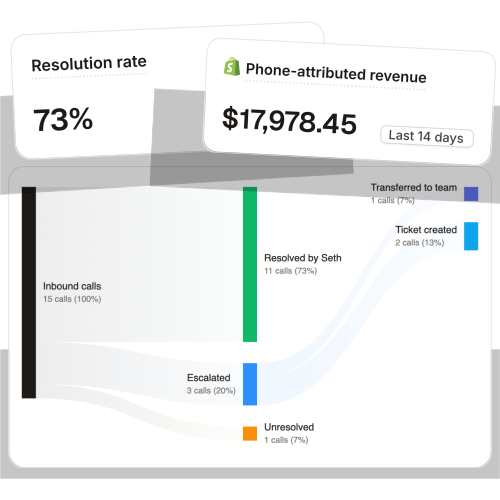
BioLongevity Labs, a supplement brand on Ringly, resolves 79% of its inbound calls end to end without a human ever touching them. That number isn't magic. It's what happens when the routine 79% is designed as a system instead of absorbed by tired reps.
The third difference is the one that can actually cost you money in a way a refund can't: compliance. An apparel rep who says the wrong thing makes a customer grumpy. A supplement rep who tells a caller a product "cures" their condition just made a disease claim your brand isn't allowed to make. We'll build the line that keeps that from happening later in this post. For now, just hold the idea that your scripts need a legal layer a normal store's don't. If you want the full taxonomy of what those calls sound like, our breakdown of the most common supplement support contacts and the deep dive on WISMO calls cover the ground.
How I built this playbook
I'm Ruben, co-founder of Ringly. We run AI phone support for Shopify brands, a good chunk of them supplement and wellness brands, so I'm in supplement CS data constantly, not as a critic but as someone who has to make it work.
For this playbook I did five things, in this order:
- Read 40+ real call transcripts from supplement and wellness brands and tagged every contact by what it was actually about. That's where the 70-80%-repeatable and subscription-is-number-one numbers come from, not a survey.
- Pulled the phrases reps got wrong. I logged the moments a rep drifted toward a health claim or guessed at a dosage, then mapped each one to the safe version.
- Checked every script line against the FDA's structure/function rules so the language in this post is the compliant version, not a paraphrase.
- Ran the cost math on real billing across in-house, offshore, and AI-handled contacts instead of using list prices.
- Built the metrics dashboard from what actually correlates with kept subscribers and lower spend across the brands we run, and dropped the vanity numbers that don't.
The five pieces are weighted toward the two that supplement operators skip most: the compliance line and the subscription desk. Where a brand's stack is different from the standard Shopify-plus-Gorgias-plus-phone setup, the steps still hold, but the screens won't match.
Design the contact mix, channels, and SLAs
Before you hire anyone or buy anything, decide which channel handles which job and what "answered" means on each. Most brands skip this and end up with a phone line that rings out and an email inbox doing work chat should handle.
Every channel should have one job and one promise. Here's the architecture that holds up for a supplement brand:
| Channel | Best at | Target SLA | Notes |
|---|---|---|---|
| Phone | Subscription saves, anxious "is this right for me", urgent WISMO | Answer rate over 80%, including after-hours | Your highest-intent, highest-LTV channel. Older base lives here. |
| Detailed product questions, documentation, non-urgent refunds | First response under 1 hour (4-6 hr is the industry average) | Good for anything that needs a paper trail. | |
| Live chat | Quick WISMO, pre-purchase nudges, simple how-to | Under 1 minute | 72% of customers expect a response within 30 minutes; chat is where you meet that. |
| SMS | Proactive shipping milestones, cancel-save follow-ups | Same-day | Cuts WISMO volume before it becomes a contact. |
The numbers that matter here come from real benchmarks. Industry-average first response for ecommerce support sits at 4-6 hours, which is far too slow for chat and fine for email. The aggressive targets are chat under a minute and email under an hour. Pick yours, write them down, and hold the team to them. If you want the deeper version, our guide to ecommerce customer service SLAs and the response-time benchmarks lay out the targets by channel.
Then build the escalation ladder, because supplements need one more tier than most stores:
- Tier 0, self-serve. Tracking page, subscription portal, FAQ. Handles the easiest WISMO and skip requests.
- Tier 1, frontline rep or AI. The repeatable 70-80%: order status, returns, cancel/pause/skip, label-level product questions.
- Tier 2, lead or founder. Angry customer, a save worth fighting for, anything weird.
- Tier 3, medical and compliance. Any question that touches a health condition, a medication, pregnancy, or a dosage the label doesn't cover. The answer here is never an answer. It's a referral to a doctor. More on that next.
The after-hours piece is where supplement brands quietly bleed. 85% of callers who can't reach a person never call back, and 62% switch to a competitor. A subscriber who calls Saturday to fix a billing issue, hits voicemail, and never hears back doesn't just churn quietly. Sometimes they dispute the charge. WashCo, a Shopify brand we launched recently, handled 271 calls in its first week and answered them around the clock instead of letting them roll to voicemail.
Build the knowledge base and macro library
This is the spine of the whole function. A good knowledge base is what lets a new rep be useful in week one instead of month three, and it's the exact same asset an AI agent reads from. Build it once, point everything at it.
Your knowledge base should hold one structured record per SKU, not a pile of PDFs. For each product, capture:
- Ingredients in common and scientific names so a rep can answer "does this have soy in it" without guessing.
- The top 9 allergens, flagged per SKU. Allergen mislabeling is a real FDA trigger, with nine warning letters on allergen labeling issued between 2017 and 2020.
- Dosage and timing straight off the label, with food-interaction notes. Reps repeat the label. They never freelance.
- Lot number and expiration lookup for the recall-and-freshness questions older buyers ask.
- The 20 most-asked questions for that product, with the approved answer next to each.
On top of the per-SKU records, build a macro library: the canned, compliant responses for your repeat contacts. At minimum, write macros for WISMO, subscription cancel, subscription pause and skip, returns and refunds, allergen questions, and the "is this right for me" pre-purchase question. Each macro is short, in your brand voice, and pre-cleared by whoever owns compliance.
A macro library is the cheapest quality-control tool you'll ever build. It turns "every rep answers a little differently" into "every rep answers the right way," and it's what makes onboarding fast. If you want starting points, our customer service scripts and email templates give you a skeleton to adapt. The knowledge base also feeds Ringly's AI knowledge base directly, so the same source of truth answers calls.
Write the compliance line: what reps may and may not say
This is the section the rest of the internet skips, and it's the one that matters most for a supplement brand. Under the Dietary Supplement Health and Education Act, your brand can make structure/function claims about how an ingredient affects normal body function. It cannot make disease claims. Only a drug can say it treats, cures, prevents, or diagnoses anything. Your reps need to live on the right side of that line on every call.
Here is the line, in the words your team will actually use, with the safe version on the left and the version that draws an FDA letter on the right.
| A rep MAY say (structure/function) | A rep may NOT say (disease claim) |
|---|---|
| "supports immune health" | "cures colds" |
| "helps maintain healthy energy levels" | "treats chronic fatigue" |
| "promotes relaxation" / "supports a calm mood" | "cures anxiety" |
| "helps maintain healthy blood sugar already in the normal range" | "treats diabetes" / "lowers blood pressure" |
| "traditionally used to support digestion" | "prevents acid reflux" |
| "an excellent source of vitamin C" | "prevents the flu" |
The pattern is simple enough to train: words like supports, promotes, helps maintain, and traditionally used for are safe. Words like treats, cures, prevents, heals, fixes, reverses, and diagnoses are not, even when they're implied indirectly. The FDA's own structure/function claims guidance and plain-English breakdowns like this one from Truli spell out the boundary.
Three rules bolt onto the language:
- Dosage comes off the label, never out of a rep's head. "The label suggests two capsules with food" is fine. "You should take four for your situation" is medical advice, and it's not yours to give.
- No medical advice, ever. The moment a caller mentions a condition, a medication, pregnancy, or breastfeeding, the rep stops being a product expert and becomes a referral.
- Carry the disclaimer. Anywhere you publish a claim, the required language is verbatim: "This statement has not been evaluated by the Food and Drug Administration. This product is not intended to diagnose, treat, cure, or prevent any disease."
Give every rep one escalation script for the Tier 3 moment: "I'm really glad you asked, and I want to give you good information. I'm not able to give medical advice, so for anything related to your health condition or medication, please check with your doctor or pharmacist before starting. What I can tell you is what's on the label." That single sentence keeps the brand safe and the customer cared for at the same time. It also happens to be the kind of rule you can hard-code, which is why a well-built AI agent can be safer on this line than a rushed human, because it physically can't drift.
Run the subscription and auto-ship desk
If subscriptions are the biggest slice of your support volume, then the subscription desk is the highest-value thing your CS function does. Every cancel you turn into a pause or a skip is roughly twelve months of LTV you just kept. Every cancel you make hard is a chargeback and a one-star review waiting to happen.
The brands that get this wrong build a wall. Ritual got hammered on Trustpilot for exactly this, with reviewers describing "over 10 hours with an inefficient bot" and "no way to actually cancel." That's not retention. That's a complaint factory, and the FTC is paying attention to it.
Run cancels through a ladder, not a wall. When a subscriber wants out, the SOP is offer, in order:
- Skip the next shipment. "Want me to just skip your next box so you're not paying for product you haven't used yet?"
- Pause for a set time. "I can pause you for 30 or 60 days and you won't be charged until you're ready."
- Adjust frequency or size. "A lot of folks switch to every 8 weeks instead of every 4, so it lasts longer."
- Then cancel, cleanly, with confirmation. If they still want out, do it in one step and send a confirmation. No hostage-taking.
The save happens on the call, not in the portal. A bot that loops a frustrated subscriber generates the worst outcomes. A calm human, or an AI that genuinely sounds like one, offering a skip in the first ten seconds saves the subscriber and the review.
"My customers also feel like it's a normal person. They feel like they can communicate if they have questions."
— Claudia Droge, TechCraft Studio
That "feels like a normal person" bar is the whole game on a save call. It's also why we keep our subscription and retention playbook focused on the conversation, not the cancel-flow friction, and why brands moving off rigid tools often pair this with a look at subscription-app alternatives.
The metrics that matter (the dashboard to run)
Most supplement operators can't answer the founder's "what's our resolution rate trending?" question because the data is scattered across Gorgias, Shopify, the subscription app, and somebody's spreadsheet. Fix that by running one dashboard with a short list of numbers that actually move the business.
Track these six, and ignore most of the rest, because a short list you actually look at beats a long one you don't.
| Metric | What good looks like | Why it matters for supplements |
|---|---|---|
| First contact resolution | 70-80% (over 80% is strong) | Repeat contacts are where cost and frustration compound. |
| CSAT | 85-90%, NPS over +30 | Reviews and referrals come from here, and supplements run on trust. |
| First response time | Chat under 1 min, email under 1 hr | The 4-6 hr industry average loses the older phone-first buyer. |
| After-hours answer rate | Over 80% | The weekend voicemail is where subscribers churn. |
| Subscription-save rate | The single number to obsess over | Each save is roughly 12 months of LTV. |
| Cost per contact | Trending down as volume grows | This is the number your CFO will ask about. |
Pair first contact resolution with CSAT and repeat-contact rate so you don't game one at the expense of the others. Our deeper guides on the CS KPIs that matter for ecommerce, first call resolution, and the 2026 CSAT benchmarks give you the full benchmark set.
Now the part the dashboard is really for: deciding what the function costs and when to hire. Here's the math for a typical $30M supplement brand.
A team like that usually runs 5 reps plus a couple of part-timers covering weekend subscription calls:
- 5 reps × $4,000 loaded = $20,000/mo
- 2 part-time @ $2,000 = $4,000/mo
- Total today: $24,000/mo, with weekends still thin
Route the repeatable 70-80% (order status, cancel/pause/skip, label-level product questions) to an AI layer at roughly $5,000/mo and your team handles the 20-30% that genuinely needs a human. Net savings land around $19,000/mo, $228,000/yr, and the phone stops rolling to voicemail at 6 p.m.
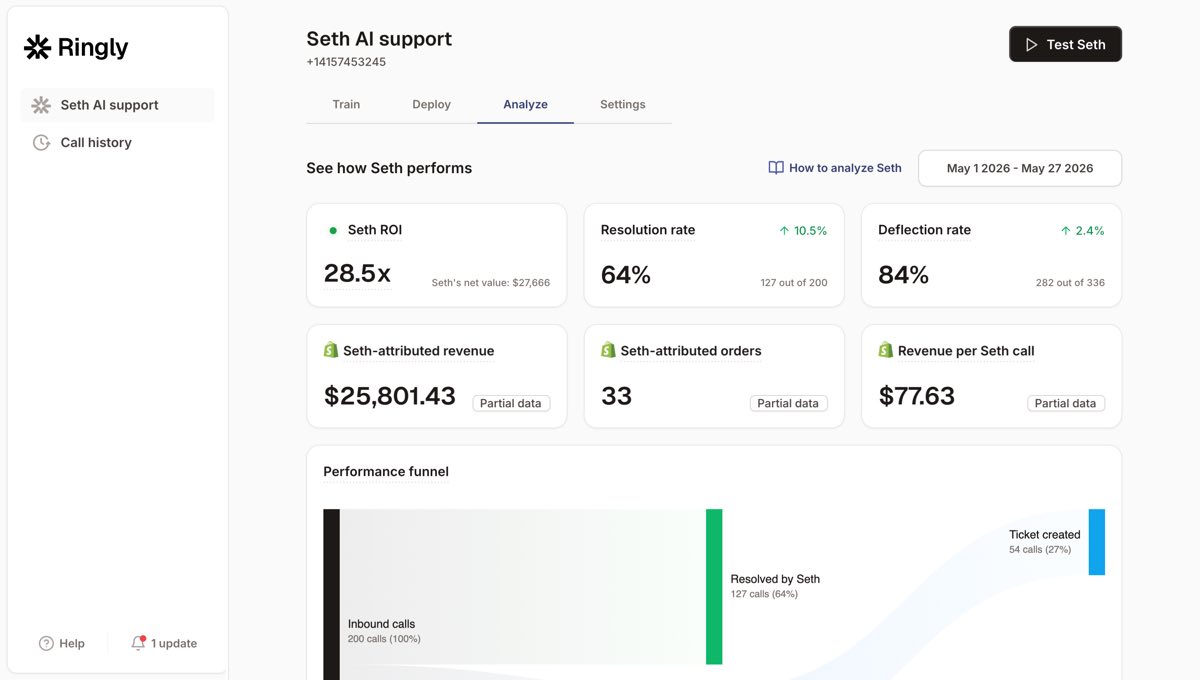
Real numbers from WashCo, a Shopify brand we launched recently:
- $22,664 in attributed revenue, first 7 days post-launch
- 271 calls handled
- 85% deflection rate
- 66% resolution rate
- $0.91 per call vs $2.70 per human-handled call
Source: Ringly dashboard, verified live data.
If you want to run that math against your real call volume instead of a typical brand, book a 30-min call and we'll do it live on your store.
Where AI fits in the function
AI isn't the function. It's a layer inside it, and it belongs in a specific place: Tier 0 and Tier 1, taking the repeatable phone volume off your team while running on the same knowledge base and the same compliance gate you just built.
Ringly.io is AI phone support for Shopify brands. Instead of growing your support headcount every time call volume goes up, the AI handles inbound calls 24/7: order status, returns, product questions from your knowledge base, and canceling orders when a caller asks. It resolves up to 90% of calls autonomously, and calls that need a human escalate cleanly to Gorgias, Richpanel, Reamaze, or whatever helpdesk you already run. The compliance line matters here too: the agent is hard-coded so it can never make a health claim, which on a supplement desk is a feature your reps can't perfectly guarantee on a tired Friday.
The point is sequencing. Build the contact mix, the knowledge base, and the compliance line first. Then drop an AI layer on top to carry the routine. If you want the full version of that argument, our deep dive on AI for supplement store customer service and the overview of Shopify voice agents go further, and voice AI for customer service covers how the handoff works.
What happens on the call.
- We pull your last 7 days of missed calls live, on the call. No homework for you.
- We show you the recovered revenue at the resolution rates we see for supplement brands.
- You decide if it's worth a deeper conversation. No deck, no follow-up sequence.
The call makes sense if:
- You're a Shopify or Shopify Plus brand doing $10M-$100M
- You run a paid helpdesk (Gorgias, Zendesk, Gladly, Re:amaze, or Intercom)
- You have a visible phone number on your store
- Your CS team is 3 to 12 people
If that's you, book a 30-min call and we'll map your routing and run the math on your store.
Frequently asked questions
How is customer service for supplement stores different from regular ecommerce support? Three things set it apart. The buyer base skews older and calls more, subscription cancel and billing requests are the single biggest ticket category, and every product answer carries FDA compliance risk that a generic store doesn't face. You design the channels, scripts, and escalation tiers around those three, not around generic retail advice.
What can a supplement customer service rep legally say about a product's benefits? Reps may make structure/function claims like "supports immune health" or "helps maintain healthy energy levels." They may not make disease claims like "treats," "cures," or "prevents." When a caller mentions a condition, medication, or pregnancy, the rep refers them to a doctor and sticks to what's on the label.
How should we handle subscription cancellations without losing the customer? Run a ladder, not a wall. Offer to skip the next shipment, then pause, then adjust frequency, and only then cancel cleanly with confirmation. The save happens in the conversation, so make sure a human or a human-sounding AI is in it within the first few seconds.
When should a supplement brand hire its next CS rep? Hire when the genuinely complex 20-30% of contacts is overflowing your current team, not when total volume rises. If the repeatable 70-80% is what's drowning you, an AI layer or better self-serve is cheaper and faster than a hire that takes three months to train and often quits within a year.
What customer service metrics should a supplement brand track? First contact resolution (target 70-80%), CSAT (85-90%), first response time by channel, after-hours answer rate, subscription-save rate, and cost per contact. The subscription-save rate is the one to obsess over because each save is worth roughly a year of LTV.
Should supplement brands offer phone support or just email and chat? Phone, yes, because your base skews older and high-intent and 62% of callers who can't reach you switch to a competitor. Use chat for quick questions and email for documentation, but keep a phone line that actually gets answered, including after hours.
Can AI handle supplement customer service given the compliance rules? Yes, and often more safely than a rushed human, because the compliance line can be hard-coded so the agent never makes a health claim. AI belongs at the Tier 0 and Tier 1 layer, handling the repeatable phone volume on the same knowledge base and compliance gate while your team takes the complex calls.
Talk to us

If your phone rolls to voicemail after 6 p.m. and your subscription cancels pile up in a Monday queue, a 30-min call is the fastest way to see what that's costing you. We'll pull your missed calls, run the math on your real volume, and show you where an AI layer fits in the function you're building.
Our 3 promises.
- Live in under 1 hour. Setup and test calls are free.
- 30-day money back on the $99 plan fee.
- 65% resolution guarantee: if Seth resolves under 65% of your support calls in a month, that month comes back as credit (after 90 days on Pay per call).
Ruben (Ringly co-founder) takes these calls personally.