
This post in 30 seconds.
- An escalation process isn't about adding more tiers. It's about making sure the handful of issues that actually need a human reach the right one fast, and everything else never gets there.
- You'll get the 4 escalation types, a 5-tier ladder for an ecommerce queue, a paste-ready escalation matrix, the triggers and SLAs that move an issue, and the metrics that tell you it's working.
- Built for founders and CX leads at $10M-$100M Shopify brands running Gorgias or Zendesk with a visible phone line and 3-12 reps.
Most escalation processes aren't designed. They just happen. A ticket sits too long, a customer gets loud, and it bounces up to a manager, or up to the founder's personal cell, because nobody ever drew the lines for who handles what.
I went through the call logs across the 50+ Shopify brands we run phone support for and counted what actually needed a human. It came out around 27%. The other 73% were the same repeatable stuff, over and over: where's my order, can I return this, do you ship to Canada. If your escalation process treats all of it the same, your reps drown in the routine and the genuinely hard calls wait behind them.
This is the playbook for fixing that. If you run customer experience at a Shopify brand and the hard calls keep landing on your phone after 6pm, book a 30-min call and we'll map your routing with you.
In this post:
- What an escalation process actually is
- The real cost of a broken escalation path
- The 5 tiers of an ecommerce escalation ladder
- Build your escalation matrix
- Triggers and SLAs: when an issue should move
- The phone channel nobody designs escalation for
- Five escalation mistakes to avoid
- How to measure whether it works
What a customer service escalation process actually is
An escalation process is the set of rules that decide which issues move to a more senior or more specialized person, when they move, and how the handoff happens. That's it. The goal is to get every issue to the person who can actually solve it, in the fewest hops possible, without the customer repeating themselves.
There are four kinds of escalation, and a working process uses all of them.
| Type | What it means | Ecommerce example |
|---|---|---|
| Functional | Route sideways to someone with specialized skill | A fraud flag goes to whoever owns chargebacks |
| Hierarchical | Move up to someone with more authority | A refund over your policy limit goes to a manager |
| Priority | Fast-track a severe issue regardless of tier | A safety or injury complaint jumps straight to a human |
| Automated | Rule-based triggers in your helpdesk route it for you | A ticket untouched for 12 hours auto-escalates |
The point of the process is to make the routing automatic, so a rep never has to guess whether a case is theirs to solve. When the lines are clear, issues move fast and nobody sits on a ticket they were never equipped to close.
This part matters more than it looks. Teams without documented escalation protocols see first-contact resolution drop below 65%, while teams with them routinely clear 75% (StealthAgents, 2026). The difference isn't talent. It's whether the rep knows where a problem goes the second they realize it isn't theirs.
The real cost of a broken escalation path
Here's what a broken path looks like in practice. A customer calls about a damaged order on a Saturday. No rep is on. It rolls to voicemail. The voicemail never gets returned because Monday's queue is 200 tickets deep. The customer files a chargeback and buys from a competitor.
That's not a hypothetical. 85% of callers who can't reach a person never call back, and 62% switch to a competitor (PCN, 2026). Most businesses answer only 37.8% of their inbound calls (AmbsCallCenter). Every one of those unanswered calls is an escalation path that dead-ended at a beep.
Speed is the other half of the cost. CSAT sits at 92% when a customer gets a response in under five minutes. Let it slip to 24 hours and CSAT falls to 51% (StealthAgents, 2026). A slow escalation is almost as expensive as no escalation. A customer doesn't care which tier solved their problem. They care that someone did, before they gave up. WashCo, a Shopify brand we launched, recovered $22,664 in its first 7 days once their phone stopped dropping calls.
The 5 tiers of an ecommerce escalation ladder
Most guides give you a generic Tier 0 to Tier 4 ladder built for software support. Here's the same idea mapped to an actual ecommerce queue.
| Tier | Who | What they handle |
|---|---|---|
| Tier 0 | Self-service + AI | Order tracking, FAQs, the repeatable 70% |
| Tier 1 | Frontline rep | Simple human cases, refunds under $150 |
| Tier 2 | Specialist | Return edge cases, subscription disputes, product-heavy questions |
| Tier 3 | Team lead / manager | Policy exceptions, escalated complaints, comped orders |
| Tier 4 | Founder / fraud / legal | Chargebacks, legal threats, safety, press risk |
The mistake most brands make is collapsing Tier 0 and Tier 1 into one human queue. When a rep is the first stop for "where's my order," they spend their day on tickets that a tracking page or an AI could close, and the Tier 2 and Tier 3 work backs up behind them. Push the routine down to Tier 0 and your humans move up the ladder where they're actually useful.
"My customers also feel like it's a normal person. They feel like they can communicate if they have questions."
Claudia Droge, TechCraft Studio
High-performing teams resolve their escalations within 24 to 48 hours and hold CSAT above 85% (industry benchmark, 2026). That's only possible when the tiers are thin and the routing is sharp, not when every issue lands in one shared inbox and someone fishes it out.
Build your escalation matrix
A matrix is just a table that says: for each kind of issue, who owns it first, who it escalates to, what triggers the move, and how fast it has to happen. You build it once and it kills 90% of the "who handles this?" questions.
Five moves to build yours:
- List your real issue types. Pull the last 30 days of tickets and tags. Don't theorize. Use what's actually coming in.
- Assign a first owner to each. Most should start at Tier 0 or Tier 1, not at a manager.
- Set the escalate-to person. Name the role, not the individual, so it survives turnover.
- Define the trigger. A dollar amount, a time limit, a keyword, a VIP tag. Something a rep or a system can check without judgment.
- Set an SLA per row. How long before it has to move or resolve.
Here's a starter matrix for a Shopify DTC queue. Adapt the thresholds to your margins.
| Issue | First owner | Escalates to | Trigger | SLA |
|---|---|---|---|---|
| WISMO / order status | Tier 0 AI | Tier 1 rep | tracking shows lost or stuck | 4h |
| Standard return / exchange | Tier 1 | Tier 2 specialist | outside policy window | 24h |
| Refund over threshold | Tier 1 | Tier 3 manager | amount over $150 | 24h |
| Damaged or wrong item | Tier 1 | Tier 2 | photo plus reship needed | 24h |
| Subscription cancel / dispute | Tier 1 | Tier 2 | retention attempt failed | 24h |
| Chargeback / fraud flag | Tier 1 | Tier 4 fraud | payment dispute opened | 48h |
| VIP / high-LTV customer | any | Tier 3 lead | flagged VIP tag | 2h |
| Grief, illness, safety | any | Tier 4 human | keyword or sentiment | immediate |
| Legal threat / press | any | Tier 4 founder | keyword detected | immediate |
Give your frontline reps refund authority up to a fixed limit, usually $100 to $200, so the routine money decisions never have to climb the ladder at all (ecommerce escalation best practice, 2026). The fewer rows that require a manager, the faster your whole queue moves. Want a closer look at where your tickets actually break? Compare notes on a 30-min call.
Triggers and SLAs: when an issue should move
A trigger is the thing that tells a rep or a system "this isn't yours anymore." Good triggers don't require a judgment call. They're checkable.
- Time-based. A ticket untouched past its SLA auto-escalates. The classic pattern: frontline owns it for 12 hours, then it goes to a specialist, then to a lead after 24.
- Value-based. A refund or a customer above a dollar threshold routes up before a rep can act alone.
- Sentiment-based. Anger, a legal word, a safety word. These should fast-track to a human regardless of tier.
- Compliance-based. Anything touching fraud, chargebacks, or a regulated claim follows a fixed path, no exceptions.
Pair every trigger with an SLA so the move actually happens on a clock. A simple version:
| Priority | Acknowledge within | Resolve within |
|---|---|---|
| Critical (safety, legal) | 15 min | same day |
| High (VIP, large refund) | 30 min | 24h |
| Standard (returns, WISMO) | 4h | 48h |
The acknowledge column is the one brands skip, and it's the one customers feel. A fast "we've got this, here's what happens next" holds satisfaction even when the fix takes a day. Silence is what makes them file the chargeback.
The phone channel nobody designs escalation for
Every escalation guide online walks you through email and chat tiers. Almost none of them mention the phone. That's a problem, because phone is the hardest channel to staff and the one where your escalation path quietly has no floor.
Think about what happens to a phone call that can't be resolved on the spot. There's no ticket queue to drop it into. After 6pm there's no rep at all. So it rolls to voicemail, or, if the customer is determined enough, they find the founder's cell number on their credit-card statement and call that. We see it constantly: roughly 18% of calls at founder-led brands still land on the owner's personal phone. A voicemail box is not an escalation path. It's a place calls go to be forgotten.
This is where designing the Tier 0 layer for phone changes the math. If an AI phone agent handles the routine 70% of calls 24/7, the only calls that ever reach a human are the ones that genuinely need one, around 27% in our data, and they arrive with full context instead of a beep. The hard rules stay hard-coded: grief, illness, safety, fraud, and legal always route to a person immediately, never to automation.
Your helpdesk doesn't change. The AI sits in front of Gorgias, Zendesk, or Intercom and escalates into the same tools your team already lives in, via a warm call transfer or a ticket with the call summary attached. If you want to see what your after-hours phone queue is actually dropping, book a 30-min call and we'll pull your missed calls live.
What this looks like with AI handling the routine tier
Ringly.io is AI phone support for Shopify brands. Your team wasn't hired to answer the same call 50 times a day, so the AI takes the routine inbound calls and your reps get the work that actually needs them.
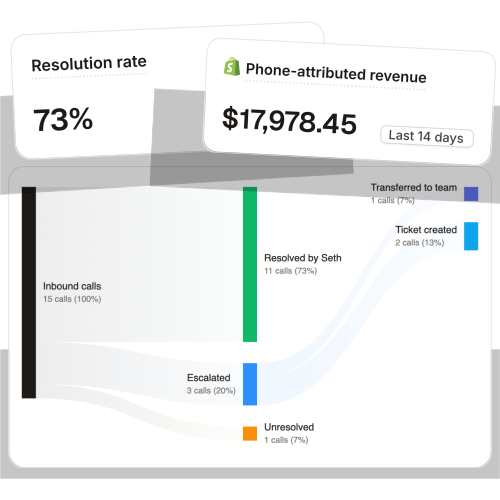
The AI answers calls 24/7. It finds orders in your Shopify store, processes returns and exchanges, answers product questions from your knowledge base, and rescues abandoned carts. Across 50+ brands, it resolves 73% of calls autonomously at roughly $0.42 per resolved call. The calls that need a human escalate cleanly, on the hard rules you set, into your existing helpdesk. You can review every call and its outcome in the call analytics dashboard.
The math is straightforward. Take a typical $50M Shopify brand running a 6-rep CS team:
| Line item | Today | With Ringly |
|---|---|---|
| 6 reps × $4K loaded per rep | $24,000/mo | n/a |
| Ringly (~$5K/mo) | n/a | $5,000/mo |
| Net monthly CS spend | $24,000/mo | $5,000/mo |
| Monthly savings | n/a | $19,000/mo |
| Annual savings | n/a | $228,000/yr |
That's the repeatable 70% (order status, returns, the same five questions) handled by the AI. The genuinely hard 30% still goes to your team, who now have the time to actually solve it instead of fishing it out from under a pile of WISMO tickets. It's also the difference between hiring reps you can't quite afford and not having to.
Five escalation mistakes that quietly cost you customers
A process can exist on paper and still leak. These are the failure modes we see most across the brands we work with.
- Everything starts at a human. When a rep is the first stop for order-status questions, the routine work buries the hard work. WISMO alone is 30 to 40% of tickets, and 50% at peak (Salesforce). None of that needs a person if your Tier 0 is set up right.
- No authority at the frontline. A rep who can't issue a $40 refund without a manager turns a 30-second fix into a two-day escalation. Cap the authority, then trust it.
- Triggers that need judgment. "Escalate if the customer seems really upset" isn't a trigger, it's a coin flip. Make it checkable: a keyword, a dollar amount, a time limit.
- No acknowledge step. Brands obsess over resolution time and forget the first reply. A customer who hears nothing for an hour assumes nobody's coming, and starts a chargeback or a tweet.
- Nobody reads the patterns. Every escalation is a signal about a gap somewhere upstream. If you never look at why issues climb the ladder, you fix the same problem one ticket at a time forever.
The brands that get escalation right treat a repeat escalation as a bug in the system, not a hard customer. Fix the source once and you stop paying for it every day. The cost of getting this wrong compounds the other direction too: replacing a single burnt-out CS rep runs $14,113, against industry turnover of 31.2% (Gartner via Insignia). A team drowning in mis-routed work churns, and you pay to rehire and retrain on top of the lost customers.
How to measure whether your escalation process works
You can't fix what you don't watch. Five numbers tell you whether your escalation process is doing its job.
| Metric | What it tells you | Target |
|---|---|---|
| Escalation rate | What share of issues leave Tier 0/1 | as low as the work allows |
| First-contact resolution | Issues solved without escalating | 70-75%+ |
| Time-to-resolution by tier | Where things stall | falling over time |
| Repeat-escalation rate | Issues that bounce more than once | near zero |
| Post-escalation CSAT | Whether the handoff actually helped | 85%+ |
Repeat-escalation rate is the one most teams never track, and it's the most telling. If the same kind of issue keeps climbing the ladder, the problem isn't the customer. It's a gap in your Tier 0 knowledge base or a trigger that's firing too late. Escalation patterns are a free root-cause report. Read them, fix the source, and watch your first-contact resolution climb. For the full set of numbers to watch, see our guide to ecommerce customer service KPIs.
A working escalation process compounds. Cleaner routing means faster resolution, faster resolution means higher CSAT, and the patterns you spot in escalations feed back into a better Tier 0 that escalates even less. Want to compare your current setup against this on a 30-min call? We'll do the math live.
Frequently asked questions
What are the types of customer service escalation? There are four. Functional escalation routes an issue sideways to a specialist, hierarchical escalation moves it up to someone with more authority, priority escalation fast-tracks a severe case regardless of tier, and automated escalation uses rule-based triggers in your helpdesk to route it without anyone deciding manually.
What is an escalation matrix? It's a table that maps each issue type to a first owner, an escalate-to role, a trigger that moves it, and an SLA. Built once, it removes the guesswork about who handles what, which is the single biggest cause of slow resolution.
When should a support agent escalate a ticket? When they hit a checkable trigger: the issue needs authority or a skill they don't have, it crosses a value threshold like a large refund, it carries anger or a safety or legal word, or it's been open past its SLA. The trigger should be objective so reps never have to guess.
How do I stop every issue from escalating to me? Push the routine work down to a Tier 0 self-service or AI layer, and give your frontline reps real authority, including refunds up to a fixed limit. Most issues that reach a founder do so because nobody below them was allowed to act.
What SLA should I set for escalations? Acknowledge critical issues within 15 minutes and high-priority ones within 30, then resolve standard cases within 24 to 48 hours. The acknowledge time matters most, because a fast "we've got this" holds satisfaction even when the fix takes a day.
How does AI fit into an escalation process? AI sits at Tier 0, resolving the repeatable calls and tickets 24/7, so only the genuinely hard cases reach a human. Done right, it escalates into your existing helpdesk with full context, and the hard rules, like grief, fraud, and safety, are hard-coded to always reach a person.
How do I measure escalation performance? Track escalation rate, first-contact resolution, time-to-resolution by tier, repeat-escalation rate, and post-escalation CSAT. Repeat-escalation rate is the most overlooked one, because a recurring escalation points straight at a gap you can fix at the source.
Talk to us

If your weekend calls roll to voicemail and the hard ones end up on your personal cell, that's an escalation process with no floor. A 30-min call is the fastest way to see what your phone is dropping and how much of it never needed a human in the first place.
The 3-layer guarantee.
- Live in 14 days or it's free until launched.
- 65% resolution in 90 days or we refund the last 3 months of subscription fees.
- We keep working free until we hit 65%.
Ruben (Ringly co-founder) takes these calls personally.